
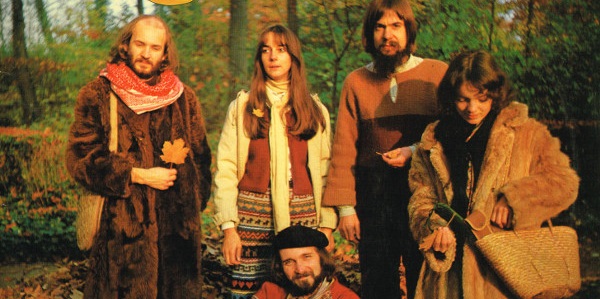
Tanzbär was a German folk-rock band behind the 1977–79 albums Tanzbär and Missethaten, both released on Nature Records.
Members: Ernst Käshammer (hurdy gurdy), Marie-Rose (crumhorn, flute, épinette des Vosges), Roswita Konradi (vocals, percussion), Ursula Renner (vocals, percussion), Martina Müller (recorder), Alfred Schwind (bass, keyboards, bouzouki), Hans-Dieter Schotsch (vocals, guitar, mandolin)
Background
Tanzbär formed in Mannheim in 1975 when instrument maker Ernst Käshammer and his Alsatian wife Marie-Rose teamed with four students from the Pädagogische Hochschule Heidelberg: singers Rosita Konradi and Ursula Renner, bassist-keyboardist Alfred Schwind, and singer-guitarist Hans-Dieter Schotsch. Recorder player Martina Müller also belonged to the ensemble.
The Käshammers, Schotsch, and Renner researched medieval German verse, prompted by the work of Ougenweide and the Heidelberg folk group Elster Silberflug. Their selections included love poetry by Dietmar von Aist, a twelfth-century Austrian Minnesänger; and Walther von der Vogelweide, a German singer-poet active around 1200. They also drew from Carmina Burana, a 13th-century collection of mostly Latin songs and verse concerning love, drinking, and social satire. Where historical melodies had not survived, Tanzbär wrote new tunes based on medieval church modes, arranged for solo and choral voices.
Käshammer built traditional instruments for the group, which combined hurdy-gurdy and crumhorn with the épinette des Vosges, a plucked zither from eastern France with melody and drone strings. Tanzbär made their first public appearances in the Mannheim pedestrian precinct. Hamburg label Metronome selected the group for Nature, its new folk imprint, and financed sessions at Studio Walldorf near Frankfurt with producer Thomas Brück and engineer Klaus Stingel for the 1977 debut Tanzbär.
Discography:
- Tanzbär (1977)
- Missethaten (1979)
References and notes
- Hans-Dieter Schotsch — Tanzbär. Firsthand formation history, repertoire, instruments, performances, and Nature sessions. (Musician archive)
- Walther von der Vogelweide and Dietmar von Aist. Biographical and literary histories of the medieval poets. (Österreichisches Musiklexikon; Stifterhaus)
- Carmina Burana — Library of Congress. Manuscript origins, languages, and poetic subjects. (Manuscript history)
- Épinette des Vosges — Metropolitan Museum of Art. Instrument origins and melody/drone string configuration. (Instrument collection)
- Tanzbär — Tanzbär (1977). Original Nature pressing and album program. (Release documentation)
Artist/Album Pages:
Lakeside was an American soul-funk band from Dayton, Ohio, that released a self-titled debut on AB...
Graham Parker is an English New Wave/soul-rock singer and songwriter who released the popular 1976...
Zon was a Canadian symphonic/hard-rock band that released the 1978/79 Epic albums Astral Projector...
Jordi Sabatés (born Oct. 23, 1948) is a Spanish jazz pianist who emerged in mid-Sixties Barcelona ...
Neuschwanstein was a German symphonic-rock band that released the 1979 album Battlement on Racket ...
Blue Öyster Cult are an American hard-rock band from Long Island known for their literate lyrics, ...
Il Baricentro was an Italian jazz-rock band that released the 1976–78 EMI Italiana albums Sconcert...
Catch Up was a German jazz-funk trio behind the 1975/76 Calig albums Vol. 1 and Birth of the Secon...
East Harlem Bus Stop was an American soul-funk band that released the 1976 album Get On Down! on D...
Raul de Souza (Aug. 23, 1934 – June 23, 1921) was a Brazilian trombonist, saxist, and composer who...
Miles Davis (May 26, 1926 — September 28, 1991) was an American jazz trumpeter with a recording care...
Tyndall was a German electronic duo behind the 1980–83 Sky Records titles Sonnenlicht, Traumland, ...