

Blue Öyster Cult are an American hard-rock band from Long Island known for their literate lyrics, dual-guitar interplay, and fusion of heavy riff structures with cryptic sci-fi and occult themes. They emerged in 1972 with a trilogy of stark, riff-driven albums—Blue Öyster Cult, Tyranny and Mutation, and Secret Treaties—anchored by the tight rhythm section of brothers Albert and Joe Bouchard, the keyboard textures of Allen Lanier, and the twin-guitar front of Eric Bloom and Donald “Buck Dharma” Roeser.
Their mid-’70s breakthrough Agents of Fortune featured the spectral anthem “(Don’t Fear) The Reaper,” pairing radio reach with eerie tonality. Spectres and Mirrors followed with cleaner production and theatrical arrangements, while Cultösaurus Erectus and Fire of Unknown Origin (produced by Martin Birch) restored sonic weight and introduced epic tracks like “Black Blade” and “Veteran of the Psychic Wars.”
Across eleven studio albums and three live sets—including the definitive On Your Feet or on Your Knees—the band developed a hybrid style that merged pounding rock frameworks with narrative lyrics, modal solos, and compositional unpredictability. Their catalog reflects constant tension between precision and excess, control and spectacle, intellect and impact.
Members: Eric Bloom (guitar, vocals), Buck Dharma (lead guitar, vocals), Allen Lanier (rhythm guitar, keyboards, bass, 1970-85, 1987-2007), Albert Bouchard (drums, guitar, vocals, 1970-81), Joe Bouchard (bass, vocals, 1970-86), Rick Downey (drums, 1981-85), Thommy Price (drums, 1985), Tommy Zvonchek (keyboards, 1985-86), Jimmy Wilcox (drums, vocals, 1985-86), Jon Rogers (bass, 1986-95), Ron Riddle (drums, 1987-91)
Background
Blue Öyster Cult formed as Soft White Underbelly, a garage-psych band assembled in 1967 by Stony Brook University students Donald Roeser (guitar, vocals), Allen Lanier (keyboards), Andrew Winters (bass), and Albert Bouchard (drums). At this early stage, they also featured singer Jeff Kagel, who later found success as Hindu devotional singer Krishna Das.
While jamming one night at their campus communal house, they were overheard by rock writer Sandy Pearlman, who offered to be their manager. Another Stony Brook music writer, Richard Meltzer, provided the band with lyrics. After Pearlman secured them a deal with Elektra, Soft White Underbelly recorded an album’s worth of material in 1968. Their lead vocalist at this time, Les Braunstein, left soon after it was recorded, prompting Elektra to shelve the album.
Eric Bloom, first employed as their sound engineer, was hired as their new lead singer. As their live act faltered, Pearlman changed their name to Oaxaca, then to Stalk-Forrest Group. He also gave each member a stagename: Buck Dharma (Roeser), Jesse Python (Bloom), Andy Panda (Winters), Prince Omega (Bouchard), La Verne (Lanier). Only Roeser would keep his stagename.
In 1970, the band recorded another album for Elektra, but the only release at this time was the single “What Is Quicksand?” (b/w “Arthur Comics”). (The album was later released as St. Cecilia: The Elektra Recordings in 2001 on Rhino Handmade Records.) Pearlman changed their name again, this time to Blue Öyster Cult, taken from one of his poems about a group of aliens who guide the history of the Earth. Winters cleared way for Albert’s bassist brother Joe Bouchard.
The renamed band was spotted by producer David Lucas, who cut demos of their newer hard rock material. Pearlman took these tapes to Columbia, which signed the band in 1971. That October, they entered Lucas’ eight-track studio to cut their first album.
Blue Öyster Cult
 Blue Öyster Cult released their self-titled debut album on January 16, 1972, on Columbia.
The album introduces a taut, riff-driven sound defined by the interlocked phrasings of guitarist Buck Dharma and keyboardist Allen Lanier, who trade accents and harmonic stabs beneath Bloom’s sharp vocal turns. Dharma’s lead phrasing curves against structured chord figures with occasional unison punch-ins from Lanier, while his solos (notably on “Then Came the Last Days of May”) arc in elongated bends and slow climbs. Lanier supplements the guitar focus with jabs of organ or electric piano, especially in tandem passages. Bassist Joe Bouchard and drummer Albert Bouchard anchor the set with a rock-steady backbeat and lean, unmuddled timing that keeps the arrangements tight and front-loaded. Sandy Pearlman, Donald Roeser, and Albert Bouchard co-wrote five of the ten tracks.
Blue Öyster Cult alternates between sharp-edged riff anthems and slow-motion hallucinations, each sequence laced with narrative sleight and structural detours. “Transmaniacon MC” opens with curt, stabbing chords and threads jagged vocal lines through a contorted backbeat. “Before the Kiss, a Redcap” shifts repeatedly—initially riding clipped guitar bursts, then veering into a bouncing syncopated section led by distorted keyboard stabs and staggered vocal phrasing, before collapsing back into tight interlocked riffing. “Then Came the Last Days of May” inverts the pace: a slow, mournful descent framed by spare lead lines and skeletal rhythm support, each verse stretching into open space as the tragic narrative unfolds.
“Screams” and “She’s As Beautiful As a Foot” push further into murky abstraction; both unfold with deliberate drag and sudden tonal diversions, layering guitar sustain and sparse electronic textures into elliptical structures. “Cities on Flame With Rock and Roll” locks into a mid-tempo grind, launching jagged riffs off a staccato snare pulse, broken by abrupt silences and capped with false endings that coil back into climactic phrases. “Workshop of the Telescopes” expands into slow, fragmented motion where each instrumental layer enters like a half-memory; refrains emerge and vanish without resolution.
“Redeemed” pivots entirely, led by acoustic chord shapes and relaxed cadences that trace upward rather than descend. Across the album, Buck Dharma’s guitar frames each piece with clipped statements or escalating flurries, while Allen Lanier’s keyboards alternately thicken or destabilize the harmonic center. Joe Bouchard’s lines dart and pivot between drum accents, with Albert Bouchard steering the entire record’s lurching-forward feel.
A1. “Transmaniacon MC” (3:21) – Bloom/A. Bouchard/Roeser/Pearlman
A2. “I’m on the Lamb but I Ain’t No Sheep” (3:10) – Bloom/A. Bouchard/Pearlman
A3. “Then Came the Last Days of May” (3:31) – Roeser
A4. “Stairway to the Stars” (3:43) – A. Bouchard/Roeser/Meltzer
A5. “Before the Kiss, a Redcap” (4:59) – Lanier/Krugman/Roeser/Pearlman
B1. “Screams” (3:10) – J. Bouchard
B2. “She’s as Beautiful as a Foot” (2:58) – A. Bouchard/Lanier/Meltzer
B3. “Cities on Flame with Rock and Roll” (4:03) – A. Bouchard/Roeser/Pearlman
B4. “Workshop of the Telescopes” (4:01) – Bloom/A. Bouchard/J. Bouchard/Lanier/Roeser/Pearlman
B5. “Redeemed” (3:51) – A. Bouchard/Lanier/Farcas/Pearlman
Blue Öyster Cult recorded the album in October 1971 at The Warehouse in New York City, using an eight-track system at David Lucas’ jingle studio. Lucas produced and engineered the sessions, using tape manipulation and doubling techniques that recalled late-’60s British innovations. Columbia staffers Sandy Pearlman and Murray Krugman served as conceptual and co-production overseers, shaping the record into the band’s defining statement of identity.
Columbia issued “Cities on Flame with Rock and Roll” as a single on April 21, 1972, backed with “Before the Kiss, a Redcap.” Though it did not chart, the A-side became a concert staple and helped secure their contract with Columbia. The album entered the Billboard 200 on May 20, 1972, and peaked at No. 172.
Tyranny and Mutation
 Blue Öyster Cult released their second album, Tyranny and Mutation, in February 1973 on Columbia.
The album presents a sharpened, denser attack built on the interplay between guitarist Buck Dharma and keyboardist Allen Lanier, whose call-and-response phrasings alternate between clustered bursts and sustained chord backdrops. Dharma’s leads slice across tight ensemble parts, while Lanier injects jabs of organ and synthesizer. Joe Bouchard and Albert Bouchard underpin the material with a taut rhythmic spine, anchoring abrupt shifts and sustained drive alike. Sandy Pearlman and Albert Bouchard co-wrote five of the eight tracks, with additional lyrics contributed by Patti Smith and Richard Meltzer.
Tyranny and Mutation splits its intensity between fast-burning precision and shadowed theatricality, structuring the album as a binary: high-speed shock on side one (“The Black”) and slow-burn menace on side two (“The Red”). “The Red and the Black” reworks its predecessor’s riff scheme into a doubled tempo barrage, with vocal trade-offs cutting through rapid guitar sequences and a back half that escalates into flurried instrumental breaks. “O.D.’d on Life Itself” rides a pacing midway between stomp and sprint, alternating compact chord cycles with spaced vocal lines before erupting in clipped solo passages. “Hot Rails to Hell” bolts forward on a punishing downstroke rhythm and barked refrains, capped by shrieking cadences that puncture the mix like shrapnel. “7 Screaming Diz-Busters” stretches into episodic form: alternating thick-set unison riffs with tempo feints, a drum-led breakdown, and a midsection swirl of processed organ, creeping bass patterns, and spoken incantation before looping back to a closing riff spiral.
Side two opens with “Baby Ice Dog,” which breaks the drive with a mid-tempo march undercut by eerie vocal inflections and tightly gated piano phrases; interludes surface between verses as guitar shapes splinter across the stereo field. “Wings Wetted Down” projects ceremonial pacing—low-register guitar and saturated background voices swell into choruses that hover and decay, leaving space for submerged lead lines. “Teen Archer” flips the tempo back to full sprint, cutting through with clipped chords, rising piano interjections, and a keyboard solo that spikes upward before vanishing into the verse cycle.
“Mistress of the Salmon Salt (Quicklime Girl)” closes the album in a warped minor-key sway, coiling through staggered rhythm patterns, clustered organ tones, and slanted guitar overlays that flare and dissolve across the final passage. Throughout, Buck Dharma’s guitar leads push past the beat with fluid rapidity while Allen Lanier’s keys stretch and displace the harmonic core. Joe Bouchard’s lines slide in close tandem with Albert Bouchard’s tightly wound fills, which anchor the set’s shifts in drive and direction.
A1. “The Red & the Black” (4:20) – Bloom/A. Bouchard/Pearlman
A2. “O.D.’d on Life Itself” (4:47) – Bloom/A. Bouchard/J. Bouchard/Pearlman
A3. “Hot Rails to Hell” (5:12) – J. Bouchard
A4. “7 Screaming Diz-Busters” (7:01) – A. Bouchard/J. Bouchard/Roeser/Pearlman
B1. “Baby Ice Dog” (3:29) – Bloom/A. Bouchard/Smith
B2. “Wings Wetted Down” (4:12) – A. Bouchard/J. Bouchard
B3. “Teen Archer” (3:57) – Bloom/Roeser/Meltzer
B4. “Mistress of the Salmon Salt (Quicklime Girl)” (5:08) – A. Bouchard/Pearlman
Sessions took place in late 1972 at Columbia Studios, New York City, with Murray Krugman and Sandy Pearlman again handling production. Engineers Tim Geelan, Lou Schlossberg, and Phil Giambalvo oversaw the tracking. Bill Gawlik returned for cover design, and Jack Ashkinazy mastered the LP.
Columbia released “Hot Rails to Hell” as a single on July 13, 1973, backed with “Wings Wetted Down.” Joe Bouchard took lead vocal on the A-side, marking the band’s first single to feature a non-Bloom frontman. Though it didn’t chart, it became a cult favorite and appears on multiple live albums and compilations.
Tyranny and Mutation entered the Billboard 200 on May 12, 1973, and peaked at No. 122.
Secret Treaties
 Blue Öyster Cult released their third album, Secret Treaties, on April 5, 1974, on Columbia.
The album centers on hard-driving ensemble passages shaped by the counterpoint between guitarist Buck Dharma and keyboardist Allen Lanier, who dart between layered voicings and stark chromatic riffs. Lanier’s organ and synthesizer accents press against Dharma’s ascending solos, while both engage in tight overlaps on tracks like “Flaming Telepaths.” Joe and Albert Bouchard lock into a tense, nimble backbeat that reinforces the record’s forward thrust. Sandy Pearlman wrote all the lyrics except “Career of Evil,” penned by Patti Smith, and two Meltzer contributions.
Secret Treaties sustains an unbroken tension between sinister theatrics and sharp structural control, balancing swaggering drive with sudden dives into abstraction. “Career of Evil” opens in a creeping stagger, guitar and organ coiling over a slurred vocal cadence that dips into clipped half-sentences and returns with sharper phrasing. “Subhuman” elongates the space with suspended harmonies and layered guitar that ebbs into a quiet pull before sudden volume shifts drag it back to the surface. “Dominance and Submission” escalates in segments: a clipped opening riff fractures into shouted phrases, then shifts into a pounding midsection where gang vocals trade with piano and guitar eruptions. “ME 262” cuts through with clipped snare bursts and divebombing leads, alternating shouted lines with spoken retorts in a tight volley, then swerving mid-track into a breakneck riff cycle and shouted codas.
On side two, “Cagey Cretins” snaps into motion with jittered phrasing and compressed rhythm, stacking brief statements over sudden shifts in drum placement and angular guitar bursts. “Harvester of Eyes” rides a halting sequence of off-beat guitar punches, unfolding into curdled blues phrasing and a staggered refrain that lurches into a fast fade. “Flaming Telepaths” opens with chiming tones and tilts from suspended piano phrases into sudden breaks, stuttering between keyboard pulses and short vocal fragments, each chorus winding tighter before splintering into synth flashes and receding into a cold harmonic drop.
“Astronomy” draws that tension into a slow build, beginning with quiet, single-note piano strikes and minimal drumming, gradually layering vocal rounds and interlocking guitar textures. Each phrase extends past its end point, bleeding into the next, until the track spirals into its final ascent. Across the album, Buck Dharma carves narrow lines through shifting harmonic layers while Allen Lanier alternates between support and disorientation. Joe Bouchard locks tight with Albert Bouchard’s shifting accents, each change in pace carrying weight without excess. Every track pushes forward through constraint, anchoring its drama in clipped precision and rhythmic disruption.
A1. “Career of Evil” (3:59) – Smith/A. Bouchard
A2. “Subhuman” (4:39) – Pearlman/Bloom
A3. “Dominance and Submission” (5:23) – Pearlman/Bloom/A. Bouchard
A4. “ME 262” (4:48) – Pearlman/Bloom/Roeser
B1. “Cagey Cretins” (3:16) – Meltzer/A. Bouchard
B2. “Harvester of Eyes” (4:42) – Meltzer/Bloom/Roeser
B3. “Flaming Telepaths” (5:20) – Pearlman/Bloom/A. Bouchard/Roeser
B4. “Astronomy” (6:28) – Pearlman/A. Bouchard/J. Bouchard
Sessions took place at Columbia’s 30th Street Studio in New York City. Murray Krugman and Sandy Pearlman handled production, with Tim Geelan and Jerry Smith engineering. John Berg oversaw the album’s packaging, with a Ron Lesser illustration of the band beside a WWII-era German ME 262 jet.
Columbia issued “Career of Evil” as a single in 1974, backed with “Born to Be Wild.” The A-side appeared in a revised mix that removed a verse and altered select vocal lines. A second single, “Flaming Telepaths,” followed later that year. While neither charted, “Astronomy” and “Flaming Telepaths” became fan favorites and remain associated with the band’s classic period.
Secret Treaties spent 14 weeks on the Billboard 200, peaking at No. 53. It earned a gold certification from the RIAA in 1992 and gained lasting recognition as a defining early statement in the band’s catalog.
On Your Feet or on Your Knees
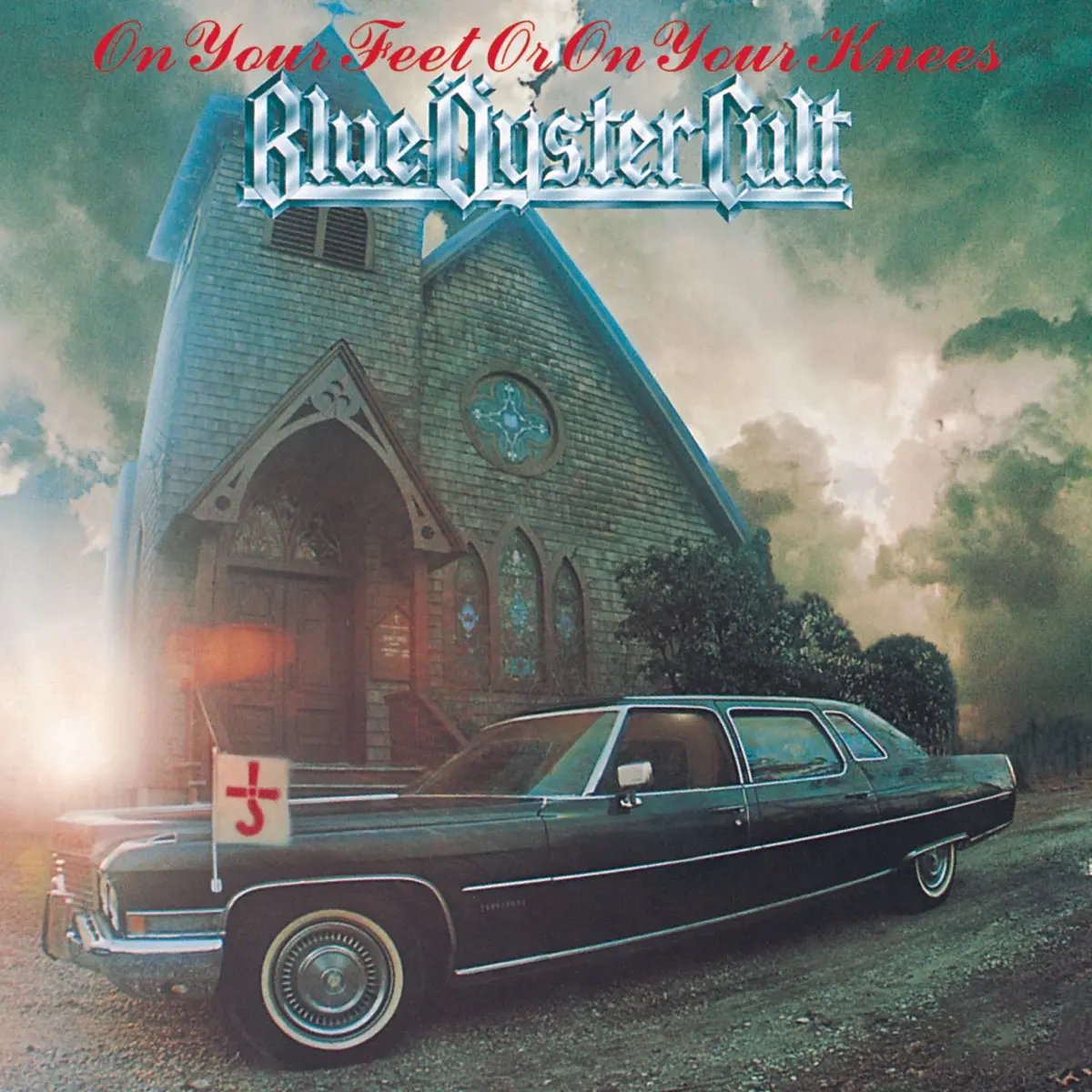 In February 1975, Blue Öyster Cult released On Your Feet or on Your Knees, a live double-album sourced from their October 1974 tour.
The album captures their stage arrangements in extended form, foregrounding the exchange between guitarist Buck Dharma and keyboardist Allen Lanier, who lock into mirrored phrases, intercut solos, and shifting harmonic backdrops. Dharma’s lead lines push against Lanier’s Fender Rhodes and organ overlays, often stretching into twin lines or alternating passages. Joe Bouchard and Albert Bouchard form a stable underpin for the extended instrumental sections, with tight rhythmic coordination and controlled dynamic surges. The band wrote all twelve tracks except for the two covers on side four.
On Your Feet or on Your Knees strips Blue Öyster Cult’s early catalog of its studio restraint and reintroduces each song with hardened drive, weightier guitar tone, and extended pacing that favors performance dynamics over concision. “Subhuman” stretches into a brooding overture, layering icy bends and cycling bass under phased organ and delay-laced guitar lines before ramping into a thickened outro. “Harvester of Eyes” punches forward with distortion-packed riffs over throbbing synth sustain, its original doom-fade swapped for a palm-muted surge into an uptempo close. “The Red and the Black” barrels with trebled bass clarity and darting guitar fills locked into double-time drums.
“7 Screaming Diz-Busters” sheds its clipped studio form for nine minutes of accelerating tempo changes, spiraling leads, and a final break where Dharma’s guitar moves through a series of climbing swells, pulsed feedback, and stuttering phrases against a syncopated vamp. “Last Days of May” holds back its intensity, building space between phrases to frame its narrative turns in clean, reverb-split lines and ascending solos over drifting keyboard support. “Cities on Flame” cuts slower and heavier, the main riff shaped into thick-edged stabs that sharpen around the beat. “Hot Rails to Hell” swings with pronounced urgency, opening up between verses for sharper interchanges before landing on a locked final run.
“Born to Be Wild” appears in a sped-up, abrupt arrangement that bursts through the first verse and escalates into a frenzied double-kick pre-chorus. Across the set, the rhythm section anchors the performances with forceful, forward-leaning pressure, while Bloom, Dharma, and Lanier trade lines and textures with a sense of trial-by-fire escalation rather than replication. The live mix foregrounds guitar and drums, often burying vocals and keys, but the tradeoff favors intensity and momentum throughout.
A1. “Subhuman” (7:30) – Secret Treaties
A2. “Harvester of Eyes” (4:55) – Secret Treaties
A3. “Hot Rails to Hell” (5:55) – Tyranny and Mutation
B1. “The Red and the Black” (4:33) – Tyranny and Mutation
B2. “7 Screaming Diz-Busters” (8:27) – Tyranny and Mutation
B3. “Buck’s Boogie” (7:40) – non-album track (studio version unreleased at the time)
C1. “Then Came the Last Days of May” (4:35) – Blue Öyster Cult
C2. “Cities on Flame” (4:08) – Blue Öyster Cult
C3. “ME 262” (8:47) – Secret Treaties
D1. “Before the Kiss, a Redcap” (5:05) – Blue Öyster Cult
D2. “Maserati GT (I Ain’t Got You)” (8:59) – cover of Calvin Carter’s “I Ain’t Got You” (originally by The Flamingos; version here based on the Yardbirds’ interpretation)
D3. “Born to Be Wild” (6:36) – cover of “Born to Be Wild” by Mars Bonfire (Steppenwolf)
The band recorded the material at multiple venues between April and October 1974, including the Academy of Music in New York, Long Beach Arena, the Show Palace in Phoenix, and the Paramount Theatres in Portland and Seattle. Murray Krugman and Sandy Pearlman oversaw production. Engineers Tom Scott, Aaron Baron, Tim Geelan, Pete Weiss, and Jerry Smith handled the mobile recordings, with Jack Douglas mixing the album. Gerard Huerta designed the gothic-style logo, and John Berg photographed the cover image at St. Paul’s Episcopal Chapel in South Salem, New York.
Columbia issued On Your Feet or on Your Knees as a standalone live release with no promotional single. Its version of “Buck’s Boogie,” previously heard on bootlegs and radio tapes, became a centerpiece of the band’s live sets and remains one of their most requested instrumental pieces.
The album peaked at No. 22 on the Billboard 200 and reached No. 19 in France and No. 22 in Canada. It became their first RIAA-certified gold record in the US.
Agents of Fortune
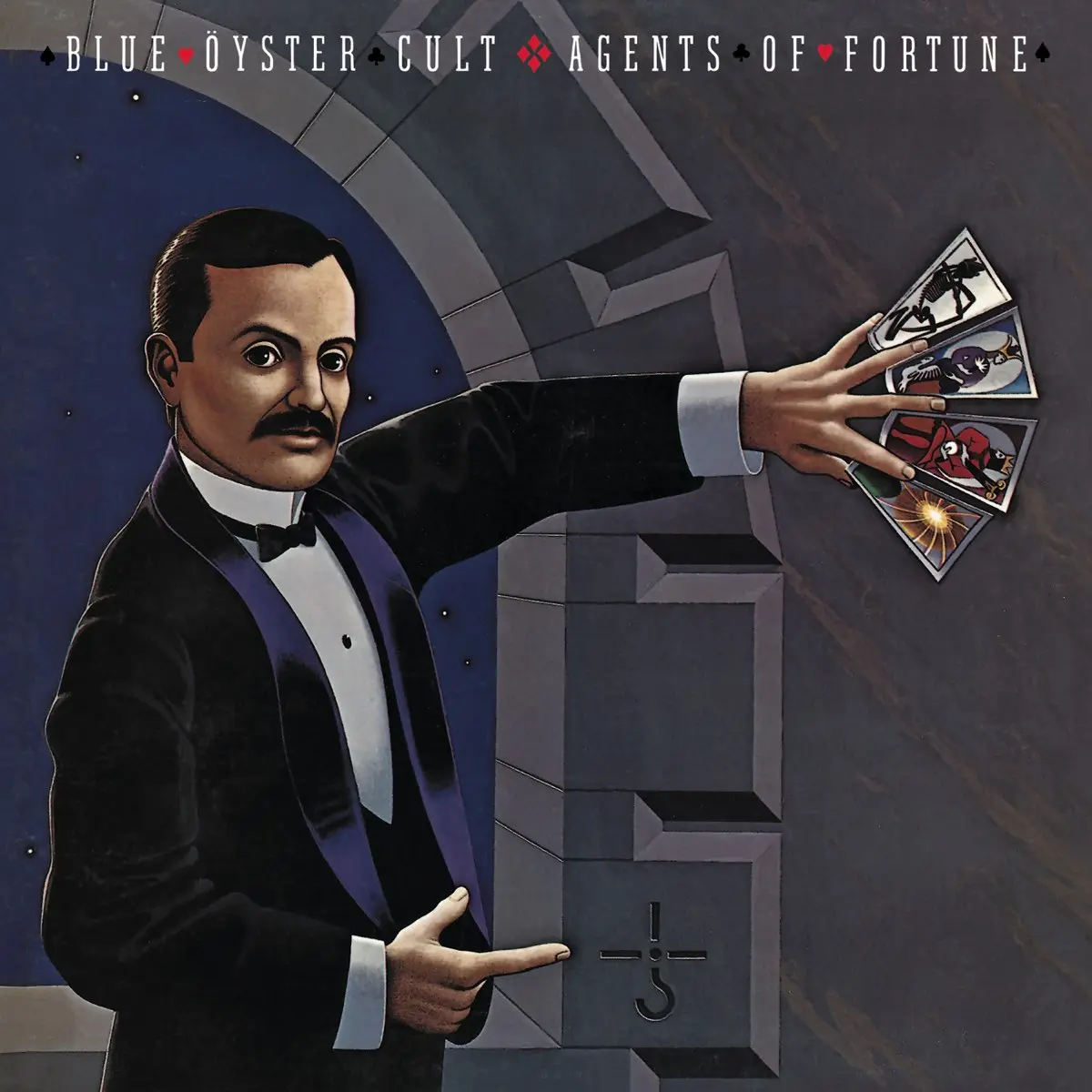 Blue Öyster Cult released their fourth album, Agents of Fortune, on May 21, 1976, on Columbia.
The album widens their dynamic range through sharp contrasts between ambient textures and tightly wound riff structures, centered on the interplay between guitarist Buck Dharma and keyboardist Allen Lanier. Dharma’s guitar lines pivot from clipped repetition to fluid single-note runs, while Lanier offsets the motion with clustered electric piano voicings and background synths. Joe Bouchard and Albert Bouchard supply a firm backbeat and textural underpin, alternating between lockstep precision and loosened restraint. Every band member takes at least one lead vocal; only Eric Bloom does not receive a songwriting credit.
Agents of Fortune fragments its tension across refracted surfaces—each track shifting tone and texture without fully abandoning the band’s earlier menace. “This Ain’t the Summer of Love” opens on a narrow, churning riff that slows into short vocal phrases before pressing forward with clipped choruses and hard-edged guitar drops. “E.T.I. (Extra Terrestrial Intelligence)” pivots between steady propulsion and brief harmonic lift, cycling call-and-response vocals around a coiled lead motif that drops into sudden blues-informed phrasing before climbing back to the chorus peak. “Tattoo Vampire” fires on compressed speed and barbed phrasing, vocals riding clipped turns while the rhythm section hits rapid accents beneath a mid-song collapse into churned static and snare flares. “The Revenge of Vera Gemini” slows the pace but not the tension—Patti Smith’s voice drifts behind the beat, offsetting clipped piano pulses and angular guitar figures that widen and narrow in uneven breath patterns.
“Morning Final” pushes into low-light motion, with delayed vocal entrances and an undercurrent of slow piano chords beneath sharp lead lines that flicker in the margins. “Tenderloin” rides on restrained mid-tempo pacing, vocals stretched across repeating keyboard fragments and sharp guitar swells, the atmosphere saturated with held-back collapse. “Sinful Love” contrasts upstroke phrasing and bent vocal lines against pointed drum inflections, shifting suddenly into a descending chorus and guitar that moves in sharp diagonals. “Debbie Denise” resolves with softened contours—acoustic elements and staggered backing vocals moving between verses, each pass widening until the song closes in unresolved symmetry.
“(Don’t Fear) The Reaper” threads fingerpicked acoustic cycles through layered vocal overlays and long tones, with sudden elevation mid-song as the lead section cuts upward in controlled escalations, peaking in a restrained solo that overlays but never overtakes the pulse. Throughout the album, Buck Dharma’s leads cut and ascend without excess, and Allen Lanier shifts between rhythmic grounding and fragmental detail. Joe and Albert Bouchard press and release the pacing across sharp transitions and hovering sustain, never allowing one tonal palette to settle too long before reshaping its edge.
A1. “This Ain’t the Summer of Love” (2:21) – A. Bouchard/Krugman/Waller
A2. “True Confessions” (2:57) – Lanier
A3. “(Don’t Fear) The Reaper” (5:08) – Roeser
A4. “E.T.I. (Extra Terrestrial Intelligence)” (3:43) – Bloom/Roeser/Pearlman
A5. “The Revenge of Vera Gemini” (3:52) – A. Bouchard/Smith
B1. “Sinful Love” (3:29) – A. Bouchard/Wheels
B2. “Tattoo Vampire” (2:41) – A. Bouchard/Wheels
B3. “Morning Final” (4:30) – J. Bouchard
B4. “Tenderloin” (3:40) – Lanier
B5. “Debbie Denise” (4:13) – A. Bouchard/Smith
Blue Öyster Cult recorded the album across 1975–76 at the Record Plant in New York City with producers David Lucas, Murray Krugman, and Sandy Pearlman. Shelly Yakus and Andy Abrams engineered the sessions, with Tony Stevens mastering the final mix. Lynn Curlee designed the tarot-themed cover painting, with layout by John Berg and Andy Engel.
Columbia issued “(Don’t Fear) The Reaper” as the lead single in July 1976, backed with “Tattoo Vampire.” Dharma wrote and sang the track, which features a rising arpeggiated riff and a midsection instrumental break excised from the 3:45 single edit. The song peaked at No. 12 on the Billboard Hot 100 and No. 7 in Canada, becoming their highest-charting single in both countries. In May 1978, CBS reissued the unedited version in the UK, where it reached No. 16.
In June 1977, Columbia released “This Ain’t the Summer of Love” as a follow-up single, more than a year after the album’s debut. The track opens the LP with clipped phrasing and a stark vocal cadence, but did not match the success of its predecessor.
Agents of Fortune reached No. 29 on the Billboard 200 and No. 10 in Sweden. It became their first Platinum-certified album in the US.
Spectres
 Blue Öyster Cult released their fifth album, Spectres, in November 1977 on Columbia.
The album expands their tonal range with layered interplay between guitarist Buck Dharma and keyboardist Allen Lanier, who pivot between compact riffs and slow-building harmonic detail. Dharma arcs solos across Lanier’s Mellotron-tinged textures and electric piano swells, while Lanier alternates between rhythmic jabs and atmospheric fills. Joe and Albert Bouchard provide a lithe but forceful backline, shifting seamlessly between jagged pulses and rolling undercurrents. Each band member sings lead on at least one track; Donald Roeser wrote four of the ten songs, with additional lyrics by Patti Smith, Helen Wheels, Richard Meltzer, and Ian Hunter.
Spectres balances clipped propulsion with atmospheric restraint, pairing tight riff construction with layered harmonic detours. “Godzilla” opens with low-register guitar figures that repeat in compressed pulses before shifting into broader rhythmic phrasing, placing clipped vocals over staggered accents. “The Golden Age of Leather” begins with an a cappella prelude, then transitions into mid-tempo pacing that alternates dynamic bursts and vocal refrains with clean dual-guitar overlays and expanding harmonic intervals. “R.U. Ready 2 Rock” holds a forward-moving rhythmic base, built from repeated vocal phrases and stable drum subdivisions that culminate in circular refrains. “Tattoo Vampire” moves with fractured pacing—short verse segments and sharp instrumental breaks over a fast pulse, with distorted leads threading between clipped vocal statements.
In its slower tracks, the album centers on pacing shifts and sustained layering. “I Love the Night” drifts on slow, looped phrasing, with the vocal stretched across consistent meter, its midpoint marked by extended lead phrases that arch and retract before returning to the refrain. “Nosferatu” employs minor piano voicings and synth textures to set its framework, with vocal delivery embedded between low tonal passages and intermittent guitar accenting. “Death Valley Nights” progresses in halting steps—staggered harmonic phrases stretch over restrained drumming, with chord motion frequently interrupted by rests. “Searching for Celine” unfolds on unstable rhythmic footing, where offset beat placement and delayed vocal entries cross against narrow instrumental fills and occasional harmonic dissonance.
“Fireworks” and “Celestial the Queen” use layered harmonies and composite vocal sections over mid-paced backdrops, their structures built from recurring phrases that delay modulation. “Goin’ Through the Motions” centers on uniform tempo and smooth harmonic movement, with vocals elevated into high register lines and underlined by even guitar phrasing. Across the album, Buck Dharma alternates between compact, ascending solos and phrases that resolve slowly over delayed rhythmic returns. Eric Bloom anchors sharper vocal segments, often leaning into syncopated phrasing. Joe and Albert Bouchard stabilize each arrangement with controlled changes in tempo subdivision and metric emphasis, reinforcing the alternation between tight rhythmic focus and open-ended instrumental layering.
A1. “Godzilla” (3:41) – Roeser
A2. “Golden Age of Leather” (5:53) – Roeser/Abbott
A3. “Death Valley Nights” (4:07) – A. Bouchard/Meltzer
A4. “Searchin’ for Celine” (3:35) – Lanier
A5. “Fireworks” (3:14) – A. Bouchard
B1. “R. U. Ready 2 Rock” (3:45) – A. Bouchard/Pearlman
B2. “Celestial the Queen” (3:24) – J. Bouchard/Wheels
B3. “Goin’ Through the Motions” (3:12) – Bloom/Hunter
B4. “I Love the Night” (4:23) – Roeser
B5. “Nosferatu” (5:23) – J. Bouchard/Wheels
Sessions took place between July and September 1977 at the Record Plant in New York City. David Lucas, Murray Krugman, and Sandy Pearlman co-produced the album alongside the band. Shelly Yakus handled primary engineering and mixing, assisted by John Jansen and Corky Stasiak. Eric Meola shot the laser-saturated cover photography, supported by David Infante’s effects setup.
Columbia released “Goin’ Through the Motions” as the lead single in December 1977, backed with “Nosferatu.” Ian Hunter co-wrote the A-side, which leans into clipped phrasing and a bright chorus structure.
“Godzilla” followed as a single in February 1978 with “Nosferatu” retained as the B-side. Though it did not chart, the A-side became a signature song, boosted by FM airplay and frequent placement in live sets. The track eventually gained sleeper status, earning retrospective acclaim and appearances in pop culture, including as walk-up music for baseball player Hideki Matsui and a 2019 film cover by Serj Tankian.
On August 4, 1978, Columbia issued “I Love the Night” in the UK with “Fireworks” as the B-side. Roeser took lead vocal and guitar duties, pairing slow dynamic tension with suspended chord voicings.
Spectres peaked at No. 43 on the Billboard 200 and No. 28 in France. The RIAA certified it Gold on January 19, 1978.
Some Enchanted Evening
 In September 1978, Blue Öyster Cult released Some Enchanted Evening, a live album sourced from recent shows in the US South and England.
The album presents concise yet expansive versions of their stage repertoire, with Buck Dharma’s lead guitar cutting through tightly arranged ensemble lines and trading off with Allen Lanier’s rhythmic keyboards and tonal support. Lanier reinforces transitions with organ layers and electric piano accents, while Joe Bouchard and Albert Bouchard hold a forceful rhythmic center, alternating between charged bursts and locked mid-tempo undercurrents. Roeser wrote three of the seven core tracks; the band added two covers and reprised several material from prior studio releases.
Some Enchanted Evening captures Blue Öyster Cult in transition, scaling back the extended improvisations of their earlier live set in favor of shorter, more direct renditions drawn from their mid-’70s studio output. “R.U. Ready 2 Rock” opens with compressed pacing and clipped vocal phrasing, using stacked guitar and keyboard lines to build tension without deviating from its fixed pulse. “E.T.I.” follows with sharper attack and faster turnover than its studio counterpart, trading slow-burn layering for taut transitions and a central section that locks into a charged dual-guitar push.
“Godzilla” pivots on heavy downstrokes and sudden breaks, letting the rhythm section drop into staggered half-time while guitar lines fold back into the main riff without drift. “Astronomy” stands apart with its elongated pacing and sectional contrast: verses drift through clean phrasing and floating sustain before the band ratchets tension upward into a series of louder, angular cadences that peak on extended sustain. Of the two covers, “Kick Out the Jams” rides a narrow dynamic path, staying within a blunt, one-tempo delivery that flattens its pacing, while “We Gotta Get Out of This Place” draws out its phrasing and leans into rhythmic declamation, pushing the chorus as a group chant. The set’s brevity curtails deeper structural development, but within the 37-minute frame, the band maintains sharp execution, tight segues, and performance focus that foregrounds riff motion and compact instrumental phrasing.
A1. “R.U. Ready 2 Rock” (5:29) – Spectres
A2. “E.T.I. (Extra Terrestrial Intelligence)” (5:04) – Agents of Fortune
A3. “Astronomy” (8:18) – Secret Treaties
B1. “Kick Out the Jams” (3:03) – cover of the MC5 song from Kick Out the Jams (1969)
B2. “Godzilla” (4:10) – Spectres
B3. “(Don’t Fear) The Reaper” (5:51) – Agents of Fortune
B4. “We Gotta Get Out of This Place” (4:09) – cover of The Animals’ 1965 version (originally written by Barry Mann & Cynthia Weil)
Recordings were drawn from concerts in April and June 1978 at venues in Georgia, Arkansas, and Newcastle, England. Sandy Pearlman and Murray Krugman produced the album with the band. Corky Stasiak engineered and mixed the recordings, assisted by Jay Krugman. George Geranios handled live sound coordination.
Columbia issued “We Gotta Get Out of This Place” as a single in October 1978. The cover of the Barry Mann–Cynthia Weil song paired urgency with dense instrumental overlays and gained exposure as part of the group’s tour set.
The album reached No. 44 on the Billboard 200, No. 18 in the UK, and No. 43 in Canada. It later earned Platinum certification in the United States.
Mirrors
 Blue Öyster Cult released their sixth album, Mirrors, on June 19, 1979, on Columbia.
The album shifts toward a more polished, melodic direction while retaining intricate exchanges between guitarist Buck Dharma and keyboardist Allen Lanier, who split chord figures and melodic threads between guitar arpeggios and piano ornamentation. Dharma’s lines alternate between phrased restraint and quick bursts, with Lanier complementing rather than shadowing. Joe and Albert Bouchard maintain a steady anchor with clipped syncopation and accent-driven momentum. Roeser wrote or co-wrote four tracks, while Allen Lanier and both Bouchard brothers contribute individual compositions.
Mirrors opens with brisk, backing-vocal-laced cuts like “Dr. Music” and “Mirrors,” where clipped rhythms and layered refrains ride sharp keyboard accents and midrange guitar counterpoint. “In Thee” softens the pace with slow arcs and clean-limbed voicings that center around Allen Lanier’s spare frame and Buck Dharma’s restrained, expressive lines. “Moon Crazy” twists through shifting rhythmic shapes and time changes, with darting interplay between Dharma’s tone-bending solos and darting keyboard accents; the outro flares into double-time intensity with a sudden harmonic pivot.
“The Vigil” blends acoustic introspection with arching solos and tonal swell, phasing through shifting sections built on syncopated build-and-release passages, its cryptic lyrical framing echoed in synthetic pulses and delay effects. “I Am the Storm” rides a surging rhythm with terse, forward-driving riffs and tight cymbal-snare interplay, while “You’re Not the One” locks into a snappy, clipped pulse and keyboard shimmer reminiscent of late-70s new wave formatting. “Lonely Teardrops” punctuates its mid-tempo drive with bubbling Clavinet patterns, staggered vocal interplay, and a spliced-in lead break that widens and cools into a glassy, drawn-out fade. Throughout, the album favors structure and phrasing over weight, often pulling its intensity from interlocking instrumental contours and sharp rhythmic pivots.
A1. “Dr. Music” (3:10) – J. Bouchard/Roeser/Meltzer
A2. “The Great Sun Jester” (4:48) – Bloom/Moorcock/Trivers
A3. “In Thee” (3:48) – Lanier
A4. “Mirrors” (3:44) – Roeser/Abbott
A5. “Moon Crazy” (4:06) – J. Bouchard
B1. “The Vigil” (6:25) – Roeser/Sandra Roeser
B2. “I Am the Storm” (3:42) – J. Bouchard/Binder
B3. “You’re Not the One (I Was Looking For)” (3:14) – A. Bouchard/Caryn Bouchard
B4. “Lonely Teardrops” (3:37) – Lanier
Tom Werman produced the album across sessions held at Kendun Recorders (Burbank), CBS Studios (New York), and the Record Plant (Los Angeles). Gary Ladinsky handled engineering and mixing. Loren Salazar painted the photorealistic cover image, with additional inner sleeve art referencing The Lady From Shanghai’s mirror sequence.
In August 1979, Columbia issued “In Thee” as the album’s lead single in the US, backed with “Mirrors.” Allen Lanier wrote the song and Roeser took lead vocal. The single reached No. 74 on the Billboard Hot 100 and marked one of the group’s most widely aired ballads.
In the UK, Columbia issued “Mirrors” as a single on August 17, 1979. Roeser co-wrote and sang the A-side, which paired syncopated chords with stacked background vocals by Genya Ravan and Ellen Foley. “Moon Crazy” was released as a Japan-only single in 1979 with the same B-side. In November 1979, Columbia issued “You’re Not the One (I Was Looking For)” as a final single, spotlighting Albert Bouchard’s lead vocal.
Mirrors peaked at No. 44 on the Billboard 200, No. 49 in Canada, and No. 46 in the UK. Though it did not reach RIAA Gold status, it maintained moderate chart visibility throughout late 1979.
Cultösaurus Erectus
 Blue Öyster Cult released their seventh album, Cultösaurus Erectus, in June 1980 on Columbia.
The album returns to the band’s weightier, riff-centered style after the gloss of Mirrors. Guitarist Donald Roeser and keyboardist Allen Lanier build layered interplay into the instrumental sections, with counter-phrasing from guitarist Eric Bloom and occasional dual lines with Lanier’s synths. Roeser also plays bass on some tracks, but Joe Bouchard anchors the rhythm section on most songs, locking with Albert Bouchard’s flexing drum backbeat. Guest saxophonist Mark Rivera adds a shifting solo passage on “Monsters.” Michael Moorcock wrote the lyrics to “Black Blade,” and Don Kirshner voices the mock TV intro on “The Marshall Plan.”
Cultösaurus Erectus opens with “Black Blade,” where clipped, ascending phrases alternate with sudden rhythmic drops and distorted voice inserts, its mid-tempo pace disrupted by layered synth surges and tension-building breaks. “Monsters” pivots between stacked guitar riffing, chromatic sax bursts, and piano-suspended tempo dips; abrupt transitions pull the structure into coiled patterns before it recycles its opening line with doubled force. “Divine Wind” flattens the tempo into a dirge-like stagger, its sustain-heavy guitar lines folding through sparse chord beds. “Deadline” replaces force with atmosphere, threading echo-washed guitars and soft backbeats through a pulse anchored by bass delay and clustered keys.
“The Marshall Plan” plays with stage-show pastiche, framing its stop-start build around gang-shout refrains and faux-live effects, climaxing in shrill, overdriven chants and glissando stabs. “Hungry Boys” and “Fallen Angel” lean into tightly wired piano-guitar interlock, with Bouchard’s vocal phrasing stretched across clipped chords and punchy time changes. “Lips in the Hills” accelerates through spiraling lead lines, galloping figures, and continuous double-kick propulsion, its contours tightening as the layers converge. “Unknown Tongue” opens on a clean rhythmic frame with stark piano punctuation and clipped syncopation; the final sequence descends into hysteria as Bloom chants in locked, breathless repetition before the fadeout laughter. Across the album, the band sharpens their tonal contrasts and structural turns, building drama through pace-shift, section dropouts, and abrupt re-entry.
A1. “Black Blade” (6:34) – Bloom, Moorcock, Trivers
A2. “Monsters” (5:10) – A. Bouchard, C. Bouchard
A3. “Divine Wind” (5:07) – Roeser
A4. “Deadline” (4:27) – Roeser
B1. “The Marshall Plan” (5:24) – Bloom, A. Bouchard, J. Bouchard, Lanier, Roeser
B2. “Hungry Boys” (3:38) – A. Bouchard, C. Bouchard
B3. “Fallen Angel” (3:11) – J. Bouchard, Wheels
B4. “Lips in the Hills” (4:24) – Bloom, Roeser, Meltzer
B5. “Unknown Tongue” (3:55) – A. Bouchard, Roter
Blue Öyster Cult recorded the album at Kingdom Sound in Long Island with British producer Martin Birch, marking the first of two collaborations with him. Birch handled both production and engineering, assisted by Clay Hutchinson. The band arranged all tracks. Richard Clifton-Dey contributed the Behemoth’s World painting for the cover, with Paula Scher designing the sleeve layout.
“Fallen Angel” appeared as the lead single on July 18, 1980, in the UK. “Deadline” followed in October 1980, also issued in the UK. “The Marshall Plan” came out as a single in November 1980 and circulated widely as a promotional track. While none of the singles charted independently, Cultösaurus Erectus reached No. 34 on the US Billboard 200 and No. 12 in the UK Albums Chart, where it became the band’s highest-charting studio album.
Fire of Unknown Origin
 Blue Öyster Cult released their eighth album, Fire of Unknown Origin, on June 22, 1981, on Columbia.
The album integrates sharp ensemble sections with layered guitar-and-synth textures, pairing guitarist Donald Roeser’s clean-toned phrasing against Allen Lanier’s keyboard motifs and Eric Bloom’s rhythm fills. Joe Bouchard underpins the songs with a grounding bass presence, while Albert Bouchard reinforces each structure with tight, responsive kit patterns and inserts subtle synth inflections on key tracks. Roeser wrote all of his lead-vocal tracks and co-wrote the band’s major charting single with lyricist Richard Meltzer. Michael Moorcock collaborated on “Veteran of the Psychic Wars,” and Allen Lanier co-wrote the closing track, his final compositional contribution to the band.
Fire of Unknown Origin opens with the title track’s angular synth phrasing and clipped rhythmic bed, its chorus pulled across rising progressions and a coiled keyboard underlay. “Burnin’ for You” steadies into a smooth mid-tempo arc with tonal shifts wrapped around Dharma’s layered leads. “Veteran of the Psychic Wars” unfolds in slow, measured steps, anchored by low-register synth drones, tom-heavy pacing, and sustained minor-key guitar figures that ripple through a stark, spacious mix. “Sole Survivor” turns more fluid, its forward glide framed by bright keyboard overlays and trailing chord voicings that stretch into clean, spatial breaks.
“Heavy Metal: The Black and Silver” strikes in bursts with chant-driven refrains and brief, flanged lead phrases cut against tight drum accents and rapid shifts in tonal density. “Vengeance (The Pact)” drapes its structure in cinematic buildup, moving from narrative-driven verses into sectioned escalation with layered instrumentation rising into chant-like exclamations. “After Dark” compresses its motion into pulse-driven patterns and sharply clipped guitar punctuation.
“Joan Crawford” builds its eerie tone on stark piano motifs and tense string-layered bridges that tilt into clustered refrains and theatrical overlays, its shifts in dynamics paced by sudden dropouts and whisper-voiced interjections. “Don’t Turn Your Back” closes the album in a compact yet detailed frame, where elastic basslines lock into fluid keyboard interplay, and Dharma threads a lyrical lead passage over a staccato pattern that subtly expands before the final cadence. Throughout the album, tightly phrased synths and deliberate pacing structure each track’s form, with rhythmic contrast and tonal accent often used as structural anchors.
A1. “Fire of Unknown Origin” (4:09) – Bloom, A. Bouchard, J. Bouchard, Roeser, Smith
A2. “Burnin’ for You” (4:29) – Roeser, Meltzer
A3. “Veteran of the Psychic Wars” (4:48) – Bloom, Moorcock
A4. “Sole Survivor” (4:04) – Bloom, Myers, Trivers
A5. “Heavy Metal: The Black and Silver” (3:16) – Bloom, A. Bouchard, Pearlman
B1. “Vengeance (The Pact)” (4:41) – A. Bouchard, J. Bouchard
B2. “After Dark” (4:25) – Bloom, Myers, Trivers
B3. “Joan Crawford” (4:55) – A. Bouchard, Rigg, Roter
B4. “Don’t Turn Your Back” (4:07) – A. Bouchard, Lanier, Roeser
Blue Öyster Cult recorded Fire of Unknown Origin during spring 1981 at Kingdom Sound in Long Island and The Automatt in San Francisco. Martin Birch produced and engineered the sessions and oversaw the mix. Jesse Levy arranged strings on “Veteran of the Psychic Wars” and “Joan Crawford,” with additional percussion by Bill Civitella and Tony Cedrone on “Veteran.” Greg Scott illustrated the cover art.
Columbia issued “Burnin’ for You” in August 1981, backed with “Vengeance (The Pact).” The single reached No. 1 on Billboard’s Mainstream Rock chart and peaked at No. 40 on the Billboard Hot 100. A music video entered early MTV rotation, contributing to its 23-week run on the charts. In Canada, the single climbed to No. 47.
“Veteran of the Psychic Wars” appeared in the Heavy Metal animated film and gained further exposure through the band’s 1982 Extraterrestrial Live album. Its lyric, derived from Michael Moorcock’s Eternal Champion mythos, aligns with the fantasy themes found across the band’s collaborations with the author. “Joan Crawford” charted at No. 49 on the Billboard Mainstream Rock chart. Its video, which depicted controversial imagery, was banned by MTV but added to the song’s notoriety.
Fire of Unknown Origin became Blue Öyster Cult’s highest-charting studio album, peaking at No. 24 in the US, No. 21 in Canada, and No. 29 in the UK. It earned Gold certification in both the US and Canada.
Extraterrestrial Live
 In April 1982, Blue Öyster Cult released Extraterrestrial Live, a live double-album sourced from their 1980–81 US tours.
The album captures the band in transitional form, with tracks sourced from the Black and Blue and Fire of Unknown Origin tours. Guitarist Donald Roeser stretches leads across tight frameworks laid down by keyboardist Allen Lanier and second guitarist Eric Bloom, trading layered parts that shift between precision riffs and sustained chord interplay. Joe Bouchard locks the low end with either Albert Bouchard or his replacement Rick Downey, forming a rhythmic backbone that adjusts between taut syncopation and flowing propulsion. Roeser wrote all number tracks unless otherwise noted.
Extraterrestrial Live opens at full charge with a fired-up take on “Dominance and Submission,” which compresses its phrasing and accelerates transitions into a vocal-forward delivery punctuated by midsection call-outs and an abrupt pull into final chorus. “Cities on Flame” follows with sharp-edged riffing and a clipped half-time push before giving way to “Dr. Music,” which tightens its pacing and leans into syncopated group accents that raise its intensity beyond the studio version. “The Red and the Black” surges with fast repetition and bright low-end attack, peaking in doubled rhythm figures and unison pull-offs. Later tracks shift toward thematic tension and sustained phrasing:
“Black Blade” moves in sharp-step measures, spacing its vocal lines between thick guitar overlays and angular breaks. “Veteran of the Psychic Wars” opens in slow, suspended motion with repeated open-string figures and spaced percussion hits before rising into a mid-tempo climb that supports extended soloing. “Godzilla” slows into heavy downbeats with rising fills and stacked feedback at each transition, and “Don’t Fear the Reaper” adopts a looser vocal cadence and spread delay that alters its internal symmetry. “Roadhouse Blues” stretches into a drawn-out setpiece, layering guest guitarist Robby Krieger’s expressive leads over elongated instrumental exchanges and staged rhythmic drops.
A1. “Dominance and Submission” (5:56) – Secret Treaties
A2. “Cities on Flame with Rock and Roll” (5:19) – Blue Öyster Cult
A3. “Dr. Music” (3:40) – Mirrors
A4. “The Red and the Black” (4:39) – Tyranny and Mutation
B1. “Joan Crawford” (5:17) – Fire of Unknown Origin
B2. “Burnin’ for You” (4:50) – Fire of Unknown Origin
B3. “Roadhouse Blues” (9:06) – cover of the 1970 Doors song from Morrison Hotel
C1. “Black Blade” (6:17) – Cultösaurus Erectus
C2. “Hot Rails to Hell” (5:03) – Tyranny and Mutation
C3. “Godzilla” (7:46) – Spectres
D1. “Veteran of the Psychic Wars” (8:11) – Fire of Unknown Origin
D2. “E.T.I. (Extra Terrestrial Intelligence)” (5:20) – Agents of Fortune
D3. “(Don’t Fear) The Reaper” (6:42) – Agents of Fortune
Across the set, performance tone leans sharper and more aggressive than prior live albums, with Buck Dharma’s lead figures slicing through the mix in clipped runs and feedback-streaked bends. Though varied in source and sequence, the album retains pacing through hard intros, short breakdowns, and contrasting song forms that alternate drive and release.
Blue Öyster Cult recorded Extraterrestrial Live across multiple US dates: Nassau Coliseum, Mid-Hudson Civic Center, Tower Theater, Hollywood Sportatorium, Country Club (Reseda), and others. Sandy Pearlman and George Geranios produced and assembled the recordings, with live sound engineering by Rod O’Brien and Dave Hewitt. Paul Stubblebine mastered the album, and Greg Scott illustrated the sleeve.
Columbia issued “Burnin’ for You” (live) backed with “(Don’t Fear) The Reaper” (live) as a single in June 1982, reasserting the band’s chart profile following the success of the studio versions. Roeser leads both tracks, with extended solos and crowd interaction captured on the Florida dates. The live album charted at No. 29 on the US Billboard 200, No. 37 in Canada, and No. 39 in the UK.
The Revölution by Night
 Blue Öyster Cult released their ninth album, The Revölution by Night, on November 8, 1983, on Columbia.
The album centers around sharp contrasts between guitar-led sections and extended synthesizer passages, pairing guitarist Donald Roeser’s angular leads with Allen Lanier’s layered keyboard textures. Eric Bloom and Roeser alternate on rhythm and lead, forming tight call-and-response structures across several tracks. Joe Bouchard underpins the material with bass, acoustic, and electric guitar textures, while Rick Downey locks each arrangement into a consistent backbeat with firm kit control. Roeser wrote all number tracks unless otherwise credited.
The Revölution by Night opens with “Take Me Away,” built on clipped synth pulses and layered harmonic bursts under Aldo Nova’s sharpened lead figures, its phrasing pulled tight over steady, locked rhythms. “Eyes on Fire” smooths into a slow-churn arrangement with padded keys and elongated vocal lines over minimal shifts in intensity. “Shooting Shark” unfurls across seven minutes with a suspended rhythm section, saturated synth textures, and a bass-led undercurrent that cycles beneath soft-tension verses and staggered instrumental peaks, capped by a saxophone break that crests before the final dissolve.
“Veins” sharpens the edges with Downey’s fast, syncopated tom work and a fractured sequence of stabs, loops, and abrupt harmonic pivots. “Shadow of California” rides a staggered pulse and rising phrasing, layering chantlike refrains over atmospheric dropouts and spectral textures that swell behind each verse. “Feel the Thunder” presses forward with denser guitar overlays and clipped section breaks, shifting between short bursts and extended phrases that mirror the tension in Bloom’s delivery. “Let Go” reduces to a blunt rhythmic frame and call-and-response chants, cycling through half-time refrains and a compressed instrumental break.
“Dragon Lady” layers descending riff patterns over mid-tempo sequencing, its motion checked by sharp rest intervals and trailing vocal layers. “Light Years of Love” closes the album in suspended motion, where Joe Bouchard’s vocal arc traces over reverb-washed piano, soft synth washes, and brief nylon-string filigree that fades into layered resonance. Across the album, production choices favor spacious frames and synth-forward textures, with several tracks stretching phrasing through repetition, delay, and tonal contrast between verses and instrumental bridges.
A1. “Take Me Away” (4:31) – Bloom, Nova
A2. “Eyes on Fire” (3:56) – Winter
A3. “Shooting Shark” (7:09) – Roeser, Smith
A4. “Veins” (3:59) – Roeser, Meltzer
B1. “Shadow of California” (5:10) – J. Bouchard, Pearlman, N. Smith
B2. “Feel the Thunder” (5:48) – Bloom
B3. “Let Go” (3:28) – Bloom, Roeser, Hunter
B4. “Dragon Lady” (4:08) – Roeser, Blotto
B5. “Light Years of Love” (4:05) – J. Bouchard, Wheels
Bruce Fairbairn produced The Revölution by Night at Boogie Hotel Studios (Port Jefferson, NY), Kingdom Sound (Long Island), and The Automatt in San Francisco. Dave Wittman engineered the sessions, with mixing assistance from George Geranios and Ken Kessie. Bob Ludwig mastered the final sequence. Guest contributions include Larry Fast on synthesizer programming, Randy Jackson on bass for “Shooting Shark,” Marc Baum on saxophone, and Aldo Nova, who co-wrote and played on “Take Me Away.”
Columbia issued “Take Me Away” as the lead single in November 1983. The track originated as “Psycho Ward” by Aldo Nova, with Bloom rewriting the chorus and contributing lyrics. It reached No. 11 on Billboard’s Mainstream Rock chart.
“Shooting Shark” followed in February 1984 across multiple formats, including a 7″ (b/w “Dragon Lady”) and 12″ editions with “Take Me Away” and “Eyes on Fire.” Roeser fronted the track, drawing on a Patti Smith poem for its lyric. The song peaked at No. 16 on Billboard’s Mainstream Rock chart and No. 83 on the Hot 100, supported by a saxophone-driven extended mix and heavy MTV rotation. In the UK, it reached No. 97.
The Revölution by Night peaked at No. 93 on the US Billboard 200 and No. 95 on the UK Albums Chart.
Club Ninja
 Blue Öyster Cult released their tenth studio album, Club Ninja, on December 10, 1985, on Columbia.
The album features alternating lead vocals and guitar exchanges between Eric Bloom and Donald Roeser, with Bloom’s rhythm parts locking into keyboardist Tommy Zvoncheck’s synth lines and Roeser stepping forward with layered solos and melodic counterpoint. Joe Bouchard anchors the low end with both electric and acoustic textures, shifting roles as needed while Jimmy Wilcox drives each track with a firm, structured backbeat. Roeser wrote all number tracks unless otherwise credited.
Club Ninja opens with “White Flags,” built on a steady mid-tempo pulse with clipped guitar figures and alternating vocal layers that fold into a sweeping refrain framed by sharp transitions. “Dancin’ in the Ruins” uses a bright, bouncing rhythmic base that carries clipped phrases into vocal layering and compressed refrains. “Make Rock Not War” flattens into a rigid structure, driven by syncopated chords and chant-aligned slogans across a static beat.
“Perfect Water” stretches into broader territory, opening with suspended phrasing and gradually building into layered arpeggios and broad harmonic contours that expand beneath a restrained lead figure. “Spy in the House of the Night” rides a plodding, subdued progression with interwoven guitar and synth lines that rise and recede behind tightly compressed vocals. “Beat ’Em Up” alternates between barked callouts and hammering chord punctuation, its phrasing locked to a single-register drive. “When the War Comes” builds tension with a declarative monologue and dissonant guitar overlays, grounded by a slow, deliberate beat and descending instrumental fills.
“Shadow Warrior” staggers its phrasing across static drum accents and bent low-register figures, pausing at intervals for sustained refrains with delayed lead patterns. “Madness to the Method” closes the album with coiled piano accents, shifting between spare, arpeggiated motifs and sharp, open chords; it layers verse refrains over a dragging backbeat that gradually expands into a fragmented resolution. Throughout the album, arrangements compress intensity into narrow structures, with clipped transitions, static pulses, and recurring motifs emphasized over modulation or dynamic expansion.
A1. “White Flags” (4:41) – H. Leggatt, G. Leggatt
A2. “Dancin’ in the Ruins” (4:00) – Gottlieb, Scanlon
A3. “Make Rock, Not War” (3:58) – Halligan Jr.
A4. “Perfect Water” (5:31) – Roeser, Carroll
A5. “Spy in the House of the Night” (4:23) – Roeser, Meltzer
B1. “Beat ’Em Up” (3:24) – Halligan Jr.
B2. “When the War Comes” (6:02) – J. Bouchard, Pearlman
B3. “Shadow Warrior” (5:42) – Bloom, Roeser, Lustbader
B4. “Madness to the Method” (7:25) – Roeser, Trismen
Sandy Pearlman produced the album across four New York studios: Bearsville, Boogie Hotel, Tallysin, and Warehouse. Paul Mandl engineered and coordinated overdub editing, with additional tracking by John Devlin and Toby Scott. Brian McGee mixed the album, and David Lucas contributed production and backing vocals. Tommy Zvoncheck handled the full keyboard workload, replacing Allen Lanier, while Thommy Price and Phil Grande added session support on drums and guitar. Columbia released the LP in the UK in December 1985 and in the US on February 11, 1986.
“White Flags” appeared in the UK as the lead single. Columbia followed with “Dancin’ in the Ruins” in March 1986, backed with “Shadow Warrior.” Roeser sang lead and handled guitar on both sides. The single peaked at No. 9 on Billboard’s Top Rock Tracks and entered power rotation on MTV, debuting February 22, 1986. Frances Dilea directed the video.
“Perfect Water” appeared as the third single in July 1986. Roeser co-wrote the track with poet Jim Carroll and took lead vocal.
Club Ninja charted at No. 63 on the US Billboard 200, No. 21 in Finland, and No. 41 in Sweden. It marked the final studio appearance of Joe Bouchard and the only studio album without Allen Lanier during his lifetime.
Imaginos
 Blue Öyster Cult released their eleventh studio album, Imaginos, in July 1988 on Columbia.
Imaginos began as Sandy Pearlman’s long‑gestating myth cycle, conceived in the late 1960s as a multi‑volume rock opera tracing hidden forces across two centuries of world history. The story centers on Les Invisibles, occult or extraterrestrial entities who manipulate political and technological change through human intermediaries. Their chosen agent, a shape‑shifting child born in New Hampshire in 1804, grows into the wanderer known as Imaginos and later Desdinova, gaining prophetic sight and the power to assume shifting identities. Guided toward Mexico, he encounters the beings directly, accepts resurrection into their service, and becomes a covert instrument within European power structures. His actions help transmit knowledge, artifacts, and influence that alter the balance of nations across the nineteenth century. Discovery of a mirrored relic tied to John Dee extends that influence into the modern era, quietly poisoning leadership circles until global conflict erupts in 1914.
The album unfolds as a dense, concept‑driven work built from layered guitar orchestrations and re‑recorded keyboard textures, pairing guitarist Donald Roeser’s lead lines with Allen Lanier’s and Tommy Zvoncheck’s stacked harmonic frameworks. Eric Bloom and Roeser alternate lead passages across the material while Albert Bouchard and session rhythm players retain the original rhythmic backbone drawn from earlier sessions, creating a composite ensemble assembled across several recording periods. Sandy Pearlman and Albert Bouchard wrote most of the album’s core material across multiple phases of development tied to Pearlman’s long‑form narrative cycle.
Imaginos opens with “I Am the One You Warned Me Of,” which moves with tightened forward drive, layering dense rhythm guitar under sharp vocal emphasis and sustained instrumental accents. “Les Invisibles” hinges on pulse repetition, returning cyclically to its seven-count refrain while shifting textures between verses. “In the Presence of Another World” builds gradually from skeletal, low-lit phrasing into a widened, intensifying second half with broad-scope climaxes that swell across a slow ascent.
“The Siege and Investiture of Baron von Frankenstein’s Castle at Weisseria” escalates from initial bombast into increasingly elaborate interplay, with cross-patterned vocals and ascending instrumentation culminating in a lavish, overextended resolution. “Del Rio’s Song” tucks into a brisker, streamlined pattern, led by snappy percussion and contoured chorus turns. “Magna of Illusion” lifts into a relatively spacious, buoyant cadence, offsetting the album’s denser segments with lighter motion and simpler vocal phrasing.
“Blue Öyster Cult,” a reframed version of “Subhuman,” resets the narrative in chant-like callouts and surging low-end tension, eventually cresting into spiraled crescendos. “Astronomy” reappears with galloping movement and clock-strike pacing, transposed to Buck Dharma’s register and polished with percussive overlays and extended crescendos. The title track descends into finality through reverb-laced vocals and subdued instrumental layering, drawing the curtain on a fractured but self-contained arc.
A1. “I Am the One You Warned Me Of” (5:04) – A. Bouchard, Roeser, Pearlman
A2. “Les Invisibles” (5:33) – A. Bouchard, Pearlman
A3. “In the Presence of Another World” (6:26) – J. Bouchard, Pearlman
A4. “Del Rio’s Song” (5:31) – A. Bouchard, Pearlman
A5. “The Siege and Investiture of Baron von Frankenstein’s Castle at Weisseria” (6:43) – A. Bouchard, Pearlman
B1. “Astronomy” (6:47) – A. Bouchard, J. Bouchard, Pearlman
B2. “Magna of Illusion” (5:53) – A. Bouchard, Roeser, Pearlman
B3. “Blue Öyster Cult” (7:18) – Bloom, Pearlman
B4. “Imaginos” (5:46) – A. Bouchard, Pearlman
Recording began in 1982 at Kingdom Sound and Boogie Hotel in New York and continued through later overdub and remix sessions at Alpha & Omega in San Francisco, extending across nearly eight years of intermittent production. Sandy Pearlman and Albert Bouchard oversaw production and engineering phases with Corky Stasiak, Paul Mandl, and Steve Brown contributing to tracking and mix preparation. Numerous guest musicians added guitars, keyboards, bass, and vocals during successive sessions, while later work introduced new lead vocals by Bloom and Roeser before final mastering in Los Angeles.
Columbia issued an edited version of “Astronomy” as the primary single in October 1988, with spoken narration by Stephen King on certain formats. The single reached No. 12 on Billboard’s Mainstream Rock chart and received additional exposure through a UK video tied to the supporting tour.
Imaginos entered the Billboard 200 on August 19, 1988, peaked at No. 122, and marked the band’s final chart appearance for more than three decades. The released album condenses only the opening movement of Pearlman’s planned trilogy, leaving the wider narrative implied rather than fully resolved.
Discography:
- Blue Öyster Cult (1972)
- Tyranny and Mutation (1973 • The Blue Öyster Cult)
- Secret Treaties (1974)
- On Your Feet or on Your Knees (live 2LP, 1975)
- Agents of Fortune (1976)
- Spectres (1977)
- Some Enchanted Evening (live, 1978)
- Mirrors (1979)
- Cultösaurus Erectus (1980)
- Fire of Unknown Origin (1981)
- Extraterrestrial Live (live 2LP, 1982)
- The Revölution by Night (1983)
- Club Ninja (1986)
- Imaginos (1988)
Sources:
- Discogs: Blue Öyster Cult
- RYM: Blue Öyster Cult
- 45worlds: Blue Öyster Cult
- 45cat: Blue Öyster Cult
Artist/Album Pages:
White Lion was a Danish-American metal band behind the 1985 Grand Slamm album Fight to Survive, f...
Rockie Robbins is an American soul-pop singer from Minneapolis who recorded five albums between 19...
Dane Donohue is an American vocalist and songwriter who released a self-titled album on Columbia i...
David Newman (Feb. 24, 1933 — Jan. 20, 2009) was an American jazz-funk saxophonist and flutist. He...
Uni Sono was a Finnish jazz-rock supergroup comprised of distinguished players on the Helsinki mus...
Boz Scaggs is an American vocalist, musician, and songwriter who emerged in the late-sixties incar...
Sandy Denny — aka Alexandra Elene Maclean Denny (Jan. 6, 1947 — April 21, 1978) — was an English s...
Harlequin Mass was an American symphonic-rock band from Portland, Oregon, that released a self-tit...
Tully was an Australian folk-psych band from Sydney that released a self-titled 1970 album on Columb...
The Günther Fischer Quintett was an East German jazz-rock band that made five albums between 1973 ...
Freur was a Welsh synthpop band that released the 1983–85 CBS albums Doot-Doot and Get Us Out of H...
Evángelos Odysséas Papathanassíou (March 29, 1943 — May 17, 2022) was a Greek electronic musician ...