

Orchestra Njervudarov was an Italian avant-jazz/rock band that released the 1979 album Con le Orecchie di Eros.
Members: Bruno Mariani (guitar, synthesizer, percussion), Piero Baldassarri (keyboards), Piergiorgio Bonafè (saxophone, clarinet, recorder), Roberto Costa (bass, synthesizer, trombone), Adriano Pedini (drums, vibraphone, percussion, recorder)
Background
Based in Bologna, the group performed as Frogs from the mid-1970s, playing jazz-rock influenced by Soft Machine and Weather Report. Though their live activity was limited, they gained studio access through ties with singer-songwriter Claudio Lolli. In 1977, they recorded an instrumental album backed by Lolli for EMI. The release was delayed after his departure from the label and eventually issued in 1979 under the name Orchestra Njervudarov.
Con le Orecchie di Eros
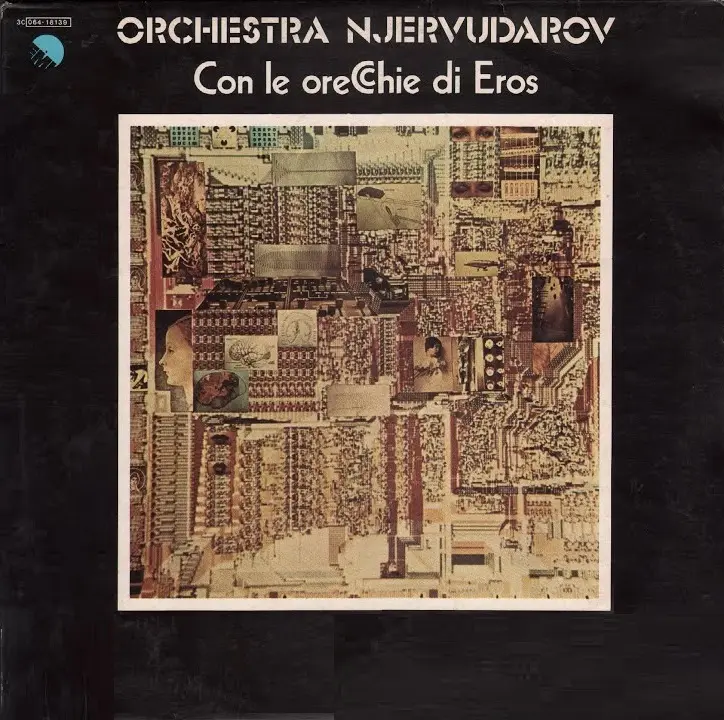 Orchestra Njervudarov saw their singular album, Con le Orecchie di Eros, appear in June 1979 on EMI.
The group presents a dense, satirical, and compositionally advanced work that intersects chamber experimentation with elements of Italian political rock, parody, and instrumental rigor.
Drummer Adriano Pedini alternates between vibraphone, flute, and assorted percussion, shaping both the rhythmic foundation and many of the album’s transitional textures. Roberto Costa plays both electric and upright bass, layering foundational lines against Crumar and Polymoog synthesizers, and occasionally interjecting with trombone flourishes. Guitarist Bruno Mariani interlaces acoustic strums and overdriven runs with textures from a Roland guitar synthesizer, frequently doubling on percussive accents. Piero Baldassarri commands the harmonic landscape with electric piano, acoustic piano, and Polymoog, supplying abrupt shifts and tonal overlays. Multi-reedist Piergiorgio Bonafé phrases across soprano, alto, and tenor saxophones as well as clarinet, bass clarinet, cornet, and recorder, anchoring the album’s ensemble sections with alternating harmonic backdrops and caustic interjections.
All seven tracks are credited collectively to Adriano Pedini, Bruno Mariani, Piergiorgio Bonafé, and Roberto Costa, who also handled the arrangements.
The album moves between rigorously structured chamber constructions and moments of pointed satire. “Tot Stelle Reflex” opens with staggered rhythmic interplay between drums and bass, over which fragmented guitar and keyboard lines lock into tightly intermeshed counterpoint. “Spleen, codice notturno” slows the pace into a sax-led jazz chamber piece with smoother transitions, balancing linear phrasing against percussive piano accents. “Una baldoria verticale” opens with a tom-driven drum cadence and unfurls into an angular sequence of passages marked by dissonant piano figures and shifting ensemble cues. “Tristessa” layers acoustic piano and synth in a sustained tension with gradual additions from reeds and guitar; the track incorporates elements of modernist chamber music and slow-building dynamics.
“Rapporto Njervudarov sulla teoria degli opposti estremismi” contrasts the suite with a compressed, parodic format, cycling through mock-disco and punk tropes with spoken absurdist text in broken English and Italian. “Toujours l’amour” reverts to complex instrumental form, built on volatile meter changes and subtle synth-guitar dialogues. The closing multipart suite “Il montaggio delle attrazioni / Sinfonia erotica” cycles through three movements — “L’oscillazione poetica,” “Batte il tamburo… lentamente,” and “Fedeltà al respiro!” — using loosely improvised transitions, abrupt silences, and dynamic swells to collapse tonal polarity and stretch ensemble cohesion.
A1. “Tot Stelle Reflex” (4:18) — Dense, high-velocity ensemble opener driven by intersecting rhythm lines and angular piano–guitar interplay.
A2. “Spleen, codice notturno” (5:53) — Slower-paced, sax-led composition built on jazz voicings and sustained atmospheres.
A3. “Una baldoria verticale” [A Vertical Revelry] (4:52) — Opens with tom-driven cadence and expands into discontinuous chamber sequences with abrupt piano interjections.
A4. “Tristessa” [Sadness] (3:34) — Synth and piano foreground a restrained, chamber-inspired development with gradual reed and guitar layering.
B1. “Rapporto Njervudarov sulla teoria degli opposti estremismi” [Njervudarov Report on the Theory of Opposing Extremisms] (2:52) — Satirical piece parodying disco and punk vocal tropes through mock-English phrases and abrupt stylistic cut-ups.
B2. “Toujours l’amour” [Always Love] (4:42) — Structurally complex instrumental centered on tempo shifts and interlocking synth-guitar figures.
B3. “Il montaggio delle attrazioni / Sinfonia erotica” [The Montage of Attractions / Erotic Symphony] (6:32)
a. “L’oscillazione poetica” [The Poetic Oscillation]
b. “Batte il tamburo… lentamente” [The Drum Beats… Slowly]
c. “Fedeltà al respiro!” [Loyalty to the Breath!]
— Extended tripartite suite exploring avant-garde pacing, disjunct piano transitions, and alternating ensemble focus.
Sessions took place at UMBI Studios. Roberto Costa served as recording engineer. Mixing duties were shared by Bruno Mariani, Piergiorgio Bonafé, and Roberto Costa.
Though long unavailable in any format, Con le Orecchie di Eros was eventually reissued on CD decades later. The track “Tristessa” was sampled in a Jay-Z production, drawing renewed interest to the album. The project’s members continued active careers in Italian music, with Costa becoming a prolific arranger and engineer, and Mariani and Pedini contributing to multiple projects across jazz and pop contexts.
Postlude
After the album’s delayed release, several members continued in professional music. In 1982, Mariani, Costa, and Pedini partook in Deluxe, a studio one-off. Costa partnered with Lucio Dalla, who also briefly employed Bruno Mariani.
Discography:
- Con le Orecchie di Eros (1979)
Sources:
- Discogs: Orchestra Njervudarov
- RYM: Orchestra Njervudarov
- ItalianProg: Orchestra Njervudarov
- ProgArchives: Orchestra Njervudarov
Artist/Album Pages:
Flea was an Italian symphonic/hard-rock band that appeared with a 1971 album as Flea on the Honey....
Sfinx was a Romanian symphonic/hard-rock band that released two singles, two EPs, and three albums...
Tina Turner (Nov. 26, 1939 – May 24, 2023) was an American soul-pop singer who first rose to promi...
The Atlanta Rhythm Section was an American southern-rock boogie band that released two 1972–73 alb...
Jorge Dalto (July 7, 1948 — Oct. 27, 1987) was an Argentine jazz-funk pianist who emerged as a sid...
Mike Oldfield is an English composer, arranger, and multi-instrumentalist with a career in music dat...
Hank Crawford (Dec. 12, 1934 — Jan. 29, 2009) was an American post-bop/jazz-funk alto saxophonist...
Gasolin’ was a Danish rock band formed in Copenhagen in 1969 by singer–guitarist Kim Larsen, guit...
Manuel Göttsching is a German guitarist who rose to prominence as the mastermind behind Ash Ra Tem...
Lard Free was a French improve/electroacoustic band that released three albums through 1977 on Vam...
Leo's Sunshipp was an American soul-funk band that released the album We Need Each Other on Lyon's...
Greenslade was an English symphonic-rock supergroup comprised of ex-members of Colosseum, Fields, ...