

Lucio Dalla (March 4, 1943 — March 1, 2012) was an Italian singer/songwriter with a career that spanned five decades. During the second half of the 1960s, he released multiple singles and the album 1999 (1966) on ARC. Between 1970 and 1990, he released more than fifteen albums on RCA Italiana.
Background
Lucio Dalla was born on March 4, 1943, in Bologna, Emilia-Romagna. He learned clarinet after receiving the instrument as a child, then joined the Rheno Dixieland Band, whose members included future film director Pupi Avati. In 1960, Rheno Dixieland Band placed first among traditional bands at the European Jazz Festival in Antibes. The Second Roman New Orleans Jazz Band then brought Dalla into the studio for “Telstar,” an RCA single that used him on clarinet.
Dalla entered the Flippers at the end of 1962 as singer, clarinetist, and saxophonist. The group included piano Franco Bracardi, trumpet Massimo Catalano, vibraphone and percussion Romolo Forlai, and drums Fabrizio Zampa. He also appeared on Flippers-backed Edoardo Vianello recordings and sang scat on the Flippers album At Full Tilt. Gino Paoli urged him toward a solo career during the 1963 Cantagiro.
ARC issued “Lei (non è per me)” in 1964 (b/w “Ma questa sera”). The A-side adapts “Careless Love” with Italian text by Paoli and Sergio Bardotti; the B-side adapts Curtis Mayfield’s “Hey Little Girl.” Dalla formed Gli Idoli in 1966 with Bologna musicians and recorded his debut album for ARC.
1999
 Lucio Dalla released his debut album, 1999, in 1966 on ARC.
The album compiles four previously issued single sides with new material by Dalla, Sergio Bardotti, the Reverberi brothers, and outside writers. Gian Piero Reverberi arranged most of the program; Ruggero Cini arranged “Io non ci sarò.” The program includes two James Brown adaptations and an Italian version of the Shangri-Las’ “Remember (Walking in the Sand).”
Gli Idoli play the core backing parts with guitarists Beppe Barlozzari and Giorgio Lecardi, organist Bruno Cabassi, bassist Emanuele Ardemagni, and drummer Roberto Senzasono. “L’ora di piangere” uses I 4+4 di Nora Orlandi, and “Io non ci sarò” uses I Cantori Moderni di Alessandroni.
“Quando ero soldato” regales parade form through Farfisa figures and sardonic text delivery. “L.S.D.” twists the same keyboard bite into comic, acid-linked syllables. “I Got You” bolts through Brown-derived exclamations and rough ensemble heat. “Mondo di uomini” recasts the Brown source in Italian through broad declamation. “1999” rattles through jagged group motion as Dalla phrases at a hoarse edge. “Lei (non è per me)” and “Io non ci sarò” place choir replies around the lead line.
A1. “Intro” (0:48) – Dalla
A2. “Quando ero soldato” [When I Was a Soldier] (2:47) – Bardotti, Gian Franco Reverberi
A3. “Lei (non è per me)” [She Is Not for Me] (2:52) – traditional; Bardotti–Paoli Italian text
A4. “I Got You” (2:29) – Brown
A5. “L’ora di piangere” [The Hour to Cry] (2:39) – Morton; Bardotti–Carrera Italian text
A6. “L.S.D.” (2:15) – Bardotti, Gian Franco Reverberi, Dalla
A7. “Mondo di uomini” [World of Men] (2:58) – Brown; Bardotti–Tenco Italian text
B1. “1999” (2:23) – Bardotti, Dalla, Gian Franco Reverberi
B2. “Tutto il male del mondo” [All the Evil in the World] (2:39) – Bardotti, Gian Franco Reverberi, Dalla
B3. “Pafff…bum!” (2:20) – Bardotti, Gian Franco Reverberi
B4. “La paura” [Fear] (1:59) – Bardotti, Gian Piero Reverberi, Dalla
B5. “Io non ci sarò” [I Won’t Be There] (3:01) – Bardotti, Gian Piero Reverberi, Dalla
B6. “Le cose che vuoi” [The Things You Want] (2:57) – Falzoni, Trombetti, Zaffiri
B7. “Finale” (2:55) – Dalla
Gian Franco Reverberi produced 1999 for ARC during the 1966 Dalla single run that included “Pafff… bum!”. The credit sits just before his 1967/68 film-score sequence on Soldati e capelloni, A Black Veil for Lisa, and Chimera.
ARC lifted “Quando ero soldato” as a 1966 single (b/w “Tutto il male del mondo”). RCA reissued the album in 1989 with nearly identical sleeve graphics and catalog number NL 74156.
Terra di Gaibola
 Dalla released his second album, Terra di Gaibola, in June 1970 on RCA Italiana.
The album follows a four-year LP gap and excludes the intervening singles. Guido and Maurizio De Angelis arrange most of the program; Ruggero Cini arranges “Orfeo bianco” and “Sylvie.” Gli Idoli return with Barlozzari, Lecardi, Cabassi, and Ardemagni; drummer Giovanni Pezzoli and violinist–bassist Renzo Fontanella enter the album lineup. The program includes the instrumental “Stars Fell on Alabama,” the scat piece “ABCDEFG,” and “Non sono matto,” Dalla’s first album lyric under his own name.
“Il fiume e la città” swells through orchestral shading and flute figures as Dalla holds an imperious, strained line. “Dolce Susanna” and “Sylvie” linger as soft-drawn ballads. “Stars Fell on Alabama” gives Dalla’s clarinet the instrumental lead.
“Fumetto” shuffles through a soiled club figure. “ABCDEFG” scats through nonsense syllables and elastic phrasing. “Africa” and “K.O.” tilt the band toward lysergic turns and unsettled accents. “Non sono matto o la capra Elisabetta” mutters a courtroom defense over subdued De Angelis accompaniment and taped tribunal sound. “Occhi di ragazza” springs through a fast, fresh pace.
A1. “Il fiume e la città” [The River and the City] (3:48) – Bardotti, Dalla
A2. “Orfeo bianco” [White Orpheus] (3:35) – Pallottino, Dalla
A3. “Dolce Susanna” [Sweet Susanna] (2:21) – Bardotti, Baldazzi, Dalla
A4. “ABCDEFG” (2:27) – Dalla
A5. “Stars Fell on Alabama” (3:26) – Parish, Perkins
B1. “Fumetto” [Comic Strip] (2:04) – Bardotti, Baldazzi, Dalla
B2. “Sylvie” (3:01) – Bardotti, Baldazzi, Dalla
B3. “Africa” (4:08) – Pallottino, Bardotti, Dalla
B4. “Non sono matto (o la capra Elisabetta)” [I’m Not Crazy (or Elisabeth the Goat)] (4:01) – Dalla, Paoli
B5. “K.O.” (4:37) – Bardotti, Dalla
B6. “Occhi di ragazza” [Girl’s Eyes] (3:08) – Bardotti, Baldazzi, Dalla
B7. “Il mio fiore nero (Girlie)” [My Black Flower] (2:55) – Phillips, Migliacci
Terra di Gaibola produced Terra di Gaibola for RCA Italiana, with Roberto Formentini in the project-coordination role. RCA Studios engineers Franco Finetti and Enzo Martella handled the sessions amid work with The Trip (Caronte).
RCA issued “Sylvie” in April 1970 (b/w “Orfeo bianco”).
Storie di casa mia
 Dalla released his third album, Storie di casa mia, in June 1971 on RCA Italiana.
The album extends the Dalla–Bardotti–Baldazzi writing circle and adds several Paola Pallottino lyrics, including “4/3/1943.” Dalla wrote most of the music; Lally Stott supplied the music to “Strade su strade.” Guido and Maurizio De Angelis arranged everything apart from the Ruggero Cini-conducted “Il gigante e la bambina” and “4/3/1943.” Storie retains Barlozzari, Lecardi, Cabassi, Ardemagni, and Fontanella. Additional ensemble credits name the Cini orchestra, I 4+4 di Nora Orlandi, and I Cantori Moderni di Alessandroni.
“Itaca” rallies a worker chorus into sailors’ replies, with Dalla addressing the captain in direct accusation. “Il bambino di fumo” drifts into a cinematic ending after its smog-child fable. “Il colonnello” roughens the spoken character into a hoarse authority figure. “Il gigante e la bambina” sets Cini’s orchestra and the Cantori Moderni around Pallottino’s child-adult metaphor.
“La casa in riva al mare” starts from a short guitar arpeggio and turns the prisoner’s imagined Maria into a slow lament. “4/3/1943” carries its street narrative on a crooked violin refrain, with Dalla singing in a bardic address. “Lucio dove vai?” folds self-questioning into a tender address and answers with repeated life phrases.
A1. “Itaca” [Ithaca] (4:13) – Baldazzi, Bardotti, Dalla
A2. “Un uomo come me” [A Man Like Me] (3:30) – Pallottino, Dalla
A3. “Il bambino di fumo” [The Child of Smoke] (4:29) – Pallottino, Dalla
A4. “Il colonnello” [The Colonel] (3:46) – Baldazzi, Bardotti, Dalla
A5. “Il gigante e la bambina” [The Giant and the Little Girl] (4:44) – Pallottino, Dalla
B1. “La casa in riva al mare” [The House by the Sea] (4:00) – Baldazzi, Bardotti, Dalla
B2. “Per due innamorati” [For Two Lovers] (4:46) – Baldazzi, Bardotti, Dalla
B3. “4/3/1943” (3:45) – Pallottino, Dalla
B4. “Strade su strade” [Roads upon Roads] (3:36) – Baldazzi, Bardotti, Stott
B5. “L’ultima vanità” [The Last Vanity] (3:16) – Baldazzi, Bardotti, Dalla
B6. “Lucio dove vai” [Lucio, Where Are You Going] (2:58) – Bardotti, Dalla, Gian Franco Reverberi
Dalla recorded Storie di casa mia at RCA Studio A, Rome, inside the Terra di Gaibola production setup. Finetti and Martella engineered the sessions, and Finetti also handled re-recording. Martella worked in sequence on the 1972 Trip album Atlantide.
RCA issued “4/3/1943” in 1971 (b/w “Il fiume e la città”). The song entered Sanremo under a revised title after the original “Gesù bambino” title encountered censorship. RCA also lifted “La casa in riva al mare” in June 1971 (b/w “Itaca”) and “Il colonnello” in September 1971 (b/w “Il gigante e la bambina”).
Il giorno aveva cinque teste
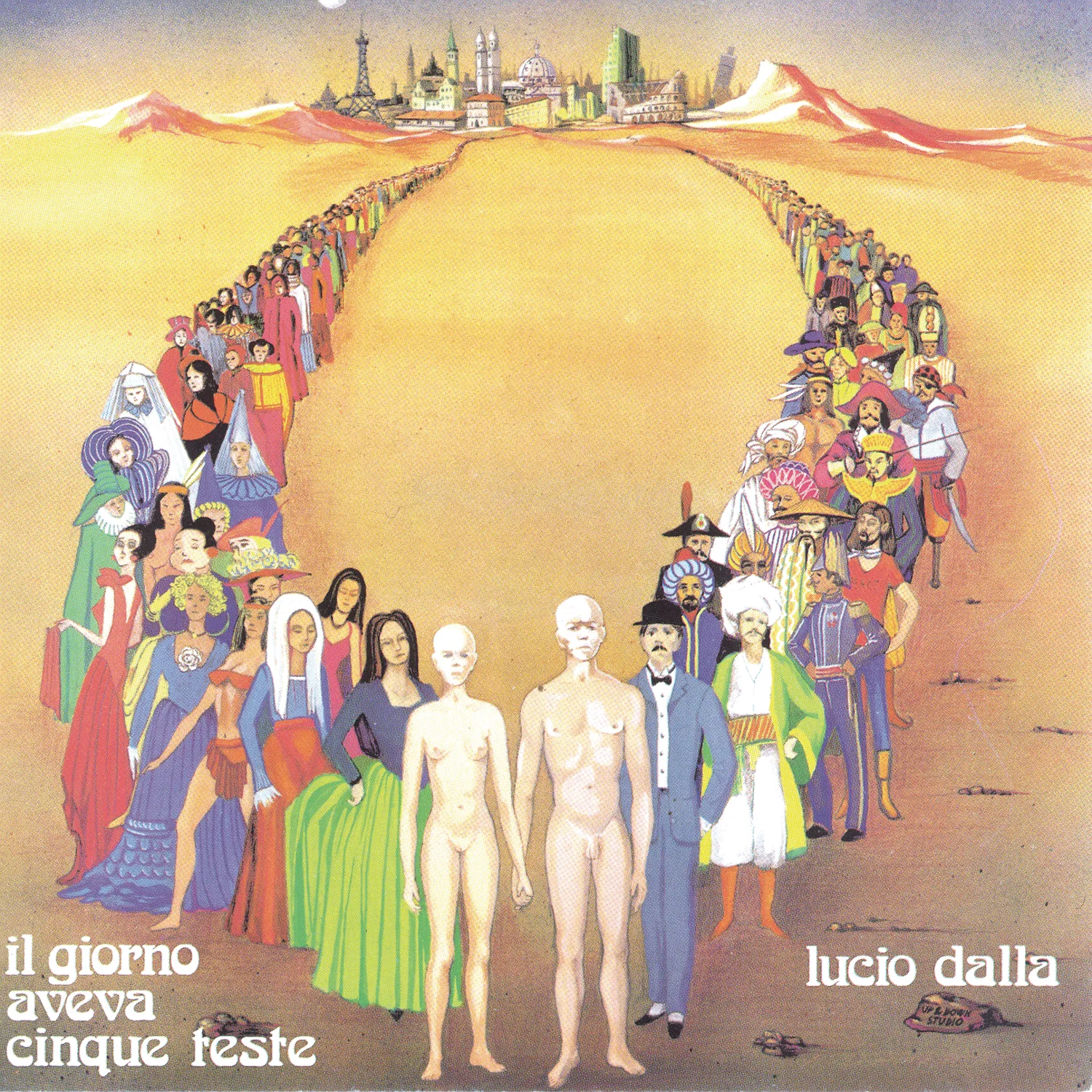 Dalla released his fourth album, Il giorno aveva cinque teste, in April 1973 on RCA Italiana.
The album begins Dalla’s three-album collaboration with poet Roberto Roversi. Dalla wrote the music to nine tracks; “Pezzo zero” carries Dalla’s sole music-and-text credit and uses a textless scat part. The album moves out of the Gli Idoli frame and uses keyboardist Toto Torquati, guitarist Luciano Ciccaglioni, bassist Piero Ricci, drummer Massimo Buzzi, and arranger-keyboardist Ruggero Cini.
“L’auto targata TO” settles strings and bell peals around the Scilla-to-Turin migration image. “È lì” recedes to bare voice and leaves the dead-man image exposed. “Il coyote” drifts through fable turns and symphonic passages. “Grippaggio” unfolds as a five-part suite, with rural quiet and roadside desolation sharing the same path. “La bambina” gathers around Dalla’s saxophone solo and a naturalist return to innocence. “Pezzo zero” bends language into scat phonemes and lets the instrumental track carry the song.
A1. “L’auto targata TO” [The Car with Turin Plates] (4:29) – Roversi, Dalla
A2. “Alla fermata del tram” [At the Tram Stop] (3:59) – Roversi, Dalla
A3. “È lì” [It Is There] (4:31) – Roversi, Dalla
A4. “Passato, presente” [Past, Present] (4:32) – Roversi, Dalla
A5. “L’operaio Gerolamo” [The Worker Gerolamo] (3:34) – Roversi, Dalla
B1. “Il coyote” [The Coyote] (4:35) – Roversi, Dalla
B2. “Grippaggio” [Seizure] (4:07) – Roversi, Dalla
B3. “La bambina (L’inverno è neve, l’estate è sole)” [The Little Girl (Winter Is Snow, Summer Is Sun)] (3:00) – Roversi, Dalla
B4. “Pezzo zero” [Piece Zero] (2:58) – Dalla
B5. “La canzone d’Orlando” [Orlando’s Song] (1:38) – Roversi, Dalla
Formentini produced Il giorno aveva cinque teste for RCA Italiana, with Ruggero Cini in the arrangement role. Leandro Leandri handled the re-recording after early-Seventies RCA work with The Feed-back, Middle of the Road, and Angelo Branduardi. The gatefold sleeve presents a symbolic drawing with two columns of male and female figures in historical dress and a present-day nude pair.
RCA issued “Anna Bellanna” in April 1974 (b/w “Pezzo zero”). Only the B-side came from Il giorno aveva cinque teste. The album reached No. 36 on the Italian album chart.
Anidride solforosa
 Dalla released his fifth album, Anidride solforosa, on January 20, 1975 on RCA Italiana.
The album continues the Dalla–Roversi cycle and uses Roversi lyrics across the full program. The texts address juvenile crime, workplace injury, market language, and media treatment of criminal cases. “Le parole incrociate” quotes “Ciuri ciuri,” while “La borsa valori” quotes “Raindrops Keep Fallin’ on My Head” and “Singin’ in the Rain.” Cini, Torquati, and Ciccaglioni continue from Il giorno aveva cinque teste. The album adds guitarist Roberto Rosati, bassist Mario Scotti, drummer Carlo Felice Marcovecchio, and backing-vocal group Baba Yaga.
“Anidride solforosa” spreads theatrical diction across analog and electronic haze. “La borsa valori” turns share-price names into scat syllables while strings quote familiar screen-song material. “Ulisse coperto di sale” unfolds through solemn orchestral passages and firm rhythm changes. “Carmen Colon” lingers on a lilting accompaniment and repeated name-phrases.
“Tu parlavi una lingua meravigliosa” settles into long phrases and a delicate sung contour. “Mela da scarto” drifts between harder ensemble passages and folk-rooted contours as the Baba Yaga choir shadows the reformatory narrative. “Un mazzo di fiori” rests on spare accompaniment, with winds tracing the suicide story. “Le parole incrociate” winds its historical word game around accordion phrases.
A1. “Anidride solforosa” [Sulfur Dioxide] (5:13)
A2. “La borsa valori” [The Stock Exchange] (3:20)
A3. “Ulisse coperto di sale” [Ulysses Covered in Salt] (4:44)
A4. “Carmen Colon” (4:19)
A5. “Tu parlavi una lingua meravigliosa” [You Spoke a Wonderful Language] (3:52)
B1. “Mela da scarto” [Discarded Apple] (4:02)
B2. “Merlino e l’ombra” [Merlin and the Shadow] (4:04)
B3. “Non era più lui” [He Was No Longer Himself] (4:06)
B4. “Un mazzo di fiori” [A Bunch of Flowers] (4:05)
B5. “Le parole incrociate” [The Crosswords] (5:23)
Cremonini produced Anidride solforosa at RCA Studios, Rome, with Cini in the arrangement role. Cini’s surrounding RCA orchestral work includes Dalla (“4/3/1943”) and Claudio Baglioni (Un cantastorie dei giorni nostri), and the string arrangements on Dalla’s next album. Enrico Manelli drew the sleeve image of Dalla, and the first edition included an inner poster.
RCA issued “Anidride solforosa” in March 1975 (b/w “Tu parlavi una lingua meravigliosa”).
Automobili
 Dalla released his sixth album, Automobili, on March 14, 1976 on RCA Italiana.
The album closes the Dalla–Roversi partnership and draws its material from a wider Rai project titled Il futuro dell’automobile e altre storie. Roversi used the Norisso pseudonym in the credits after Dalla selected part of the larger project for the LP. Cini returned as co-arranger with Dalla. Scotti and Ciccaglioni remain from Anidride solforosa. The sessions introduce future Stadio players bassist Marco Nanni and drummer Giovanni Pezzoli, plus pianist Rosalino Cellamare, keyboardist Carlo Capelli, percussionist Tony Esposito, and horn player Rodolfo Bianchi.
“Intervista con l’Avvocato” settles at the piano and lets pseudo-English grammelot loosen into scat. “Mille miglia” unfolds as a suite, with tarantella-like percussion, electronic oases, Baba Yaga choir, and broad race narration. “Nuvolari” glides over light swing and retro female choir while Dalla shades the driver portrait in theatrical phrases.
“L’ingorgo” descends through echo-treated voice and solemn organ before the arrangement rises through synthesizer breaths. “Il motore del 2000” hovers in a glacial electronic atmosphere. “Due ragazzi” rests on intimate piano and widens into a long symphonic close.
A1. “Intervista con l’Avvocato” [Interview with the Lawyer] (2:18)
A2. “Mille Miglia (prima e seconda)” [Mille Miglia (First and Second)] (8:38)
A3. “Nuvolari” (5:27)
B1. “L’ingorgo” [The Traffic Jam] (6:00)
B2. “Il motore del 2000” [The Engine of 2000] (4:25)
B3. “Due ragazzi” [Two Boys] (4:58)
Cremonini produced Automobili for RCA, with Marco Vicari in the realization credit. Leandri engineered the recording and mix, while Raffaele Di Maio handled the recordist role.
RCA issued “Nuvolari” in March 1976 (b/w “Il motore del 2000”). Automobili reached No. 21 on the Italian album chart and placed No. 48 on the year-end album chart.
Come è profondo il mare
 Dalla released his seventh album, Come è profondo il mare, in September 1977 on RCA Italiana.
The album marks his first full LP as both lyricist and composer. Ron joins Dalla in the arrangement credit. Nanni and Pezzoli continue from Automobili, and Ciccaglioni returns within the studio group. The regular cast adds guitarist Ricky Portera, keyboardist Fabio Liberatori, and keyboardist Alessandro Centofanti.
“Come è profondo il mare” looms on a bass descent and steady rhythmic motion while Dalla shapes the long declamatory line. “Treno a vela” lingers through Fender-keyboard softness and suspended melodic turns. “Il cucciolo Alfredo” eases through similar harmonic balance, with brief air pockets around the sung phrases. “Corso Buenos Aires” gathers electric piano, instrumental bustle, and scat-like street noise into a live-report scene.
“Disperato erotico stomp” sways from two chords into a loose off-island rhythmic mixture. “Quale allegria” folds soft romanza melody into guitars, piano, and Cini’s strings. “…e non andar più via” retreats to Dalla alone at the piano, with dry timbres and waiting silence around the line. “Barcarola” drifts on pedal phasing that gives the electric guitar a mandolin-like shimmer.
A1. “Come è profondo il mare” [How Deep the Sea Is] (5:23)
A2. “Treno a vela” [Sailing Train] (3:20)
A3. “Il cucciolo Alfredo” [Alfredo the Puppy] (5:17)
A4. “Corso Buenos Aires” (4:36)
B1. “Disperato erotico stomp” [Desperate Erotic Stomp] (5:48)
B2. “Quale allegria” [What Cheer] (4:30)
B3. “…E non andar più via” […And Don’t Go Away Anymore] (3:21)
B4. “Barcarola” [Barcarolle] (3:45)
Sessions occurred in 1977 at RCA Studios, Rome, and Stone Castle Studios, Carimate, with producers Alessandro Colombini and Renzo Cremonini. Colombini entered the Dalla run from 1972–77 productions by Banco del Mutuo Soccorso (Banco del Mutuo Soccorso, Darwin!), Edoardo Bennato (Non farti cadere le braccia, Burattino senza fili), and Maxophone (Maxophone). Maurizio Montanesi and Ezio De Rosa recorded and mixed the album; De Rosa’s Carimate-era credits include Alan Sorrenti (Figli delle stelle), PFM (Passpartù, mix), Alberto Camerini (Comici cosmetici), and Pooh (Boomerang).
RCA issued “Quale allegria” in 1977 (b/w “Il cucciolo Alfredo”). Come è profondo il mare reached No. 7 on the Italian album chart and placed No. 18 on the Italian year-end chart.
Lucio Dalla
 Dalla released his eighth studio album, Lucio Dalla, in 1979 on RCA Italiana.
The album continues the self-authored approach of Come è profondo il mare. “Cosa sarà” uses music by Rosalino Cellamare and includes Francesco De Gregori. Gian Piero Reverberi arranged strings on “Anna e Marco,” “Tango,” “Notte,” and “L’anno che verrà.” Portera, Nanni, Pezzoli, Ron, and Ciccaglioni continue from Dalla’s late-seventies recording band.
“L’ultima luna” grows through a slow-building design and a Portera solo before the final image. “Stella di mare” rises from piano-led intimacy into a quicker middle passage. “La signora” settles into a subdued portrait, with Nanni’s bass following Dalla’s wordless turns.
“Anna e Marco” places the suburban dance scene against a small string frame. “Tango” lingers on Reverberi strings and Zilioli accordion. “Cosa sarà” shares its questions between Dalla and Francesco De Gregori, then breathes around Dalla’s saxophone solo. “Notte” unfolds as a very slow Reverberi string setting. “L’anno che verrà” gathers its letter-form melody into a gradual crescendo.
A1. “L’ultima luna” [The Last Moon] (5:44)
A2. “Stella di mare” [Starfish] (5:56)
A3. “La signora” [The Lady] (4:00)
A4. “Milano” [Milan] (3:30)
B1. “Anna e Marco” [Anna and Marco] (3:42)
B2. “Tango” (3:59)
B3. “Cosa sarà” [What Will It Be] (4:20) – Dalla, Cellamare
B4. “Notte” [Night] (3:38)
B5. “L’anno che verrà” [The Coming Year] (4:25)
Colombini and Cremonini produced Lucio Dalla at Stone Castle Studios. De Rosa recorded and mixed the sessions with assistant Maurizio Peverali, continuing the Carimate desk line from Come è profondo il mare. Gian Piero Reverberi conducted the string arrangements on “Anna e Marco,” “Tango,” “Notte,” and “L’anno che verrà.”
RCA issued “Ma come fanno i marinai” in November 1978 (b/w “Cosa sarà”), with Dalla and De Gregori on both sides. Lucio Dalla reached No. 2 on the Italian album chart and placed No. 1 on the Italian year-end chart.
Banana Republic
 Dalla and Francesco De Gregori released the live album Banana Republic in 1979 on RCA Italia.
The album documents the 1979 Dalla–De Gregori tour and includes Ron in the touring arrangements. Portera, Curreri, Liberatori, Pezzoli, and Nanni continue from Dalla’s recording circle. The concert band adds guitarist George Sims and drummer Franco Di Stefano.
“Banana Republic” eases Dalla and De Gregori into a bittersweet duet with a relaxed summer drift. “Un gelato al limon” loosens Paolo Conte’s piece into a lightly jazzed concert exchange. “Ma come fanno i marinai” settles around Dalla’s clarinet riff while the two singers answer in a shared, nostalgic register. “Piazza Grande” returns as Dalla’s plainest street portrait within the live set.
A1. “Banana Republic” (3:33)
A2. “Un gelato al limon” [A Lemon Ice Cream] (4:50)
A3. “La canzone di Orlando” [Orlando’s Song] (1:53)
A4. “Bufalo Bill” [Buffalo Bill] (5:06)
A5. “Piazza Grande” [Big Square] (4:02)
B1. “4/3/1943” (4:51)
B2. “Santa Lucia” (4:16)
B3. “Quattro cani” [Four Dogs] (3:42)
B4. “Addio a Napoli” [Farewell to Naples] (3:39)
B5. “Ma come fanno i marinai” [But How Do Sailors Do It] (4:44)
Manor Mobile recorded the 1979 Dalla–De Gregori tour, and Colombini produced Banana Republic for RCA. Pete Greenslade engineered and mixed the concert tapes after his credit on Fabrizio De André (Fabrizio De André in concerto – Arrangiamenti PFM). Montanesi joined the mix at RCA Studios, Rome, extending his Dalla credit line from Come è profondo il mare to the live album.
Banana Republic reached No. 1 on the Italian album chart.
Dalla
 Dalla released his ninth studio album, Dalla, on September 13, 1980 on RCA Italiana.
The album retains Ron as arranger with Dalla and adds Gaetano Curreri to the arrangement credit. Dalla wrote all eight tracks. Portera, Nanni, Pezzoli, Ron, Curreri, Del Conte, and La Notte continue from the late-seventies recording band.
“Balla balla ballerino” unfurls from Ricky Portera’s guitar figure into a supple, sustained rhythm. “Il parco della luna” lets brass punctuation follow Sonni Boy and Fortuna through the lunar scene. “La sera dei miracoli” rests in Reverberi’s fluid nocturnal arrangement. “Mambo” sways through a sustained rhythm and uneven turns as Dalla plays the abandoned-man scene.
“Cara” opens on a lilting keyboard figure and a delicate arpeggio. “Siamo dei” rises from wry dialogue into a firmer exchange. “Futura” broadens through a gradual crescendo around the couple’s imagined child.
A1. “Balla balla ballerino” [Dance, Dance, Dancer] (5:49)
A2. “Il parco della luna” [The Moon Park] (4:58)
A3. “La sera dei miracoli” [The Evening of Miracles] (5:17)
A4. “Mambo” (5:04)
B1. “Meri Luis” (4:36)
B2. “Cara” [Dear] (5:39)
B3. “Siamo dei” [We Are Gods] (4:32)
B4. “Futura” (6:07)
Sessions occurred in April and May 1980 at Stone Castle Studios, where Colombini produced Dalla with Cremonini in the executive-production credit. De Rosa recorded the album with assistant Mario Lovallo; Melkuist “Gay” Grazie handled the computer mix and Marcello Spiridioni transferred the disc master. Renzo Chiesa photographed the cover image at the studio.
RCA issued “Cara” in March 1981 (b/w “Balla balla ballerino”). Dalla reached No. 1 on the Italian album chart and placed No. 1 on the Italian year-end chart. Sony/Legacy issued a 40th-anniversary limited remaster in 2020.
Q Disc
 Dalla released the mini-album Q Disc, also known as Lucio Dalla, in 1981 on RCA.
The four-track release used RCA’s Qdisc format. Dalla wrote three pieces and adapts Carole King’s “You’ve Got a Friend” as an instrumental vehicle with clarinet and scat. No standard domestic 45 came from the mini-album, though “Telefonami tra vent’anni” appeared on a jukebox single for the Festivalbar market. The compact backing band uses guitarist Ricky Portera, keyboardist Gaetano Curreri, guitarist Ron, bassist Marco Nanni, and drummer Giovanni Pezzoli.
A1. “Telefonami tra vent’anni” [Call Me in Twenty Years] (4:41)
A2. “Madonna disperazione” [Madonna Despair] (7:20)
B1. “Ciao a te” [Goodbye to You] (4:22)
B2. “You’ve Got a Friend” (7:29) – King
Q Disc reached No. 2 on the Italian album chart and placed No. 10 on the Italian year-end chart. RCA/Sony reissued the mini-album on white vinyl in 2020.
1983
 Dalla released his tenth studio album, 1983, in April 1983 on RCA Italiana.
The album marks his first full studio album after the Qdisc format and his last studio album with much of the band that had become Stadio in September 1982. Mauro Malavasi arranges the album and begins the Dalla–Malavasi studio partnership that continued on Viaggi organizzati. “Noi come voi” adds Gaetano Curreri to the music credit. Curreri, Liberatori, Nanni, Portera, and Pezzoli remain from the prior band; horn players Sandro Comini, Enzo Soffritti, and Rudy Trevisi and backing singers Lalla Esposito, Giulia Fasolino, and Noemi Hackett enter the cast around Malavasi.
“1983” settles from a subdued keyboard opening into gradual ensemble entry, then widens through a dreamlike change and a big-band-styled middle scene before the synth ending. “Pecorella” lingers on guitar harmonics, even kit patterning, bleated syllables, and a sax coda. “L’altra parte del mondo” drifts through nocturnal stops and returns, with synthetic strings under Dalla’s sax soprano and piano.
“Camion” eases into an intimate ballad frame, then lets bass and guitar answer through the changing sections. “Noi come voi” moves at a quicker pace from a sixteenth-note keyboard figure into a sax-and-guitar unison solo. “Stronzo” rolls through scat syllables, syncopated footing, and horn interventions. “Solo” recedes into sequencer, synthesizers, multiplied Dalla lines, and a somber electronic bed.
A1. “1983” (5:56)
A2. “Pecorella” [Little Sheep] (5:04)
A3. “L’altra parte del mondo” [The Other Side of the World] (6:27)
B1. “Camion” [Truck] (5:39)
B2. “Noi come voi” [We, Like You] (3:59) – Dalla, Curreri
B3. “Stronzo” [Bastard] (3:57)
B4. “Solo” [Alone] (5:20)
Cremonini produced 1983 at Fonoprint, Bologna, with Mauro Malavasi in the arrangement credit. Maurizio Biancani recorded and mixed the album with Giorgio Diritti; Marcello Spiridioni mastered the RCA edition. Biancani’s 1981–84 Fonoprint credits include Change (Miracles), Vasco Rossi (Siamo solo noi, Bollicine), Ron (Guarda chi si vede), Stadio (Stadio, “Acqua e sapone”), My Mine (“Hypnotic Tango”), and Pooh (Tropico del Nord).
1983 reached No. 1 on the Italian album chart and placed No. 4 on the Italian year-end chart.
Viaggi organizzati
 Dalla released his eleventh studio album, Viaggi organizzati, on September 4, 1984 on Pressing.
The album inaugurates Dalla’s Pressing label period and removes the Stadio band unit from the studio cast. Malavasi shares production with Dalla and handles keyboards, synthesizers, programming, and arrangements. Ron appears on piano and keyboards; Roberto Costa joins on keyboards and bass. The backing cast adds guitarist Bruno Mariani, keyboardist Serse May, and drummer Mauro Gherardi.
“Tutta la vita” glides over a cold minimal electronic base under a light Latin-tinged surface. “Toro” sways through a false-tango outline, salsa-like traces, vocoder haze, and queasy guitar detail. “Aquila” circles Ron’s piano into processed pan-flute-like sounds and a broad desolate middle movement. “60.000.000 di anni fa” opens with reassuring choral parts before synthetic disturbances unsettle the exchange.
“Stornello” floats on pale pads, thin electronic textures, and barely grounded rhythm. “Viaggi organizzati” hovers around synthetic choral figures, scattered synth inserts, and processed guitar. “Washington” carries its dramatic text through synthetic dance motion and a late spoken aside. “Tu come eri” rests on a minimal electronic arrangement, with cold details placed beneath the resigned delivery.
A1. “Tutta la vita” [All Life Long] (4:53)
A2. “Toro” [Bull] (4:13)
A3. “Aquila” [Eagle] (4:33) – Dalla, Cellamare
A4. “60.000.000 di anni fa” [60,000,000 Years Ago] (4:47)
B1. “Stornello” [Stornello] (4:15) – Dalla, Cellamare
B2. “Viaggi organizzati” [Organized Trips] (4:52)
B3. “Washington” (4:33) – Dalla, Ferro
B4. “Tu come eri” [You as You Were] (4:50)
Dalla and Malavasi produced Viaggi organizzati at Fonoprint, with Cremonini in the executive-production credit. Roberto Costa recorded and mixed the sessions with assistant Vic Troiani, after Costa’s production and desk work on Luca Carboni (…intanto Dustin Hoffman non sbaglia un film) and before his 1985/86 run with Carboni (Forever), Ron (st), and Stadio (Canzoni alla radio). Malavasi arrived from the Change production orbit, where his early-Eighties credits include The Glow of Love, Miracles, and Sharing Your Love.
Viaggi organizzati reached No. 1 on the Italian album chart for five consecutive weeks and placed No. 10 on the Italian year-end chart. “Tutta la vita” later produced Spanish-language versions by Franco and Emmanuel, both of which reached No. 1 on Billboard’s Hot Latin Songs chart in 1986.
Lucio Dalla/Marco Di Marco
 Dalla and pianist Marco Di Marco released Lucio Dalla/Marco Di Marco in 1985 on Fonit Cetra.
The album places Dalla in a small jazz setting with Di Marco, bassist Jacky Samson, and drummer Charles Saudrais. Di Marco wrote four pieces, while “Stella by Starlight” and “It Might as Well Be Spring” supply the standards. Dalla appears on clarinet and voice. Bassist Luca Malaguti appears on “Cervia’s Kites.”
A1. “Glowing” (6:39) – Di Marco
A2. “Stella by Starlight” (7:57) – Young, Washington
A3. “Camparenda” (4:35) – Di Marco
B1. “Gull Flight” (7:50) – Di Marco
B2. “It Might as Well Be Spring” (5:30) – Rodgers, Hammerstein
B3. “Cervia’s Kites” (6:17) – Di Marco
Dalla and Marco Di Marco recorded Lucio Dalla/Marco Di Marco at Fonoprint. Luca Bignardi mixed the album after early-Eighties Fonoprint engineering work on Cube (Can Can in the Garden) and before his keyboard-programming credit on Dalla’s next studio album, Bugie.
Bugie
 Dalla released his twelfth studio album, Bugie, on January 4, 1986 on Pressing.
The album follows the Malavasi-led sound of Viaggi organizzati with Roberto Costa as producer and arranger. Dalla wrote five tracks alone and collaborated with Costa, Ron, Bruno Mariani, Giovanni Pezzoli, and Robert Sidoli on the remaining songs. “Tania del circo” is an instrumental. Ron remains in the arrangement circle, and Costa’s studio group draws on guitarist Bruno Mariani, pianist Franco D’Andrea, drummer Giovanni Pezzoli, programmer Robert Sidoli, and keyboardist Mauro Malavasi.
“Se io fossi un angelo” returns Dalla to a plainer ballad path around Roberto Costa’s music. “Soli io e te” hums with carillon detail and suspended fairy-tale atmosphere. “Luk” wanders through Dalla’s invented sung speech for the dog’s strange monologue. “Tania del circo” lets Dalla’s saxophone and Franco D’Andrea’s piano carry the instrumental.
“Chissà se lo sai” softens around Ron’s piano and a spare arrangement with few ornaments. “Ribot” ripples as a lighter sporting reverie. “Navigando” closes the album in a reflective water image, with the group-written setting held in a gentle current.
A1. “Se io fossi un angelo” [If I Were an Angel] (4:58) – Dalla, Costa
A2. “Soli io e te” [Only You and I] (5:22)
A3. “Luk” (5:07)
A4. “Tania del circo” [Tania of the Circus] (4:31)
B1. “Scusami tanto ma ho solo te” [Forgive Me, but I Only Have You] (5:30)
B2. “Chissà se lo sai” [Who Knows if You Know] (4:03) – Dalla, Ron
B3. “Ribot” (3:53)
B4. “Navigando” [Sailing] (4:38) – Dalla, Mariani, Pezzoli, Sidoli, Costa, Ron
Sessions spanned September and October 1985 at Fonoprint, where Costa produced, recorded, and mixed Bugie. Costa and Ron arranged the album, with Bignardi in the keyboard-programming credit and Vic Troiani among the assistant engineers.
Pressing issued “Se io fossi un angelo” on November 28, 1985. “Navigando” followed on May 14, 1986. Bugie reached No. 1 in Italy and No. 11 in Switzerland, then placed No. 5 on the Italian year-end chart.
DallAmeriCaruso
 Dalla released the live album DallAmeriCaruso on October 10, 1986 on RCA Italiana and Pressing.
The album documents Dalla’s March 23, 1986 performance at the Village Gate in New York and adds the new studio song “Caruso.” The CD and LP configurations differ; the LP and cassette include three additional live titles absent from the original CD. The touring band retains guitarist Ricky Portera, keyboardist Gaetano Curreri, bassist Marco Nanni, and drummer Giovanni Pezzoli from the Dalla/Stadio circle. Keyboardist Aldo Fedele joins the stage band, and guitarist Bruno Mariani appears on “Caruso.”
“Caruso” lingers at the piano and folds Neapolitan melodic strain into Dalla’s studio addition to the live album. “Viaggi organizzati” lengthens in concert form, with the Stadio setting allowing broader instrumental variation. “L’ultima luna” revisits the earlier narrative piece in an expanded Village Gate reading. “Tutta la vita” eases into the set’s warm live atmosphere. “Washington” widens through the longer concert form and the instrumental coda preserved on the original vinyl and cassette editions. “Stella di mare” stretches into a spacious late-set reprise.
A1. “Caruso” (5:11)
A2. “Balla balla ballerino” [Dance, Dance, Dancer] (5:52)
A3. “La sera dei miracoli” [The Evening of Miracles] (5:50)
A4. “Viaggi organizzati” [Organized Trips] (5:39)
B1. “Anna e Marco” [Anna and Marco] (5:13)
B2. “Tutta la vita” [All Life Long] (5:21)
B3. “Se io fossi un angelo” [If I Were an Angel] (4:57) – Dalla, Costa
B4. “Cara” [Dear] (6:32)
C1. “Grande figlio di puttana” [Great Son of a Bitch] (5:13) – Dalla, Baldazzi, Pezzoli, Curreri
C2. “L’ultima luna” [The Last Moon]
C3. “Washington” (7:17) – Dalla, Ferro
C4. “4/3/1943” (4:49) – Pallottino, Dalla
D1. “Futura” (5:43)
D2. “Stella di mare” [Starfish] (6:08)
D3. “L’anno che verrà” [The Coming Year] (6:48)
Costa produced and arranged DallAmeriCaruso. The live material came from Dalla’s March 23, 1986 performance at the Village Gate, New York, and the album mix occurred at Fonoprint in June 1986. Costa engineered the album with assistant engineers Alex Volpi and Troiani, keeping the live record inside the same Fonoprint chain as Viaggi organizzati and Bugie. “Caruso” was recorded and mixed at Fonoprint as the new studio title, with Cremonini in the executive-production credit.
DallAmeriCaruso reached No. 4 on the Italian album chart and placed No. 18 on the Italian year-end chart.
Dalla/Morandi
 Dalla and Gianni Morandi released Dalla/Morandi on June 9, 1988 on RCA and Pressing.
The double album pairs new Dalla–Morandi material with songs associated with each singer. The recording cast reconnects Dalla and Morandi with guitarist Bruno Mariani, keyboardist Gaetano Curreri, bassist Marco Nanni, drummer Giovanni Pezzoli, pianist Ron, keyboardist Beppe D’Onghia, and saxophonist Carlo Actis Dato. Bassist Ares Tavolazzi and pianist Franco D’Andrea appear on selected tracks, and Francesco Guccini appears on “Emilia.”
“Vita” eases the two voices across Malavasi’s carefully woven backing. “C’era un ragazzo che come me amava i Beatles e i Rolling Stones” darkens the old protest piece through Dalla’s more pained delivery. “Chiedi chi erano i Beatles” settles Morandi’s broad singing inside a fuller arrangement. “Felicità” lingers in a tender Dalla setting, with irony and melancholy held in the same phrase. “Il duemila, un gatto e il re” gives Dalla a more declamatory Roversi piece.
“Cuori di Gesù” softens the adolescence scene through a protective tone and a shaped middle section. “Emilia” folds Guccini’s words into Dalla’s livelier melodic path. “Che cosa resterà di me” places Battiato’s piece inside the two-singer program. “Misterioso” turns the Monk theme into the album’s small-combo excursion.
A1. “Vita” [Life] (4:36) – Mogol, Lavezzi
A2. “C’era un ragazzo che come me amava i Beatles e i Rolling Stones” [There Was a Boy Who, Like Me, Loved the Beatles and the Rolling Stones] (4:32) – Migliacci, Lusini
A3. “Dimmi dimmi” [Tell Me, Tell Me] (4:58) – Dalla, Morandi, Malavasi
A4. “Chiedi chi erano i Beatles” [Ask Who the Beatles Were] (4:31) – Roversi, Curreri
B1. “Felicità” [Happiness] (5:45) – Dalla
B2. “Il cielo” [The Sky] (4:13) – Bardotti, Baldazzi, Gian Franco Reverberi
B3. “Il duemila, un gatto e il re” [The Year 2000, a Cat, and the King] (5:32) – Roversi, Dalla, D’Onghia, Curreri
B4. “Disperati complici” [Desperate Accomplices] (4:30) – Mogol, Cellamare
C1. “Emilia” (4:25) – Guccini, Dalla
C2. “Cuori di Gesù” [Hearts of Jesus] (4:27) – Dalla, Cocciante
C3. “Tu mi entri dentro il cuore” [You Enter My Heart] (4:08) – Mogol, Dalla
C4. “Il motore del 2000” [The Engine of 2000] (5:03) – Roversi, Dalla
C5. “Misterioso” [Mysterious] (5:39) – Monk
D1. “Che cosa resterà di me” [What Will Remain of Me] (4:35) – Battiato
D2. “Pomeriggio in ufficio” [Afternoon at the Office] (5:18) – Tirinelli, Dalla, Mariani
D3. “Soli, ma splendenti” [Alone, but Shining] (4:33) – Mogol, Malavasi
D4. “Amore piccolino” [Little Love] (5:12) – Dalla, Cellamare
D5. “Felicità (finale)” [Happiness (Finale)] (1:39) – Dalla
Malavasi produced, recorded, mixed, mastered, and arranged Dalla/Morandi with Dalla. Sessions occurred at Clock Studio, Bologna, with additional mixing at Fonoprint. Luca Malaguti and Costa handled the sound-engineering and mix credits, placing the double album between Costa’s DallAmeriCaruso work and Malaguti’s engineering role on Cambio.
Dalla/Morandi reached No. 1 on the Italian album chart and placed No. 4 on the Italian year-end chart.
Mamma Lucia
 Lucio Dalla and Mauro Malavasi released the soundtrack album Mamma Lucia in 1988 on RCA.
The album contains music for the television production known in the United States as Mario Puzo’s The Fortunate Pilgrim. Dalla and Malavasi composed the score; Luciano Pavarotti sings “Caruso” on the opening track.
“Caruso” rests on Luciano Pavarotti’s formal line and carries Dalla’s Neapolitan strain into the television score. “Caruso (Strumentale)” returns the same theme without the sung part. The remaining cues stay outside the MST because the available sources give titles and credits without concrete musical description.
A1. “Caruso” (5:12)
A2. “Frank’s Madness” (5:00)
A3. “Waltz 1929” (2:27)
A4. “Kidnapping” (2:02)
A5. “The Window” (2:43)
A6. “Allegretta” (2:40)
A7. “Frank’s Theme” (2:25)
B1. “Mc Kraig’s Theme” (2:28)
B2. “Winnie’s Death” (1:47)
B3. “Riverbank” (1:18)
B4. “Sleazy” (2:13)
B5. “Depression” (3:47)
B6. “Caruso (strumentale)” [Caruso (Instrumental)] (5:10)
Dalla and Malavasi produced and arranged Mamma Lucia for RCA’s soundtrack issue of The Fortunate Pilgrim. The credit belongs to the same Dalla–Malavasi studio partnership that produced Dalla/Morandi, with Malavasi carrying the arranger-producer role from the Change and Dalla catalog into screen music. Paola Bergonzoni handled cover and design, and Sven Arenstein supplied photography.
In Europa
 Dalla and Morandi released In Europa in 1988 on Ariola for the non-Italian market.
The album condenses Dalla/Morandi from eighteen LP tracks to ten. “Dimmi dimmi” appears in a different version. The release retains the Dalla/Morandi recording cast.
“Vita” returns as the shared Malavasi-shaped duet. “Dimmi dimmi (New Version)” reshapes the Dalla/Morandi single for the shorter foreign-market sequence. “Chiedi chi erano i Beatles” again gives Morandi the broadest interpretive space. “Cuori di Gesù” keeps the soft middle-section emphasis from the parent album. “Felicità” lingers as the Dalla-led tender setting. “Che cosa resterà di me” folds Battiato’s reflective piece into the reduced program.
A1. “Vita” [Life] (4:35)
A2. “Il motore del 2000” [The Engine of 2000] (5:03)
A3. “Amore piccolino” [Little Love] (5:12)
A4. “Pomeriggio in ufficio” [Afternoon at the Office] (5:18)
A5. “Che cosa resterà di me” [What Will Remain of Me] (4:36)
B1. “Dimmi dimmi” [Tell Me, Tell Me] (new version)
B2. “Chiedi chi erano i Beatles” [Ask Who the Beatles Were]
B3. “Cuori di Gesù” [Hearts of Jesus]
B4. “Il cielo” [The Sky]
B5. “C’era un ragazzo che come me amava i Beatles e i Rolling Stones” [There Was a Boy Who, Like Me, Loved the Beatles and the Rolling Stones]
In Europa condenses Dalla/Morandi for the non-Italian market and retains the parent album’s Dalla–Malavasi production framework. Malaguti remains the traceable soundman in the album metadata, with the same engineer credit attached to the exported Ariola program.
In Europa reached No. 18 on the Italian album chart and placed No. 86 on the Italian year-end chart.
Cambio
 Dalla released his thirteenth studio album, Cambio, on September 11, 1990 on Pressing.
The album renews the Dalla–Malavasi studio partnership after the Dalla/Morandi project. Ron wrote “Attenti al lupo,” Malavasi wrote the music to “Le rondini,” and Roversi returned for the lyric to “Comunista,” a song with roots in the unused Automobili material. Malavasi arranged the album. The supporting cast includes guitarists Mauro Gardella and Bruno Mariani, drummer Lele Melotti, saxophonist Carlo Actis Dato, multi-instrumentalist Luca Malaguti (bass, keyboards), and backing singers Iskra Menarini and Marco Nanni.
“Attenti al lupo” settles Ron’s circular song into Dalla’s theatrical delivery. “2009 (Le cicale e le stelle)” keeps the album’s cosmic address on a reflective path. “E l’amore” places speech fragments and samples over a hard synthetic base. “Le rondini” glides through Malavasi’s dreamier melodic setting.
“Apriti cuore” stays in the same inward register, with the arrangement softened around Dalla’s plea. “Bella” rests among the album’s more instrument-led pieces. “Tempo” carries the nostalgic side of the record without heavy electronic covering. “Comunista” revisits Roversi through a painful recollection.
A1. “Attenti al lupo” [Beware of the Wolf] (4:20) – Ron
A2. “2009 (Le cicale e le stelle)” [2009 (The Cicadas and the Stars)] (5:16)
A3. “E l’amore” [And Love] (4:19)
A4. “Le rondini” [The Swallows] (5:35) – Dalla, Malavasi
A5. “Apriti cuore” [Open Up, Heart] (5:13)
B1. “Denis” (4:58)
B2. “Bella” [Beautiful] (4:15)
B3. “Tempo” [Time] (4:43)
B4. “Comunista” [Communist] (5:35) – Roversi, Dalla
Dalla produced Cambio with Malavasi and Bruno Mariani at Clock Studio, with Cremonini in the executive-production credit. Malavasi recorded, mixed, and mastered the album; Malaguti shares the engineering and mix credit after Dalla/Morandi.
Cambio appeared with a Luigi Ghirri cover image of Dalla as a child with his mother Jole Melotti and cousin Silvana Scaglioni at the Pastore dance hall in Manfredonia.
Pressing issued “Attenti al lupo” in 1990. Cambio reached No. 1 in Italy, No. 16 in Switzerland, and No. 37 on the European albums chart.
The album placed No. 1 on the Italian year-end chart for 1990.
Discography:
- 1999 (1966)
- Terra di Gaibola (1970)
- Storie di casa mia (1971)
- Il giorno aveva cinque teste (1973)
- Anidride solforosa (1975)
- Automobili (1976)
- Come è profondo il mare (1977)
- Lucio Dalla (1979)
- Banana Republic (live, 1979 • Lucio Dalla-Francesco De Gregori)
- Dalla (1980)
- 1983 (1983)
- Viaggi organizzati (1984)
- Bugie (1985)
- Dallamericaruso (Dal vivo) (live, 1986)
- Dalla/Morandi (1988 • Lucio Dalla & Gianni Morandi)
- Mamma Lucia (TV, 1988 • Lucio Dalla & Mauro Malavasi)
- In Europa (1989 • Lucio Dalla & Gianni Morandi)
- Cambio (1990)
Sources:
Artist/Album Pages:
Ping Pong was a Swiss new wave trio behind a 1982 self-titled album and the single "Destry Rides A...
Artport was an American jazz-rock band behind a 1982 self-titled album. Bassist John Purtle resurf...
Rick Saucedo is an American singer, musician, and actor from Chicago who performed as an Elvis im...
Lightmen Plus One were an American jazz-funk band that released the 1970/71 albums Free As You Wan...
The Lemon Pipers were an American pop-psych band from Ohio, best known for their 1968 hit "Green Tam...
Andraé Crouch & The Disciples were an American soul-gospel group that released seven albums o...
The Allman Brothers Band were an American blues-rock band that formed in Jacksonville, Fla., in 19...
Antonello Venditti (born March 8, 1949) is an Italian singer/songwriter who emerged in the duo The...
Pepe Maina is an Italian avant-garde composer who released two albums on Ascolto and Imbroglio bet...
Lotus was a Norwegian jazz-rock band that released a 1979 self-titled album on Nor-Disc. Members...
Kensington Market was a Canadian psychedelic rock band from Toronto that released five singles an...
Titanic was a Norwegian hard-rock band that released four albums on CBS between 1970 and 1975, fol...