

Nuova Idea was an Italian symphonic-rock band that released the 1971–73 Ariston albums In the Beginning, Mr. E. Jones, and Clowns.
Members: Marco Zoccheddu (guitar, vocals, 1969-72), Claudio Ghiglino (guitar, vocals), Giorgio Usai (keyboards), Enrico Casagni (bass, flute, vocals), Paolo Siani (drums, vocals), Antonello Gabelli [aka Duke Lake] (guitar, vocals, 1972), Ricky Belloni (guitar, vocals, 1973)
Background
Nuova Idea formed in 1969 in Genova following the dissolution of Plep, a local quartet composed of bassist Enrico Casagni, drummer Paolo Siani, guitarist Paolo Martinelli, and keyboardist Luciano Biasato. After a lineup change, the group rebranded as J. Plep for a 1969 single on Carosello, credited to “Gil dei J.Plep” in reference to singer–keyboardist Giorgio Usai, who fronted the revised formation.
In 1970, the band adopted the name Nuova Idea and released their first single, “Pitea, Un Uomo Contro L’Infinito” [Pytheas, a Man Against the Infinite] (b/w “Dolce Amore” [Sweet Love]), on Oregon Records. They performed the single at Disco per l’Estate and gained further exposure through live appearances.
In August 1971, Nuova Idea performed at the first Festival Pop di Viareggio, where they presented “Come, come, come” in a 20-minute extended version later issued on the Ariston sampler Al Festival Pop Viareggio 1971 alongside tracks by Stormy Six and Top 4.
In the Beginning
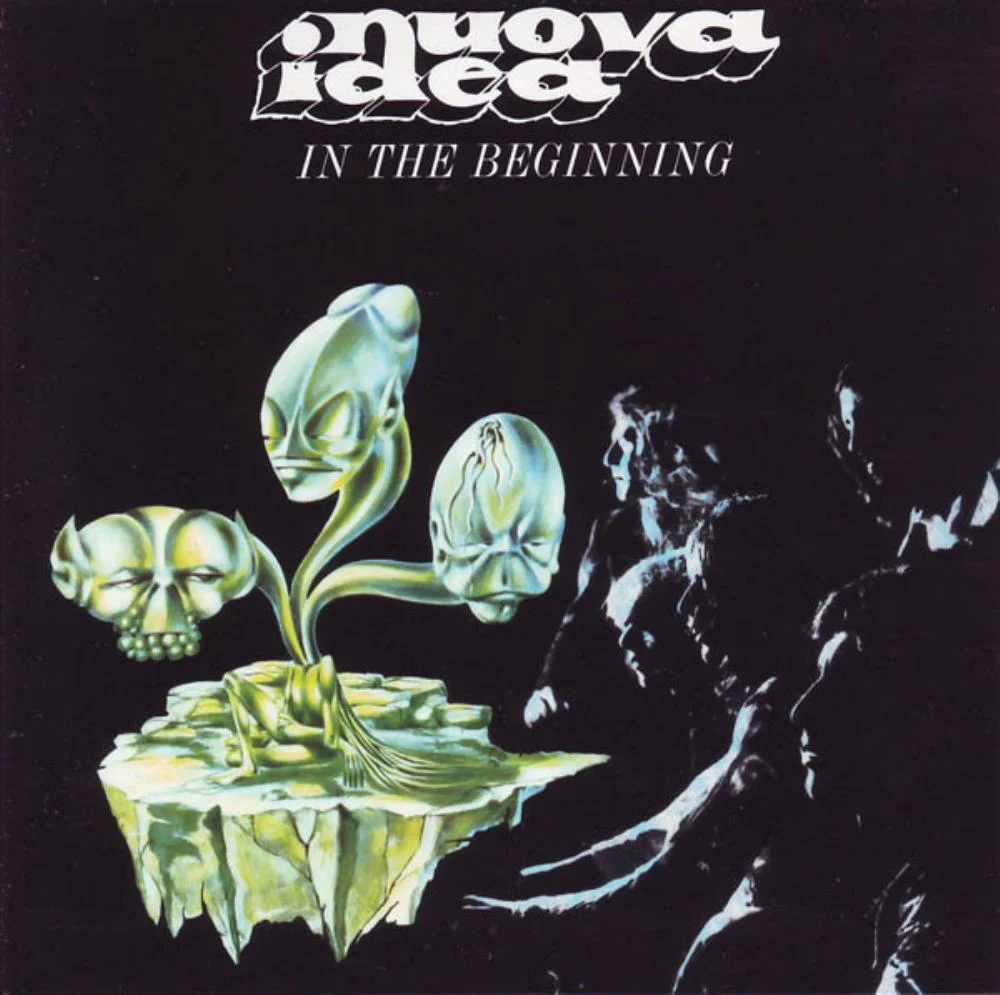 Nuova Idea released their debut album, In the Beginning, in 1971 on Ariston.
The album centers on the side-long suite “Come, Come, Come…” and marks an early attempt at large-form composition with extended passages for instrumental development and vocal layering. Side B compiles four shorter tracks that reflect varied writing partnerships and contrasting song forms.
Guitarist–vocalist Marco Zoccheddu shares frontline duties with guitarist–vocalist Claudio Ghiglino, surrounded by keyboardist Giorgio Usai (organ, e-piano), bassist–fluitist Enrico Casagni, and drummer Paolo Siani. The arrangements emphasize group dynamics, alternating between ensemble sections and isolated instrumental breaks.
Casagni composed all five tracks, collaborating with Ghiglino on the suite and with lyricists Guglieri, Reverberi, Cioffi, Franchi, and Podestà across the B-side. “Dolce Amore” originated as the b-side to their 1970 debut single on Oregon Records.
A. “Come, Come, Come… (Vieni, Vieni, Vieni…)” (20:03) — multi-part suite that opens with searing electric guitar themes over Hammond organ and bass-driven cycles. At the six-minute mark, the song enters a mellow acoustic phase with group harmonies and low-register keys. A percussive break follows with phased electronics, an unaccompanied drum solo, and call-and-response vocals. The suite resumes with clipped jazz chords and a shouted chorus over accelerating rhythms.
B1. “Realtà” (4:05) — combines folk ballad elements and electric rock; shifts from acoustic verse to guitar-led hard sections and reprises the full arc.
B2. “La Mia Scelta” (3:37) — minor-key vocal lines over mid-tempo hard-rock backing with a central riff motif.
B3. “Non Dire Niente… (Ho Già Capito)” (4:20) — acoustic-based folk with electric organ accents and a rising vocal bridge.
B4. “Dolce Amore” (3:59) — originated as the b-side to their 1970 Oregon single; structured as a multi-voice ballad with organ and light effects.
Sessions occurred in 1971 at Ariston Studios in Milan with Gian Piero Reverberi credited as musical director.
The cover features a floating bio-organic entity with three stalks, each terminating in a translucent head with stylized alien features: closed eyes, pursed lips, and exaggerated contours. It hovers over a rocky platform against a stark black void. Along the right, shadowy human figures sit in profile, transfixed by the glowing form—suggesting a liminal threshold between evolution and observation.
In 1971, guitarist Marco Zoccheddu departed to form Osage Tribe. His replacement, Antonello Gabelli, joined in time to record Nuova Idea’s second album, Mr. E. Jones, a concept piece centered on the routine life of a white-collar worker.
Mr. E. Jones
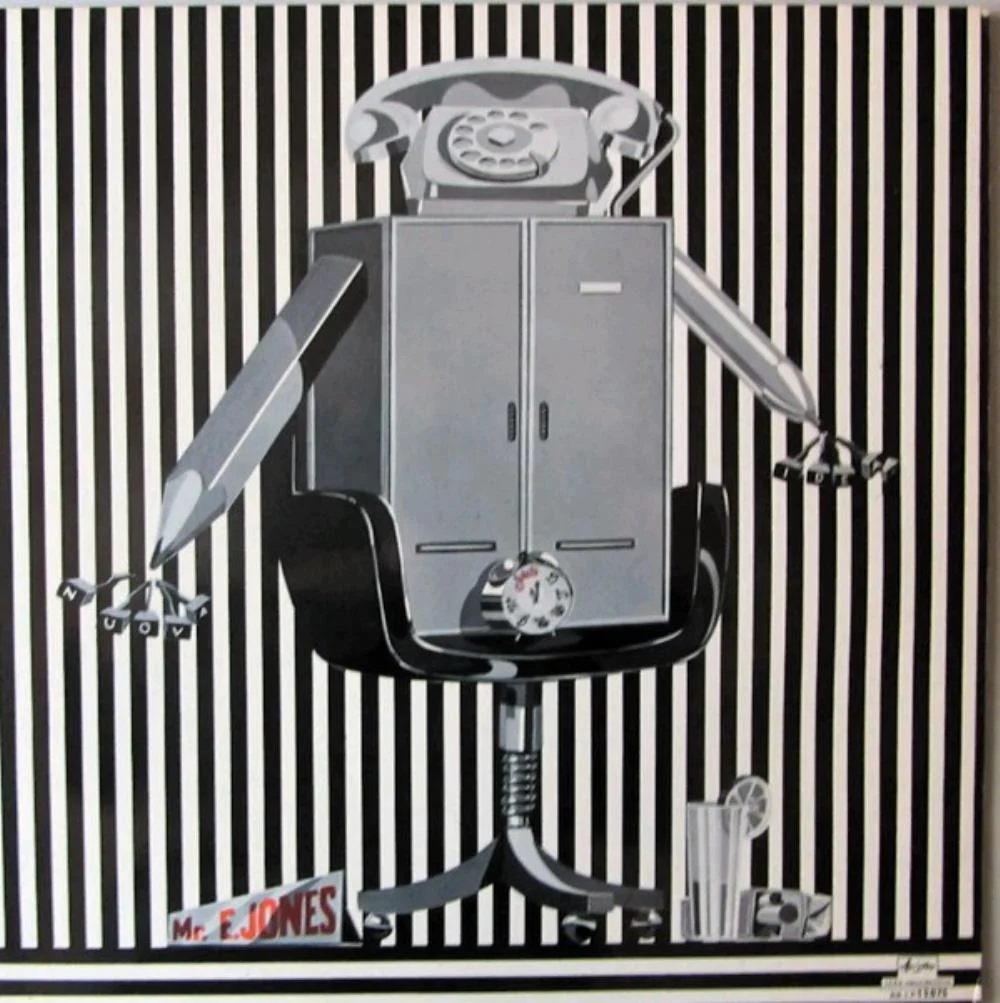 Nuova Idea released their second album, Mr. E. Jones, in 1972 on Ariston.
Mr. E. Jones presents a conceptual sequence centered on the frustrations and imagined escapes of a white-collar worker. Nuova Idea moves from the extended-suite format of their debut toward shorter, interlinked pieces marked by dramatic contrast and ensemble interplay. Ballad segments alternate with full-band passages and transitional interludes that mirror the protagonist’s cyclical routine.
Guitarist–vocalist Claudio Ghiglino composed the music with lyrics by bassist Enrico Casagni. The album features assorted instruments by keyboardist Giorgio Usai (organ, Mellotron, Moog, harpsichord, electric piano, piano, shaker) and drummer Paolo Siani (timpani, bells, congas, gong). They’re joined by guitarist–synthesist–vocalist Antonello Gabelli, who replaced Marco Zoccheddu.
The album alternates compact vocal-driven pieces and multi-part epics with pronounced contrasts in tone, pacing, and density. “Sveglia Edgar” opens with alarm clocks and crowded street noise before shifting into rotating electric motifs and sharp drum accents. “Un’Ora del Tuo Tempo” turns on clipped guitar figures and tight drum fills, escalating into a doubled sequence of organ and wah-soaked soloing. “Viaggio Nel Mondo Dei Sogni” floats through subdued Hammond layers and voice before surging into spaced keyboard interludes and stepwise chord shifts.
“Illusione da Poco” opens in sparse acoustic mode but builds through choral layering and phased organ swells into a contoured finale of lead guitar and Moog. “Premio di Una Vita” moves between harpsichord and piano transitions, inserting strident guitar riffs, suspended vocal lines, and full stops across its second half. “Un Altro Giorno” closes the album in subdued pulse, centered on open piano chords and restrained voice.
A1. “Svegliati Edgar” [Wake Up Edgar] (3:35) — alarm clocks and traffic noise preface the day’s start; rhythmic interplay alternates guitar breaks and street ambience
A2. “Mr. E. Jones” (3:15) — driven by synth and organ; cyclical motifs and vocals mirror repetition in daily routine
A3. “Viaggio Nel Mondo Dei Sogni” [Journey Into the World of Dreams] (5:35) — quiet Hammond lines and intimate vocals introduce a drifting sequence with louder returns
A4. “Un’Ora Del Tuo Tempo” [An Hour of Your Time] (5:30) — fuzzed guitar and keyboard shifts in clipped and fluid measures; multi-part with central guitar solo and jazz turn
A5. “Fumo Di Una Sigaretta” [Smoke of a Cigarette] (2:23) — soft acoustic opening with pastoral vocals; slow build toward closing piano
B1. “Illusioni Da Poco” [Minor Illusions] (9:08) — expands from strummed acoustic guitar into layered vocals, organ waves, and thick electric solos
B2. “Premio Di Una Vita” [Prize of a Life] (7:08) — begins with piano and reserved voice; transitions into heavier passages and classical piano detours
B3. “Un Altro Giorno” [Another Day] (4:00) — quiet closer with melodic piano phrases and final vocal reflection
Sessions occurred in 1972 at Ariston Studios in Milan with engineer Roberto Di Muro Villicich and assistant Lino Castriotta. Franco Orlandini arranged “Un’Ora del Tuo Tempo.” G.F. Reverberi co-produced with the band.
On the cover, a surreal anthropomorphic collage depicts Mr. E. Jones as a hybrid office machine: a file cabinet torso, rotary phone head, pen arm, and clock crotch. He sits in a padded swivel chair against a disorienting backdrop of vertical black-and-white stripes. A tumbler with cigarette butts and a nameplate labeled “Mr. E. Jones” ground the satire in clerical absurdity. The band’s name appears diagonally as chrome letters scattered across the floor.
Clowns
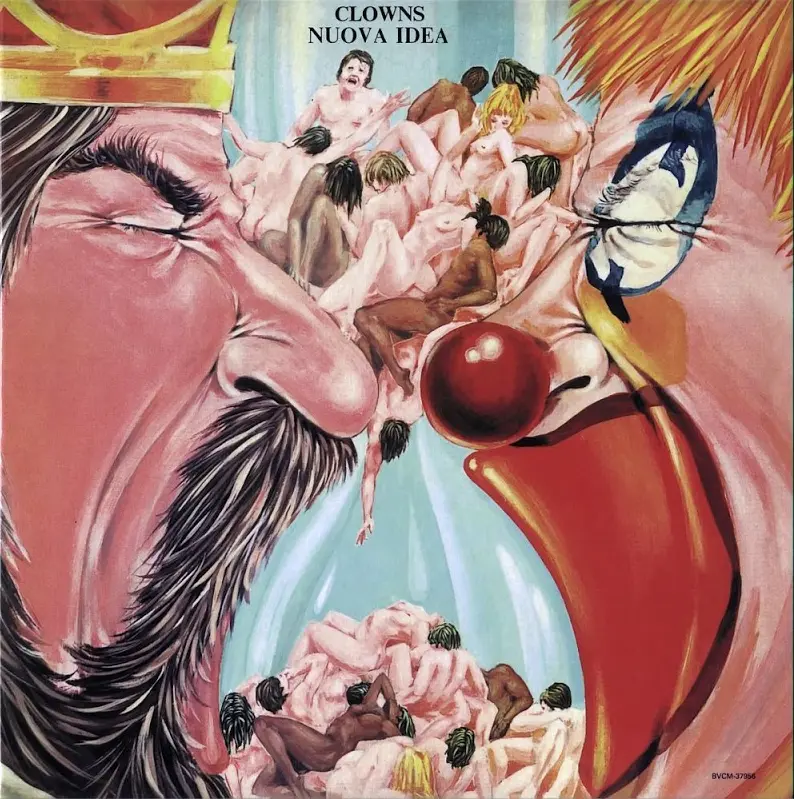 Nuova Idea released their third and final album, Clowns, in 1973 on Ariston.
Clowns presents a loosely conceptual cycle centered on existential performance and distorted reality. Nuova Idea expands its textural palette with dual guitarists, augmented percussion, and brass passages, while shifting between ensemble sections, theatrical vocals, and episodic contrasts.
This time, guitarist–vocalist Claudio Ghiglino and bassist Enrico Casagni (recorder, whisky bottle) co-composed the music with their bandmates. Keyboardist Giorgio Usai plays Hammond organ (C-3, L-122), Hohner clavinet, Eminent organ, Moog IIIp, piano, bells, and bongos. Drummer Paolo Siani multi-tasks on timpani and sundries (tam-tam, congas, guiro, crotales, triangle). They’re joined by guitarist–violinist Ricky Belloni, who plays electric, 12-string guitar, and crotales. Emilio Soana guests on trumpet.
The album opens with “Clessidra,” which pivots from a horn fanfare into sharp organ riffs and jagged guitar phrases over dense rhythmic drive. “Un’Isola” unfolds in cycles, trading quiet vocal sections with sudden band surges before retreating to its opening pulse. “Il Giardino dei Sogni” alternates clipped vocals and staccato phrasing with forceful instrumental rises and steep organ–guitar pairings. The title track moves in episodic waves, linking piano-led scenes, trumpet and sax breaks, a children’s chorus, and chromatic returns through percussion transitions and orchestral layering. “Una Vita Nuova” closes on subdued harmonies that shift between fragile voice, rising piano figures, and final brass dissonance.
A1. “Clessidra” [Hourglass] (5:29) — opens with fanfare-like brass and descends into layered organ–guitar exchanges; stops mid-section for vocal interlude and rhythmic return
A2. “Un’Isola” [An Island] (8:05) — shifts between acoustic ballad phrasing and rising group surges; pacing modulates in alternating vocal sections and instrumental bridges
A3. “Il Giardino Dei Sogni” [The Garden of Dreams] (5:21) — fluctuates between quieter guitar–organ sections and jagged vocal outbursts
B1. “Clown” (10:42) — opens with piano, organ, and vocals in alternation; expands into group vocal climaxes, trumpet soloing, and a children’s chorus over Mellotron and organ
B2. “Una Vita Nuova” [A New Life] (5:23) — closes the album in a subdued sequence for acoustic guitar, electric keys, and dissonant horn punctuation
Sessions occurred in 1973 at Ariston Studios in Milan with engineers Lino Castriotta and Roberto Di Muro Villicich.
Clowns features gatefold cover art by Gianni Zanini, who supplies a full-panel illustration and layout centered on contorted circus masks under abstract type. The confrontational close-up pits a red-faced king against a grinning clown, their gaping mouths serving as mirrored funnels for a mass of entangled nude bodies. At the apex of this fleshy vortex, distressed figures reach skyward as if attempting escape. The grotesque composition suggests a cycle of authoritarian consumption and carnival chaos, rendered in hyperreal illustration with exaggerated facial details and suggestive staging.
Discography:
- In the Beginning (1971)
- Mr. E. Jones (1972)
- Clowns (1973)
Sources:
- Discogs: Nuova Idea
- RYM: Nuova Idea
- 45cat: Nuova Idea
- ItalianProg: Nuova Idea
- ProgArchives: Nuova Idea
Artist/Album Pages:
Westwind was an English folk trio that released the album Love Is... on the Penny Farthing label in ...
Thunderpussy was an American art-rock trio that released the 1973 album Documents of Captivity on ...
Hot Chocolate was an American soul-funk trio from Cleveland that released a 1971 album on Co Co Re...
Freda Payne (born Sept. 19, 1942) is an American soul-pop/jazz singer from Detroit. She started wi...
Fantasy was an English symphonic-rock band from Kent that released the album Paint a Picture on Po...
Group 1850 was a Dutch psych-rock band from Den Haag that released five singles on GTB and Philips...
The Running Man was an English rock trio that released a 1972 album on RCA. Guitarist Ray Russell...
The Pink Fairies were an English psychedelic hard-rock band from London that released three albums...
Balkan was a Danish folk trio behind the 1973 Sonet album Spiller, recorded with Turkish musician...
Fairport Convention are an English revolving-door folk ensemble, founded in London 1967. The band de...
Green Lyte Sunday was an American psych-rock band from Dayton that released a self-titled album o...
The Fuzz was an American soul group from Washington, D.C., that released a 1971 album on Calla Re...