

Hanuman was a German Krautrock band that released a self-titled album in 1971 on Kuckuck. Three-fourths of the band continued as Lied des Teufels.
Members: Wolf-Rüdiger Uhlig (organ, piano, vocals), Peter Barth (flute, alto saxophone, vocals), Jörg Hahnfeld (bass), Thomas Holm (drums)
Inception
Hanuman formed in May 1971 when organist Wolf-Rüdiger Uhlig befriended a jazz trio at a Munich festival. Uhlig hailed from Murphy Blend, which cut the album First Loss and disbanded upon its release.
Hanuman
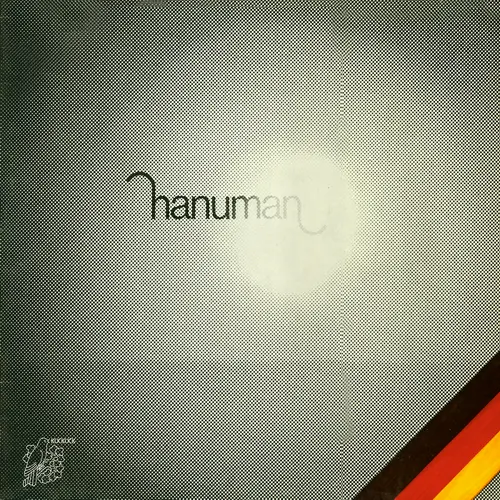 Hanuman released their self-titled album in late 1971 on Kuckuck. It documents their heavy organ-led approach built around long-form ensemble passages and short vocal interludes.
Keyboardist Wolf-Rüdiger Uhlig shapes the harmonic center on organ and piano while flutist/alto saxophonist Peter Barth answers with contrasting timbres and phrasing, creating a steady back-and-forth between chord mass and reed/woodwind lead lines. Jörg Hahnfeld and Thomas Holm supply the underpinning, keeping the pulse stable through slow-building sections and longer crescendos while leaving space for the soloists to expand and regroup.
Hanuman balances shifting instrumental layers with abrupt dynamic turns and extended ensemble passages. “Schadelstatten” moves through sharp contrasts—early organ and flute threads unwind into a midsection lull before returning with pulsing organ, forceful drumming, and bursts of saxophone. “Machtwechsel” opens in a fragmented sequence of cymbals, bass, and flute, broken by piano and dissonant sax before tightening into rhythm-forward interplay between flute, drums, and vocals.
“Lied des Teufels” alternates between stripped-down, percussive verses and brief melodic swells led by flute and piano. “Sonnenaufgang” develops in layered waves: from an abstract prelude to a full-band section with prominent sax lines and staggered vocals, then back through cycles of restraint and build-up, closing on surging organ figures. Throughout, the group pivots fluidly between solo focus and ensemble density, often using silence and breakdowns to reset momentum.
A1. “Schädelstätten” [Places of Skulls] (10:37)
A2. “Machtwechsel” [Change of Power] (9:35)
B1. “Lied Des Teufels” [Song of the Devil] (3:10)
B2. “Taue Der Fremdheit” [Ropes of Strangeness] (3:43)
B3. “Sonnenaufgang” [Sunrise] (11:23)
Hanuman recorded the album October 11–15 and October 27–29, 1971 at Bavaria Musikstudios, with Wolfgang Löper credited as engineer. The original sleeve design uses a layout credited to Caspar Klebusch.
Discography:
- Hanuman (1971)
Sources:
Artist/Album Pages:
Necronomicon was the German Krautrock band behind the 1972 album Tips zum Selbstmord. In 1990, the a...
Masahiko Sato — 佐藤允彦 (born Oct. 6, 1941) — is a Japanese jazz pianist and composer with credits on...
Missus Beastly was a German jazz-rock band that released a self-titled album on CPM in 1970. After...
Anthony Reebop Kwaku Baah (Feb. 13, 1944 – Jan. 12, 1983) was a Ghanaian percussionist who recorded ...
Brian Cadd (born Nov. 29, 1946) is an Australian singer/songwriter from Sydney who made two albums...
The Insect Trust was an American psych-rock band that released a 1968 Capitol Records album, foll...
Hermeto Pascoal (June 22, 1936 – September 13, 2025) was a Brazilian composer, multi-instrumentali...
Pidgeon was an American folk-psych band that released a self-titled album and a standalone single...
Thunder and Roses were an American hard-rock/psych trio from Philadelphia that released the album...
Richard Thompson is an English singer, guitarist, and songwriter who formed the folk rock band Fai...
Embryo is a German ethno-jazz/rock ensemble that debuted with the 1970 Ohr release Opal, followed ...
Lied des Teufels were a German jazz-rock band that released two albums between 1973 and 1975 on K...