

Richard Thompson is an English singer, guitarist, and songwriter who formed the folk rock band Fairport Convention, which he co-headed on the 1968–70 albums Fairport Convention, What We Did on Our Holidays, Unhalfbricking, Liege & Lief, and Full House. Post-Fairport, he played on albums by Nick Drake, Gary Farr, Mick Softley, John Martyn, and former bandmates Ian Matthews and Sandy Denny.
In 1972, Thompson debuted as a solo artist with the album Henry the Human Fly on Island Records. The same year, he married his backing vocalist Linda Peters, who assumed his surname. As a duo, they released the 1974–75 Island albums I Want to See the Bright Lights Tonight, Hokey Pokey, and Pour Down Like Silver, followed by the 1978–79 Chrysalis albums First Light and Sunnyvista. Their partnership and marriage concluded with the popular 1982 Hannibal Records release Shoot Out the Lights.
Thompson resumed his solo career with the 1983 Hannibal release Hand of Kindness, followed by the 1985–86 Polydor titles Across a Crowded Room and Daring Adventures. Concurrently, he played on albums by David Thomas, Dagmar Krause, and the Golden Palominos. He continued his solo career on Capitol and formed the super-group French, Frith, Kaiser & Thompson with guitarists Fred Frith and Henry Kaiser.
Early Life
He was born Richard John Thompson on April 3, 1949, in Ladbroke Crescent, a neighborhood in the Notting Hill district of West London. His father, a Scotland Yard detective, played amateur guitar and raised his son on jazz and Scottish folk music. Richard attended William Ellis School in Highgate, where he formed his first band, Emile & The Detectives (named after German satirist Erich Kästner’s 1929 novel) with Hugh Cornwell, who later surfaced as the guitarist–frontman of The Stranglers.
Fairport Convention
In 1967, Richard Thompson (then eighteen) formed Fairport Convention with guitarist Simon Nicol, bassist Ashley “Tyger” Hutchings, drummer Martin Lamble, and singers Ian Matthews and Judy Dyble.
They hit the local folk circuit, where Thompson’s guitar skills impressed London-based American producer Joe Boyd, who became their manager and presented the band to Polydor, which issued their June 1968 debut Fairport Convention. Judy cleared for singer Sandy Denny, who sings on their three subsequent albums — What We Did on Our Holidays, Unhalfbricking, and Liege & Lief — all released in 1969 on Islands Records.
Before Unhalfbricking hit shelves, Lamble died along with Thompson’s then-girlfriend, Jeannie Franklyn, when the Fairport van crashed en route from Birmingham to London. After Leige, Sandy formed Fotheringay and Thompson finished his Fairport tenure with the 1970 album Full House.
Henry the Human Fly
 Richard Thompson released his debut solo album, Henry the Human Fly, in April 1972 on Island (UK) and Reprise (US).
Fly marked a decisive turn toward idiosyncratic songwriting steeped in English folk idioms, eccentric storytelling, and muted electric textures. It avoids epic solos in favor of compact structures with sly arrangements, forming a blueprint for his later work with Linda Thompson.
Thompson handles vocals, guitars, accordion (on “Roll Over Vaughn Williams”), tin whistle (“Shaky Nancy”), and mandolin (“Twisted”). The core trio features Timi Donald (drums, vocals) and Pat Donaldson (bass, vocals). Guest players include fiddlers Sue Draheim and Barry Dransfield, accordionist John Kirkpatrick, pianist Andy Roberts (dulcimer), and harpist David Snell. Sandy Denny adds vocals (“Shaky Nancy,” “The Angels Took My Racehorse Away”) and piano (“Painted Ladies”), joined by Linda Peters (vocals), Ashley Hutchings (vocals), and a brass section on “The New St. George” and “Mary and Joseph.”
Thompson wrote all twelve songs. Though rooted in folk tradition, the lyrics adopt oblique angles on romantic disillusionment, death, and social decay. Vocal arrangements often feature clustered harmonies with guests from the Fairport circle.
“Roll Over Vaughn Williams” opens with layered accordion, flanged guitar, and a rising refrain that breaks into a brief, distorted solo. “The Poor Ditching Boy” presents spare fingerpicking beneath a plaintive vocal line that gains dulcimer and fiddle midway. “Shaky Nancy” and “Painted Ladies” draw from the minor-mode English ballad tradition, the latter paced by Denny’s chordal piano and descending vocal cadences.
“The Angels Took My Racehorse Away” interweaves chorus vocals with squeezebox lines over a shuffle rhythm. “Wheely Down” sustains a two-chord drone with harmonium, fiddle, and off-beat piano stabs. “The New St. George” evokes a brass-powered dance motif; “Mary and Joseph” resembles a Salvation Army hymn in 6/8 time. “The Old Changing Way” builds from harp arpeggios into shifting chord patterns that underpin a cynical sibling tale. The 1:58 closer, “Twisted,” plays tricks with meter and tonality, lurching like a slurred folk cabaret.
A1. “Roll Over Vaughn Williams” (4:09)
A2. “Nobody’s Wedding” (3:13)
A3. “The Poor Ditching Boy” (3:01)
A4. “Shaky Nancy” (3:26)
A5. “The Angels Took My Racehorse Away” (4:01)
A6. “Wheely Down” (3:00)
B1. “The New St. George” (2:08)
B2. “Painted Ladies” (3:31)
B3. “Cold Feet” (2:26)
B4. “Mary and Joseph” (1:38)
B5. “The Old Changing Way” (3:55)
B6. “Twisted” (1:58)
Sessions occurred in February 1972 at Sound Techniques in London with producers Richard Thompson and John Wood.
Henry the Human Fly features a title-adorned photo of Thompson in a disheveled overcoat and sash, framed against a Victorian theatre curtain, photographed and designed by John B. Hayward.
Richard & Linda Thompson
I Want to See the Bright Lights Tonight
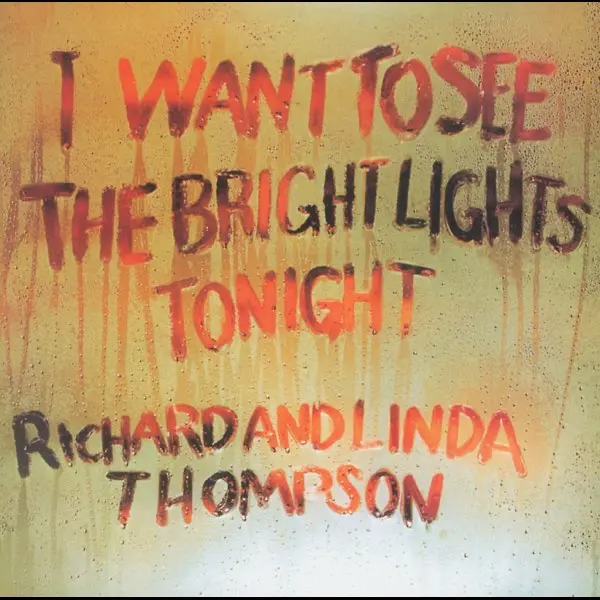 Richard & Linda Thompson released their first album as a duo, I Want to See the Bright Lights Tonight, on April 20, 1974, on Island.
Their first recorded collaboration as a duo, the album sets Richard’s sardonic, fatalist lyricism against Linda’s solemn vocal poise, forming a ten-song cycle of urban disillusionment and broken dreams cast in minor-key folk settings with muted electric textures, horns, and harmonium. Though recorded in 1973, Island shelved the album for nine months amid industry strikes and label restructuring.
Richard handles guitars, vocals, hammered dulcimer (“The Great Valerio”), mandolin (“When I Get to the Border,” “The Little Beggar Girl”), tin whistle (“When I Get to the Border,” “Has He Got a Friend for Me”), and keyboards (piano on “The Calvary Cross,” electric piano on “Down Where the Drunkards Roll,” harmonium on “Has He Got a Friend for Me”). Linda sings six tracks and dominates the emotional weight of the set. Timi Donald (drums) and Pat Donaldson (bass) form the rhythm section. John Kirkpatrick plays accordion and concertina on multiple numbers. Simon Nicol adds dulcimer, while Brian Gulland and Richard Harvey supply krummhorns. Harmony vocals appear courtesy of Trevor Lucas and Royston Wood. The CWS Manchester Silver Band plays brass on “I Want to See the Bright Lights Tonight” and “Has He Got a Friend for Me.”
Richard wrote all ten songs. The lyrics frame working-class unrest and private anguish through a lens of gallows humor, cynicism, and resignation. Vocal alternation mirrors emotional polarity — Linda voices grief, disappointment, and isolation; Richard delivers stoic detachment or dark irony.
“When I Get to the Border” opens with mandolin and whistle counterlines over an ambling acoustic rhythm, culminating in a march-like coda with krummhorn and concertina. “The Calvary Cross” follows with halting organ stabs and a distorted guitar solo that rises from a sparse waltz. “Withered and Died” and “Has He Got a Friend for Me” are slow laments led by Linda’s restrained alto and framed by droning reeds and light fingerpicking. The title track introduces a punchy brass fanfare beneath Linda’s resolute vocals. “Down Where the Drunkards Roll” fades in on sustained electric piano and slow bass pulses, gradually filled by layered vocals and shuffling cymbals.
“We Sing Hallelujah” layers an upward krummhorn riff beneath male harmony vocals in clustered thirds. “The Little Beggar Girl” rides a diatonic mandolin–concertina pattern with bouncing meter and internal rhymes. “The End of the Rainbow” adopts a lullaby cadence, offset by caustic lyrics and Richard’s deep vocal tone. “The Great Valerio” closes the album with Linda unaccompanied at first, joined sparingly by hammered dulcimer and guitar in suspended intervals.
A1. “When I Get to the Border” (3:26)
A2. “The Calvary Cross” (3:51)
A3. “Withered and Died” (3:24)
A4. “I Want to See the Bright Lights Tonight” (3:07)
A5. “Down Where the Drunkards Roll” (4:05)
B1. “We Sing Hallelujah” (2:49)
B2. “Has He Got a Friend for Me” (3:32)
B3. “The Little Beggar Girl” (3:24)
B4. “The End of the Rainbow” (3:55)
B5. “The Great Valerio” (5:22)
Sessions occurred in May 1973 at Sound Techniques in Chelsea, London, with producers Richard Thompson and John Wood.
I Want to See the Bright Lights Tonight features cover art of the album title scrawled in condensation across a bus window, symbolizing late-night weariness and fleeting escape. The designer remains uncredited.
Despite minimal promotion, the album gradually attained classic status and became the first of six studio releases by the duo between 1974 and 1982.
Hokey Pokey
 Richard & Linda Thompson released their second duo album, Hokey Pokey, in April 1975 on Island.
Their second album as a duo pivots from the sustained melancholy of Bright Lights toward an uneven mix of sardonic character sketches, vintage-style waltzes, and light-hearted pub tunes. Across ten songs, the album alternates between whimsical singalongs and cryptic moral tales, with deeper spiritual overtones surfacing on side two.
Richard plays guitar, vocals, piano, mandolin (“Smiffy’s Glass Eye,” “Mole in a Hole”), hammered dulcimer (“The Egypt Room,” “Never Again”), and electric dulcimer (“Never Again,” “A Heart Needs a Home”). Linda sings seven tracks and delivers the most affecting performances. Core backing includes Timi Donald (drums), Pat Donaldson (bass), and Simon Nicol (guitar, piano, organ on “The Sun Never Shines on the Poor,” vocals on “Old Man Inside a Young Man”). John Kirkpatrick returns on accordion for four cuts. Ian Whiteman plays piano and calliope, Sidonie Goossens contributes harp, and Aly Bain adds fiddle. Brass charts on “Georgie on a Spree” and “Mole in a Hole” feature the CWS Silver Band.
Richard wrote nine of the ten tracks. His lyrics adopt a sharper, sometimes grotesque satirical tone, contrasting nursery-rhyme melodies with harsh images of abuse, addiction, aging, and class despair. Mike Waterson’s “Mole in a Hole” closes the album with surreal whimsy.
The title track opens with a brisk polka rhythm and fiddle–accordion interplay, couching a string of double-entendres in playground chant form. “I’ll Regret It All in the Morning” overlays a swaying waltz with threatening, self-loathing verses. “Smiffy’s Glass Eye” delivers a minor-mode tale over spiraling mandolin and fiddle figures. “The Egypt Room” suspends dulcimer phrases over a slow 6/8 frame, unraveling a cryptic narrative. “Never Again” contrasts modal dulcimer with sparse guitar, highlighting Linda’s desolate vocal line.
“Georgie on a Spree” spins a jaunty refrain over a bouncing rhythm, with dobro fills and strummed slides. “Old Man Inside a Young Man” builds from piano stabs into a brash group refrain. “The Sun Never Shines on the Poor” rolls on slow marching snare and Hammond organ, cycling through verses of increasing moral gravity. “A Heart Needs a Home” employs a quietly swelling dulcimer–harp arrangement to back one of Linda’s most restrained performances. “Mole in a Hole” ends the album with layered calliope, accordion, and brass, evoking a drunken English music-hall finale.
A1. “Hokey Pokey (The Ice Cream Song)” (2:59)
A2. “I’ll Regret It All in the Morning” (3:32)
A3. “Smiffy’s Glass Eye” (3:19)
A4. “The Egypt Room” (3:53)
A5. “Never Again” (3:12)
B1. “Georgie on a Spree” (3:39)
B2. “Old Man Inside a Young Man” (3:15)
B3. “The Sun Never Shines on the Poor” (3:38)
B4. “A Heart Needs a Home” (3:30)
B5. “Mole in a Hole” (Mike Waterson) (3:26) — originated as a 1972 Watersons B-side on Topic.
Sessions occurred between September and October 1974 at Sound Techniques in London with producers Richard Thompson and Simon Nicol.
Hokey Pokey features cover art of hand-drawn signage on a glass sweet-shop window with distorted red text, designed to resemble the fogged aesthetic of its predecessor. The concept was later echoed on Counting Crows’ Hard Candy.
Hannibal reissued Hokey Pokey in 1986 and again in 2004 with five bonus tracks, including live versions of “Hokey Pokey” and “A Heart Needs a Home,” BBC session cuts, and covers of Merle Haggard and Buddy Holly.
Pour Down Like Silver
 Richard & Linda Thompson released their third duo album, Pour Down Like Silver, in November 1975 on Island.
Their third album reflects a dramatic spiritual shift: both had joined a Sufi Muslim community, and Richard’s songwriting took on themes of submission, withdrawal, and divine longing. The resulting work is more solemn and meditative than prior efforts, shaped by the couple’s ascetic lifestyle and spiritual discipline.
Richard sings and plays guitar throughout, adding mandolin (“The Poor Boy Is Taken Away,” “Hard Luck Stories”), Appalachian dulcimer (“The Poor Boy Is Taken Away,” “Beat the Retreat”), hammered dulcimer (“Night Comes In”), banjo (“Dimming of the Day”), harmonium, and electric piano. Linda sings five tracks, anchoring the album’s most mournful material. Two rhythm sections appear: Timi and Pat Donald on most of side two; Dave Mattacks and Dave Pegg on side one. John Kirkpatrick contributes accordion and concertina; Ian Whiteman adds flute and shakuhachi; fiddlers Aly Bain and Nic Jones appear on key midtempo cuts. Trumpet, cello, and clarinet embellish selected arrangements.
Richard wrote all eight tracks. His lyrics center on retreat, renunciation, and divine reconciliation. Musical settings balance austerity with luminous detail, trading folk-rock immediacy for inner stillness and melodic economy.
“Streets of Paradise” opens with a steady snare and clipped guitar riff, unfolding into a hopeful prayer for transformation. “For Shame of Doing Wrong” moves slowly in 6/8, with intertwined vocals over a backdrop of accordion, cello, and fiddle. “The Poor Boy Is Taken Away” suspends Linda’s voice over soft mandolin and dulcimer patterns. “Night Comes In” builds from slow arpeggios into a central passage of lyrical transcendence, dissolving into five minutes of electric guitar variations on modal themes.
“Jet Plane in a Rocking Chair” shifts to brisk 2/4 with flute and fiddle call-and-response. “Beat the Retreat” follows with a solemn tempo and circular dulcimer figure, its lyric evoking surrender as homecoming. “Hard Luck Stories” restores a sense of wry momentum with fiddle breaks and a clipped guitar solo. “Dimming of the Day” unfolds on slow chords, voiced by Linda with Richard joining on the bridge. The segue into “Dargai” (by James Scott Skinner) presents an elegiac clarinet line over harmonium, closing the album in hushed reverence.
A1. “Streets of Paradise” (4:17)
A2. “For Shame of Doing Wrong” (4:44)
A3. “The Poor Boy Is Taken Away” (3:35)
A4. “Night Comes In” (8:12)
B1. “Jet Plane in a Rocking Chair” (2:48)
B2. “Beat the Retreat” (5:52)
B3. “Hard Luck Stories” (3:51)
B4. “Dimming of the Day” / “Dargai” (7:16) — “Dargai” composed by James Scott Skinner.
Sessions occurred in summer 1975 at Sound Techniques in London with producers Richard Thompson and John Wood.
Pour Down Like Silver features a stark black-and-white photo of Richard in traditional Sufi garb, standing in a narrow passageway with soft natural light, reinforcing the album’s introspective and spiritual tone.
The album reappeared in 2004 with remastered sound as part of The Island Recordings box set.
First Light
 Richard & Linda Thompson released their fourth duo album, First Light, in October 1978 on Chrysalis.
After a three-year retreat from recording, the couple resumed their musical career with this transitional work that blends English folk forms with American studio polish. The album reflects their continued commitment to Sufi practice while moving toward fuller arrangements and varied stylistic terrain, aided by a mix of UK folk peers and US rhythm players.
Richard handles vocals and a wide range of instruments: guitar, mandolin, dulcimer, whistle, banjo, and guitar synthesizer. Linda sings lead on most tracks, with backing vocals from Julie Covington, Maddy Prior, Andy Fairweather Low, Trevor Lucas, Iain Matthews, and others. The core rhythm section includes American session musicians Andy Newmark (drums), Willie Weeks (bass), and Neil Larsen (keyboards), supplemented by percussionists Dave Mattacks and Chris Karen. John Kirkpatrick adds accordion; Dolores Keane plays whistle; Ian Whiteman and Dave Brady also appear among the ensemble.
Richard wrote nine of the ten songs, with one co-written by Linda and one traditional arrangement. Several tracks reflect spiritual longing or moral parable through Sufi imagery, while others return to secular themes of romantic betrayal and quiet despair. The production frames the duo’s signature modal structures with layered instrumentation and occasional American soul inflections.
“Restless Highway” opens in a light gallop of mandolin and dulcimer over brushed snare and choir vocals. “Sweet Surrender” follows in slow 4/4 with synth pads and subdued gospel inflections under Linda’s restrained delivery. “Don’t Let a Thief Steal Into Your Heart” breaks the tone with slap bass, stacked percussion, and phased guitar solos, merging rock and funk under a veiled devotional lyric. “The Choice Wife” is a brisk, trad-style instrumental reel. “Died for Love” unfolds in a minor mode over whistle, accordion, and dulcimer, with Linda narrating a tale of martyrdom and lost innocence.
“Strange Affair” glides on a droning string pad and flute figures under Linda’s crystalline vocal. “Layla” (pronounced “Lie-la”) sets electric piano and clipped rhythm guitar under Richard’s voice in a Band-like shuffle. “Pavanne” mixes tremolo guitar, dulcimer, and choir harmonies in a slow lament, describing a cold-hearted assassin through opaque metaphors. “House of Cards” merges accordion, whistle, and synth textures over a stepped 6/8 rhythm, with lyrics touching on sociopolitical collapse. The title track closes the album on a rising chord sequence with shared vocals and a radiant refrain.
A1. “Restless Highway” (3:52)
A2. “Sweet Surrender” (4:40)
A3. “Don’t Let a Thief Steal Into Your Heart” (4:38)
A4. “The Choice Wife” (2:30) — traditional, arranged by Richard Thompson
A5. “Died for Love” (6:30)
B1. “Strange Affair” (3:05)
B2. “Layla” (4:17)
B3. “Pavanne” (Richard & Linda Thompson) (5:00)
B4. “House of Cards” (3:24)
B5. “First Light” (4:17)
Sessions occurred in 1978 at Olympic Studios in London with producers Richard Thompson and John Wood.
First Light features a subdued portrait of Richard and Linda standing against a hazy, gold-tinged background with autumnal lighting, evoking the album’s themes of dusk, transition, and tentative reawakening.
Chrysalis issued “Don’t Let a Thief Steal Into Your Heart” (b/w “First Light”) as a UK and German single (CHS 2278). The Pointer Sisters later covered the song in a disco-funk arrangement for their 1979 album Energy.
Sunnyvista
 Richard & Linda Thompson released their fifth duo album, Sunnyvista, in October 1979 on Chrysalis.
The album finds the duo stretching their stylistic palette with satirical themes, eclectic arrangements, and a sharper tilt toward commercial production. It marks their most musically varied set, incorporating tango, funk, polka, and pastiche alongside their core folk-rock sensibility. The concept critiques suburban conformity, reflected in the faux-utopian cover imagery and sardonic title track.
Richard handles guitars, Roland guitar synthesizer, mandolin, and hammered dulcimer. Linda sings lead on multiple tracks, including three ballads. Core players include bassist Dave Pegg, drummer Michael Spencer-Arscott, keyboardist Pete Wingfield, and percussionist Luís Jardim. Timi and Pat Donald contribute rhythm on select numbers; Bruce Lynch and Dave Mattacks appear on “Justice in the Streets.” Guest keyboardist Rabbit Bundrick plays on “Why Do You Turn Your Back?” and “Traces of My Love.” John Kirkpatrick adds accordion and triangle; Sue Harris plays oboe and dulcimer. Vocals come from Kate & Anna McGarrigle, Gerry Rafferty, Squeeze frontman Glenn Tilbrook, and others across the London folk circuit.
Richard wrote all ten songs, incorporating diverse idioms to mirror themes of societal illusion and spiritual dislocation. Linda sings lead on “Sisters,” “Traces of My Love,” and co-leads others with shifting tone and phrasing.
“Civilisation” opens with electric strumming and staccato drums, framing a darkly comic depiction of suburban alienation. “Borrowed Time” builds tension across shifting rhythmic cells and layered instrumentation. “Saturday Rolling Around” applies Cajun stylings over a swinging 6/8 pulse, anchored by accordion. “You’re Going to Need Somebody” moves in gentle arcs with an airy chorus and tight phrasing.
“Why Do You Turn Your Back?” draws on gospel and soul inflections with keyboard flourishes and rich vocal layering. The title track adopts tango meter and arch phrasing for its bleak satire. “Lonely Hearts” slows into a spacious ballad with interwoven dulcimer and oboe lines. “Sisters” sways gently with string harmonics and soft backing by the McGarrigles. “Justice in the Streets” rides a clipped funk rhythm with syncopated bass and trumpet accents. “Traces of My Love” closes with open voicing and Linda’s restrained delivery over piano and string textures.
A1. “Civilisation” (4:45)
A2. “Borrowed Time” (5:34)
A3. “Saturday Rolling Around” (3:20)
A4. “You’re Going to Need Somebody” (3:56)
A5. “Why Do You Turn Your Back?” (5:08)
B1. “Sunnyvista” (4:30)
B2. “Lonely Hearts” (5:00)
B3. “Sisters” (4:47)
B4. “Justice in the Streets” (4:00)
B5. “Traces of My Love” (4:00)
Sessions occurred in 1979 at Olympic Studios in London with producers Richard Thompson and John Wood and assistant engineer Andy Lunn.
Sunnyvista features a mock travel brochure cover by Peter Wagg with photography by Gered Mankowitz. The front shows the Thompsons superimposed on a concrete housing block, while the back portrays them in hospital garb, casting the suburban dream as institutional entrapment.
Strict Tempo!
 Richard Thompson released his second solo album, Strict Tempo!, in September 1981 on Elixir Records.
The album diverges from Thompson’s singer–songwriter output with a fully instrumental set of traditional jigs, reels, marches, and medleys drawn primarily from Scottish and Irish sources. Cut during a period of label limbo after Sunnyvista, the project was self-financed and recorded at Fairport Convention’s studio, serving as a showcase for Thompson’s technical command and deep roots in Celtic dance music.
Thompson plays all instruments except for drums, which are handled by longtime collaborator Dave Mattacks. The multi-tracked arrangements feature layers of acoustic and electric guitars, mandolin, dulcimer, and other stringed instruments in place of a conventional band. The tone varies from slow airs to fast reels, with stylistic detours into jazz and North African motifs.
Strict Tempo! includes ten medleys and two standalone pieces. Most material is traditional, arranged by Thompson, with select modern compositions. “Glencoe” opens a three-part reel with mournful phrasing and gradual accelerando. “Rockin’ in Rhythm” — the one non-folk piece — is a solo acoustic interpretation of Duke Ellington’s 1931 big band number, revoiced with rhythmic clarity and nimble chordal shifts. “The Knife-Edge,” the only original composition, closes the album in compound meter with a layered theme of minor-string ostinati and rotating lead figures.
A1. “New-Fangled Flogging Reel / Kerry Reel”
A2. “Vaillance Polka Militaire / Belfast Polka”
A3. “Glencoe / Scott Skinner’s Rockin’ Step / Bonny Banchory” (James Scott Skinner, uncredited)
A4. “Banish Misfortune”
A5. “Dundee Hornpipe / Poppy-Leaf Hornpipe”
A6. “Do It for My Sake”
B1. “Rockin’ in Rhythm” (Duke Ellington)
B2. “The Random Jig / The Grinder”
B3. “Will Ye No Cam Back Again / Cam O’er the Stream Charlie / Ye Banks and Braes”
B4. “Rufty Tufty / Nonsuch à la Mode de France”
B5. “Andalus / Radio Marrakesh”
B6. “The Knife-Edge” (Richard Thompson)
Sessions occurred in 1981 at Woodworm Studios, Oxfordshire, with Thompson self-producing.
The original Elixir LP appeared in a red-tinted foldout sleeve with pseudo-bureaucratic type and a humorous subtitle: “Traditional and Modern Tunes for All Occasions.” Though modestly distributed, Strict Tempo! became a cult favorite and was reissued on CD by Hannibal and later by Topic with remastered sound.
Shoot Out the Lights
 Richard & Linda Thompson released their sixth and final duo album, Shoot Out the Lights, on March 15, 1982, on Hannibal Records.
The material confronts personal conflict, emotional detachment, and the aftermath of a failing relationship, often interpreted—rightly or not—as a chronicle of their separation.
Richard handles electric guitar, vocals, accordion, hammered dulcimer, and writes all eight songs, co-authoring one with Linda. Linda takes lead vocals on three ballads and shares harmonies on the rest. Fairport alumni Simon Nicol (rhythm guitar), Dave Pegg (bass), and Dave Mattacks (drums) anchor the core band. Pete Zorn plays bass on four tracks and backs vocals throughout. The Watersons contribute a chorus on “Back Street Slide,” joined by brass players Clive Gregson, Stephen Corbett, Brian Jones, Phil Goodwin, Stephen Barnett, and Mark Cutts.
Shoot Out divides vocal leads evenly. Richard opens with the galloping “Don’t Renege on Our Love” and offers grim commentary in “Man in Need” and the scathing title track. Linda responds with the weary “Walking on a Wire” and the sorrowful “Just the Motion.” Together they co-narrate the morbid “Did She Jump or Was She Pushed?” and close with the metaphor-laden “Wall of Death.” Instrumentally, the album contrasts lean arrangements with sudden bursts of Thompson’s biting, modal guitar lines, particularly across the central pair “Shoot Out the Lights” and “Back Street Slide.”
The album’s musical tension rests on the balance between brittle restraint and sudden accelerations, often within the same track. Richard Thompson’s guitar functions as both rhythmic engine and emotional scalpel, slicing through lean structures with modal phrasing and stark dynamic shifts. The title track circles a terse, mid-tempo frame with coiled momentum that explodes in spiraling, distorted leads. “Back Street Slide” pivots on a sinuous, minor-key pattern laced with clipped horn lines and Eastern-tinged bends, where Thompson’s lines jab like quick feints in an alley scuffle. “Man in Need” offsets its somber lyric with bounding energy, as dry rhythm chords push against tightly meshed backing vocals and a lopsided cadence that blurs folk and country lilt with martial stomp.
Linda’s two spotlight ballads impose a slow, deliberate pace that exposes the songs’ emotional weight. “Walking on a Wire” suspends her voice in quiet tension, tethered to Thompson’s phased, reverberant licks that glint like exposed wire ends. “Just the Motion” floats on soft, circular chords with subtle harmonic shifts, its inertia reflecting the resignation embedded in the lyric. On the co-sung “Did She Jump or Was She Pushed?”, the pair trade lines over a murmuring pulse and skeletal phrasing that hints at violence without release. The closer “Wall of Death” plays like an elegy disguised as a valediction, with a bounding rhythm and bright harmonic sequence that contrasts its fatalistic metaphor—closing the album not with catharsis but a final ride into collapse.
A1. “Don’t Renege on Our Love” (4:19) — Conjures the voice of a betrayed partner demanding loyalty as emotional collapse looms, vacillating between pleading and recrimination. “When my heart breaks it breaks like the weather / If you leave me now it’ll thunder forever” equates personal devastation with elemental force, externalizing the inner storm.
A2. “Walking on a Wire” (5:29) — Expresses the numb, drawn-out tension of emotional fatigue and relational imbalance, as one partner bears the weight of a slow unraveling. “This grindstone’s wearing me / Your claws are tearing me” evokes physical depletion and pain rendered through tactile, grinding imagery.
A3. “Man in Need” (3:36) — Describes a restless figure in flight from responsibility, driven by internal voids no external source can fill. “Well I’ve sailed every ship in the sea / But I travelled this world in misery” captures the futility of escapism and the persistence of inward suffering.
A4. “Just the Motion” (6:19) — Offers weary consolation to one drowning in chaos, recasting crisis as transient turbulence in an endless current. “It’s only the pain that’s keeping you sane / And gives you a mind to travel on” isolates suffering as both ballast and propulsion, a paradox of survival.
B1. “Shoot Out the Lights” (5:24) — Portrays a man consumed by isolation, emotional volatility, and latent violence, retreating into darkness to mask his instability and suppress his visibility to the outside world. The “trigger” line—“Keeps his finger on the trigger”—anchors the metaphor of psychological pressure teetering on the edge of eruption, linking emotional suppression with a threat of destructive release. The repeated command “Shoot out the lights” becomes a mantra for obliterating exposure, evading confrontation, and dwelling in a space where denial, threat, and silence coalesce.
B2. “Back Street Slide” (4:33) — Skewers a world of petty cruelty and backstabbing gossip, cloaking violence in slang and dance idiom. “Now slander is a loving tongue / They speak your name to everyone” recasts malicious talk as an intimate betrayal, sung with venom in disguise. The song hinges on a 3/4 syncopated cello riff reminiscent of “Kashmir.”
B3. “Did She Jump or Was She Pushed?” (4:52) — Reveals a sordid post-mortem of a woman’s fall from grace, blurring accident and intent amid veiled threats and social decay. “They found some fingerprints / Right around her throat” introduces a forensic detail that turns rumor into implied murder, tightening the song’s menace. Co-written with Linda, the music creeps eerily along with chorused, staccato guitar lines (in D minor).
B4. “Wall of Death” (3:43) — Frames risk as release, using carnival imagery to romanticize emotional freefall as a last bid for freedom and immediacy. “You can waste your time on the other rides / But this is the nearest to being alive” rejects distraction in favor of danger as the sole authentic experience.
The album emerged under tense circumstances after the collapse of an earlier version produced by Gerry Rafferty. Joe Boyd stepped in to fund and release a new version on his Hannibal imprint. Though most songs were written prior to the couple’s breakup, Shoot Out the Lights was recorded amid growing estrangement and released during their final joint tour.
Sessions took place in November 1981 at Olympic Studios, London, with Joe Boyd producing and Bill Gill engineering. The cover photo by Gered Mankowitz depicts Richard seated alone in a stark, empty room with Linda visible only as a portrait—amplifying the album’s theme of estrangement.
“Don’t Renege on Our Love” appeared as a UK single (b/w “Living in Luxury”). A 2004 hybrid SACD reissue and a 2010 deluxe edition restored alternate mixes and live tracks. Shoot Out the Lights is now widely considered a defining high point in the Richard & Linda Thompson catalog.
Post-Duo Solo Career
Hand of Kindness
 Richard Thompson released his third solo album, Hand of Kindness, in June 1983 on Hannibal.
The album marked his first set of new material since the dissolution of his marriage and musical partnership with Linda Thompson. It balanced acerbic lyrics and ballads of romantic fallout with uptempo roots-rockers arranged for a brass-accented ensemble. Several tracks revisit motifs from Thompson’s earlier folk-rock work but with the added textures of zydeco and swing.
Thompson handles lead vocals and guitar, joined by his Fairport associates Dave Pegg (bass), Simon Nicol (guitar), and Dave Mattacks (drums). Accordionist John Kirkpatrick and fiddler Aly Bain inject strong traditional flavor, while Pete Thomas and Pete Zorn supply saxophones. Backing vocals come from John Hiatt, Bobby King, and Clive Gregson.
Thompson wrote all nine tracks, which veer between sardonic narrative and plainspoken lament. “Tear-Stained Letter” opens with a buoyant brass-and-accordion shuffle undercut by break-up fallout imagery. “How I Wanted To” parses emotional stasis over slow, staggered phrases. The blistering “A Poisoned Heart and a Twisted Memory” seethes with contempt, while “Devonside” drops to hushed confession. Tracks like “Both Ends Burning” and “Two Left Feet” echo the playful stomp of Strict Tempo! with loose vocals over danceable folk–Cajun grooves. The title track stands apart: a sparse, spacious plea anchored by Thompson’s icy guitar and a stark, minor-key refrain.
A1. “Tear-Stained Letter” (4:42)
A2. “How I Wanted To” (5:12)
A3. “Both Ends Burning” (3:51)
A4. “A Poisoned Heart and a Twisted Memory” (5:25)
A5. “Where the Wind Don’t Whine” (4:09) — CD bonus track
B1. “The Wrong Heartbeat” (3:15)
B2. “Hand of Kindness” (6:03)
B3. “Devonside” (4:46)
B4. “Two Left Feet” (3:53)
Sessions occurred in early 1983 at Olympic Studios, London, and Ocean Way, Hollywood, with Joe Boyd producing.
Hand of Kindness appeared on CD via Hannibal (HNCD 1313) with the B-side “Where the Wind Don’t Whine” added as a bonus track. The cover shows Thompson mid-stride on a rainy pier, guitar in hand — a visual match for the album’s blend of humor, pathos, and resilience.
Across a Crowded Room
 Richard Thompson released his fourth solo album, Across a Crowded Room, in April 1985 on Polydor.
The album finds Thompson reckoning with personal fallout in the wake of his failed marriage and the dissolution of his long-time musical partnership. He leans into themes of disillusionment, resentment, and exile across a set of nine songs steeped in cynicism and existential drift. The arrangements emphasize spacious production and sharp contrasts: taut rhythm tracks, stormy guitar leads, and medieval flourishes. It marked Thompson’s final collaboration with producer Joe Boyd.
Thompson sings and plays lead guitar on all tracks, supported by longtime Fairport allies Simon Nicol (guitar) and Dave Mattacks (drums), with New Zealand bassist Bruce Lynch anchoring the ensemble. Alan Dunn adds accordion, while medievalist Philip Pickett contributes period winds (shawm, crumhorn, recorder). Saxophonists Dave Bitelli and Pete Thomas bolster the punchier cuts, and vocalists Christine Collister, Clive Gregson, Phil Barnes, and The Soultanas handle choruses.
Thompson wrote all nine songs. “When the Spell Is Broken” opens with hushed intensity and a spacious minor-key build. “You Don’t Say” layers nagging backing vocals against mid-tempo resignation, while “I Ain’t Going to Drag My Feet No More” bursts with brisk defiance. “Love in a Faithless Country” stretches into near-epic length with winding solos and a sense of moral fatigue. “Fire in the Engine Room” and “Little Blue Number” inject rockabilly swagger, offsetting the downcast tone with taut, punchy riffs. “Ghosts in the Wind” closes the album on a weary, panoramic note.
A1. “When the Spell Is Broken” (4:31)
A2. “You Don’t Say” (3:35)
A3. “I Ain’t Going to Drag My Feet No More” (4:22)
A4. “Love in a Faithless Country” (5:55)
B1. “Fire in the Engine Room” (3:39)
B2. “Walking Through a Wasted Land” (4:01)
B3. “Little Blue Number” (3:04)
B4. “She Twists the Knife Again” (3:12)
B5. “Ghosts in the Wind” (5:39)
Sessions took place in September and October 1984 at RAK Studios, London, with Joe Boyd producing and Jack Nuber engineering. Remix work was handled by Greg Jackman and Jerry Boys with assistant Chris Dickie.
The sleeve features photographs by Dennis Keeley, Phil Smee, and Donato Cinicolo, with Smee handling design at Waldo’s. Across a Crowded Room appeared on Polydor CD with one pressing featuring the bonus track “Shine On Love” inserted between Side A tracks. The 1992 BGO reissue restored the original LP sequence but omitted the bonus cut.
Daring Adventures
 Richard Thompson released his fifth solo album, Daring Adventures, in June 1986 on Polydor.
The material shows stylistic variety—ranging from folk-ballad introspection to jumpy rockabilly and synth-accented pop—while continuing Thompson’s lyrical exploration of romantic failure, disillusionment, and cultural observation.
Thompson sings and plays guitar, mandolin, dulcimer, and theremin, backed by bassist Jerry Scheff, drummer Mickey Curry, percussionist Alex Acuña, and session icon Jim Keltner (drums on select cuts). Mitchell Froom supplies keyboards and also joins Thompson on theremin. Christine Collister and Clive Gregson return on backing vocals alongside a brass section (Brian Taylor, Tony Goddard, David Horn, Ian Peters) and early-music specialist Philip Pickett on shawm, crumhorn, and recorder. Accordionist John Kirkpatrick and fiddler Chuck Fleming also contribute to the album’s varied textures.
The album opens with “A Bone Through Her Nose,” a sardonic takedown of vacuous trend culture set to a surging rhythm and angular riffs. “Valerie” contrasts upbeat fiddle flourishes with jittery verses on romantic instability, while “Missie How You Let Me Down” pairs biting imagery with Thompson’s slow shuffle phrasing. “Dead Man’s Handle” revisits the fairground-as-life metaphor of past work, this time shifting from carnival rides to railways, while retaining a familiar tension between reckless abandon and looming fate. Three mid-sequence tracks—“Long Dead Love,” “Lover’s Lane,” and the countrified “Nearly In Love”—filter romantic detachment through varying lenses of fatalism, cynicism, and black humor with jabbing lyrical punchlines.
“Jennie” offers a subdued, blues-toned lament, while “Baby Talk” and “Cash Down Never Never” take lighter, uptempo detours into doo-wop pastiche and consumer satire. The final pair—“How Will I Ever Be Simple Again” and “Al Bowlly’s in Heaven”—return to stripped, acoustic arrangements, delivering two of Thompson’s most affecting post-divorce narratives: the former channels wartime trauma into emotional distance, while the latter contrasts Big Band nostalgia with veteran displacement and regret.
A1. “A Bone Through Her Nose” (4:04)
A2. “Valerie” (4:13)
A3. “Missie How You Let Me Down” (3:42)
A4. “Dead Man’s Handle” (3:50)
A5. “Long Dead Love” (4:38)
A6. “Lover’s Lane” (3:28)
B1. “Nearly In Love” (3:54)
B2. “Jennie” (5:12)
B3. “Baby Talk” (2:48)
B4. “Cash Down, Never Never” (3:07)
B5. “How Will I Ever Be Simple Again” (3:32)
B6. “Al Bowlly’s in Heaven” (4:28)
Sessions took place in 1986 at Sunset Sound in Los Angeles with Mitchell Froom producing. Engineering was handled by Jack Nuber with remix engineers Greg Jackman and Jerry Boys, and assistant Chris Dickie. The package features cover photography by Phil Smee and Donato Cinicolo, with back cover photo by Dennis Keely and design by Smee at Waldo’s.
Amnesia
 Richard Thompson released his sixth solo album, Amnesia, in October 1988 on Capitol.
The album spans acoustic balladry, electric folk rock, and politically laced satire, supported by an expanded Anglo-American ensemble. Despite some criticism of the production’s balance and drum sound, the material drew praise for its topicality, lyrical wit, and Thompson’s sharp guitar work.
Thompson handles vocals, electric and acoustic guitars, mandolin, and hammer dulcimer. Producer Mitchell Froom plays multiple keyboard-based curios, including portative organ, regal, and stereophonic Optigan. Bassists Jerry Scheff and Tony Levin divide duties across the ten tracks, while drummers Jim Keltner and Mickey Curry alternate on rhythm. Other contributors include John Kirkpatrick (concertina, accordion), Aly Bain (fiddle), Fred Tackett (guitar), and Frances Kelly (baroque harp), with brass by the Fairey Band on “I Still Dream.” Backing vocals come from Christine Collister and Clive Gregson, and Danny Thompson appears on double bass for the waltzing ballad “Waltzing’s for Dreamers.”
The album opens with “Turning of the Tide,” a spry acoustic number on aging and resentment. “Gypsy Love Songs” and “Can’t Win” feature driving rhythms, dense chordal patterns, and piercing electric solos. “Jerusalem on the Jukebox” takes on religious dogma through ironic lyrical juxtapositions, while “Yankee, Go Home” critiques geopolitical hubris. “I Still Dream” floats a sorrowful melody over brass chorales, and “Pharaoh” closes the album with a slow dirge over droning modal accompaniment. “Waltzing’s for Dreamers” and “Don’t Tempt Me” offer quieter interludes, the latter laced with Thompson’s dry humor.
A1. “Turning of the Tide” (2:55)
A2. “Gypsy Love Songs” (6:14)
A3. “Reckless Kind” (4:23)
A4. “Jerusalem on the Jukebox” (4:08)
A5. “I Still Dream” (5:09)
B1. “Don’t Tempt Me” (3:35)
B2. “Yankee, Go Home” (3:05)
B3. “Can’t Win” (5:28)
B4. “Waltzing’s for Dreamers” (4:06)
B5. “Pharaoh” (4:24)
Sessions occurred in 1988 at Sunset Sound in Los Angeles and Konk Studios in London with Mitchell Froom producing and Tchad Blake as principal engineer. Mike Kloster and Ted Patterson assisted, and Bob Ludwig handled mastering. Cover art and photography were by Hugh Brown.
Rumor and Sigh
 Richard Thompson released his seventh solo album, Rumor and Sigh, in May 1991 on Capitol.
The album opens with three contrasting character sketches. “Read About Love” presents a young man’s confusion over intimacy, pairing dry lyrical phrasing with terse power chords and abrupt rhythmic pivots. “I Feel So Good” follows with a steady backbeat and angular guitar lines as its narrator boasts of reckless indulgence after release from prison. “I Misunderstood” shifts to mid-tempo melancholy, framing a misread relationship in clean-toned arpeggios and a weary vocal cadence.
Thompson strips down to voice and acoustic guitar for “1952 Vincent Black Lightning,” a modal narrative that intertwines outlaw imagery with personal devotion. “Don’t Sit on My Jimmy Shands” uses accordion and snare-driven two-step rhythm to evoke memories of old 78s. “Mother Knows Best” surrounds its satire of political certainty with biting electric leads and layered keyboard textures. “God Loves a Drunk” pairs chamber instrumentation with a hymnlike melody that blurs sanctity and self-destruction.
Additional songs explore themes of distance, disillusionment, and surreal confusion. “Keep Your Distance” contrasts lyrical restraint with brisk acoustic rhythm and brushed snare. “Backlash Love Affair” uses staccato vocal phrasing and keyboard accents to parody reactive romance. “Psycho Street” closes the set with sharp visual imagery over an unsettled harmonic structure.
1. “Read About Love” (3:34)
2. “I Feel So Good” (3:21)
3. “I Misunderstood” (4:05)
4. “Grey Walls” (4:21)
5. “You Dream Too Much” (4:06)
6. “Why Must I Plead” (4:58)
7. “1952 Vincent Black Lightning” (4:43)
8. “Backlash Love Affair” (4:49)
9. “Mystery Wind” (4:35)
10. “Don’t Sit on My Jimmy Shands” (4:26)
11. “Keep Your Distance” (4:11)
12. “Mother Knows Best” (4:59)
13. “God Loves a Drunk” (4:43)
14. “Psycho Street” (4:28)
Sessions occurred in 1991 at Sunset Sound (Los Angeles) and Konk Studios (London), with overdubs at RAK Studios and Sunset Sound Factory. Mitchell Froom produced with engineering and mixing by Tchad Blake.
Laura Levine handled cover art and photography, with set design by Kelly Ray, art direction by Tommy Steele, and layout by Jeffery Fey.
Discography:
- Henry the Human Fly (1972)
- I Want to See the Bright Lights Tonight (1974 • Richard & Linda Thompson)
- Hokey Pokey (1975 • Richard & Linda Thompson)
- Pour Down Like Silver (1975 • Richard & Linda Thompson)
- First Light (1978 • Richard & Linda Thompson)
- Sunnyvista (1979 • Richard & Linda Thompson)
- Strict Tempo! (1981)
- Shoot Out the Lights (1982 • Richard & Linda Thompson)
- Hand of Kindness (1983)
- Variations on a Theme (1983 • David Thomas & The Pedestrians with Richard Thompson)
- Across a Crowded Room (1985)
- Daring Adventures (1986)
- Live, Love, Larf & Loaf (1987 • French, Frith, Kaiser & Thompson)
- Amnesia (1988)
- Rumor and Sigh (1991)
Sources:
- Discogs: Richard Thompson
- 45cat: Richard Thompson
- RYM: Richard Thompson
- MusicBrainz: Richard Thompson
Artist/Album Pages:
Black White and Co were a French soul-funk band that released three albums on assorted labels betw...
Catharsis was a French jazz-rock/psych band that made two albums in 1971/72 on Saravah, followed ...
Idris Muhammad (1939–2014) was an American jazz-funk drummer. He played on Fifties hits by The Ha...
Minako Yoshida — 吉田美奈子 (April 7, 1953) — is a Japanese singer/songwriter who debuted with an album...
The Brooklyn, Bronx & Queens Band — commonly billed as the B. B. & Q. Band — was an Americ...
Streets were an American hard-rock band behind the 1983–85 Atlantic albums 1st and Crimes in Mind....
Mother's Finest was an American funk-rock band from Atlanta that made a 1973 self-titled album on ...
Blue Condition were an American psych-pop band that released the album Beyond the Sun on self-pre...
Essra Mohawk — born Sandra Elayne Hurvitz on April 23, 1948, in Philadelphia — is an American sing...
Afterglow was an American psych-rock band from Chico, California, that released a self-titled alb...
Ablution was a Swedish jazz-rock band that released a self-titled album in 1974 on CBS. Four of it...
Train was a German jazz-rock band that released the 1977 album Coo-Coo Out! on JA Tonaufnahmestudi...