

Galaxy was an American psychedelic space-rock band from Jacksonville, Florida, that released the 1976 album Day Without the Sun on their own private-press label, Sky Queen.
Members: Mark ‘Frenzi’ Fabbri (guitar), Marilyn ‘Space Mama’ Geiger (keyboards), Pepper Leonardi (bass), Miss Gunner Powell (drums)
Background
Galaxy formed in Jacksonville, Florida, in early 1975 around guitarist Mark “Frenzi” Fabbri and keyboardist Marilyn “Space Mama” Geiger, who wrote and arranged the group’s material and spearheaded its visual concept. They recruited bassist Pepper Leonardi and drummer Miss Gunner Powell, solidifying a lineup geared toward riff-based hard rock and atmospheric space passages.
After just three months of rehearsal, Galaxy debuted as the sole attraction at a Fourth of July street celebration sponsored by the Jacksonville Beach Chamber of Commerce, performing more than forty originals to an estimated audience of 30,000. Their popular regional profile grew through repeat civic bookings, mall showcases, and festival engagements, culminating in a 1976 victory at WAPE Radio’s inaugural Battle of the Bands. The prize, a recording contract with Bang Records, became a mere overnight studio reservation, but the group seized the opportunity to document its repertoire.
Day Without the Sun
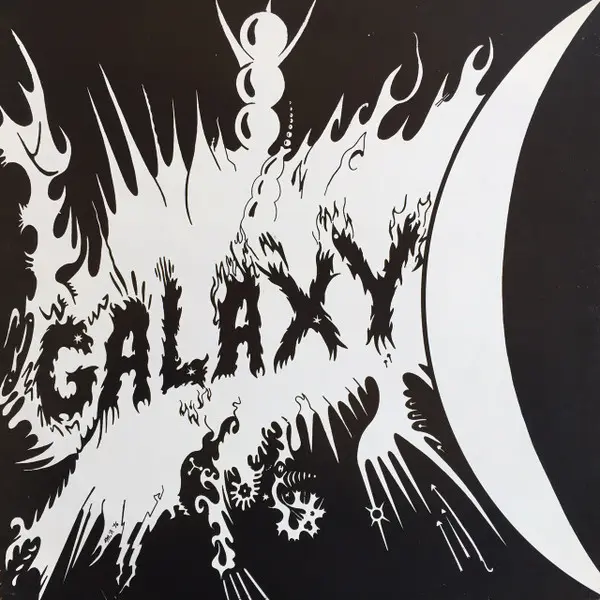 Galaxy released their lone album, Day Without the Sun, in 1976 on their privately operated Sky Queen label. Issued in a tiny pressing, the record blends mid-’70s funk-rock pulse with fuzzed channel-splitting guitars, glistening analog keyboards, and sultry vocals that suggest West Coast acid rock filtered through space-age production.
Side One moves through concise pieces that push steadily ahead. “Space Mountain” jumps from echoed announcements into a snare-driven exchange of fuzzed guitar threads and bright keyboard flashes. “Green Stuff” holds a medium pace with smoky vocals over gleaming keys and a speaker-sweeping guitar solo. “Galaxy” rides dual fuzz riffs, a cowbell pulse, and a burst of rapid-fire leads.
A1. “Space Mountain” (4:05) – echoed intercom announcement signals this snare-plowed instrumental exchange of fuzzed filigree and sparkling keyboard counterpoint (in A minor)
A2. “Green Stuff” (4:35) – funky medium-uptempo track (in F sharp) with glistening fuzzy keyboards and sultry vocals; soaring channel-to-channel guitar break.
A3. “Look What You Done” (3:58)
A4. “Galaxy” (6:10) – mid-tempo rocker with dual-channel fuzzed riffs (in E minor) across a slippery bass figure and cowbell beat; revved lightning licks explode along the break.
B1. “Sky Queen” (3:58)
B2. “Day Without the Sun” (14:22) – cryptic intro with distant alien sounds, foreboding pulses and smoldering feedback; song commences (at 1:45) with slow bassline (in E minor) and Space Mama vocals (faux-Asian accent), gradually overlaid with echoing pings and smoke-fuzz sustain; which churn into a foggy vortex of swirling sonic haze. Midway, Frenzi’s half-spoken interlude signals a more aggressive stretch searing multi-channel guitar fire and machine-gun percussion. Gunner Bonham’s her way through an unaccompanied three-minute spotlight, followed by a recapitulation of Marilyn’s verse.
Sessions occurred overnight at The Warehouse Recording Studio in Jacksonville, arranged, written, and produced by Fabbri and Geiger, who also designed the sleeve artwork. The album’s microscopic distribution turned it into a prized trophy among progressive and private-press collectors, prompting a 1990s Akarma CD reissue that reintroduced the record to international audiences and affirmed its hybrid of funk-flared hard rock, psychedelic atmospherics, and progressive ambition.
Postlude
Following the album, Galaxy continued performing large outdoor engagements along the Florida coast, sharing stages with civic sponsors, product showcases, and guest turns—including an appearance by teen idol Leif Garrett.
Though no second LP arrived at the time, two subsequent bodies of material, recorded in 1979 and 1984, later appeared as Very 1st Stone – 1979 To 1984, a two-record archival set on the Italian Arkama label.
In the 2000s, Fabbri and Geiger revived the Sky Queen label with an “author’s edition” reissue of Day Without the Sun and a new space-rock set titled Find Another World, keeping Galaxy’s cult legacy orbiting among collectors and genre enthusiasts.
Sources:
Artist/Album Pages:
Petr Novák (September 6, 1945 – August 19, 1997) was a Czech rock singer and songwriter who formed...
Truth and Janey were an American Midwest hard-rock trio that issued two singles and the 1976/77 p...
Moira was a German jazz-rock sextet led by Embryo co-founder Edgar Hofmann. They released the 197...
Haruko Kuwana (桑名晴子) is a Japanese pop singer and songwriter who made the 1978/79 Philips albums M...
The 360 Degree Music Experience was an American jazz ensemble formed in New York in 1968 by drumme...
The Rhythm Makers were an American soul-funk band from the Bronx that released the album Soul on Y...
Ray Russell (born April 4, 1947) is an English jazz-rock guitarist who emerged as a quartet leader...
Gino Pertot is an Austrian singer, guitarist, and songwriter who appeared on 1973 titles by Milest...
Moose Loose was a Norwegian jazz-rock band behind the 1974 Mai release Elgen er Løs, followed by t...
Takayuki Inoue — 井上堯之 (March 15, 1941 — May 2, 2018) — was a Japanese guitarist who emerged in the...
Japan was an English new wave band that released five albums between 1978 and 1981. They formed in 1...
T. Rex was an English rock band best known for the UK hits "Ride a White Swan," "Hot Love," "Teleg...