
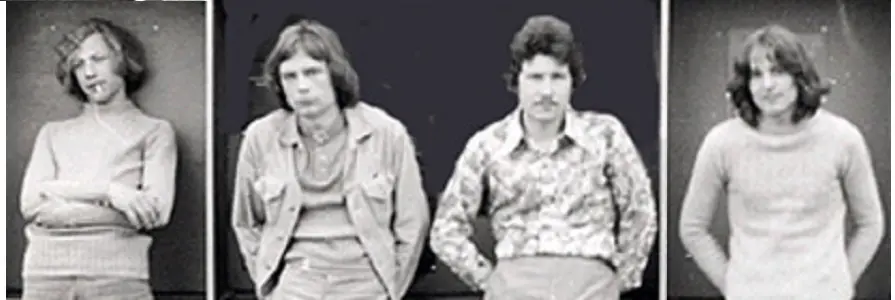
Flaming Bess was a German symphonic-rock band that self-released the 1979 album Tanz der Götter, followed by the 1981 Polydor title Verlorene Welt.
Members: Hans Wende (guitar, bass, clavinet, drums), Horst Wagner (bass, 1969-?), Rolf Selbach (drums, 1969-?), Peter Figge (keyboards), Achim Wierschem (guitar, keyboards, drums, vocals), Peter Wahle (drums, gong, guitar, bells, rhythm machine), Joachim Jansen (organ, violin, synthesizer, piano, clavinet), Barry Peeler (acoustic guitar, keyboards), Dieter Joswig (1994-present), Claas Reimer (1994-present), Melanie Halbauer (vocals, effects)
Background
Flaming Bess formed in 1969 in Düsseldorf with guitarist Hans Wende, bassist Horst Wagner, drummer Rolf Seelbach, and keyboardist Peter Figge. Initially conceived as a narrative-driven rock project built around an original fantasy saga, the group spent its first years refining long-form instrumental arrangements alongside story elements and sound collages.
By 1977, a new lineup with Wende, keyboardist Joachim Jansen, producer Dieter Joswig, and drummer Peter Wahle recorded a self-produced demo that fused their composed instrumental passages with spoken narration. The tape reached WDR presenter Wolfgang Neumann, who featured the band on his Rockstudio program, sparking a surge in listener response and opening the path to their first album.
Tanz der Götter
 Flaming Bess released their debut album, Tanz der Götter, in 1979 as a DIY gray-label title.
Tanz der Götter presents five instrumental pieces with narration by Wolfgang Neumann, who recites texts by Rainer M. Schröder-Rostock across the album’s preludes and interludes. Keyboardist Joachim Jansen—credited here as Porgy Flaming—composed the material and alternates between organ, Clavinet, grand piano, and synth textures.
Guitarist Bruno Blättler trades short motifs with Jansen across each arrangement, occasionally layering electric violin passages into the midrange. Hans Wende underpins the album’s pacing from multiple positions, switching between bass, acoustic guitar, and supplemental percussion. Drummer Peter Wahle reinforces the structure with dry kit patterns and auxiliary sounds, including sequenced loops and gong strikes. Wolfgang Hoffmann adds secondary rhythm guitar on select passages.
“Bedrohung” builds from clipped rhythm guitar and filtered synth figures into a lead section where guitar lines cut across sustained organ tones. “Kampf und Vertreibung” opens with soft piano, then locks into a repeated pattern for guitar and keys over a rigid backbeat, later stretching into a sustained distorted solo. “Oasis” slows the pace, centering on smooth guitar phrases over subdued organ layers, with a short synth break in the center. “Arkana” rotates clipped phrases between organ and guitar, moving across a loose, unaccented meter. “Tanz der Götter” opens on syncopated Clavinet and stacked keyboard tones, then extends into alternating solos for saxophone, piano, and guitar.
A1. “Bedrohung” [Threat] (9:43)
A2. “Kampf und Vertreibung” [Struggle and Expulsion] (8:22)
B1. “Oasis” (5:27)
B2. “Arkana” [Arcana] (4:56)
B3. “Tanz der Götter” [Dance of the Gods] (10:10)
Flaming Bess recorded Tanz der Götter in collaboration with Westdeutscher Rundfunk Köln under the technical supervision of Fritz Fey and Lars Eric Hidde. The band self-produced and issued the album with support from WDR, with animation by Dieter Joswig and visual design handled in-house.
Verlorene Welt
 Flaming Bess released their second album, Verlorene Welt, in 1981 on Polydor.
Verlorene Welt extends the group’s narrative format with layered exchanges between guitarist Barry Peeler and composer–keyboardist Joachim Jansen, who contrast acoustic passages and synthesized voicings across evolving tonal landscapes.
Jansen shapes the harmonic backdrop with organ, clavinet, and broad synth layers while Peeler moves between chordal anchors and melodic figures. Bassist Hans Wende shares foundational duties, underpinning the progressions with sustained low-end phrasing. Drummer Hans Schweiß steadies the arrangements with centered, unembellished backbeats that support the album’s shifting dynamics.
The set favors slow-building structures shaped by acoustic overlays, spaced electric lines, and softened rhythmic motion. “Kristallplanet” centers on Peeler’s patterned fingerpicking over sustained keys and gradual tonal layering. “Cron Endor” inserts sparse female vocal phrases between instrumental passages built on electric lead breaks, piano figures, and ambient synth textures. The title track moves through staggered sections framed by clavinet, filtered electronics, and acoustic runs, guided by a steady pulse. Shorter cues like “Zay” and “Mythos” pivot to sequenced rhythm parts and chorused vocal refrains, maintaining a compact structure with integrated solo passages.
A1. “Mythos” [Myth] (4:03)
A2. “Aufbruch” [Departure] (6:50)
A3. “Kristallplanet” [Crystal Planet] (4:21)
A4. “Zay” [Zay] (5:31)
B1. “Cron Endor” [Cron Endor] (6:21)
B2. “Ballade” [Ballad] (4:21)
B3. “Verlorene Welt” [Lost World] (9:07)
Verlorene Welt was recorded at Dierks Studios with engineer Jürgen Krämer. Michael Cretu arranged the vocals “Zay.” The album marked the band’s first major-label release and coincided with one of Germany’s earliest promotional music videos.
Discography:
- Tanz der Götter (1979)
- Verlorene Welt (1981)
Sources:
Artist/Album Pages:
Embryo is a German ethno-jazz/rock ensemble that debuted with the 1970 Ohr release Opal, followed ...
The Moodists were an Australian new wave band that cut two singles and the 1983 extended-play Engine...
Change was a soul-funk studio project that spawned six albums between 1980 and 1985 on Warner and ...
Flash and the Pan were an Australian studio-based art-pop project from Sydney headed by the songwr...
The Skids were a Scottish new wave rock band that released four albums and thirteen singles betwee...
Ragnarök was a Swedish symphonic/folk band that released four albums between 1976 and 1983 on Sile...
Roger Glover (born Nov. 30, 1945) is a Welsh bassist, composer, and producer with a six-decade mus...
Ozric Tentacles is an English space-rock band that self-released six cassette-albums (numbered OT ...
The Bureau was an English new wave/ska band from Birmingham that released a 1981 self-titled album...
Crispy Ambulance was an English post-punk band that released the 1982 album The Plateau Phase on F...
Streetheart was a Canadian melodic-rock band that released the 1978/79 Atlantic albums Meanwhile B...
Thomas Leer — aka Thomas Wishart (born 1953) — is a Scottish musician and producer who cut the sem...