

Christian Boulé (1951 – 2002) was a French space-rock guitarist and composer who played on the first three Clearlight albums and toured with Steve Hillage. As a solo artist, Boulé made the 1978/79 Polydor albums Photo Musik and Non-Fiction.
Background
Christian Boulé was born on February 12, 1951, in Clichy, France. He grew up in Paris, where he took up guitar as a teenager and frequented the Golf-Drouot nightclub. From 1968 to 1970, Boulé played guitar in Resurrection, a Paris trio with bassist–singer Jean-Claude Pruvos and drummer René-Paul Soler.
In 1971, Boulé formed Babylone with bassist–singer Jean-Paul “Loppo” Martinez, drummer René-Paul Soler, saxophonist–flutist Antoine Duvernet, and keyboardist Cyrille Verdeaux. Dashiell Hedayat suggested the group name after Boulé and Duvernet assembled the project and Verdeaux replaced an early organist. Babylone pooled its savings in a borrowed country house, where Boulé brought songs and Verdeaux added instrumental material. The group played Creuse and Haute-Vienne dates, appeared at festivals, and toured the Netherlands with appearances at Melkweg and Paradiso in Amsterdam. Babylone ended early in 1973 after the Dutch dates.
Clearlight / Hillage
Verdeaux retained the Babylone connection after the group ended. He recorded the piano basis for a forty-minute composition and took the tape to Virgin through Jean-Pierre Lentin and Gong synthesist Tim Blake. They recruited Boulé and Gilbert Artman for the French-side sessions. Boulé played electric guitar on the side with bassist Martin Isaacs and drummer–vibraphonist Gilbert Artman. The sessions produced the 1975 Virgin album Clearlight Symphony.
Boulé stayed in the Clearlight circle across the next studio projects. He played cosmic guitar on Forever Blowing Bubbles and electric guitar on Delired Cameleon Family, the Verdeaux–Yvan Coaquette soundtrack project for Pierre Clémenti’s Visa de Censure No. X.
After the 1975 Clearlight sessions, Boulé joined Gilbert Artman’s Lard Free in a trio with synthesist Phil Marboeuf and played the Fête de l’Humanité during a tenure of just over one year. He also formed the short-lived Nova Vano and worked with Tim Blake before Steve Hillage recruited him in summer 1976 through a demo routed by Virgin.
Hillage placed Boulé in the first post-L touring band with synthesist–vocalist Miquette Giraudy, bassist Colin Bass, drummer Clive Bunker, keyboardist Phil Hodge, and synthesist–flutist Basil Brooks. The Steve Hillage Band debuted at the Hyde Park Free Concert in London in September 1976 and toured the U.K. through late December. In January/February 1977, they supported Electric Light Orchestra in the U.S. and played London’s Rainbow Theatre that March. Boulé’s 1977 Rainbow recordings later appeared on Live Herald, where he received glissando and rhythm guitar credits.
Boulé spent the following summer in Brighton at 22 Broad Street, where he composed material for his first solo album and worked with Caravan keyboardist David Sinclair. Back in France, he secured a Polydor deal with Verdeaux’s help.
Photo Musik
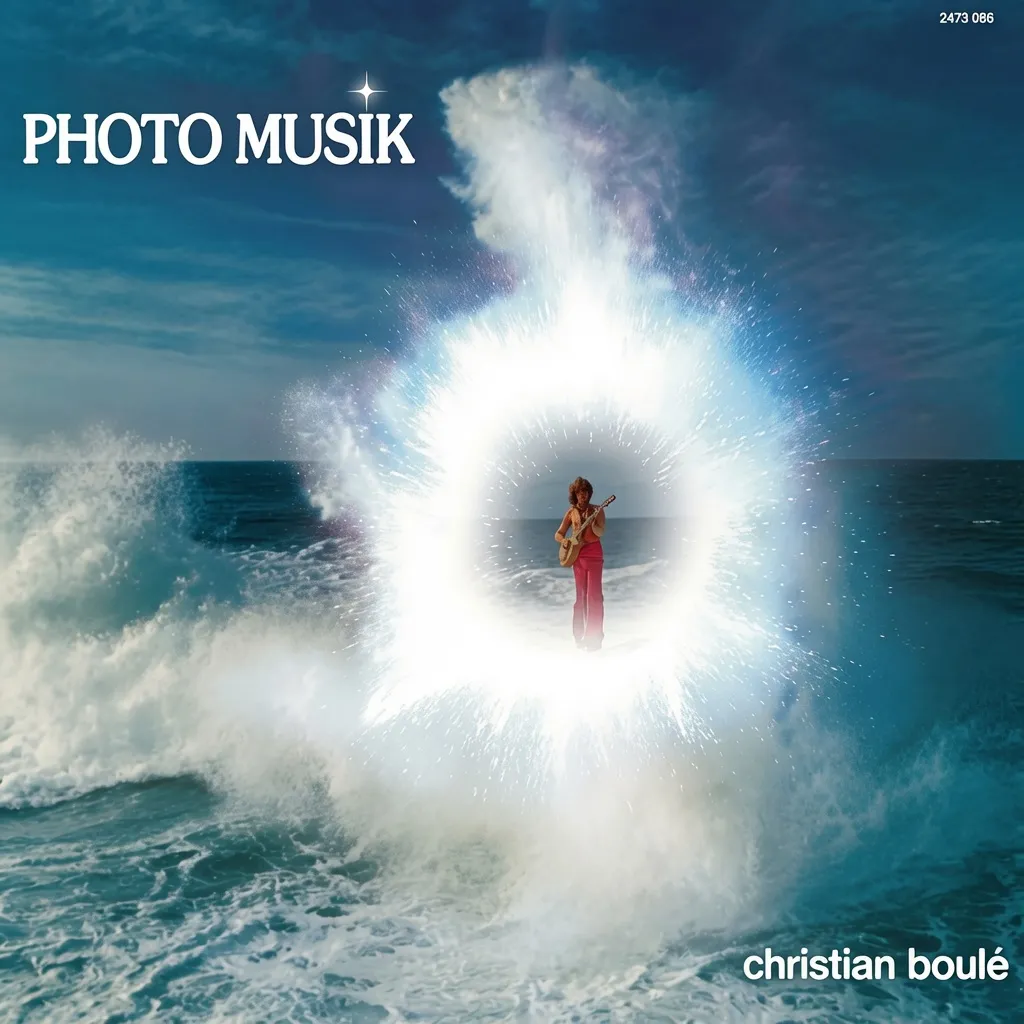 Christian Boulé released his debut album, Photo Musik, in 1978 on Polydor.
Photo Musik contains nine Boulé compositions and uses a compact studio band: singer Andy Slatin, bassist Patrice Congas, drummer Jacky Bouladoux, saxophonist Jean-Pierre Thirault, and keyboardist Cyrille Verdeaux. Boulé extends the guitar parts with EMS synthesizer; his credits also include harmonica and flute. Verdeaux adds piano and organ, plus Fender Rhodes and Micro Moog. His percussion credits cite tubular bells and tambourine. The album threads treated leads, floating electronics, sung passages, and abrupt section turns.
“Elastic Minute” races through intricate fast figures, then shifts into saxophone and guitar lines over spacey synthesizer. “Photo Musik” starts with strummed guitar, adds a soloing line, then thickens around vocals and fuzzed lead before a harmonica tag cuts the track short. “Crystal Palace” opens with twittering electronics, settles into strum, beat, and vocal, then returns to guitar-led passages before the vocal re-enters.
“Radio-Arc-En-Ciel” layers radio fragments, floating organ, synthesizer, and spoken female words. “Seme Ocean” lifts vocal melody over strummed accompaniment before piano comes forward. “Aqua Deva” suspends water sounds and atmospheric electronics, then passes into the fuller vocal entry of “Inter Galactic Cosmic Triolet.” “Orange Climax” starts with bells and atmosphere, gathers tempo after the first minute, then turns through piano and saxophone leads before a drawn-down close.
A1. “Elastic Minute” (4:07)
A2. “Photo Musik” (2:40)
A3. “Cristal Palace” (7:33)
A4. “22 Broad Street” (4:22)
B1. “Radio Arc-En-Ciel” (2:34)
B2. “5º Ocean” (2:40)
B3. “Aqua Deva” (3:33)
B4. “Inter Galactic Cosmic Triolet” (3:30)
B5. “Orange Climax” (7:15)
Boulé recorded and mixed Photo Musik during January and February 1978 at Studio Ramsès in Paris with producer-arranger Cyrille Verdeaux and engineer Billi Key.
The front sleeve, designed by Sergio Macédo with photography by Eric Brucker, places a guitarist inside white sea spray against a blue ocean field. Yvonne Garnier contributed artwork and back-cover photography.
Non-Fiction
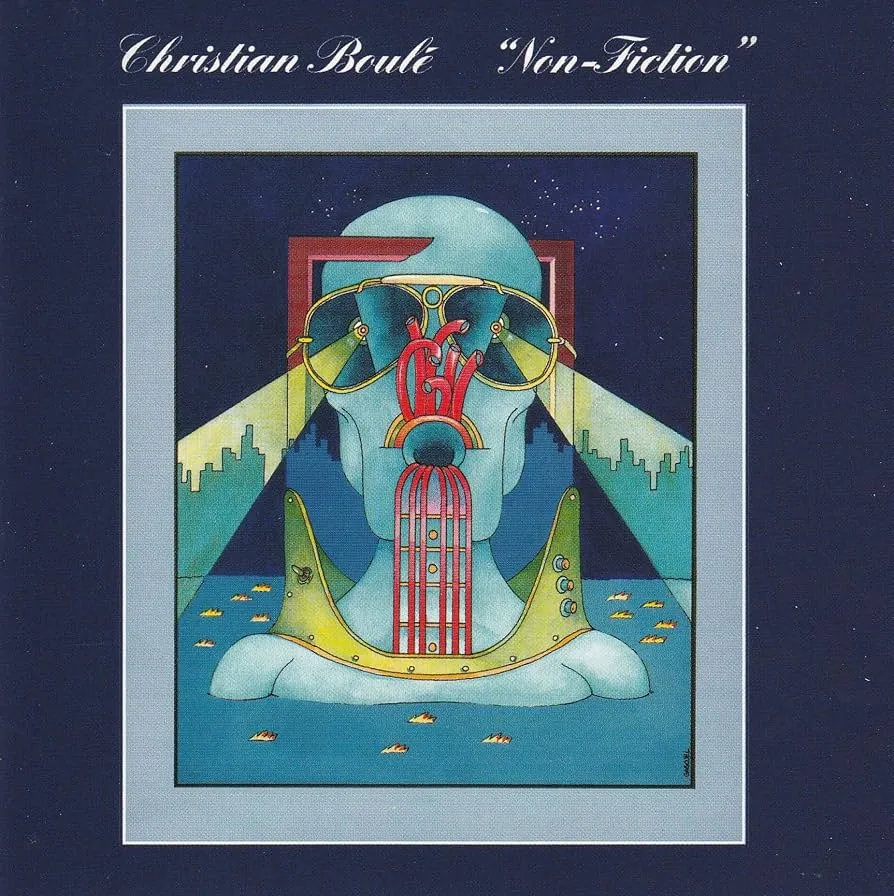 Christian Boulé released his second album, Non-Fiction, in 1979 on Polydor.
Non-Fiction replaces Verdeaux with keyboardist Jean-Philippe Rykiel and retains Slatin, Congas, Bouladoux, and Thirault. Rykiel’s credits cite Mini Moog and Prophet synthesizer. Boulé adds keyboards beside guitar and glissando guitar. His electronic credit lists EMS synthesizer. Gérard Amsellem adds saxophone to “Magic Fanfare”; guitarist Xavier Baulleret and keyboardist Yves Lannes appear on “Viva Da New Sound.”
“Psychedelik” threads guitar and keyboard solos through altered-tone lines. “Viva da New Sound” layers German, French, English, and Italian voices across the track. “Glissader Aquarian” relaxes into jazz-colored phrase turns.
A1. “Non-Fiction” (3:30)
A2. “Chance” (4:45)
A3. “Psychedelik” (4:00)
A4. “Magic Fanfare” (5:05)
B1. “L.I.F.E.” (4:10)
B2. “Glissader Aquarian” (4:07)
B3. “Viva Da New Sound” (9:00)
Non-Fiction features cover art by Jean-Claude Michel, whose image depicts a monumental blue head rising from water, with oversized glasses projecting yellow beams toward mirrored city skylines. Red mechanical tubing covers the nose, mouth, and throat area, while a riveted gold collar and small floating shapes give the figure a hybrid nautical-machine form.
Polydor issued one 1979 French jukebox single from the album. “Psychedelik” appeared on the A-side, backed with “Non-Fiction.”
Postlude
After Non-Fiction, Boulé assembled a stage group with the album rhythm section, singer Andy Slatin, synthesist Twink, and Rémo on vocals, guitar, and flute. The lineup played Campagne-Première in Paris and opened for Steve Hillage on his 1979 tour.
In 1982, Boulé returned with “Il y a quelqu’un” (“Sur ma planète”), a Carrère/Vitamines single with bass guitarist Bernard Paganotti and producer Laurent Thibault. RTL named the single its record of the week.
Boulé reappeared in Cyrille Verdeaux’s circle during the middle eighties, with electric and slide guitar on two tracks from Messenger of the Son. In 1988, Verdeaux included him on the Clearlight album Rhapsody for the Blue Planet.
Discography:
- Photo Musik (1978)
- Non-Fiction (1979)
- “Il y a quelqu’un” / “Sur ma planète” (1982)
Sources:
- Discogs: Christian Boulé
- Discogs: Christian Boulé — Photo Musik
- Discogs: Christian Boulé — Non-Fiction
- RYM: Christian Boulé
- 45cat: Christian Boulé
- ProgArchives: Christian Boulé
- Official: Christian Boulé
- Last.fm: Christian Boulé
Artist/Album Pages:
Black was an English new wave band from Liverpool that released the 1981–82 indie singles "Human F...
Soft Cell was an English electro-pop duo from Leeds, composed of singer–lyricist Marc Almond and k...
SPY was a Japanese New Wave band that released a self-titled album in 1980 on Invitation. Membe...
Camera Obscura were an English coldwave/synthpop duo from York, North Yorkshire, that was active b...
Fusion was a French jazz-rock supergroup comprised of core Magma personnel Christian Vander, Benoî...
Barock was a Norwegian jazz-rock/folk band that released the 1976 Mercury album Bare en Blåveis. ...
Night Ranger is an American hard-rock band from San Francisco that emerged with the FM cuts "Don't...
John Klemmer (born July 6, 1946) is an American saxophonist and composer from Chicago who emerged ...
Motörhead was an English metal trio that released a 1977 self-titled album on Chiswick, followed b...
Cowboys International were an English New Wave/synthpop band that released the album The Original ...
Clear Light Symphony is the debut album by the French-English electronic space-rock collective Clear...
Modern Man was a Scottish new wave band that released the 1980 album Concrete Scheme with accompan...