

Blocco Mentale was an Italian symphonic-rock band that released the 1973 album Πόα (Poa) on Titania.
Members: Bernardo “Dino” Finocchi (vocals, saxophone, flute), Aldo Angeletti (vocals, bass), Gigi Bianchi (guitar, vocals), Filippo Lazzari (keyboards, vocals, harmonica), Michele Arena (drums, vocals)
Background
Blocco Mentale formed in late 1972 in the Viterbo province of Lazio. The group emerged when three members of the local band Oleum joined forces with Aldo Angeletti, a bassist and vocalist active since the 1960s with the beat-era combo Aldo e i Falisci. The new five-piece lineup included singer/reedist Bernardo “Dino” Finocchi, guitarist Gigi “Roso” Bianchi, keyboardist Filippo Lazzari, and drummer Michele Arena.
They debuted in early 1973 with the sentimental, melodically oriented single “L’amore muore a vent’anni,” issued on Titania. That same year, Blocco Mentale recorded their only album, Πόα — titled in Greek characters for “grass” — a conceptual work centered on ecological themes and naturalistic imagery.
Πόα (Poa)
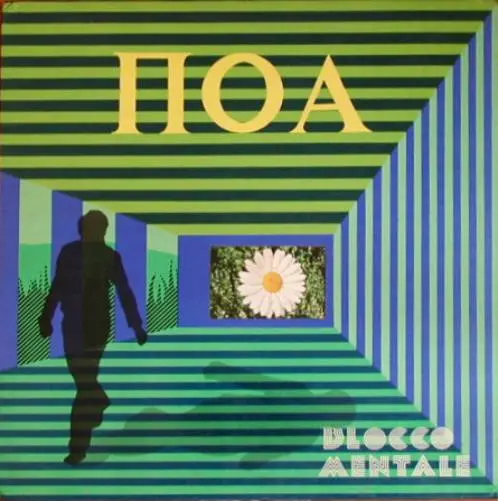 Blocco Mentale released their singular album, Poa, in 1973 on Titania.
Πόα combines ensemble symphonic rock with multi-vocal arrangements and environmental lyricism. The album expands on the melodic style of their debut single with broader instrumentation and heightened lyrical ambition, culminating in a seven-track suite centered on themes of ecological disruption and human disconnection from nature.
Singer/bassist Aldo Angeletti co-wrote the material with lyricist Claudio Merloni. Bernardo “Dino” Finocchi sings lead and contributes flute and saxophone, alternating pastoral and jazz-inflected passages. Filippo Lazzari plays keyboards, harmonica, and sings; his piano and Mellotron dominate several transitions.
“Capita” opens with staggered sax and guitar phrases that collapse into a soft vocal section backed by acoustic guitar, organ, and flute. “Aria e mele” unfolds in sections: its first half rotates piano, flute, and bass against swirling rhythms, while the second half tightens around a vocal refrain before collapsing into a dark instrumental descent. “Impressione” opens with flute and Mellotron over fingerpicked guitar and piano, then expands into layered vocals and cymbal swells, culminating in a sharp exchange between saxophone and organ in uneven time. “Io e me” pivots from a harmonica-led acoustic section into syncopated choral vocals and brief Mellotron drops.
“La nuova forza” alternates between pulsing piano attacks and brief, suspended quiet sections; its final third rebuilds around a slow vocal ascent and a final Mellotron crest. “Ritorno” opens with tense piano, briefly veers into rhythmic drive, then slows for a vocal centerpiece and instrumental coda where saxophone and piano return. “Verde” closes the album on subdued rhythms and layered voice–flute interweaving. Throughout, the band emphasizes contrast: fast instrumental passages dissolve into acoustic respites, and ensemble sections often highlight sharp transitions rather than extended climaxes.
A1. “Capita” [It Happens] (4:42) — opens with guitar–sax counterpoint and segues into a pastoral vocal sequence punctuated by flute, organ, and acoustic piano; shifts between somber and uplifting moods
A2. “Aria e mele” [Air and Apples] (4:32) — alternates jazzy sax–piano interplay with tempo drops and vocal refrains; concludes in a harmonized choral section
A3. “Impressione” [Impression] (8:20) — framed by Mellotron, flute, and acoustic guitar; builds through vocal crescendos and peaks in a sax–keyboard exchange over pulsed drumming
A4. “Io e me” [Me and Myself] (4:26) — centers on harmonica, acoustic strumming, and tambourine; includes a harmonic vocal section and brief Mellotron reprise
B1. “La nuova forza” [The New Strength] (8:08) — opens with forceful piano and electric bursts before resolving into flute–guitar phrases and swelling Mellotron; chorus returns mid-track over layered instrumentation
B2. “Ritorno” [Return] (4:56) — reprises earlier motifs with electric piano and saxophone overlays; includes a mid-track vocal peak followed by a coda referencing the opener
B3. “Verde” [Green] (3:56) — closes with flute, Mellotron, and harmonized vocals; melody unfolds in a slow-rising arc that echoes the album’s ecological message
Recorded and released in 1973 on Titania. No producer or engineer credits appear on the original issue.
The original gatefold sleeve displays the album title Πόα in large gold Greek lettering on a green and blue striped tunnel motif that converges toward a silhouette of a man walking into a field of grass. The design uses forced perspective to emphasize dimensionality and nature as escape, echoing the album’s ecological theme. No designer is credited on the original sleeve.
Titania issued the pre-album single “L’amore muore a vent’anni” (b/w “Lei è musica”) in 1973 as Titania TIT 0024. Both songs feature the full Πόα lineup and reflect the band’s early melodic style, pairing lyrical romanticism with ensemble vocals and light symphonic textures.
A. “L’amore Muore a Vent’anni” [Love Dies at Twenty]
B. “Lei è Musica” [She is Music]
Postlude
Blocco Mentale disbanded in early 1975 due to the members’ military obligations but later regrouped under the name Limousine with the same lineup. The new band won music contests in 1978 and 1979 and released several singles.
In 1980, singer–saxophonist Bernardo Finocchi issued a four-track mini-LP Sei proprio tu (Lettera A AQ122) under the name Bernardo Lafonte, featuring contributions from Michele Arena, Aldo Angeletti, and Filippo Lazzari. Finocchi later released religious-themed records with his wife, Francesca Lotà, under the same alias. Filippo Lazzari died in a car accident in 1991 en route to a concert in Rome.
Discography:
- Πόα (Poa) (1973)
- “L’amore Muore a Vent’anni” / “Lei è Musica” (1973)
Sources:
- Discogs: Blocco Mentale
- RYM: Blocco Mentale
- ItalianProg: Blocco Mentale
- ProgArchives: Blocco Mentale
Artist/Album Pages:
Agincourt was the first group project of English musicians Peter Howell and John Ferdinando, who s...
Loggins and Messina were an American country rock duo that released six studio albums and a live do...
Jerry Butler (December 8, 1939 — February 19, 2025) was an American soul singer who first fronted ...
Arzachel was an English psych-rock band, originally known as Uriel, that released a self-titled al...
Peter Michael Hamel is a German composer and electroacoustic musician behind the 1972/73 Vertigo t...
Cravinkel was a German rock band that released the 1970/71 Philips albums Cravinkel and Garden of ...
The Bobby Boyd Congress was an American soul-funk band from New York that moved to Paris, where th...
Hurdy Gurdy was a Danish psych-rock band that cut the 1970 Spectator single "Tick Tock Man," foll...
Bruno Nicolai (May 26, 1926 — Aug. 16, 1991) was an Italian composer, conductor, and arranger who ...
Olivia Newton-John (Sept. 26, 1948 – Aug. 8, 2022) was an English-born Australian singer, actress, a...
Grant Green (June 6, 1935 — Jan. 31, 1979) was an American jazz guitarist and composer from who r...
Sparks is the musical partnership of American keyboardist–songwriter Ron Mael and his vocalist bro...