

Art Blakey (October 11, 1919 — October 16, 1990) was an American jazz drummer and bandleader from Pittsburgh. For 35 years, he led the Jazz Messengers, a revolving-door band with some of the leading names in post-bop.
Blakey co-founded the Jazz Messengers in 1954 with pianist Horace Silver, trumpeter Kenny Dorham, saxophonist Hank Mobley, and bassist Doug Watkins. The group debuted under the Jazz Messengers name on a pair of live recordings from New York’s Café Bohemia in 1955. Though the original lineup disbanded in 1956, Blakey retained the name and used it as the vehicle for his bands over the next three decades.
In 1958, Blakey assembled a new lineup with Lee Morgan, Benny Golson, Bobby Timmons, and Jymie Merritt. Their self-titled album Art Blakey and the Jazz Messengers introduced enduring compositions such as “Moanin’,” “Blues March,” and “Along Came Betty.” When Golson departed, Wayne Shorter replaced him as the group’s primary composer and saxophonist. The Messengers expanded to a sextet in 1961 with trombonist Curtis Fuller, and with Freddie Hubbard and Cedar Walton in the fold, the band recorded the classics Mosaic and Buhaina’s Delight.
Through the 1960s and 1970s, the Jazz Messengers featured a rotating cast of rising players, including trumpeters Woody Shaw and Randy Brecker, saxophonists Carlos Garnett and Ramon Morris, and pianists Lonnie Liston Smith and Keith Jarrett. Despite frequent changes, Blakey guided the group through recordings like Jazz Messengers ’70, Child’s Dance, and Anthenagin, the latter featuring bassist Stanley Clarke. These records highlighted Blakey’s adaptability as he incorporated new generations of musicians while maintaining the hard bop foundation.
By 1977, the group settled into a more stable lineup with pianist James Williams and trumpeter Valery Ponomarev. In 1979, Blakey briefly expanded the Messengers into an 11-piece big band for a European tour that featured Wynton and Branford Marsalis alongside Robin and Kevin Eubanks. The core sextet, including Wynton Marsalis, Bobby Watson, Bill Pierce, Williams, and Charles Fambrough, recorded Album of the Year and Straight Ahead. Later versions of the Messengers included Terence Blanchard, Donald Harrison, and Mulgrew Miller, carrying the band into the 1980s as a proving ground for future jazz leaders.
Background
Art Blakey was born in Pittsburgh, Pennsylvania, on October 11, 1919. He studied piano as a child but taught himself drums after giving up the keyboard. He absorbed the powerful swing of Chick Webb and Sid Catlett and developed a hard-driving style that defined his playing. By the late 1930s, he worked in Pittsburgh clubs and gained his first touring experience with pianist Mary Lou Williams. From 1939 to 1944, he performed with the Fletcher Henderson Orchestra, sharpening his technique in big band settings.
In 1944, Blakey joined Billy Eckstine’s big band, where he became part of the emerging bebop movement. He played alongside future jazz leaders including Miles Davis, Dexter Gordon, Charlie Parker, and Dizzy Gillespie. After the band broke up, he recorded between 1947 and 1949 with Parker, Gillespie, Bud Powell, and Thelonious Monk, quickly earning a reputation as one of the most responsive and forceful drummers in modern jazz. He also led his first session on December 17, 1947, with a group called Art Blakey’s Messengers.
From 1951 to 1953, Blakey toured with clarinetist Buddy DeFranco in a band that also featured pianist Kenny Drew. These years deepened his command of small-group interplay and set the stage for his own leadership. In 1954, he co-led a quintet with pianist Horace Silver that recorded several sessions, blending bebop’s speed with blues-rooted patterns.
A Night at Birdland, Vol. 1–3
 In July, October, and November 1954, Blue Note issued A Night at Birdland, Vols. 1–3, three 10-inch albums by the Art Blakey Quintet, recorded live on February 21, 1954, at Birdland in New York City.
The quintet features trumpeter Clifford Brown, saxophonist Lou Donaldson (alto), pianist Horace Silver, bassist Curley Russell, and Blakey on drums. Their sets capture an early stage of hard bop with Silver’s angular writing, Brown’s clear-toned trumpet lines, and Donaldson’s Parker-inspired phrasing.
Silver wrote three numbers in the program. The band also plays J. J. Johnson and Leo Parker’s “Wee-Dot,” Dizzy Gillespie’s “A Night in Tunisia,” and two Charlie Parker tunes (“Now’s the Time,” “Confirmation”). They further cover “Once in a While” (Bud Green, Michael Edwards) and “If I Had You” (Jimmy Campbell, Reg Connelly, Ted Shapiro).
The uptempo “Split Kick” opens Volume 1 after a short announcement by Birdland host Pee Wee Marquette. “Quicksilver” and “Mayreh” typify Silver’s hard bop approach with tight heads and extended horn interplay. Brown showcases his ballad phrasing on “Once in a While,” while Donaldson takes the lead on “If I Had You.” The set peaks with “A Night in Tunisia,” which frames Blakey’s commanding drive with layered horn lines.
Volume 1
A1. “Announcement by Pee Wee Marquette” (0:58)
A2. “Split Kick” (8:44) – Silver’s theme unfolds in brisk, angular phrases, giving Brown and Donaldson space to launch into inventive lines that dart and surge with quick rhythmic pivots.
B1. “Once in a While” (5:18) – The band slows into a tender ballad, with Brown’s trumpet voice lingering over long contours that bring out the tune’s wistful character.
B2. “Quicksilver” (6:58) – A tightly constructed head opens into a series of solos that balance sharp rhythmic turns with lyrical flourishes, the horns in taut dialogue before handing back to Blakey’s driving close.
Volume 2
A1. “Wee-Dot” (7:19) – The concise theme serves as a launchpad for extended solo flights, with the rhythm section’s steady propulsion underpinning the horns’ brisk exchanges.
A2. “Mayreh” (6:19) – Silver reworks “All God’s Children Got Rhythm” into a new frame, layering bright harmonic shifts beneath solos that stretch across quickened rhythmic footing.
B1. “A Night in Tunisia” (9:20) – The quintet dives into Gillespie’s standard with tightened ensemble lines and an expansive rhythmic sway, Blakey heightening the momentum through accents and surges that frame the solos.
Volume 3
A1. “Now’s the Time” (9:02) – Parker’s blues sparks relaxed but pointed improvisations, Brown and Donaldson trading lines over Silver’s firm chordal pulse.
A2. “If I Had You” (3:31) – A subdued turn, with Donaldson tracing long, singing phrases that shift between restraint and sudden expressive rises.
B1. “Confirmation” (9:12) – The quintet drives through Parker’s intricate theme at a taut clip, solos unfurling in sharp contours as Blakey pushes the pace with quick volleys and emphatic bursts.
Volume 1 features a Francis Wolff photo and cover design by Reid Miles.
“Announcement by Pee Wee Marquette” was later sampled in the 1993 US3 track “Cantaloop (Flip Fantasia).”
The group officially took the name The Jazz Messengers with their 1956 Columbia release. When Silver left soon after, Blakey assumed control of the band, turning the Jazz Messengers into his life’s primary vehicle. Through the Messengers, he rose as a central bandleader in modern jazz and established the hard bop style that shaped the next generation of players.
The Jazz Messengers at the Cafe Bohemia
 In April 1956, Blue Note issued At the Café Bohemia, Vols. 1 & 2, two live albums by the Jazz Messengers recorded on November 23, 1955, at the Café Bohemia in New York City.
The lineup features trumpeter Kenny Dorham, saxophonist Hank Mobley (tenor), pianist Horace Silver, bassist Doug Watkins, and Blakey on drums. Bohemia presents the group’s early approach to hard bop, balancing brisk ensemble numbers with slower, reflective passages. The albums first appeared as five-track LPs. In 2001, Blue Note reissued the two volumes, each as hour-long CDs with nine tracks.
Dorham contributed three pieces, including “Minor’s Holiday,” “Prince Albert,” and the recurring set closer “The Theme.” Mobley supplied “Deciphering the Message,” “Sportin’ Crowd,” “Avila and Tequila,” and “Hank’s Symphony.” The band also covers Benny Goodman (“Soft Winds”), Tadd Dameron (“Lady Bird”), Dizzy Gillespie (“I Waited for You”), and standards by Cole Porter (“Just One of Those Things”), Jerome Kern (“Yesterdays”), and Jimmy Van Heusen (“Like Someone in Love”).
Dorham’s “Minor’s Holiday” opens with Blakey’s forceful drumming, while “Prince Albert” twists Jerome Kern’s “All the Things You Are” into a new shape. Mobley takes the spotlight on the ballad “Alone Together” and the exploratory “Deciphering the Message.” Volume 2 peaks with “Avila and Tequila,” where Blakey drives the band with Afro-Cuban accents under Silver’s modal patterns.
Volume 1
1. “Announcement by Art Blakey” (1:32) – A brief spoken cue that frames the set and leads directly into the music.
2. “Soft Winds” (12:34) – Goodman’s line unfolds as an extended warm-up, the ensemble stretching over its changes while Blakey drives steady momentum beneath solo flights.
3. “The Theme” (6:11) – Dorham’s compact head closes with a breakneck burst, serving as a quick vehicle for improvised statements.
4. “Minor’s Holiday” (9:11) – A bristling theme marked by sharp accents, pushed forward by Blakey’s forceful entry and Dorham’s darting phrasing.
5. “Alone Together” (4:15) – Mobley turns inward on this ballad, laying out elongated phrases that highlight the tune’s shadowed contours.
6. “Prince Albert (All the Things You Are)” (8:51) – Dorham recasts the familiar Kern progression, layering inventive turns across the familiar harmonic outline.
7. “Lady Bird” (7:30) – Dameron’s theme is reshaped through brisk runs and shifting accents, the group varying its approach across repeated statements.
8. “What’s New?” (4:31) – Watkins steps forward on the lead, tracing the ballad with understated motion and restrained lyricism.
9. “Deciphering the Message” (10:13) – Mobley’s theme leaps in scattered fragments, opening into extended explorations over the rhythm section’s firm foundation.
Volume 2
1. “Announcement by Art Blakey” (0:38) – A short prelude that introduces the set.
2. “Sportin’ Crowd” (6:53) – Mobley’s piece charges forward on familiar changes, the band building intensity through tight exchanges.
3. “Like Someone in Love” (9:18) – The ensemble slows into a relaxed pace, solos unfolding in long arcs that balance clarity with ease.
4. “Yesterdays” (4:20) – A brief ballad turn, Dorham spotlighted as he bends the theme in drawn-out lines.
5. “Avila and Tequila” (12:47) – Mobley’s writing collides with Afro-Cuban rhythms, Blakey’s drumming pulling the band into surging, modal stretches.
6. “I Waited for You” (9:47) – Mobley takes the foreground again, shaping plaintive, drawn-out tones across the ballad’s spare frame.
7. “Just One of Those Things” (9:28) – Porter’s tune becomes a fleet sprint, the horns interlocking in precise tandem before opening into solos.
8. “Hank’s Symphony” (4:44) – Mobley threads a theme of accented intervals and shifting colors, underscored by rhythmic patterns that break from straight swing.
9. “Gone with the Wind” (7:27) – The set closes in legato phrasing, the ensemble pacing the standard with unhurried motion and softened edges.
Sessions occurred at Café Bohemia in New York with producer Alfred Lion. Francis Wolff handled photography and John Hermansader designed the covers.
The Jazz Messengers
 The Jazz Messengers released their self-titled debut studio album in November 1956 on Columbia. It marked their fourth overall release, following two live sets at the Café Bohemia and a compilation on the same label. This was their last recording with co-founder Horace Silver on piano.
The lineup features trumpeter Donald Byrd, saxophonist Hank Mobley (tenor), pianist Horace Silver, bassist Doug Watkins, and Blakey on drums. The set captures the earliest incarnation of Blakey’s flagship ensemble, balancing brisk, forceful ensemble numbers with passages rooted in blues and Latin rhythm.
Mobley contributed four songs and Silver composed two. They also play numbers by Sammy Cahn and Jule Styne (“It’s You or No One”), Harold Arlen and Ted Koehler (“Ill Wind”), and E.C. Redding (“The End of a Love Affair”).
The opening track “Infra-Rae” frames the Messengers’ hard bop sound with sharp turns and rhythmic drive. Silver’s “Nica’s Dream” moves on a calypso-tinged pace led by Byrd’s trumpet. “Ecaroh,” a Silver original named after himself in reverse, offsets a breezy theme with Latin rhythm. “Carol’s Interlude” and Mobley’s “Hank’s Symphony” build around contrasting moods, the latter opening with an Asian-inspired introduction that segues into an Afro-Cuban undercurrent.
A1. “Infra-Rae” (6:57) – Mobley’s theme unfolds with pointed lines and a propulsive pace, opening wide space for improvisation as Blakey heightens the drive with fierce accents.
A2. “Nica’s Dream” (11:51) – Silver’s composition combines a lilting rhythmic base with an expansive, rising theme, the solos weaving fluidly around its shifting undercurrents.
A3. “It’s You or No One” (5:36) – The group treats the standard with clipped ensemble phrasing, then breaks into brisk solo exchanges that keep a tight forward motion.
B1. “Ecaroh” (6:02) – Silver builds the tune from Latin-inflected figures into angular turns, with the rhythm section anchoring sudden shifts while solos dart across the frame.
B2. “Carol’s Interlude” (5:36) – A theme of poised lyricism punctuated by rhythmic breaks, giving the horns space to alternate between smooth contours and sharper phrases.
B3. “The End of a Love Affair” (6:43) – The ballad setting invites longer arcs and sudden lifts in intensity, Blakey pressing the ensemble into dynamic swells.
B4. “Hank’s Symphony” (4:37) – Mobley fuses contrasting elements—modal colors and Afro-Cuban pulse—into a tightly compressed structure driven by Blakey’s surging pace.
Sessions occurred on April 6 and May 4, 1956, at Columbia 30th Street Studio in New York City with producer George Avakian.
Columbia reissued the album in 1968 under the title Art Blakey with the Original Jazz Messengers as part of their Jazz Odyssey Series. In 1997, it reappeared on CD with five additional tracks from the same sessions.
8. “Weird-O” (7:06) – A jagged head opens into solos marked by sharp turns, the rhythm section pressing forward with insistent, fast-footed momentum.
9. “Ill Wind” (2:52) – A brief, reflective reading where the horns soften their attack, tracing elongated lines over Silver’s sparse chords.
10. “Late Show” (7:09) – Mobley offers a head of clipped phrasing, developed into solos that alternate between fleet runs and patient expansions.
11. “Deciphering the Message” (6:29) – The theme breaks into fragmented bursts, Blakey driving the band with relentless undercurrent as Mobley develops angular passages.
12. “Carol’s Interlude (alternate take)” (6:13) – A second pass through Mobley’s theme, the solos reshaped with altered phrasing and different rhythmic inflections.
Drum Suite
 In April 1957, Columbia issued Drum Suite, half comprised of Jazz Messengers material (Side B) and a side of the Art Blakey Percussion Ensemble. It marked the first of several percussion-focused projects Blakey pursued across the late 1950s and early 1960s.
The Percussion Ensemble features pianist Ray Bryant, bassist–cellist Oscar Pettiford, drummers Jo Jones and Charles “Specs” Wright, and percussionists Candido Camero and Sabu Martinez alongside Blakey. The Jazz Messengers lineup includes trumpeter Bill Hardman, saxophonist Jackie McLean (alto), pianist Sam Dockery, and bassist Spanky DeBrest.
Blakey wrote one number and Hardman wrote one. The remaining tracks were composed by Ray Bryant (“Cubano Chant”), Oscar Pettiford (“Oscalypso”), Gigi Gryce (“Nica’s Tempo”), and Mal Waldron (“D’s Dilemma”).
“The Sacrifice” opens with a barrage of interwoven drums, timpani, and bongos that underscore Blakey’s rhythmic focus. “Cubano Chant” and “Oscalypso” extend the percussion-heavy frame with Caribbean-tinged patterns and a central section where bongos and timpani trade accents. Side B pivots into hard bop with McLean’s cutting alto lines and Hardman’s muted trumpet soloing on “D’s Dilemma,” while his “Just for Marty” allows for freer interplay between the horns and rhythm section.
A1. “The Sacrifice” (5:16) – A percussive showcase that layers Blakey’s eruptions with overlapping rhythms, moving from stark openings into surging collective force.
A2. “Cubano Chant” (4:01) – Ray Bryant’s line carries a lilting rhythmic sway, the ensemble interlocking around bongos and drums that push the theme into vibrant motion.
A3. “Oscalypso” (8:48) – Pettiford’s composition opens with agile exchanges before breaking into an extended percussion spotlight, where timpani and bongos create shifting rhythmic tiers.
B1. “Nica’s Tempo” (8:24) – Gryce’s piece winds through contoured horn lines, Jackie McLean’s alto carving sharp turns against the rhythm section’s steady propulsion.
B2. “D’s Dilemma” (8:32) – Waldron’s writing frames a tense harmonic base, the solos stretching in jagged arcs while Blakey steers with abrupt bursts and cymbal crashes.
B3. “Just for Marty” (5:56) – Hardman’s tune balances poised ensemble figures with open spaces, giving the horns room to expand before drawing back into compact unison.
Sessions occurred on December 13, 1956, and February 22, 1957, at Columbia 30th Street Studio in New York City with producer George Avakian.
In 2005, Columbia/Legacy reissued Drum Suite on CD with three additional tracks from a June 25, 1956, session with trumpeter Donald Byrd, saxophonist Ira Sullivan (tenor), pianist Kenny Drew, and bassist Wilbur Ware.
A Night in Tunisia
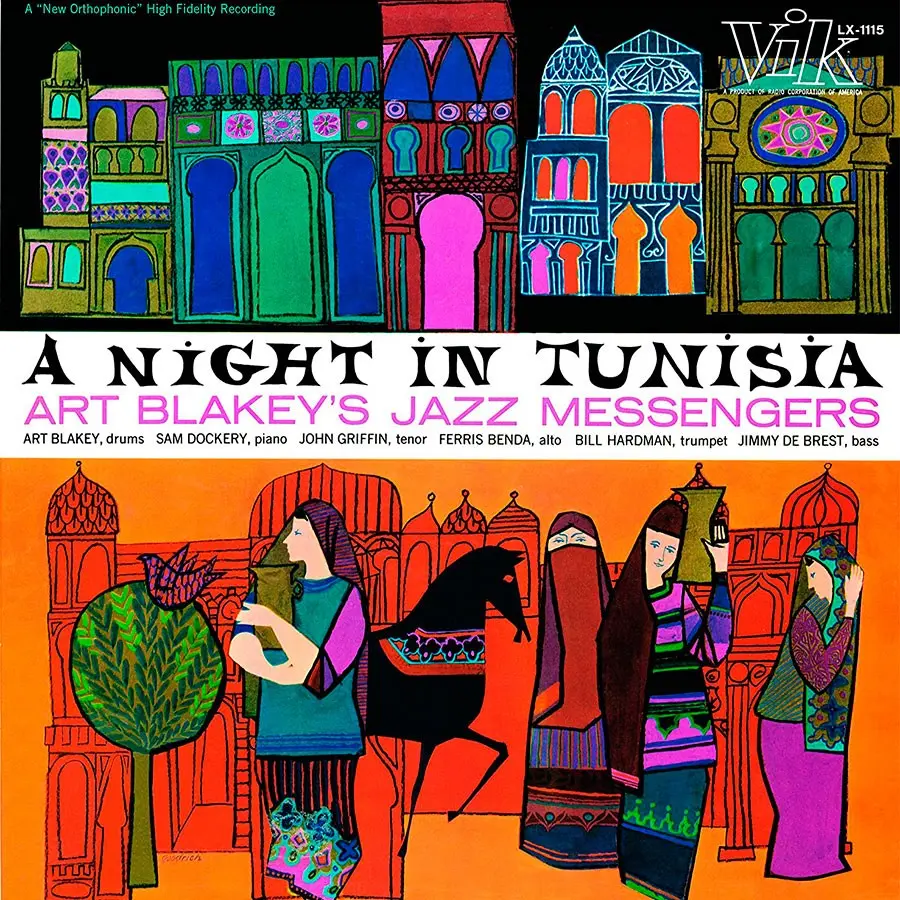 The Jazz Messengers released their seventh album, A Night in Tunisia, in February 1958 on Vik.
Tunisia features the only recorded collaboration between saxophonists Jackie McLean and Johnny Griffin, whose alto–tenor contrasts shape the album’s front line. Blakey’s ensemble includes trumpeter Bill Hardman, pianist Sam Dockery, and bassist Spanky DeBrest.
Hardman, Griffin, and McLean each contribute one composition. Hardman wrote “Theory of Art,” Griffin wrote “Off the Wall,” and McLean co-wrote “Couldn’t It Be You?” with Blakey. They also cover Sonny Rollins (“Evans”) and Dizzy Gillespie (“A Night in Tunisia”).
The title track opens with an extended drum prelude before the horns enter, stretching the theme across twelve minutes with alternating bursts of ensemble fire and drum breaks. Griffin’s “Off the Wall” places his tenor at the center with sharp angular lines, while McLean’s co-write with Blakey carries a tense rhythmic push. Hardman’s “Theory of Art” favors tighter horn voicings, while Rollins’ “Evans” gives the rhythm section a subtler framework to support the twin-sax frontline.
A1. “A Night in Tunisia” (12:55) – The piece unfolds from an extended percussion prologue into the familiar theme, the horns tracing sharp contours while Blakey pushes with volatile shifts in pace.
A2. “Off the Wall” (7:16) – Griffin’s composition drives forward with clipped horn figures, opening into vigorous solos that ride Blakey’s insistent undercurrent.
B1. “Theory of Art” (9:46) – Hardman’s tune balances bold ensemble statements with space for trumpet and saxophone to carve angular lines over the rhythm section’s steady pulse.
B2. “Couldn’t It Be You?” (8:12) – Co-written by Blakey and McLean, the theme carries quick turns and sudden accents, the improvisations stretching against its compact framework.
B3. “Evans” (6:30) – Rollins’ composition moves with rising arcs, the horns trading measured phrases while the rhythm section sustains a restless propulsion.
Sessions occurred on April 2 and 8, 1957, in New York City with producer Bob Rolontz.
Vik later reissued the album under the title Theory of Art with two nonet tracks, “A Night at Tony’s” and “Social Call,” featuring Lee Morgan, Melba Liston, Cecil Payne, Sahib Shihab, and Wynton Kelly. Subsequent CD editions of A Night in Tunisia added alternate takes of the title track, “Off the Wall,” and “Theory of Art.”
Art Blakey’s Jazz Messengers With Thelonious Monk
 In May 1958, Atlantic issued Art Blakey’s Jazz Messengers With Thelonious Monk, a collaboration between the drummer’s ensemble and the pianist.
The session paired the angular style of Monk with the direct force of Blakey’s hard bop quintet, producing one of the most distinctive cross-sections of 1950s modern jazz. Blakey’s lineup features trumpeter Bill Hardman, saxophonist Johnny Griffin (tenor), pianist Thelonious Monk, and bassist Spanky DeBrest.
Monk wrote five of the six numbers, including “Evidence,” “In Walked Bud,” “Blue Monk,” “I Mean You,” and “Rhythm-a-Ning.” Griffin contributed the closing piece, “Purple Shades.”
“Evidence” opens the album with Blakey’s roll into a stark horn theme, where Hardman presses forward in straight hard bop fashion before Monk dismantles the rhythm with clipped, percussive phrases. “In Walked Bud” carries a springing pace with Griffin’s tenor darting around Monk’s contorted runs. “Blue Monk” unfolds at a slower tempo, with Blakey’s accents pulling at Monk’s bluesy framework. “Rhythm-a-Ning” contrasts this with an uptempo charge and taut horn lines. Griffin’s “Purple Shades” offers a syncopated close that places Monk’s angular comping against the ensemble’s tighter horn voicings.
A1. “Evidence” (6:46) – The horns state the jagged theme in clipped bursts, Monk pushing against their lines with fractured chords while Blakey drives in restless flurries.
A2. “In Walked Bud” (6:39) – Monk’s springing theme sets up Griffin and Hardman, whose solos dart across shifting accents, with the pianist countering in oblique turns.
A3. “Blue Monk” (7:54) – A spacious blues stretched by Monk’s off-kilter phrasing, the horns leaning into extended arcs while Blakey underlines with sharp detonations.
B1. “I Mean You” (8:02) – The ensemble trades angular phrases over a brisk pulse, Griffin’s tenor racing ahead before Monk re-enters with spiky, staggered runs.
B2. “Rhythm-a-ning” (7:20) – The theme’s clipped syncopation sparks dense interplay, Blakey pressing forward as Monk splinters the harmony with sudden jolts.
B3. “Purple Shades” (7:48) – Griffin’s composition moves with a blues foundation, opening space for lyrical turns that Monk interrupts with stark counter-lines.
Sessions occurred on May 14–15, 1957, at Reeves Sound Studios in New York City with producer Nesuhi Ertegun and engineer Earl Brown.
Atlantic issued the album more than a year after recording, coinciding with Monk’s rising visibility during his Five Spot residency. Later CD reissues added alternate takes from the same sessions.
Art Blakey and The Jazz Messengers [Moanin‘]
 Art Blakey and The Jazz Messengers released their self-titled ninth studio album, alternately known as Moanin‘, in January 1959 on Blue Note.
The album showcased a revitalized lineup with a balance of gospel-infused themes, blues-rooted lines, and taut ensemble interplay that became a template for hard bop. Blakey’s band features trumpeter Lee Morgan, saxophonist Benny Golson (tenor), pianist Bobby Timmons, and bassist Jymie Merritt.
Timmons supplied the opening number “Moanin’,” while Golson wrote four tracks: “Are You Real?,” “Along Came Betty,” “The Drum Thunder Suite,” and “Blues March.” The quintet also covered the Harold Arlen–Johnny Mercer standard “Come Rain or Come Shine.”
“Moanin’” opens with Timmons’ call-and-response piano line, leading to Morgan’s declarative phrasing. “Are You Real?” unfolds as a brisk 32-bar piece where Morgan and Golson double lines. “Along Came Betty” slows the pace with long, arching figures. “The Drum Thunder Suite” highlights Blakey in three movements, from the tom-driven “Drum Thunder” to the closing “Harlem’s Disciples.” “Blues March” evokes New Orleans brass-band cadence, and the set closes with a sharp, clipped reading of “Come Rain or Come Shine.”
A1. “Moanin’” (9:35) – Timmons’ blues-based line unfolds in call-and-response phrases, the horns echoing the piano before the solos expand with clipped drive and rising arcs.
A2. “Are You Real” (4:50) – Golson’s theme moves with brisk pace and tight horn writing, setting up solos that pivot between sharp turns and longer flowing passages.
A3. “Along Came Betty” (6:12) – A long-lined theme carries a reflective cast, the improvisations layering subtle contours against Blakey’s steady undercurrent.
B1. “The Drum Thunder Suite” (7:33) – Cast in three movements, Blakey shapes explosive figures, somber accents, and surging polyrhythms, the horns framing each section with terse motifs.
B2. “Blues March” (6:17) – Golson adapts the cadence of parade rhythm into a driving ensemble statement, the solos stretching against its insistent, martial pace.
B3. “Come Rain or Come Shine” (5:49) – The ensemble recasts the standard in clipped syncopation, the rhythm section pressing forward as the horns bend the theme into angular lines.
Sessions occurred on October 30, 1958, at Van Gelder Studio in Hackensack, New Jersey, with producer Alfred Lion and engineer Rudy Van Gelder.
Blue Note issued the album under its catalog number BLP 4003. Its popularity quickly attached the title Moanin’ to the release, and several pieces — notably “Moanin’,” “Blues March,” and “Along Came Betty” — became permanent fixtures in the Jazz Messengers’ repertoire.
Jon Hendricks later wrote a vocalese lyric to “Moanin’,” recorded by Lambert, Hendricks & Ross. Jazz vocalists including Mel Tormé and Karrin Allyson subsequently recorded their own interpretations.
The Big Beat
 Art Blakey & The Jazz Messengers released their tenth album, The Big Beat, in September 1960 on Blue Note. The album captures a quintet lineup that balanced Blakey’s fiery rhythms with Wayne Shorter’s emerging compositional voice and Lee Morgan’s bright trumpet leads.
Blakey’s group features trumpeter Lee Morgan, saxophonist Wayne Shorter (tenor), pianist Bobby Timmons, and bassist Jymie Merritt.
Shorter wrote three of the album’s six tracks. Timmons contributed one number, while Bill Hardman wrote one piece. The set also includes a cover of a 1933 popular standard by Harold Arlen, E.Y. Harburg, and Billy Rose (“It’s Only a Paper Moon”).
“The Chess Players” unfolds as a spacious mid-tempo blues with alternating space and surges. “Sakeena’s Vision,” named for Blakey’s daughter, rides on a minor modal frame with sharp rhythmic turns and a mid-song Blakey feature. “Politely,” defined by its crisp backbeat, showcases the quintet’s sense of restraint and release. Timmons’ “Dat Dere” updates the piano–horn call style of his earlier “This Here.” Shorter’s “Lester Left Town” has a descending chromatic theme with tightly phrased horn lines. The closing “It’s Only a Paper Moon” recasts the standard with droning harmonies, staggered horn entrances, and a simmering swing pace.
A1. “The Chess Players” (9:31) – Shorter’s line unfolds with blues inflection, the horns voicing in tandem before the improvisations extend the theme in sharp contrasts of pacing and tone.
A2. “Sakeena’s Vision” (6:04) – Cast in a minor mode, the piece moves with shifting rhythmic accents, Blakey marking each turn while Shorter presses the harmony with elongated, angular phrasing.
A3. “Politely” (6:04) – Hardman’s composition leans on a steady backbeat, the quintet layering clipped ensemble figures against solos that alternate between pointed bursts and broader arcs.
B1. “Dat Dere” (8:47) – Timmons builds the theme from repeated phrases shaped in rising steps, the rhythm section maintaining forward drive as Morgan and Shorter expand its contours with bright urgency.
B2. “Lester Left Town” (6:26) – Shorter frames the piece with a chromatic descent, its taut structure allowing each soloist to bend the line through sudden shifts of pace and phrasing.
B3. “It’s Only a Paper Moon” (6:38) – The standard is recast with pared-down harmony and a slow swing pulse, the horns stretching the melody in elongated curves before Blakey punctuates with terse commentary.
Sessions occurred on March 6, 1960, at Van Gelder Studio with producer Alfred Lion and engineer Rudy Van Gelder.
Blue Note issued The Big Beat as BLP 4029. CD editions include an alternate take of “It’s Only a Paper Moon.”
A Night in Tunisia (1961)
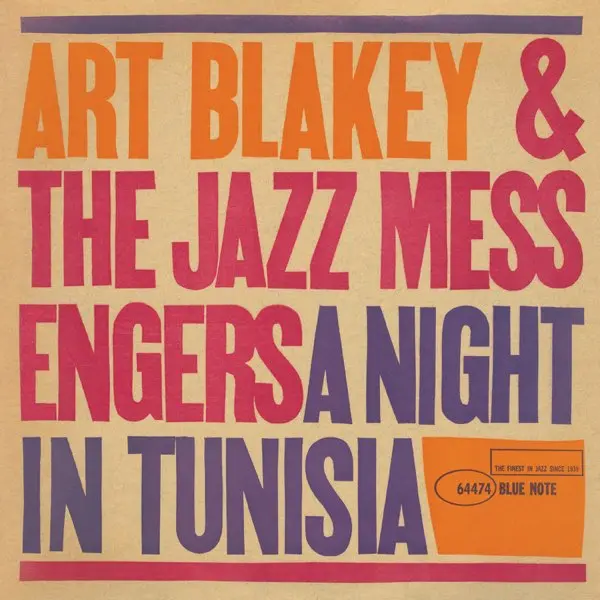 Art Blakey & The Jazz Messengers released their eleventh album, A Night in Tunisia, in January 1961 on Blue Note.
The album captures the group in a peak formation with Wayne Shorter emerging as a composer alongside Lee Morgan, Bobby Timmons, and Jymie Merritt, giving Blakey one of his most balanced and forceful lineups.
Blakey’s group features trumpeter Lee Morgan, saxophonist Wayne Shorter (tenor), pianist Bobby Timmons, and bassist Jymie Merritt.
Shorter contributed one composition. Morgan supplied two numbers, while Timmons wrote one piece. The quintet also recorded a version of Dizzy Gillespie’s standard “A Night in Tunisia,” co-written with Frank Paparelli.
The eleven-minute title track opens with a mambo-inflected pulse that Blakey drives with eruptive flourishes, broken by an extended drum solo before the horns return in angular counterpoint. “Sincerely Diana,” Shorter’s entry, rides on a brisk swing with a unison horn theme and bright solo passages. Timmons’ “So Tired” extends the blues-rooted mood of his earlier “Dat Dere.” Morgan’s two pieces provide contrast: “Yama” as a slow, moody ballad, and “Kozo’s Waltz” as an uptempo closer with hard rhythmic drive and a climactic Blakey feature.
A1. “A Night in Tunisia” (11:16) – The Gillespie theme stretches across shifting tempos, with Morgan and Shorter driving sharp-edged lines into Blakey’s surging figures, the drummer seizing center stage with an extended solo of layered cross-rhythms.
A2. “Sincerely Diana” (6:50) – Shorter’s writing frames a buoyant theme, the rhythm section pushing with clipped urgency as the tenor line opens into longer arcs, capped by a brief but incisive Blakey feature.
B1. “So Tired” (6:39) – Timmons introduces a blues-inflected theme built on insistent repetition, the ensemble lifting it with forward pace while solos pivot between angular runs and lyrical turns.
B2. “Yama” (6:23) – Morgan’s piece unfolds with a more subdued, ballad-like shape, the trumpet carving broad contours while Shorter and Timmons add subtle counterlines.
B3. “Kozo’s Waltz” (6:49) – Cast in triple meter, the tune sets a brisk dance-like pulse; Blakey’s solo erupts with cascading volleys before the horns return to close with tight ensemble clarity.
Sessions occurred on August 7 and 14, 1960, at Van Gelder Studio in Englewood Cliffs, New Jersey, with producer Alfred Lion and engineer Rudy Van Gelder. Blue Note issued A Night in Tunisia as BLP 4049.
Impulse!!!!! Art Blakey!!!!! Jazz Messengers!!!!!
 Art Blakey and the Jazz Messengers released their twelfth album, Impulse!!!!! Art Blakey!!!!! Jazz Messengers!!!!!, in September 1961 on Impulse!
The album expands the group to a sextet for the first time, introducing Curtis Fuller on trombone and marking Bobby Timmons’ final recording with the band before Cedar Walton replaced him.
The sextet features trumpeter Lee Morgan, trombonist Curtis Fuller, tenor saxophonist Wayne Shorter, pianist Bobby Timmons, bassist Jymie Merritt, and Blakey on drums.
Curtis Fuller contributed one composition, while the remaining five tracks are standards: Bronislau Kaper and Paul Francis Webster’s “Invitation,” Lou Alter and Bob Russell’s “Circus,” Gene de Paul and Don Raye’s “You Don’t Know What Love Is,” Jack Baker, George Fragos, and Dick Gasparre’s “I Hear a Rhapsody,” and Andy Razaf and Don Redman’s “Gee Baby, Ain’t I Good to You.”
The album opens with Fuller’s “À la Mode,” an energetic statement featuring Timmons’ piano figure layered beneath the horns. “Invitation” and “Circus” emphasize cool, contoured lines and subtle harmonic shifts, while “You Don’t Know What Love Is” transforms a downtrodden ballad into a moment of expressive tension. The ensemble alternates between hard-driving passages and restrained interplay, with Morgan and Shorter navigating angular solos and Blakey maintaining understated yet insistent rhythms throughout.
A1. “À la Mode” (6:40) – Fuller’s theme introduces the sextet with a sharp-edged contour, the horns layering angular responses over Timmons’ crisp chordal pulses, while Blakey interjects with subtle but driving accents.
A2. “Invitation” (7:25) – Curtis Fuller shapes the standard with extended trombone lines, Morgan and Shorter weaving tight counterpoints, Blakey punctuating with restrained, rolling figures that lift the harmonic tension.
A3. “Circus” (5:12) – The arrangement alternates between brisk unison passages and jagged solo turns, the rhythm section maintaining propulsive variations that underpin the shifting thematic shapes.
B1. “You Don’t Know What Love Is” (6:55) – A moody ballad transformed by Timmons’ piano and Blakey’s textured cymbal work, the horns tracing long, contoured phrases that ebb and swell with the rhythm section’s measured pacing.
B2. “I Hear a Rhapsody” (6:30) – Shorter and Morgan navigate angular improvisations over a steady underpinning from Merritt and Blakey, while Fuller punctuates with crisp interjections that reorient the ensemble’s forward motion.
B3. “Gee Baby, Ain’t I Good to You” (5:00) – The group balances muted trumpet lines with soft, rolling drum textures, Timmons’ subtle fills accentuating the angular phrasing of the horns without breaking the gentle, swinging pulse.
Sessions occurred on June 13–14, 1961, at Van Gelder Studio with producer Bob Thiele and engineer Rudy Van Gelder.
Mosaic
 Art Blakey & The Jazz Messengers released their thirteenth album, Mosaic, in October 1961 on Blue Note.
This recording marks the first session of the Messengers as a sextet, a formation that would persist from 1961 to 1964, and introduces Freddie Hubbard on trumpet and Cedar Walton on piano alongside returning members Curtis Fuller, Wayne Shorter, Jymie Merritt, and Art Blakey.
The lineup features trumpeter Freddie Hubbard, trombonist Curtis Fuller, tenor saxophonist Wayne Shorter, pianist Cedar Walton, bassist Jymie Merritt, and Blakey on drums.
All six compositions are penned by the band members. Cedar Walton wrote the title track, Freddie Hubbard contributed two pieces, Wayne Shorter composed one, and Curtis Fuller provided one. There are no covers on this album.
Walton’s Mosaic opens the set with a frenetic, high-energy theme built on Eastern modes, featuring Blakey’s fiery solo and sharp, interlocking horn lines. Hubbard’s Down Under leans on blues and gospel inflections, with the horns engaging in concise, angular interplay. Shorter’s Children of the Night demonstrates contrapuntal mastery, his tenor lines cutting cleanly through the ensemble while maintaining a swinging hard bop pulse. Fuller’s Arabia blends bluesy phrasing with shaded harmonies and crescendos driven by the trombone, while the closing Crisis highlights the rhythm section’s precision, layering Walton’s minor-key riff beneath Blakey and Merritt’s driving patterns as the horns enter. The ensemble sustains energy throughout, balancing fast-paced passages with tightly coordinated moments of restraint.
A1. “Mosaic” (8:13) – Walton’s composition opens with a blazing tempo, layering Eastern-inspired motifs with sharp, contoured horn lines, while Blakey drives with rolling, punctuated drums that both anchor and propel the ensemble.
A2. “Down Under” (5:29) – Hubbard’s trumpet leads with sinuous, angular phrases over a steady, blues-inflected pulse, Shorter and Fuller weaving responsive counterlines as the rhythm section maintains flexible, forward-moving variations.
A3. “Children of the Night” (8:51) – Shorter’s tenor charts a dense, flowing path through Walton’s harmonies, alternating between long, interlaced phrases and brisk, incisive runs, as the horns accentuate his lines with tight, pointed responses.
B1. “Arabia” (9:10) – Fuller shapes the piece with harmonically shaded trombone lines, while the horns layer intersecting motifs over Walton’s minor-key figures; Blakey and Merritt maintain relentless, subtly shifting patterns that structure the expanding dynamics.
B2. “Crisis” (8:33) – Hubbard and Shorter trade sharp, contoured phrases over a foundation of Blakey’s rolling, accented drumming, Walton interjects spiraling motifs, and Merritt anchors the ensemble with incisive, forward-moving bass figures that give the composition a driving force.
Sessions occurred on October 2, 1961, at Van Gelder Studio with Alfred Lion producing and Rudy Van Gelder engineering.
The African Beat
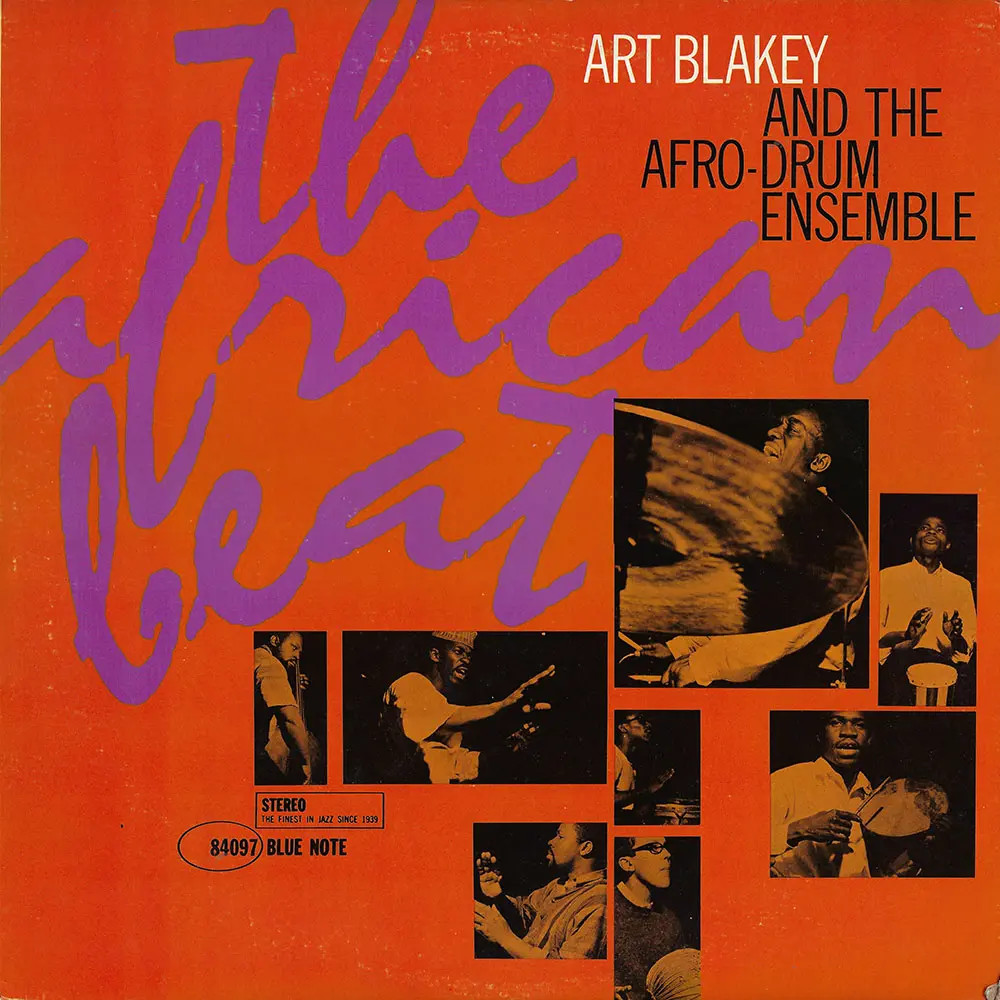 Art Blakey and the Afro-Drum Ensemble released their singular album, The African Beat, in November 1962 on Blue Note. The album merges American jazz with West African rhythms, featuring multiple percussionists alongside a small horn and bass section.
The ensemble features Art Blakey on drums, timpani, telegraph drum, and gong; Ahmed Abdul-Malik on bass; Yusef Lateef on oboe, flute, tenor saxophone, cow horn, and mbira; Curtis Fuller on timpani; Chief Bey on double gong, conga, and telegraph drum; Robert Crowder on Batá drum and conga; James Ola Folami on conga; Solomon G. Ilori on vocals, talking drum, and pennywhistle; Montego Joe on corboro drum, log drum, bambara drum, and double gong; and Garvin Masseaux on shekere, African maracas, and conga.
Compositions are credited to African and American musicians within the ensemble. Solomon G. Ilori contributed four pieces, including “Ife L’ayo” and “Ayiko, Ayiko.” Garvin Masseaux wrote “Obirin African,” Guy Warren composed “Love, the Mystery of,” and James H. Bey contributed “Tobi Ilu.”
The album opens with Ilori’s brief “Prayer,” setting a ritualistic tone. “Ife L’ayo” and “Obirin African” blend vocal chants and layered percussion with angular horn phrases from Lateef. Warren’s “Love, the Mystery of” stretches over nine minutes, contrasting spacious, minimal textures with interwoven drum patterns. The B-side emphasizes rhythmic drive: “Ero Ti Nr’Ojeje” introduces full ensemble energy, while “Ayiko, Ayiko” layers chant-like vocals over a dense percussion foundation. Bey’s “Tobi Ilu” closes with intertwined congas and shekere, leaving percussion as the central voice. Lateef’s multi-instrumental work punctuates the ensemble, weaving through the dense rhythmic landscape with bursts of melodic color.
A1. “Prayer by Solomon G. Ilori” (0:55) – A brief, ceremonial introduction, layering muted drums and vocal chants that establish the rhythmic and tonal palette of the ensemble.
A2. “Ife L’ayo (There Is Happiness in Love)” (5:31) – Ilori’s vocals trace angular, shifting lines over interlocking drum patterns, while Blakey and the percussionists punctuate with crisp, forward-moving strikes.
A3. “Obirin African (Woman of Africa)” (3:45) – Masseaux’s composition unfolds through repeating percussion motifs and subtle flurries from Lateef’s flute and oboe, emphasizing nuanced rhythmic variation.
A4. “Love, The Mystery of” (9:22) – Warren’s piece develops through extended tonal cycles, with layered gongs and congas underpinning short, contoured horn and flute interjections that punctuate the evolving tempo.
B1. “Ero Ti Nr’Ojeje” (7:33) – Ilori leads a chant-driven performance over intricate, multi-drum textures, Blakey’s accented rolls interweaving with the ensemble to heighten tension and momentum.
B2. “Ayiko, Ayiko (Welcome, Welcome, My Darling)” (7:13) – A spirited call-and-response emerges, with overlapping percussion and Lateef’s multi-instrumental lines creating constantly shifting rhythmic emphasis.
B3. “Tobi Ilu” (5:56) – Bey’s arrangement balances layered drum voices against Lateef’s oboe and flute, building in tempo and dynamics while maintaining a precise, interlocked structure throughout.
Sessions occurred on January 24, 1962, at Van Gelder Studio with Alfred Lion producing and Rudy Van Gelder engineering.
Caravan
 Art Blakey & The Jazz Messengers released their fourteenth album, Caravan, in February 1963 on Riverside.
This was Blakey’s first session for Riverside following his October 1962 signing. The quintet delivers hard bop performances that mix original compositions with reinterpretations of jazz and pop standards. The ensemble balances the fiery interplay of horns with tight rhythmic support, emphasizing both intensity and ensemble cohesion.
The core backing players are trombonist Curtis Fuller, trumpeter Freddie Hubbard, tenor saxophonist Wayne Shorter, pianist Cedar Walton, and bassist Reggie Workman, with Blakey on drums.
Compositions come primarily from band members. Shorter contributed two originals, “Sweet ‘n’ Sour” and “This Is for Albert,” while Hubbard wrote “Thermo.” Covers include Juan Tizol’s “Caravan,” popularized by Duke Ellington, and renditions of “In the Wee Small Hours of the Morning” (Mann, Hilliard) and “Skylark” (Carmichael, Mercer).
The album opens with the title track, a sprawling reinterpretation of Tizol’s piece. The melody snakes around Blakey’s strident flurries and syncopation, while Fuller, Hubbard, and Shorter exchange sharp, angular phrases. Shorter’s “Sweet ‘n’ Sour” emphasizes ensemble interplay, and “This Is for Albert” sustains that collective drive. Hubbard’s “Thermo” displays more angular lines and aggressive execution. Ballad readings of “Skylark” and “In the Wee Small Hours of the Morning” contrast the high-energy tracks with restrained, contoured phrasing.
A1. “Caravan” (9:47) – Tizol’s exotic theme twists through Blakey’s dense, syncopated drumming; Hubbard and Shorter trade sharp, angular solos over Fuller’s punctuated trombone lines, with Walton and Workman anchoring the shifting tempo.
A2. “Sweet ‘n’ Sour” (5:31) – Shorter’s composition propels forward with brisk, interlocking horn figures, layered over subtle shifts in rhythm from Blakey and a steady, probing bass foundation.
A3. “In the Wee Small Hours of the Morning” (4:06) – A slow, contemplative arrangement allows piano chords and saxophone lines to curve gently, with restrained drumming accentuating the piece’s reflective pacing.
B1. “This Is for Albert” (8:21) – The ensemble builds through repeating motifs and angular horn phrases, Blakey punctuating with crisp bursts while the rhythm section alternates between steady drive and surging intensity.
B2. “Skylark” (4:51) – Carmichael’s classic unfolds with long, contoured lines in the horns and piano, subtle variations in pace highlighting the tension and release within the harmonic framework.
B3. “Thermo” (6:48) – Hubbard’s composition twists with jagged, intersecting horn lines; Blakey punctuates with explosive rolls, while Walton and Workman respond with shifting tempos that accentuate the ensemble’s fiery energy.
CD bonus tracks:
7. “Thermo (Take 2)” (7:26) – An alternate take emphasizing tighter interplay between horns and rhythm, accentuating angular phrasing and driving, punctuated percussive motifs.
8. “Sweet ‘n’ Sour (Take 4)” (5:27) – A variant with subtle tempo variations and more aggressive horn interaction, Blakey accenting transitions with sharply timed rolls and fills.
Sessions occurred at Plaza Sound Studios in New York City on October 23–24, 1962, with producer Orrin Keepnews and engineer uncredited.
Caravan features a standard early-1960s jazz cover showing Blakey seated, with a bold typeface for the album title against a plain background.
Buhaina’s Delight
 Art Blakey & The Jazz Messengers released their fifteenth album, Buhaina’s Delight, in July 1963 on Blue Note. They recorded the tracks during the holiday 1961 season, prior to the sessions for The African Beat and Caravan.
This lineup showcases hard bop with rhythmic intensity and bright, bouncy passages. The ensemble emphasizes tight interplay and layered solos, alternating between brisk, blues-inflected numbers and more contemplative ballads.
The core backing players are trombonist Curtis Fuller, trumpeter Freddie Hubbard, tenor saxophonist Wayne Shorter, pianist Cedar Walton, and bassist Jymie Merritt, with Blakey on drums.
Wayne Shorter wrote three compositions, including “Backstage Sally,” “Contemplation,” and “Reincarnation Blues.” Curtis Fuller contributed the title track “Bu’s Delight,” and Cedar Walton wrote “Shaky Jake.” The album includes a cover of Henry Mancini and Johnny Mercer’s “Moon River.”
The album opens with Shorter’s “Backstage Sally,” a tight, blues-based number with brisk solos from the horns. “Contemplation” is a ballad featuring intertwined horn lines supporting Shorter’s tenor solo. Fuller’s “Bu’s Delight” delivers a hard-bopping, energetic performance with Blakey’s driving drum accents. Shorter’s “Reincarnation Blues” combines counterpoint and unison passages, punctuated by Walton’s piano and Hubbard’s high-flying trumpet. Walton’s “Shaky Jake” explores low, moaning blues tones over a steady shuffle, while “Moon River” reimagines the waltz as a frisky, hard-bop showcase with layered horn solos.
A1. “Backstage Sally” (5:58) – Shorter’s tenor threads angular phrases over tightly synchronized horn stabs, Blakey punctuating with crisp, rolling accents while Walton and Merritt maintain steady, propulsive pacing.
A2. “Contemplation” (6:18) – A reflective ballad where the tenor sax contours the theme with measured, elongated lines, supported by subtle piano harmonies and restrained rhythmic pulses from the drums.
A3. “Bu’s Delight” (9:20) – Fuller’s composition propels forward with sharp, staccato horn motifs, Blakey unleashing percussive bursts and Walton interjecting spiraling, rhythmic piano runs.
B1. “Reincarnation Blues” (6:36) – Horns alternate in counterpoint, exchanging short, precise phrases before uniting on the main theme, while bass and drums anchor the tempo with steady, swinging variations.
B2. “Shaky Jake” (6:38) – Walton leads with a low, moaning line over Blakey’s forceful backbeat; horns echo and expand the theme, punctuating the piece with tight bursts of rhythmic energy.
B3. “Moon River” (5:12) – The familiar waltz is refracted through angular horn lines and shifting tempo, Blakey interjecting sudden drum rolls, and each solo carving sharp turns through the harmonic landscape.
Sessions occurred at Van Gelder Studio in Englewood Cliffs, New Jersey, on November 28 and December 18, 1961, with producer Alfred Lion.
Ugetsu: Art Blakey’s Jazz Messengers at Birdland
 In October 1963, Riverside issued Ugetsu: Art Blakey’s Jazz Messengers at Birdland, a document of their June 16 set at the Birdland club in New York City.
The live set presents hard bop with dynamic interplay and spirited solos, balancing Shorter’s sophisticated compositions with contributions from Curtis Fuller and Cedar Walton. The ensemble navigates brisk tempos and extended improvisations while retaining clarity and precision in each line.
The core backing players are trombonist Curtis Fuller, trumpeter Freddie Hubbard, tenor saxophonist Wayne Shorter, pianist Cedar Walton, and bassist Reggie Workman, with Art Blakey on drums.
Wayne Shorter wrote four compositions, including “One By One,” “Ping-Pong,” “On the Ginza,” and “Eva.” Curtis Fuller contributed two pieces, “Time Off” and “The High Priest,” and Cedar Walton composed the title track “Ugetsu.” The set includes covers of Richard Rodgers and Lorenz Hart’s “I Didn’t Know What Time It Was,” George Shearing’s “Conception,” and Miles Davis’s “The Theme.”
Shorter’s “One By One” opens the set with angular, tenor-led lines, supported by tight horn riffs and precise, driving drums. Walton’s “Ugetsu” blends complex harmonic structures with energetic solos from Hubbard and Shorter. Fuller’s “Time Off” and “The High Priest” deliver brisk, hard-bopping statements with punchy brass passages, while Shorter’s “Ping-Pong” alternates rhythmic turns between horns and rhythm section. Walton’s “On the Ginza” and Shorter’s “Eva” pay homage to Japan with lively, structured improvisations. The Rodgers/Hart cover introduces lyrical phrasing amidst the ensemble’s assertive backing.
A1. “One By One” (6:18) – Shorter leads with sinuous tenor lines over tightly interlocked horn riffs, Blakey punctuating with rolling accents while Walton and Workman maintain a propulsive, varied pace.
A2. “Ugetsu” (11:03) – Walton’s composition unfolds with contoured phrases, horns exchanging angular motifs, and Blakey injecting sharp, dynamic drum punctuation to frame each solo.
A3. “Time Off” (4:56) – Fuller’s trombone carries clipped, precise statements, interwoven with ensemble riffs and energetic drum bursts that shift the tempo in subtle, driving ways.
B1. “Ping-Pong” (8:09) – Shorter’s tenor snakes between abrupt rhythmic stops and flowing motifs, the front line trading lines in rapid alternation, anchored by steady, varied drumming.
B2. “I Didn’t Know What Time It Was” (6:32) – The ballad is rendered with smooth, extended phrases, horns weaving soft counterpoints over a gently undulating rhythm section.
B3. “On the Ginza” (7:04) – Shorter evokes angular turns across the theme, with interspersed trumpet flurries and punctuated drum fills, building tension through layered rhythmic variation.
Bonus Tracks (2011 CD reissue)
7. “Eva” (5:55) – Tenor sax lines carve through the ensemble with alternating rapid bursts and lingering notes, drums and bass shaping a lively, unpredictable pace.
8. “The High Priest” (5:32) – Fuller’s trombone commands sharp, staccato phrases while Blakey and Workman vary the tempo in tight, rhythmic shifts, sustaining the ensemble’s energy.
9. “Conception” (5:15) – Shearing’s theme is interpreted with angular horn passages and responsive rhythmic textures, punctuated by abrupt drum accents and flowing bass patterns.
10. “The Theme” (1:43) – A brief, declarative closing statement with horns unifying over concise phrases and Blakey driving the tempo with controlled, dynamic strikes.
Sessions occurred live at Birdland, New York City, on June 16, 1963, with producer Orrin Keepnews capturing the performance.
The Freedom Rider
 Art Blakey & The Jazz Messengers released their sixteenth studio album, The Freedom Rider, in July 1964 on Blue Note. It’s techically their twelfth-recorded album, containing tracks recorded in the winter/spring of 1961 between A Night in Tunisia and Impulse!!!!!
The album delivers hard bop with an assertive, driving rhythm and expansive solos, featuring compositions by Wayne Shorter, Lee Morgan, Kenny Dorham, and Blakey himself. It captures the final recordings of this particular lineup before Morgan’s departure and highlights Blakey’s percussive intensity alongside expressive horns and piano.
The core backing players are trumpeter Lee Morgan, tenor saxophonist Wayne Shorter, pianist Bobby Timmons, and bassist Jymie Merritt, with Art Blakey on drums.
Wayne Shorter contributed two compositions, “Tell It Like It Is” and “El Toro.” Lee Morgan wrote three tracks, “Petty Larceny,” “Blue Lace,” and the CD bonus pieces “Uptight” and “Pisces.” Blakey composed the title track “The Freedom Rider,” and Kenny Dorham wrote the bonus track “Blue Ching.”
The album opens with Shorter’s “Tell It Like It Is,” a driving, angular piece with bold horn statements and dynamic interplay. The title track is a seven-minute drum solo in which Blakey weaves swing, Latin, and African rhythmic motifs into a continuous, evolving texture. Shorter’s “El Toro” maintains brisk, complex lines, while Morgan’s “Petty Larceny” and “Blue Lace” provide elegant and blues-infused statements, balancing assertive and contemplative moments. Bonus tracks on the CD expand the session with additional Morgan, Shorter, and Dorham compositions, maintaining cohesion with the main set.
A1. “Tell It Like It Is” (7:53) – Shorter’s tenor weaves contoured lines over the ensemble, horns interlocking in sharp turns while Blakey drives the pace with rolling, varied rhythms.
A2. “The Freedom Rider” (7:25) – Blakey commands a solo drum odyssey, shifting tempo, dynamics, and rhythmic textures with repeated motifs that evolve organically over the seven-minute span.
B1. “El Toro” (6:20) – Shorter’s composition features angular horn exchanges, punctuated by brisk, propulsive drumming and Walton’s punctuated piano phrases, maintaining an agile, shifting tempo.
B2. “Petty Larceny” (6:14) – Morgan’s trumpet asserts bold, curt statements as horns and rhythm section interweave, Blakey accentuating transitions with dynamic percussion bursts.
B3. “Blue Lace” (5:59) – The arrangement alternates flowing, contoured passages with sharp, staccato motifs, horns converging in layered lines atop Blakey’s responsive drumming.
Bonus tracks on CD reissue
6. “Uptight” (6:12) – Trumpet and tenor exchange angular phrases while the rhythm section varies pace and intensity, creating tension and release across each chorus.
7. “Pisces” (6:52) – Horn lines punctuate and intersect, piano and bass maintain a shifting undercurrent of rhythm, Blakey articulating accents to enhance dynamic contrasts.
8. “Blue Ching” (6:43) – Dorham’s trumpet explores contoured intervals while ensemble figures interlock with sudden rhythmic changes, drums and bass driving forward with subtle variation.
Sessions occurred at Van Gelder Studio on February 12, February 18, and May 27, 1961, with producer Alfred Lion.
Free for All
 Art Blakey & The Jazz Messengers released their seventeenth album, Free for All, in July 1965 on Blue Note.
The album pushes hard bop into a more intense, avant-garde register, anchored by explosive drumming, intricate horn lines, and a rhythm section that sustains high energy throughout. This session was Freddie Hubbard’s last with the Messengers, closing a four-year period of ensemble stability that began in 1961.
The core backing players are trumpeter Freddie Hubbard, trombonist Curtis Fuller, tenor saxophonist Wayne Shorter, pianist Cedar Walton, and bassist Reggie Workman, with Art Blakey on drums.
Wayne Shorter wrote two tracks, the title track “Free for All” and “Hammer Head.” Freddie Hubbard contributed “The Core,” while Clare Fischer wrote “Pensativa,” arranged by Hubbard for the session.
The album opens with Shorter’s “Free for All,” an eleven-minute assault of free-form improvisation balanced by rhythmic cohesion, with Blakey driving a cascade of explosive percussion while Shorter, Hubbard, and Fuller exchange layered solos. “Hammer Head” moves at a steadier pace, blending blues and soul references with controlled yet expressive solos from the horn section and Walton’s lively piano. Hubbard’s “The Core” dedicates its fiery interplay to the Congress of Racial Equality, combining syncopated trumpet and trombone lines with Shorter’s incisive saxophone over Blakey’s unrelenting drumming. Fischer’s “Pensativa” closes the album with a more reflective, Latin-infused contour, featuring subtle percussion, arpeggiated piano, and fluid solos that offer a tempered balance to the preceding intensity.
A1. “Free for All” (11:04) – Shorter’s tenor cuts through dense layers of horns, alternating sharp turns and angular motifs while Blakey propels the ensemble with explosive, multi-textured drumming and sudden shifts in pace.
A2. “Hammer Head” (7:47) – The horns articulate punctuated lines over a mid-tempo pulse, solos interweaving with Walton’s bright, propulsive piano and Blakey’s vigorous, responsive drumming.
B1. “The Core” (9:24) – Hubbard’s trumpet and Fuller’s trombone collide and separate in syncopated bursts, Shorter’s tenor navigates contoured lines, and Blakey drives relentless rhythmic variation beneath the ensemble.
B2. “Pensativa” (8:19) – The arrangement moves through flowing, layered passages, piano arpeggios and percussion accents creating subtle rhythmic shifts while horns trace sharp, expressive turns.
2014 Japan SHM-CD bonus:
5. “Free for All” (Alternate Take) (8:26) – This version trims the title track while preserving Shorter’s angular phrasing and the ensemble’s intense interplay, with Blakey’s dynamic drumming maintaining continuous propulsion.
Sessions occurred at Van Gelder Studio in Englewood Cliffs, New Jersey, on February 10, 1964, with producer Alfred Lion.
Indestructible
 In late 1966, Blue Note issued Indestructible, an album comprised of April/May 1964 sessions by Art Blakey & The Jazz Messengers.
The album spans modal explorations and traditional hard bop, anchored by Blakey’s dynamic drumming and the ensemble’s interlocking horns. It marked the final Blue Note recordings for pianist Cedar Walton, bassist Reggie Workman, and tenor saxophonist Wayne Shorter, while bringing Lee Morgan back on trumpet for this session.
The core backing players are trumpeter Lee Morgan, trombonist Curtis Fuller, tenor saxophonist Wayne Shorter, pianist Cedar Walton, and bassist Reggie Workman, with Art Blakey on drums.
Curtis Fuller wrote two tracks, “The Egyptian” and “Sortie,” Wayne Shorter contributed two, “Mr. Jin” and “It’s a Long Way Down,” while Lee Morgan composed “Calling Miss Khadija” and Cedar Walton wrote “When Love Is New.”
Fuller’s “The Egyptian” opens with Walton’s pensive piano, expanding into layered exchanges between brass and woodwinds, with Morgan, Fuller, and Shorter trading solos over shifting rhythms. “Sortie” emphasizes blues-inflected lines, supported by Walton’s slightly modal piano, contrasting with the more conventional flipside. Morgan’s “Calling Miss Khadija” introduces a lively, Latin-tinged pace, and Walton’s “When Love Is New” slows the mood with a contemplative, broken-hearted contour. Shorter’s “Mr. Jin” closes the original LP with expressive soloing, while the CD bonus track “It’s a Long Way Down” aligns with the side-two character rather than the modal intensity of side one.
A1. “The Egyptian” (10:25) – Fuller’s trombone opens with angular lines that interweave with Walton’s contemplative piano, while Morgan and Shorter trade solos over shifting rhythmic textures, building tension through layered brass dialogue.
A2. “Sortie” (8:13) – Trombone riffs punctuate a blues-tinged framework as Walton’s piano and Blakey’s percussive drive introduce subtle modal twists, propelling the ensemble through dynamic variations in pace.
B1. “Calling Miss Khadija” (7:21) – Morgan’s trumpet carries a sinuous line over subtle piano harmonies, the horns interplay with staggered responses, and Blakey maintains a swinging, flexible pace.
B2. “When Love is New” (6:02) – Walton’s delicate, contoured chords frame the ensemble, allowing the horns to trace expressive, sharply turned lines while the rhythm section subtly varies tempo and accent.
B3. “Mr. Jin” (7:04) – Shorter leads with angular phrasing as the horns weave and diverge, piano and bass punctuate transitions, and Blakey drives an energetic, unyielding propulsion.
CD bonus:
6. “It’s a Long Way Down” (5:26) – Layers precise horn unisons over shifting rhythmic undercurrents, piano and drums interject with accentuated variations while Shorter’s tenor arcs through contoured passages.
Sessions occurred in 1964 at Van Gelder Studio, where they recorded “Mr. Jin” on April 24 and the rest on May 15 with producer Alfred Lion.
Like Someone in Love
 In 1967, Blue Note issued Like Someone in Love, an album comprised of August 1960 tracks by Art Blakey & The Jazz Messengers.
The album blends introspective hard bop with restrained rhythmic variation, contrasting the extroverted energy of A Night in Tunisia from the same sessions. Blakey drives the ensemble with subtle but precise timekeeping, while the quintet balances expressive solos with carefully structured group interplay.
The core backing players are trumpeter Lee Morgan, tenor saxophonist Wayne Shorter, pianist Bobby Timmons, and bassist Jymie Merritt, alongside Art Blakey on drums.
Lee Morgan contributed one composition, “Johnny’s Blue,” and Wayne Shorter wrote three, including “Noise in the Attic,” “Sleeping Dancer Sleep On,” and “Giantis.” The title track, “Like Someone in Love,” is a cover of the popular standard by Johnny Burke and Jimmy Van Heusen.
The album opens with the contemplative “Like Someone in Love,” featuring Timmons’ sensitive piano introductions and Morgan’s flugelhorn contours. “Johnny’s Blue” delivers a moderate-paced statement with Morgan’s trumpet leading, while Shorter’s “Noise in the Attic” accelerates tempo with intricate phrasing and a Blakey drum showcase. “Sleeping Dancer Sleep On” unfolds in waltz-time with tender interplay between piano, saxophone, and brushes, and “Giantis” closes the LP with dynamic hard bop lines and measured rhythmic propulsion. The CD bonus presents an alternate take of “Sleeping Dancer Sleep On,” emphasizing subtle shifts in tempo and tonal color.
A1. “Like Someone in Love” (8:04) – Timmons’ piano opens with delicate, contoured chords, Blakey’s drumming flows with nuanced pace, and the horns trace angular lines that intertwine over a steady rhythmic undercurrent.
A2. “Johnny’s Blue” (9:12) – Morgan leads with assertive trumpet phrases, Shorter responds with sharply turned tenor lines, and the ensemble navigates shifting rhythmic accents with controlled propulsion.
B1. “Noise in the Attic” (7:54) – Blakey drives an energetic, complex drum framework while horns weave brisk, contoured exchanges, and piano interjects with punctuated, intricate variations.
B2. “Sleeping Dancer Sleep On” (8:06) – Shorter’s tenor arcs with flowing, mournful turns, piano articulates subtle, waltz-time harmonies, and Blakey’s brushes maintain a gentle, evolving pulse.
B3. “Giantis” (5:35) – The ensemble launches angular trumpet and sax lines over shifting rhythmic foundations, with piano and bass accentuating the interplay and adding depth to the textures.
CD bonus:
6. “Sleeping Dancer Sleep On” [Alternate Take] (8:05) – A variation of the waltz-time piece, emphasizing nuanced phrasing, slight shifts in tempo, and delicate interplay between piano, horns, and percussion.
Sessions occurred in 1960 at Van Gelder Studio on August 7 (B1–2, 6) and August 14 (Side A, B5) with producer Alfred Lion.
The Witch Doctor
 In 1967, Blue Note issued The Witch Doctor, an album comprised of March 1961 tracks by Art Blakey & The Jazz Messengers.
The album balances fiery hard bop with measured modal excursions, blending the precision of Blakey’s drumming with angular phrasing and rhythmic variation. Trumpet and tenor saxophone dialogues dominate the front line, while piano and bass provide both harmonic depth and steady propulsion.
The core backing players are trumpeter Lee Morgan, tenor saxophonist Wayne Shorter, pianist Bobby Timmons, and bassist Jymie Merritt, alongside Art Blakey on drums.
Lee Morgan contributed two compositions, “The Witch Doctor” and “Afrique,” while Wayne Shorter wrote two, “Those Who Sit and Wait” and “Joelle.” Bobby Timmons contributed one, “A Little Busy,” and the album includes a composition by Clifford Jordan, “Lost and Found.” The CD reissue adds an alternate take of “The Witch Doctor.”
The album opens with Morgan’s title track, which drives with a brisk shuffle and playful horn-piano exchanges. “Afrique” blends 6/8 modal patterns with choppy Latin beats and swing, highlighting the front line’s dynamic range. Shorter’s “Those Who Sit and Wait” and “Joelle” emphasize darker tonal colors and non-sequitur harmonies, while Timmons’ “A Little Busy” showcases rhythmic vitality and blues-inflected phrasing. “Lost and Found” closes with buoyant, straight-ahead momentum, balancing the set with a lighter, celebratory feel.
A1. “The Witch Doctor” (5:32) – Morgan drives the theme with bold, sharply contoured trumpet lines, Blakey punctuates with dynamic drumming, and piano and tenor interweave around sudden rhythmic shifts.
A2. “Afrique” (6:58) – A 6/8 clave underpins Morgan’s assertive trumpet and Shorter’s dense tenor, while piano articulates angular chords that merge modal color with swinging pace.
A3. “Those Who Sit and Wait” (5:54) – Tenor and trumpet exchange abrupt, off-minor lines over a controlled, pulsing rhythm; piano punctuates with precise, abrupt harmonies.
B1. “A Little Busy” (6:18) – Timmons’ piano propels lively, syncopated passages while horns punctuate with brisk turns, and Blakey varies tempo to energize the piece.
B2. “Joelle” (5:13) – Shorter’s tenor weaves long, contoured phrases, piano chords drop in irregular patterns, and the ensemble navigates subtle shifts in pace.
B3. “Lost and Found” (5:06) – Jordan’s composition emphasizes upbeat, angular horn lines and precise rhythmic variations, underpinned by steady, articulate drumming.
CD bonus:
7. “The Witch Doctor” [Alternate Take] (5:33) – A second rendition of the title track, highlighting slightly different trumpet inflections and rhythmic interplay while maintaining sharp, kinetic energy.
Sessions occurred on March 14, 1961, at Van Gelder Studio with producer Alfred Lion.
Discography:
- A Night at Birdland, Vol. 1 (1954 • Art Blakey Quintet)
- A Night at Birdland, Vol. 2 (1954 • Art Blakey Quintet)
- The Jazz Messengers at the Cafe Bohemia, Volume 1 (1956 • The Jazz Messengers)
- The Jazz Messengers at the Cafe Bohemia, Volume 2 (1956 • The Jazz Messengers)
- The Jazz Messengers (1956 • The Jazz Messengers)
- Selections From Lerner and Loewe’s (1957 • Art Blakey’s Jazz Messengers)
- A Midnight Session with the Jazz Messengers (1957 • The Jazz Messengers)
- Orgy in Rhythm, Volume 1 (1957)
- Drum Suite (1957 • Art Blakey and the Jazz Messengers)
- Hard Bop (1957 • The Jazz Messengers)
- Orgy in Rhythm, Volume 2 (1957)
- Cu-Bop (1957 • Art Blakey and His Jazz Messengers)
- Hard Drive (1957 • Art Blakey’s Jazz Messengers)
- A Night in Tunisia (1958 • Art Blakey’s Jazz Messengers)
- Art Blakey’s Jazz Messengers With Thelonious Monk (1958 • Art Blakey’s Jazz Messengers With Thelonious Monk)
- Art Blakey and The Jazz Messengers [Moanin‘] (1959 • Art Blakey and The Jazz Messengers)
- Art Blakey Big Band (1959 • Art Blakey’s Big Band)
- Des Femmes Disparaissent (OST, 1959 • The Jazz Messengers)
- Ritual (1959)
- Holiday for Skins, Vol. 1 (1959)
- Holiday for Skins, Vol. 2 (1959)
- Les liaisons dangereuses 1960 (OST, 1960 • Art Blakey’s Jazz Messengers avec Barney Wilen)
- The Big Beat (1960 • Art Blakey & The Jazz Messengers)
- A Night in Tunisia (1961 • Art Blakey & The Jazz Messengers)
- Impulse!!!!! Art Blakey!!!!! Jazz Messengers!!!!! (1961 • Art Blakey and the Jazz Messengers)
- Mosaic (1962 • Art Blakey & The Jazz Messengers)
- Midnight Session (1962 • Art Blakey and the Jazz Messengers)
- The African Beat (1962 • Art Blakey and The Afro-Drum Ensemble)
- Caravan (1962 • Art Blakey Jazz Messengers)
- Buhaina’s Delight (1963 • Art Blakey & The Jazz Messengers)
- Ugetsu: Art Blakey’s Jazz Messengers at Birdland (1963 • Art Blakey’s Jazz Messengers)
- A Jazz Message (1964 • Art Blakey Quartet)
- The Freedom Rider (1964 • Art Blakey & The Jazz Messengers)
- Selections From the New Musical Golden Boy (1964 • Art Blakey and the Jazz Messengers)
- ‘S Make It (1965 • Art Blakey & The Jazz Messengers)
- Free for All (1965 • Art Blakey & The Jazz Messengers)
- Soul Finger (1965 • Art Blakey and the Jazz Messengers)
- Tough (archival, 1966 • Art Blakey and the Jazz Messengers)
- Hold On, I’m Coming (1966)
- Indestructible (1966 • Art Blakey & The Jazz Messengers)
- Kyoto (1966 • Art Blakey and the Jazz Messengers)
- Like Someone in Love (1967 • Art Blakey and the Jazz Messengers)
- The Witch Doctor (1968 • Art Blakey and the Jazz Messengers)
- Roots & Herbs (1970 • Art Blakey and the Jazz Messengers)
- ドラム・ヒット – 花嫁 [Drum Hits: hanayome] (1971 • アート ブレイキー)
- Blakey (1972)
- Child’s Dance (1973 • Art Blakey and the Jazz Messengers)
- Buhaina (1973 • Art Blakey and the Jazz Messengers)
- Art Blakey & the Jazz Messengers Plus Sabu (1974)
- Anthenagin (1974 • Art Blakey and the Jazz Messengers)
- In Walked Sonny (1975 • Sonny Stitt With Art Blakey and the Jazz Messengers)
- Backgammon (1976 • Art Blakey and the Jazz Messengers)
- Mirage (1977)
- Gypsy Folk Tales (1977 • Art Blakey and The Jazz Messengers)
- In My Prime Vol. 2 (1978 • Art Blakey and The Jazz Messengers)
- In My Prime Vol. 1 (1979)
- Night in Tunisia: Digital Session (1979 • Art Blakey and the Jazz Messengers)
- Pisces (archival, 1979)
- Reflections in Blue (1979 • Art Blakey and the Jazzmessengers)
- Album of the Year (1981 • Art Blakey and the Jazz Messengers)
- Africaine (archival, 1981 • Art Blakey and the Jazz Messengers)
- Art Blakey & The All Star Jazz Messengers (1982 • Art Blakey & The All Star Jazz Messengers)
- Killer Joe (1982 • George Kawaguchi & Art Blakey)
- Oh – By the Way (1982 • Art Blakey and The Jazz Messengers)
- Originally [archival] (1982 • Art Blakey and The Jazz Messengers)
- Caravan (1984 • Art Blakey & the All Star Jazz Messengers)
- Blue Night (1985 • Art Blakey and the Jazzmessengers)
- Not Yet (1988 • Art Blakey and the Jazz Messengers)
- 70 Years Anniversary: Special Edition Vol. 1 (1989 • Art Blakey and the Jazz Messengers)
- 3 Blind Mice Volume 2 (1990 • Art Blakey & The Jazz Messengers)
- Chippin’ In (1990 • Art Blakey and His Jazz Messengers)
- I Get a Kick Out of Bu (1990 • Art Blakey and the Jazz Messengers)
- One for All (1990 • Art Blakey & The Jazz Messengers)
- Feeling Good (1992 • Art Blakey and the Jazz Messengers)
- Drums Around the Corner [archival] (1999)
- Des femmes disparaissent (2003)
- Paris Sessions (2020 • Art Blakey & The Jazz Messengers)
- Just Coolin’ [archival] (2020 • Art Blakey & The Jazz Messengers)
Sources:
- Discogs: Art Blakey
- RYM: Art Blakey
- JazzDisco.org: Art Blakey
- JazzMusicArchives: Art Blakey
- MusicBrainz: Art Blakey
- SecondHandSongs: Art Blakey
Artist/Album Pages:
Miles Davis (May 26, 1926 — September 28, 1991) was an American jazz trumpeter with a recording care...
McCoy Tyner (1938–2020) was an American jazz pianist, active for six decades. He earned his earliest...
Mike Mainieri (born July 4, 1938) is an American vibraphonist from the Bronx, N.Y.C., who entered ...
Yusef Lateef (October 9, 1920 — December 23, 2013) was an American reedist and composer with a six...
Joe Henderson (April 24, 1937 — June 30, 2001) was an American tenor saxophonist with a forty-year...
Janet Lawson (born Nov. 13, 1940) is an American jazz vocalist and quintet leader from Baltimore w...
Weather Report is the debut album by the namesake multinational jazz-rock ensemble, released in 1971...
The Black Angel is a jazz-funk album by American trumpeter Freddie Hubbard, released on Atlantic in ...
Charles Tolliver (born March 6, 1942) is an American trumpeter, composer, and bandleader from Jack...
Hank Crawford (Dec. 12, 1934 — Jan. 29, 2009) was an American post-bop/jazz-funk alto saxophonist...
Freddie Hubbard (1938–2008) was an American jazz trumpeter who released seven post-bop albums on B...
Vivian Reed (born June 6, 1947) is an American soul and stage singer from Pittsburgh who released...