

Lonnie Liston Smith is an American jazz-funk keyboardist, composer, arranger, and band-leader who has been musically active since the early 1960s. His early career included stints with Max Roach, Roland Kirk, Pharoah Sanders, and Art Blakey’s Jazz Messengers. Following an early ’70s gig with Gato Barbieri, Smith formed the Cosmic Echoes, a spiritual jazz-funk-soul ensemble that released six albums between 1973 and 1977 on Flying Dutchman/RCA.
Background
Lonnie Liston Smith Jr. was born into a musical family in Richmond, Va., on December 28, 1940. His father sang in The Harmonizing Four, a revolving-door gospel quartet that recorded for Decca. Visitors to the Smith family home during Lonnie’s childhood included fellow gospel groups the Swan Silvertones and the Soul Stirrers (featuring a pre-fame Sam Cooke).
Inspired by jazz musicians like Charlie Parker, John Coltrane, and Miles Davis, Smith studied piano, trumpet, and tuba in high school. In 1961, he earned a BS in music education from Morgan State University in Baltimore.
Before graduating, he made inroads as a pianist and vocalist on the Baltimore nightclub scene, where he played alongside fellow up-and-comers Gary Bartz and Grachan Moncur. At the famed Royal Theater on Pennsylvania Ave., he backed numerous jazz vocalists, including Ethel Ennis.
With Roland Kirk, Art Blakey
In 1963, Smith moved to New York City and served as pianist for jazz singer Betty Carter. On March 14, 1965, he played a live date with multi-reedist Roland Kirk, as documented on the 1967 Atlantic release Here Comes The Whistleman. An additional track from that gig, “Dream,” appears as an outlier on A Meeting of the Times, the 1972 joint release by Kirk and Al Hibbler.
Between November 1965 and April 1966, Smith did an unrecorded stint with Art Blakey’s Jazz Messengers. After a series of engagements at the Five Spot and the Village Vanguard, he cleared way for newcomer Chick Corea.
In 1967, Smith backed Kirk on the Verve release Now Please Don’t You Cry, Beautiful Edith, followed by an unrecorded stint behind drummer Max Roach. The following year, Smith began a three-year stint in the ensemble of saxophonist Pharoah Sanders, who was fusing free-form with strands of world music, a style soon dubbed “spiritual jazz.”
With Gato Barbieri, Pharoah Sanders
During 1969, Smith played on recordings by Argentinean saxophonist Gato Barbieri (The Third World), vocalist Leon Thomas (Spirits Known and Unknown), and the Sanders titles Karma and Izipho Zam (released in 1973). Smith then played on the 1970/71 Sanders titles Jewels of Thought and Thembi, which marked his first use of the Fender Rhodes electric piano.
During group rehearsals for Thembi, as he first improvised on the Rhodes, he conceived a pattern that later developed into “Astral Traveling,” inspired by his interest in astral projections.
In 1971, Smith commenced a two-year stint with Barbieri, playing on the albums Fenix (1971), El Pampero (1972), and the 1973 recordings Bolivia and Under Fire, titles that chart the saxist’s move toward Latin jazz.
With Miles Davis
While still with Barbieri, Smith partook in numerous sessions with Miles Davis, playing on his 1972 release On the Corner and the track “Ife,” included on the multi-source 1974 double-album Big Fun. Davis assigned Smith to the organ for these sessions, forcing him to master the instrument with little notice.
Cosmic Echoes
Ready to lead his own ensemble, Smith formed Cosmic Echoes in 1973. The original lineup featured guitarist Joe Beck, bassist Cecil McBee (a fellow Pharoah alumnus), tamboura player Geeta Vashi, drummer David Lee, Jr., and percussionists James Mtume, Sonny Morgan, and Badal Roy.
Astral Traveling
 Lonnie Liston Smith released his debut album, Astral Traveling, in July 1973 on Flying Dutchman.
Astral Traveling presents a spiritual jazz framework rooted in Smith’s work with Pharoah Sanders, blending high-octane piano and Fender Rhodes with layered percussion and modal improvisation. The album emphasizes meditative textures and multilayered rhythms, with occasional bursts of intensity that highlight the ensemble’s cohesive interplay.
The album features Smith on piano and electric piano, George Barron on soprano and tenor saxophone, Joe Beck on guitar, Cecil McBee on bass, David Lee Jr. on drums, James Mtume and Sonny Morgan on congas and percussion, Badal Roy on tabla, and Geeta Vashi on tamboura. Smith composed all six tracks.
The music divides between contemplative, rhythmically fluid pieces and tracks that erupt into intense improvisation. The title track and “Let Us Go Into the House of the Lord” flow in meditative tempo with harmonic textures from Indian instruments. “I Mani (Faith)” contrasts with a sudden, dissonant saxophone solo, while “In Search of Truth” features double-bass patterns and extended piano exploration.
A1. “Astral Traveling” (5:30) – Smith’s electric piano moves in sustained ripples over a soft rhythm section, while Barron’s soprano sax phrases drift above in rounded arcs, creating a meditative opener with minimal forward thrust.
A2. “Let Us Go Into the House of the Lord” (6:30) – Condensed from its 17-minute Pharoah Sanders form, this version tightens its tension as Smith’s piano swells against stacked percussion; the arrangement accelerates gradually, but never loses its weightless center.
A3. “Rejuvenation” (5:50) – Smith threads mid-tempo runs across guitar accents and steady bass, with congas layering a restless undercurrent beneath the otherwise placid ensemble movement.
B1. “I Mani (Faith)” (6:10) – Barron abandons soprano for tenor sax and detonates with a shrieking, dissonant solo over Smith’s restrained piano voicings; it’s the album’s sharpest tonal rupture, pushing toward free jazz with sudden intensity.
B2. “In Search of Truth” (7:04) – Smith anchors the piece with cyclical piano motifs and McBee’s pulsing double-bass figures, while Indian textures from tabla and tamboura shimmer around Barron’s curved soprano lines.
B3. “Aspirations” (4:20) – The shortest piece opens with soft percussive layers, moving at a hushed pace as Smith closes the album with delicate phrasing and a sense of upward suspension.
Sessions occurred at a New York City studio in 1973 with producer Bob Thiele and engineering credited to Flying Dutchman staff.
Cosmic Funk
 Lonnie Liston Smith released his second album, Cosmic Funk, in July 1974 on Flying Dutchman.
Cosmic Funk bridges spiritual jazz with jazz-funk, retaining Smith’s ethereal textures while incorporating more rhythmic propulsion and vocal elements. The album features his first recordings with brother Donald Smith on vocals and flute, alongside the established Cosmic Echoes lineup, capturing a transitional phase between Smith’s work with Miles Davis and his subsequent Expansions period.
Lonnie Liston Smith composed the majority of the material, with Wayne Shorter’s “Footprints,” James Mtume’s “Sais (Egypt),” and John Coltrane’s “Naima” providing outside contributions.
The ensemble features Smith on piano, electric piano, and percussion, Donald Smith on vocals, flute, and piano, George Barron on soprano saxophone, flute, and percussion, Al Anderson on electric bass, Art Gore on drums, Lawrence Killian on congas and percussion, and Andrew Cyrille, Doug Hammond, and Ron Bridgewater on percussion.
The album alternates between funk-infused and floating, cosmic textures. The title track opens with a Headhunters-style rhythmic pattern, while “Footprints” drives with interlocking piano, saxophone, and percussion. “Beautiful Woman” and “Peaceful Ones” highlight Donald Smith’s vocals over shimmering Rhodes textures and layered percussion. “Sais (Egypt)” presents muted, underwater electric piano tones, and “Naima” closes with floating electric piano, soft percussion, and passionate vocals.
A1. “Cosmic Funk” (5:35) – The title track rides a clipped, syncopated rhythm driven by high-hat percussion and electric bass. George Barron’s soprano sax trails in reverb while Donald Smith’s spaced vocals drift between sharp flute accents and filtered piano stabs.
A2. “Footprints” (6:08) – Smith’s electric piano lands in dense repetition, bouncing off Barron’s bright sax tones and Gore’s steady kit work. The band locks into a driving pace, trading sustained harmonies with bursts of rhythmic agitation.
A3. “Beautiful Woman” (6:57) – Soft, slow-moving ballad framed by Donald Smith’s relaxed vocal lines and Rhodes voicings. Percussion pulses beneath the surface, anchoring the track’s hazy tempo with constant but understated movement.
B1. “Sais (Egypt)” (8:15) – Filtered electric piano textures ripple under sparse percussion and ambient phrasing. The track resists momentum, drifting in suspended layers with a quiet, submerged tone.
B2. “Peaceful Ones” (5:03) – Donald Smith sings over radiant Rhodes lines and fluid rhythmic pacing. Congas and light cymbals support the arrangement with consistent motion, carrying a subdued call for inner calm.
B3. “Naima” (4:02) – The group delivers a vocal adaptation of Coltrane’s ballad with light touch and spatial depth. Rhodes shimmer over soft percussion as Donald Smith shapes the melody with sustained phrases and gentle pacing.
Sessions occurred at a New York City studio in April 1974 with producer Bob Thiele and engineering credited to Flying Dutchman staff.
Expansions
 Lonnie Liston Smith released his third album, Expansions, in early 1975 on Flying Dutchman.
Expansions blends spiritual jazz with jazz-funk and soul-jazz, extending the cosmic textures of Cosmic Funk while foregrounding Smith’s acoustic piano alongside electric keyboards. The album introduces soprano saxophonist David Hubbard and emphasizes layered percussion and vocal textures from Donald Smith, reinforcing the ensemble’s expansive sound palette.
Lonnie Liston Smith composed six of the seven tracks, with Horace Silver and Doug Carn credited on the Silver cover “Peace” and percussionist Michael Carvin co-writing “Voodoo Woman.”
The ensemble features Smith on piano, electric piano, and electronic textures, Donald Smith on vocals and flute, David Hubbard on soprano and alto saxophone, Cecil McBee on bass, Art Gore on drums, and percussionists Lawrence Killian, Michael Carvin, and Leopoldo Fleming.
The album alternates between airy, acoustic-led compositions and electric keyboard-driven tracks. The title track opens with layered rhythms and vocal textures. “Desert Nights” and “Summer Days” highlight acoustic piano with subtle flute and percussion. “Voodoo Woman” and “Shadows” emphasize electric piano and cascading percussive patterns, while “Peace” delivers a soulful vocal interpretation of the Horace Silver classic. “My Love” closes with lush, flowing textures combining acoustic piano, soprano saxophone, and layered percussion.
A1. “Expansions” (6:04) opens with the title track, where Donald Smith’s voice rides Lonnie Liston Smith’s electric keys against a dense percussion bed. The rhythm pushes forward steadily, while flute lines dart around with bright, sharp turns.
A2. “Desert Nights” (6:45) centers on acoustic piano, its flowing runs grounded by Cecil McBee’s bass and enlivened by shifting percussion colors. Donald Smith’s flute and David Hubbard’s soprano saxophone weave airy phrases over the pulsing frame.
A3. “Summer Days” (5:53) moves with a light Latin pace, Smith’s acoustic piano spilling broad cascades while flute and soprano sax trade smooth, winding contours.
B1. “Voodoo Woman” (4:13) leans toward funk, driven by clavinet stabs and quick-shifting percussion. Hubbard’s tenor sax adds grit to the track’s tightly wound rhythm.
B2. “Peace” (4:13) Donald Smith sings Horace Silver’s tune with calm poise, framed by his brother’s acoustic piano voicings and Art Gore’s relaxed beat.
B3. “Shadows” (6:20) layers soprano sax and flute into drifting phrases, the electric piano casting hazy textures while percussion adds restless undercurrents.
B4. “My Love” (5:40) closes the set with Donald Smith’s warm vocal against airy soprano sax and acoustic piano, easing the record into a reflective calm.
Sessions occurred at a New York City studio on November 25 and 26, 1974, with producers Bob Thiele and Lonnie Liston Smith and engineers Bob Thiele, Dave Wittman, and Smith.
Expansions features album art by Jack Martin, with art direction by Acy Lehman and Dick Smith, and liner notes by Nat Hentoff.
Visions of a New World
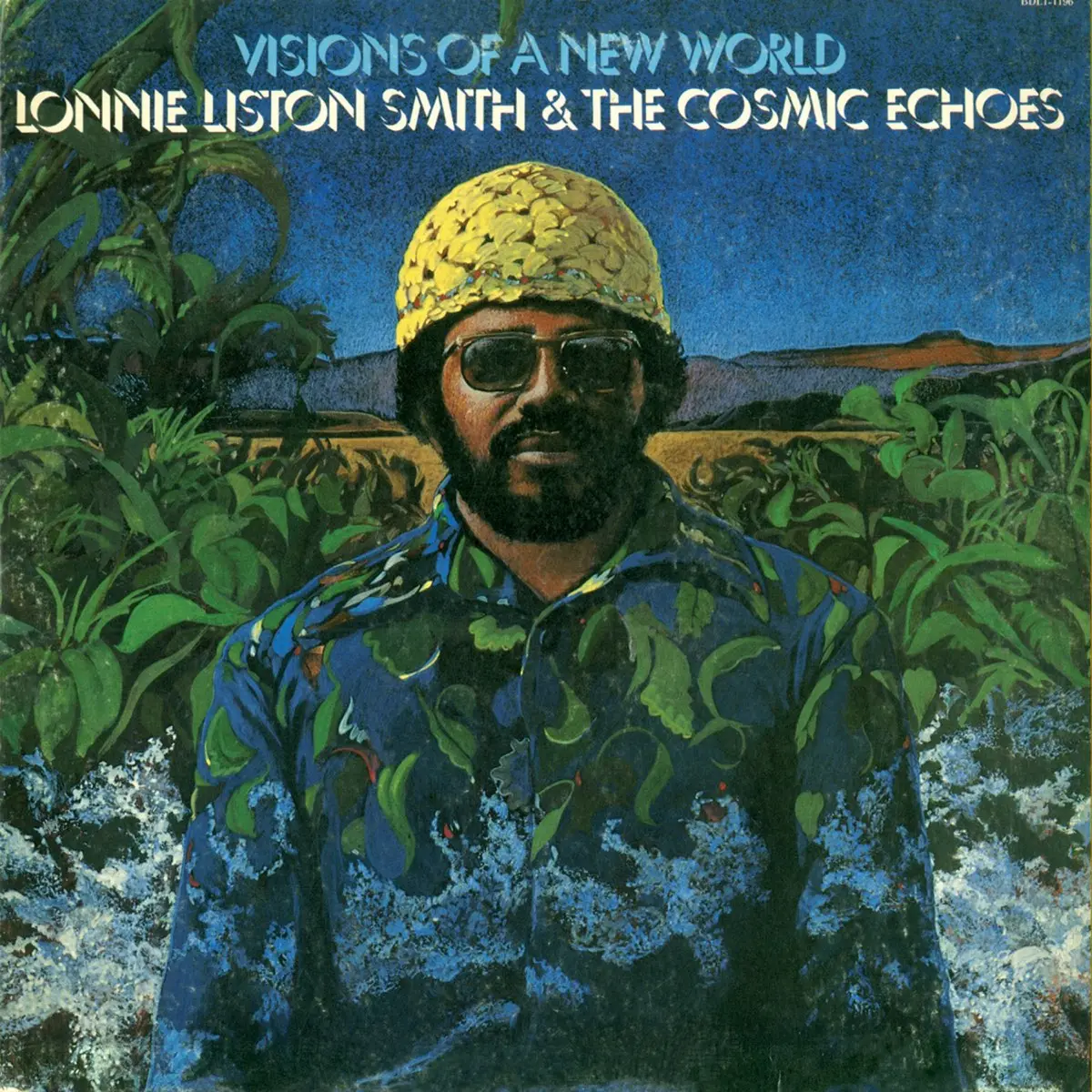 Lonnie Liston Smith released his fourth album, Visions of a New World, in September 1975 on Flying Dutchman.
Visions of a New World continues Smith’s exploration of cosmic jazz and soul-jazz, deepening the spiritual textures introduced on Expansions. The album emphasizes lush electric keyboards, layered percussion, and late-night, meditative rhythmic pacing, with Donald Smith’s vocals and Dave Hubbard’s horns complementing the ensemble’s nuanced sound.
Lonnie Liston Smith composed six of the eight tracks, with Dave Hubbard contributing “Devika (Goddess).”
Smith performs on electric piano and keyboards, joined by Donald Smith on vocals and flute, Dave Hubbard on horns and soprano saxophone, Cecil Bridgewater on trumpet, Clifford Adams on trombone, Reggie Lucas on guitar, Greg Maker on electric bass, Art Gore and Wilby Fletcher on drums, and percussionists Angel Allende, Lawrence Killian, Michael Carvin, and Ray Armando.
The album balances tranquil meditative pieces with subtly energized tracks. “A Chance for Peace” opens with ethereal electric piano and wah-inflected guitar over mid-tempo percussion, with soft vocals and layered horns. “Love Beams” maintains a quiet, radiant pulse, while “Colours of the Rainbow” pairs piano and voice in an airy duet. “Devika (Goddess)” and the final tracks—”Visions of a New World (Phase II)” and “Summer Nights”—introduce Latin-inflected rhythms, horn lines, and shimmering textures that push the ensemble into more kinetic territory. “Visions of a New World (Phase I)” presents a brief, spiritual interlude bridging meditative and expansive passages.
A1. “A Chance for Peace” (5:18) opens with electric piano and wah-wah guitar under a dense percussion web. Horns strike in bursts while Donald Smith’s vocal rides the steady bass line.
A2. “Love Beams” (4:07) drifts on soft electric piano voicings and subdued horns. The rhythm moves patiently while flute phrases and percussion flicker at the edges.
A3. “Colours of the Rainbow” (3:45) pares down to voice and piano, the phrasing stretched and echo-laden. Trombone shades the edges, giving the piece a weightless, suspended feel.
A4. “Devika (Goddess)” (5:17) carries a darker, modal frame. Soprano sax and bass circle around each other while percussion patterns shift beneath.
B1. “Sunset” (4:10) layers electric piano with hushed choral voices. The pace lingers, casting a warm, dissolving texture that mirrors its title.
B2. “Visions of a New World (Phase I)” (2:08) surges with falsetto cries and chiming piano. The brief piece moves with mounting energy, opening space for its second phase.
B3. “Visions of a New World (Phase II)” (3:40) sharpens the rhythm with wah guitar and brisk percussion. Horns flare while electric piano glides, carrying the momentum from Phase I.
B4. “Summer Nights” (5:05) closes with airy flute and electric piano against a pulsing rhythm. Donald Smith’s wordless vocal floats above, giving the track a dusk-lit, introspective calm.
Sessions occurred at Electric Lady Studios in New York City on July 18 and 20, 1975, with producers Bob Thiele and Lonnie Liston Smith and engineers Dave Wittman, Lonnie Liston Smith, and Michael Carvin.
Visions of a New World features cover art by Jack Martin, with art direction by Acy Lehman and Dick Smith, and liner notes by Lonnie Liston Smith.
Reflections of a Golden Dream
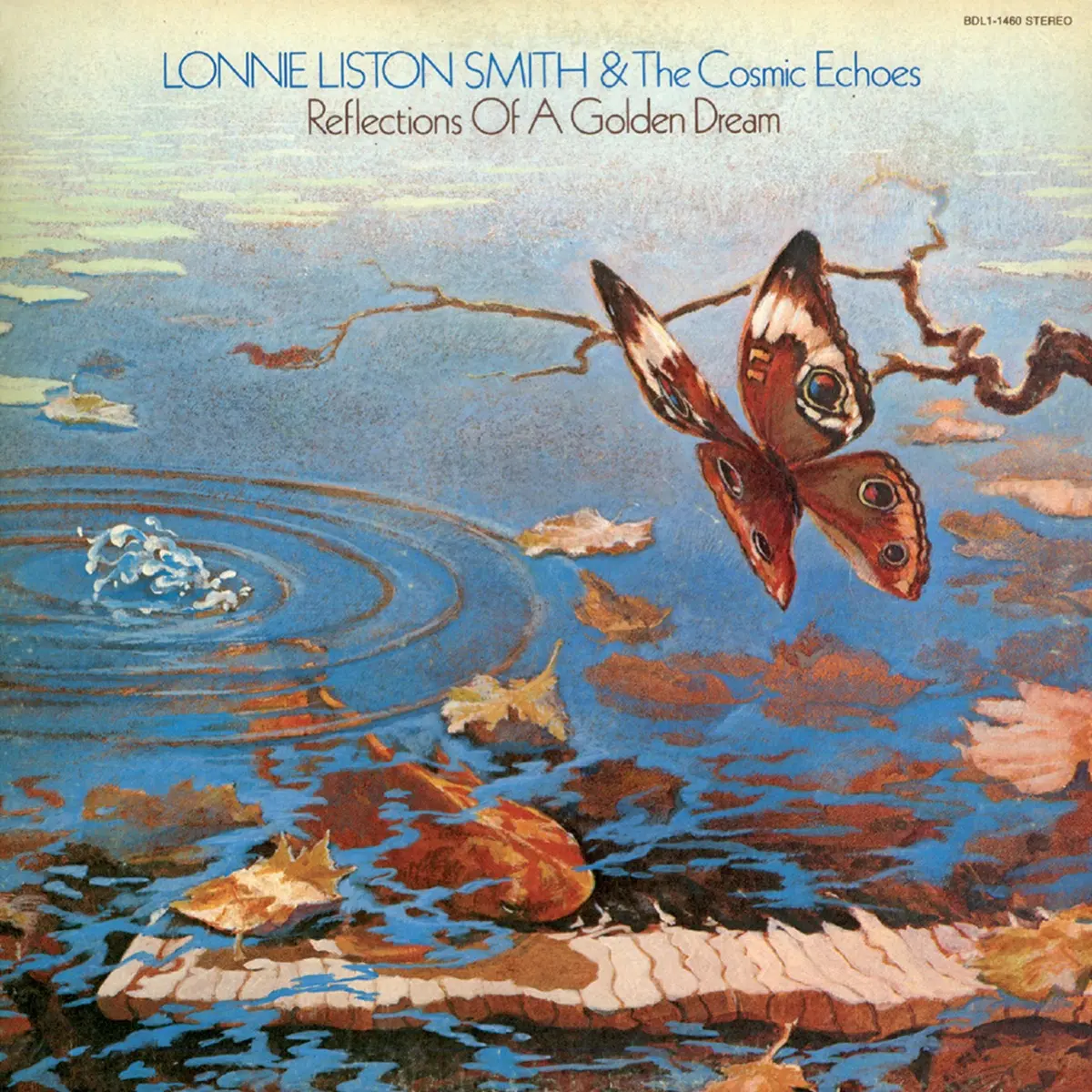 Lonnie Liston Smith released his fifth album, Reflections of a Golden Dream, in September 1976 on Flying Dutchman.
Reflections of a Golden Dream blends spiritual jazz textures with funk and Philadelphia soul influences, continuing Smith’s exploration of meditative electric piano landscapes while introducing denser rhythmic and vocal layers. The ensemble maintains Donald Smith on vocals and David Hubbard on horns, with percussion and rhythm sections expanding to include Brazilian and Latin elements.
Lonnie Liston Smith wrote seven of the ten tracks, with Leopoldo Fleming contributing words, music, and percussion on “Peace & Love.”
Smith performs on electric piano and keyboards, adding electronic effects, with Donald Smith on vocals and flute, David Hubbard on saxophone and flute, Wilby Fletcher on drums, Al Anderson on bass, Leopoldo Fleming and Guilherme Franco on percussion, Joe Shepley and Jon Faddis on trumpet and flugelhorn, George Opalisky on tenor saxophone, Arthur Kaplan on baritone saxophone, and Maeretha Stewart, Patti Austin, and Vivian Cherry providing backing vocals.
The album opens with the expansive funk of “Get Down Everybody (It’s Time for World Peace),” layered with strings, rhythmic accents, and Smith’s electronic colorations. “Quiet Dawn” and “Sunbeams” favor reflective piano and flutes over gentle percussion. “Meditations” and “Inner Beauty” continue the ambient, contemplative mood, while “Peace & Love” introduces collaborative percussion textures alongside layered vocals. “Beautiful Woman” and “Goddess of Love” heighten rhythmic intensity with subtle funk inflections and rich basslines. The title track, “Golden Dreams,” and the closing “Journey Into Space” evoke spacious, ethereal atmospheres, emphasizing meditative suspension and flowing textures throughout.
A1. “Get Down Everybody (It’s Time for World Peace)” (4:19) drives with Lonnie Liston Smith’s vocal over wah-drenched electric piano and sharp horn bursts. Layered percussion keeps the rhythm insistent while the chorus amplifies the call-and-response.
A2. “Quiet Dawn” (3:29) pares down to piano and flute, their phrases stretching over a calm, hovering rhythm. Electronic shadings color the edges, giving the piece a hazy glow.
A3. “Sunbeams” (3:52) lifts on light flute figures and soprano sax runs. The piano sets a steady pulse while percussion flickers in bright patterns.
A4. “Meditations” (4:21) strips to piano and hand percussion. Smith’s phrasing lingers in long arcs, suspended over sparse rhythmic taps.
A5. “Peace & Love” (2:39) moves briskly with Donald Smith’s lead vocal riding horns and choral refrains. Percussion cracks underneath while Lonnie adds wiry electronic textures.
B1. “Beautiful Woman” (5:57) glides on late-night rhythm, its bass line steady beneath soprano sax and Donald Smith’s smooth vocal. The electric piano gives the track a spacious, simmering air.
B2. “Goddess of Love” (4:24) unfolds as a slow instrumental, flute lines winding around bass and subdued percussion. Smith’s electric piano glows at the center, sustaining a reflective pace.
B3. “Inner Beauty” (2:18) compresses to a brief vignette with electric piano chords and Donald Smith’s gentle vocal. Soprano sax shades the edges before the track dissolves.
B4. “Golden Dreams” (4:47) sways with blended flute and voice over a drifting rhythm. The electric piano adds shimmering color, pulling the piece into a soft reverie.
B5. “Journey Into Space” (2:29) closes in abstraction, textures swelling in electronic haze. Percussion pulses faintly, carrying the piece toward an otherworldly fade.
Sessions occurred at Mediasound in New York City in September 1976 with producers Bob Thiele and Lonnie Liston Smith, and engineers Alan Varner and Bob Chiaramonte, mixed by Varner and Smith.
Reflections of a Golden Dream features cover art by Jack Martin, with art direction by Acy Lehman and photography by Nick Sangiamo, and liner notes by Lonnie Liston Smith.
Live!
 In 1977, RCA Victor issued Live!, sourced from Liston Smith’s May ’77 shows at Smucker’s Cabaret in Brooklyn.
Live! captures Smith and the Cosmic Echoes translating their studio explorations into a live setting, combining spiritual jazz, electric piano textures, and funk-infused rhythms with heightened improvisation. Donald Smith returns on vocals and flute, and Dave Hubbard contributes tenor and soprano saxophones, while the rhythm section and percussion add layered textures that expand the live sound.
The ensemble features Lonnie Liston Smith on acoustic piano, Fender Rhodes, clavinet, ARP synthesizer, and percussion; Donald Smith on flute and vocals; Dave Hubbard on tenor and soprano saxophone; Al Anderson on bass; Hollywood Barker on drums; Ronald D. Miller on guitar; Michael Carvin on percussion.
The album opens with the expansive, ethereal “Sorceress,” followed by the brief, atmospheric “Prelude.” “Expansions” and “My Love” emphasize live vocal and instrumental interplay, while the two-part title suite, “Visions of a New World,” demonstrates extended improvisation and dynamic textural shifts. “Watercolors” and “Sunset” close the set with spacious, contemplative passages interwoven with exploratory solos from Smith, Hubbard, and Miller. The live setting introduces a firmer rhythmic edge while preserving the band’s signature ethereal atmosphere.
A1. “Sorceress” (6:01)
A2. “Prelude” (2:58)
A3. “Expansions” (8:30)
A4. “My Love” (4:45)
B1. “Visions of a New World (Phase One)” (2:21)
B2. “Visions of a New World (Phase Two)” (6:17)
B3. “Watercolors” (4:51)
B4. “Sunset” (8:30)
Sessions occurred live at Smucker’s Cabaret, Brooklyn, N.Y., on May 19–21, 1977, recorded by Metro Audio, Inc., produced for Doctor Jazz Music, Ltd., and remixed by Bob Thiele, Harvey Goldberg, and Lonnie Liston Smith. Harvey Goldberg engineered with assistance from Don Berman, and the lacquer was cut at Masterdisk.
Live! features a gatefold cover with art direction by Acy Lehman and Dick Smith, cover photography by K. Abe, and back/inside photography by Nick Sangiamo.
Renaissance
 Lonnie Liston Smith released his sixth studio album, Renaissance, in 1977 on RCA Victor.
Renaissance blends spiritual jazz, late-’70s funk textures, and gentle electronic colorations, featuring Smith on acoustic and electric piano, with Donald Smith on flute and occasional vocals. David Hubbard contributes tenor and soprano saxophone and flute, while the rhythm section and percussion provide subtle propulsion that supports the album’s tranquil, meditative atmosphere.
Lonnie Liston Smith wrote all tracks except “Mongotee,” composed by David Hubbard, and “Renaissance,” with words by Jeff Gaines and music by Smith.
The ensemble features Lonnie Liston Smith on acoustic and electric piano; Donald Smith on flute and vocals; David Hubbard on flute, soprano, and tenor saxophones; Al Anderson on bass; Wilby Fletcher on drums; Lawrence Killian on congas; Guilherme Franco on percussion; Leon Pendarvis on clavinet; and Gene Bertoncini on acoustic guitar. Horace Ott arranged woodwinds, strings, and backing vocals. Ken Bichel plays Moog synthesizer on select tracks.
Tracks open with the spacious, contemplative “Space Lady” and the semi-Brazilian rhythms of “Mardi Gras (Carnival),” flowing into “Starlite and You” with ethereal interplay between piano and voice. Side two alternates between Hubbard’s flute-led “Mongotee,” the delicate romance of “A Song of Love,” and introspective pieces “Between Here and There” and the title track “Renaissance,” which layers soft textures and reflective motifs. The record emphasizes atmospheric subtlety over rhythmic intensity, producing a gentle, immersive listening experience.
A1. “Space Lady” (6:37)
A2. “Mardi Gras (Carnival)” (6:00)
A3. “Starlite and You” (5:19)
B1. “Mongotee” (5:40)
B2. “A Song of Love” (4:02)
B3. “Between Here and There” (2:35)
B4. “Renaissance” (4:49)
Sessions occurred at RCA studios in the UK, produced by Bob Thiele and Lonnie Liston Smith, engineered and mixed by Harvey Goldberg with assistance from Bob Thiele and Smith.
Renaissance features cover artwork by David Plourde, and art direction by Acy Lehman and Dick Smith.
Discography:
- Astral Traveling (1973)
- Cosmic Funk (1974)
- Expansions (1975)
- Visions of a New World (1975)
- Reflections of a Golden Dream (1976)
- Live! (1977)
- Renaissance (1977)
- Loveland (1978)
- Exotic Mysteries (1978)
- A Song for the Children (1979)
- Love Is the Answer (1980)
- Dreams of Tomorrow (1983)
- Silhouettes (1984)
- Rejuvenation (1985)
Sources:
- Discogs: Lonnie Liston Smith
- 45worlds: Lonnie Liston Smith
- 45cat: Lonnie Liston Smith
- RYM: Jazz-funk Albums Directory
Artist/Album Pages:
Yvonne Fair (Oct. 21, 1942 — March 6, 1994) was an American soul singer who emerged in the James ...
1 were an American psych-rock/folk band from Bolinas, Calif., that released a self-titled album o...
Fire was a Yugoslav hard-rock/psych trio that released the 1973 album Could You Understand Me. M...
Strutt was an American soul-funk band from New Jersey that released the album Time Moves On on Bru...
America is a rustic folk–pop combo, formed in 1968 in Watford, England, by American musicians Dewe...
Earth, Roots & Water were a Canadian roots-reggae band behind the 1977 album Innocent Youths ...
The Ghost was an English folk-psych band from Birmingham that released the album When You're Dead ...
Jan Akkerman (born Dec. 24, 1946) is a Dutch guitarist who achieved global renown as a member of F...
Lotus was a Norwegian jazz-rock band that released a 1979 self-titled album on Nor-Disc. Members...
Michael Henderson (July 7, 1951 – July 19, 2022) was an American R&B bassist, vocalist, songwr...
The Vapors were an English rock band that released the 1980–81 albums New Clear Days and Magnets o...
Il Baricentro was an Italian jazz-rock band that released the 1976–78 EMI Italiana albums Sconcert...