

Mandrake Memorial was an American psych-rock band from Philadelphia that released three albums between 1968 and 1970 on Poppy Records.
Formed in 1967, they quickly became a fixture of the East Coast underground with a distinctive blend of baroque instrumentation, modal experimentation, and electronic processing. Their self-titled debut combined ornate harpsichord textures with concise psych-pop, followed by Medium, a darker, more exploratory set with side-long epics and improvisational interplay.
After the departure of keyboardist Michael Kac, the remaining trio recorded the all-acoustic 3 Part Inventions in London with producer Shel Talmy, but the album went unreleased at the time. They instead completed Puzzle, a heavily layered studio work that fused musique concrète, chamber-folk, and proto-electronic collage.
Though short-lived, Mandrake Memorial bridged baroque psychedelia and early art rock, aligning them with late-Sixties innovators like The United States of America, Fifty Foot Hose, and Lothar and the Hand People.
Members: Craig Anderton (guitar), Randy Monaco (bass, vocals), Kevin Lally (drums), Michael Kac (keyboards, vocals, 1967-69)
Background
Formed in late 1967, The Mandrake Memorial emerged as the house band for Manny Rubin’s Philadelphia venue The Trauma, assembled by local promoter Larry Schreiber. He first enlisted multi-instrumentalist Michael Kac, a folk-rooted performer from The Candymen (later Cat’s Cradle), then recruited NYC drummer Kevin Lally, formerly of The Novae Police, a Greenwich Village fixture alongside The Flying Machine and The Ragamuffins. Kac brought in guitarist Craig Anderton, who’d opened for Woody’s Truck Stop with his college band The Flowers of Evil. Lally, in turn, recruited his Novae Police bandmate Randy Monaco on bass and vocals.
Initially a standard guitar–bass–drums combo, the group’s sound shifted when they acquired a prototype R.M.I. Rock-Si-Chord, a baroque-style electric harpsichord. Kac dropped guitar to focus on the new instrument, giving Mandrake Memorial a distinctive sound that quickly attracted attention. The band opened for The Doors, Mothers of Invention, Moby Grape, and Pink Floyd, and played East Coast circuit venues like the Boston Tea Party, the Electric Circus, and Café Au Go Go. With Schreiber’s guidance, they signed to MGM’s experimental subsidiary Poppy Records.
The Mandrake Memorial (1968)
 The Mandrake Memorial released their self-titled debut album in August 1968 on Poppy.
The album contains ten group-composed songs. Bassist Randy Monaco splits vocal leads with keyboardist Michael Kac. Craig Anderton spreads string textures against the rhythmic bombardment of Kevin Lally, an occasional timpanist.
The Mandrake Memorial centers around Kac’s electric harpsichord, the prototype R.M.I. Rock-Si-Chord, paired with sitar, fuzz guitar, and tom-heavy percussion. “Bird Journey” opens with phased harpsichord and sitar in a bright tempo underpinned by shifting psychedelia. “Rainy May” takes a gentler pace with softened vocals and lilting contours, while “Strange” veers from sparse electric piano and toms to crashing cymbals and layered guitar feedback. “Next Number” features processed vocals over a rigid rhythm bed of fuzz bass and plastic-toned percussion. Closer “Sunday Noon” stretches to seven minutes with sustained 12-string figures, a long keyboard interlude, and rhythmic turns reminiscent of modal jazz-rock.
A1. “Bird Journey” (2:40) – Harpsichord and sitar color this brief opener, which juxtaposes bright pacing with opaque lyrics.
A2. “Here I Am” (3:50)
A3. “Rainy May” (3:45) – Dreamlike pacing with a slow build and tempo shift in the final verse.
A4. “This Can’t Be Real” (3:45)
A5. “Dark Lady” (4:14) – Sitar leads through two-chord verses; female backing vocals appear uncredited.
B1. “House of Mirrors” (2:28) – Fuzz guitar and repeated harmonic structure echo “Dark Lady” in tone and form.
B2. “To a Lonely” (3:50)
B3. “Strange” (3:55) – Plodding pace turns abruptly into noise-laced passages, then recedes into snare-and-piano interplay.
B4. “Next Number” (4:11) – Anchored by machine-like rhythm and altered guitar voicings.
B5. “Sunday Noon” (7:08) – Expansive closer with layered instrumentation, long-form harpsichord solo, and shifting dynamics.
Sessions took place at Bell Sound Studios in New York City with producers Tony Bongiovi and Tony Camillo. Engineering was overseen by Val Valentin, then head of MGM’s studio division. Cover photography is by Elbert Budin. Art direction and sleeve design were handled by Milton Glaser, whose psychedelic typographic aesthetic defines the front cover.
Despite the lack of singles, The Mandrake Memorial sold roughly 100,000 copies across the Eastern Seaboard.
Medium
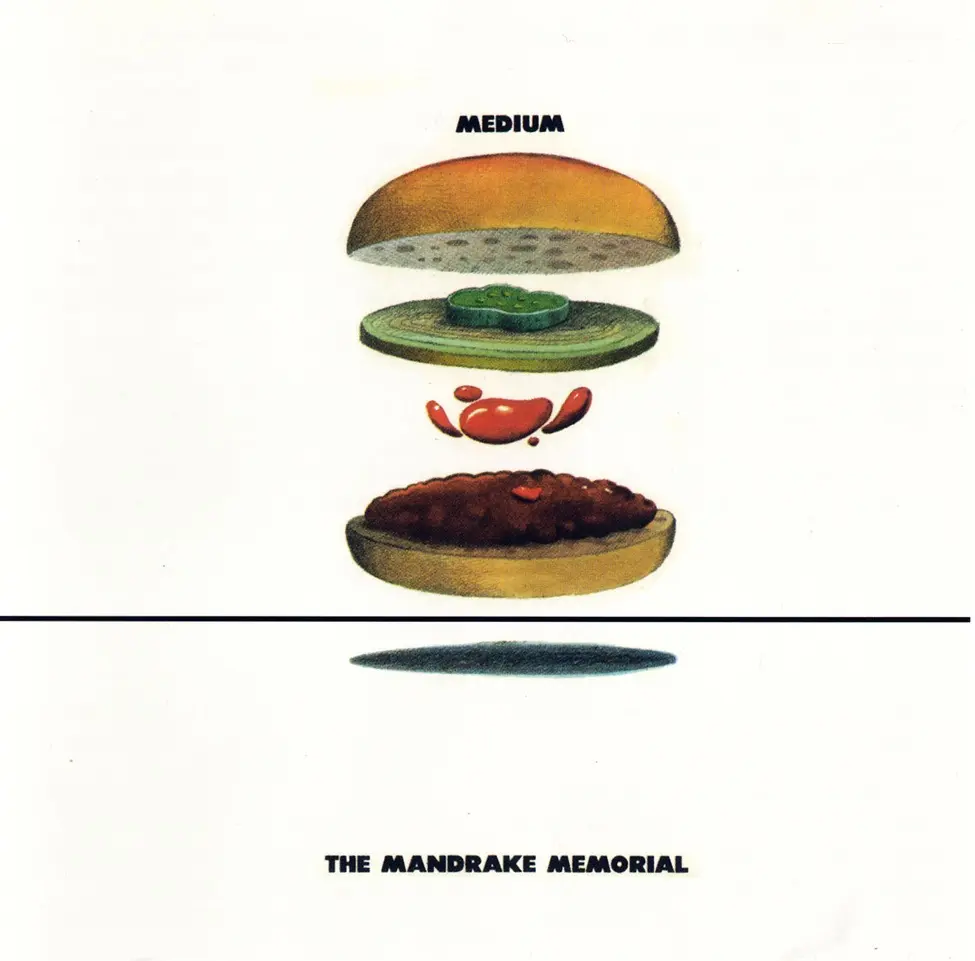 The Mandrake Memorial released their second album, Medium, in April 1969 on Poppy.
The album marks a shift away from the debut’s ornate psych-pop toward darker textures, longer forms, and more layered arrangements. The lineup remains unchanged, with Craig Anderton on guitar and electronics, Michael Kac on electric harpsichord and vocals, Randy Monaco on bass and lead voice, and Kevin Lally on drums and percussion. Louis Delgato appears on flute on one track.
While the electric harpsichord still features prominently, the overall tone is less baroque and more subdued, with expanded instrumental sections and denser harmonic fields. Side A maintains a restrained, downcast pace, rooted in minor-key folk and slow blues phrasing. “Witness the End / Celebration” carries a bleak, drawn-out progression, while “Last Number” moves with a sharper rhythmic cut than anything on the debut. Side B opens up structurally and sonically: “Smokescreen” pairs fractured pacing with a warped sense of tonal space, and “Barnaby Plum” unfolds as an extended instrumental built around flute textures and shifting atmospheres. “Cassandra” closes the album with subdued momentum and faint electronics.
A1. “Snake Charmer” (2:45) – Sparse structure, electric harpsichord and fuzz guitar lead.
A2. “Witness the End / Celebration” (5:42) – Dark, continuous composition with haunting pacing.
A3. “Other Side” (3:25)
A4. “Last Number” (4:31) – Tighter rhythm and sharper pacing than prior material.
B1. “After Pascal” (6:51)
B2. “Smokescreen” (5:06) – Fractured rhythms and dense sonic layering.
B3. “Barnaby Plum” (6:10) – Instrumental with flute and modulating textures.
B4. “Cassandra” (5:26) – Closing track with subdued energy and soft electronics.
Sessions occurred at the Record Plant in New York City with returning producers Tony Bongiovi and Tony Camillo. The album design, like its predecessor, was created by Milton Glaser, with photography by Elbert Budin.
Soon after Medium, Michael Kac left Mandrake Memorial over musical differences, thus ending their use of harpsichord. In mid-1969, the remaining trio—Craig Anderton, Randy Monaco, and Kevin Lally—traveled to London, where they recorded a live-in-the-studio acoustic album with producer Shel Talmy. However, their planned UK tour with The Nazz got red-lit by the musician’s union, which placed a summer ban on US acts. Poppy Records vetoed the acoustic album’s release over commercial concerns.
Puzzle
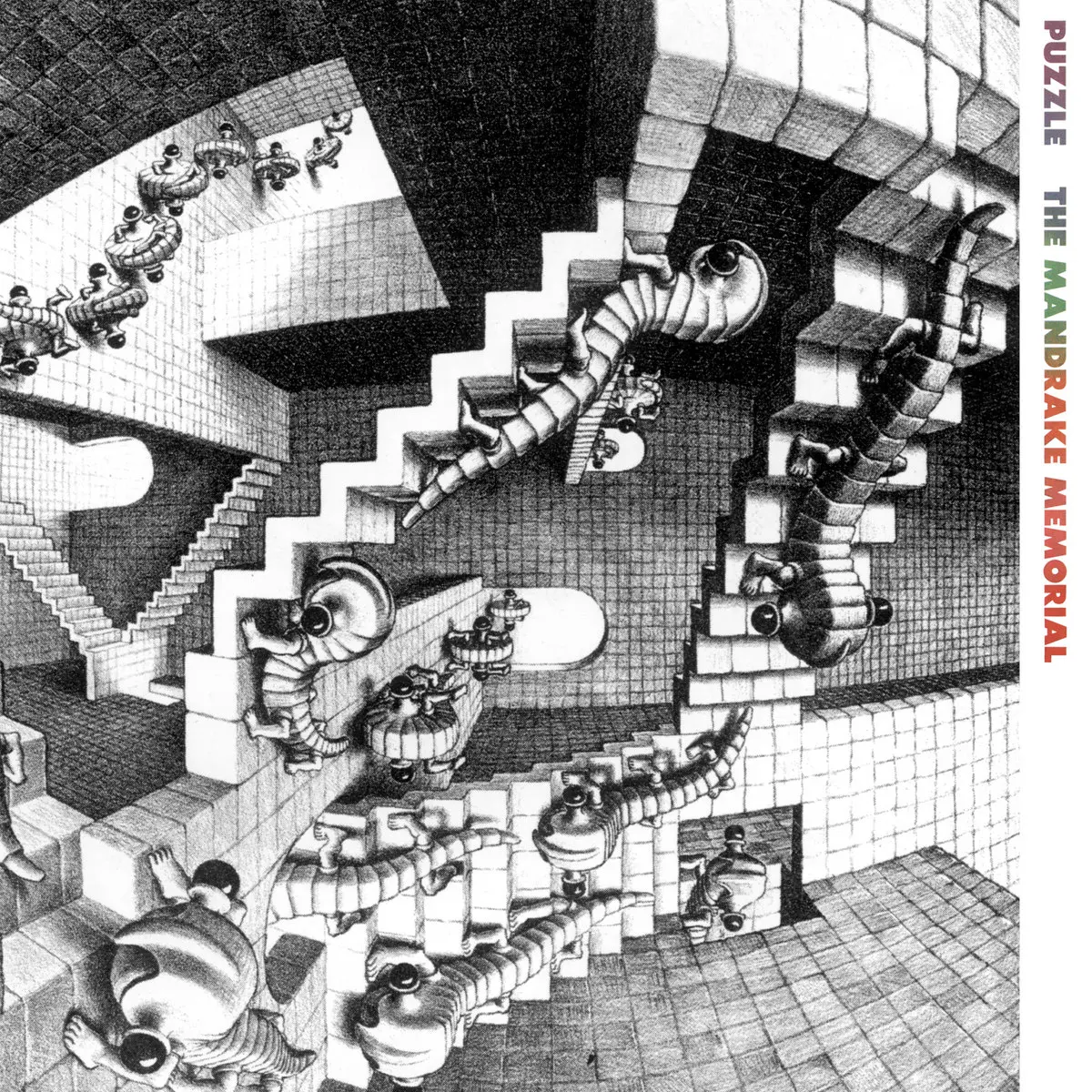 The Mandrake Memorial released their fourth-recorded album, Puzzle, in February 1970 on Poppy. It contains reworked material from their vaulted acoustic album, recorded by the remaining three-piece of bassist/singer Randy Monaco, drummer/percussionist Kevin Lally, and guitarist Craig Anderton, also credited with electronics.
Puzzle divides into two thematic halves. The first side, which includes the sequence “Earthfriend Prelude,” “Earthfriend,” “Just a Blur” (in two variations), “Hiding,” “Tadpole,” “Kyrie,” and “Ocean’s Daughter,” centers on sustained acoustic textures, layered orchestration, and intimate studio interventions. Pieces like “Earthfriend” and “Tadpole” feature intertwining rhythm work and a slow-building harmonic density, while “Kyrie” and “Children’s Prayer” incorporate liturgical motifs through chant and choral elements.
Side two introduces a more fragmented structure, beginning with “Volcano Prelude” and “Volcano,” whose processing-heavy production reflects guitarist Craig Anderton’s growing interest in electronic manipulation. “Whisper Play” and “Bucket of Air” shift further into abstraction, the latter marked by extended instrumental passages and disorienting studio treatments. Three brief reprises of “Just a Blur” function as thematic bookends across the album.
A1. “Earthfriend Prelude” (2:49) – Orchestral and atmospheric, this instrumental opener leans into filmic textures, setting a subdued tone that suggests fantasy rather than rock.
A2. “Earthfriend” (6:17) – A slow, lysergic-laced ballad where Randy Monaco’s expressive bass underpins increasingly unhinged orchestration; a key example of the album’s immersive and layered pacing.
A3. “Just a Blur (Version 1)” (0:53) – Brief acoustic vignette, subdued and fragmentary; introduces a recurring thematic phrase.
A4. “Hiding” (3:15) – Pastoral in mood, with acid-tinged overtones and expressive timekeeping from Kevin Lally; restrained, but not static.
A5. “Just a Blur (Version 2)” (0:51) – Nearly indistinguishable from the first iteration, this reprise reasserts the album’s looped motif structure.
A6. “Tadpole” (2:25) – One of the more rhythm-forward pieces, driven by a distinct opening bass figure; slow in tempo but structurally compact.
A7. “Kyrie” (3:24) – Chant-inflected and ecclesiastical, using liturgical vocal elements and a spacious production style to unsettling effect.
A8. “Ocean’s Daughter” (3:35) – Mysterious in tone, with embedded sound effects and a restrained harmonic arc; sparse lyrics are offset by Monaco’s acoustic bass.
B1. “Volcano Prelude” (2:09) – Another cinematic prelude, dark-hued and minimal; functions as an atmospheric primer rather than a standalone piece.
B2. “Volcano” (5:59) – Begins with abrasive guitar feedback before easing into a more structured format; slow-building and texturally dense.
B3. “Whisper Play” (3:00) – Soft-spoken and fragmentary, built around whispered vocals and ecclesiastical motifs; more suggestive than declarative.
B4. “Bucket of Air” (9:37) – The most extended track on the album, blending jangling guitar, turbulent drumming, and intricate bass lines. The mid-section nods toward space rock, veering close to early Kraut-influenced experimentation.
B5. “Children’s Prayer” (3:25) – Uses choral voices and Gregorian chant to eerie effect; the childlike frame contrasts sharply with its unsettled undercurrent.
B6. “Puzzle” (3:08) – The most direct composition on side B, centered around an acid-washed tonal palette and a sharp bass contour.
B7. “Just a Blur (Version 3)” (0:51) – Final iteration of the recurring motif; fades out with the same understated ambiguity that opened the album.
 Sessions occurred at Century Sound Studios in New York, where producer Ronald Frangipane enlisted a full orchestra, choir, and children’s chorus. Century staffer Brooks Arthur engineered Puzzle in sequence with titles by Astrud Gilberto, The Insect Trust, Pearls Before Swine, and Uncle Chapin.
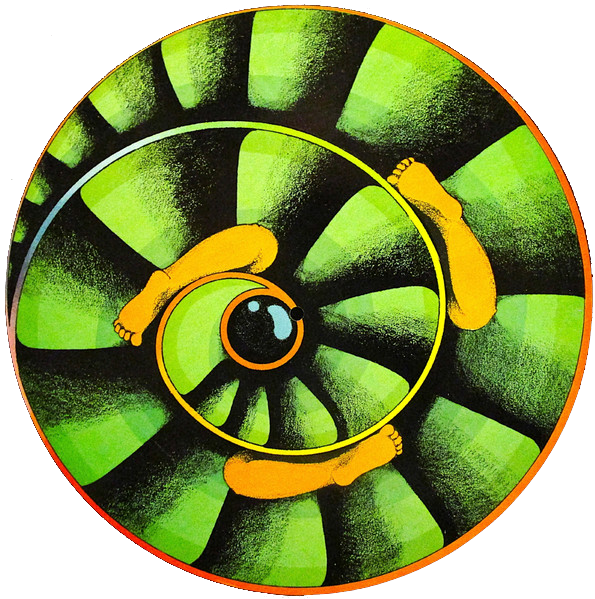
The packaging, designed by Milton Glaser, features a licensed reproduction of House of Stairs, a 1951 lithographic print by Dutch artist M.C. Escher. The famous image shows a structure with criss-cross stairs used by wentelteefje, an invented lizard with humanoid feet. They also appear on the calligraphic inner-gate. The album contains a circular insert of a coiled green wentelteefje.
Classical conductor Seiji Ozawa called it “a recording I love to hear from the very beginning, from the first note to the last,” while Fusion magazine described it as “a symphony of the mind.”
Later Activity
Mandrake Memorial released one final standalone single: “Something in the Air,” a cover of the recent Thunderclap Newman anthem backed with “Musical Man,” a Craig Anderton original.
Anderton next formed the electronic trio Anomaly with Charles Cohen and Jefferson Cain. They backed Philly folk guitarist Linda Cohen (no relation) on her 1971/72 Poppy albums Leda and Lake of Light (1972). Cohen and Cain later recorded as The Ghostwriters, issuing Objects in Mirrors Are Closer Than They Appear (1981) and the cassette Remote Dreaming (1986). Anderton, an early builder of guitar effects and synth modules, became a key figure in musician DIY culture, launching a prolific writing career with Electronic Projects for Musicians (1975). He edited Electronic Musician (1980–90), contributed to Synapse and Keyboard, and designed circuits for TASCAM, Peavey, PAiA, Steinberg, and Kurzweil. He issued a cassette solo album in 1977, Forward Motion on CD in 1989, and the digital titles Simplicity and Neo-Psychedelic Music for the 21st Century in 2017, followed by Joie de Vivre (2018).
During 1969, Michael Kac collaborated with Linda Cohen in a harpsichord/guitar duo. After moving to Los Angeles in 1971 for doctoral studies in linguistics at UCLA, he later joined the University of Minnesota faculty and performed harpsichord in classical settings. In 1998, he reunited with Anderton and Cohen for Naked Under the Moon.
In 1974, Randy Monaco attempted a short-lived Mandrake Memorial revival with drummer Lonnie Castille (formerly of Janis Joplin’s Kozmic Blues Band). Monaco died in 1983 of cirrhosis.
3 Part Inventions
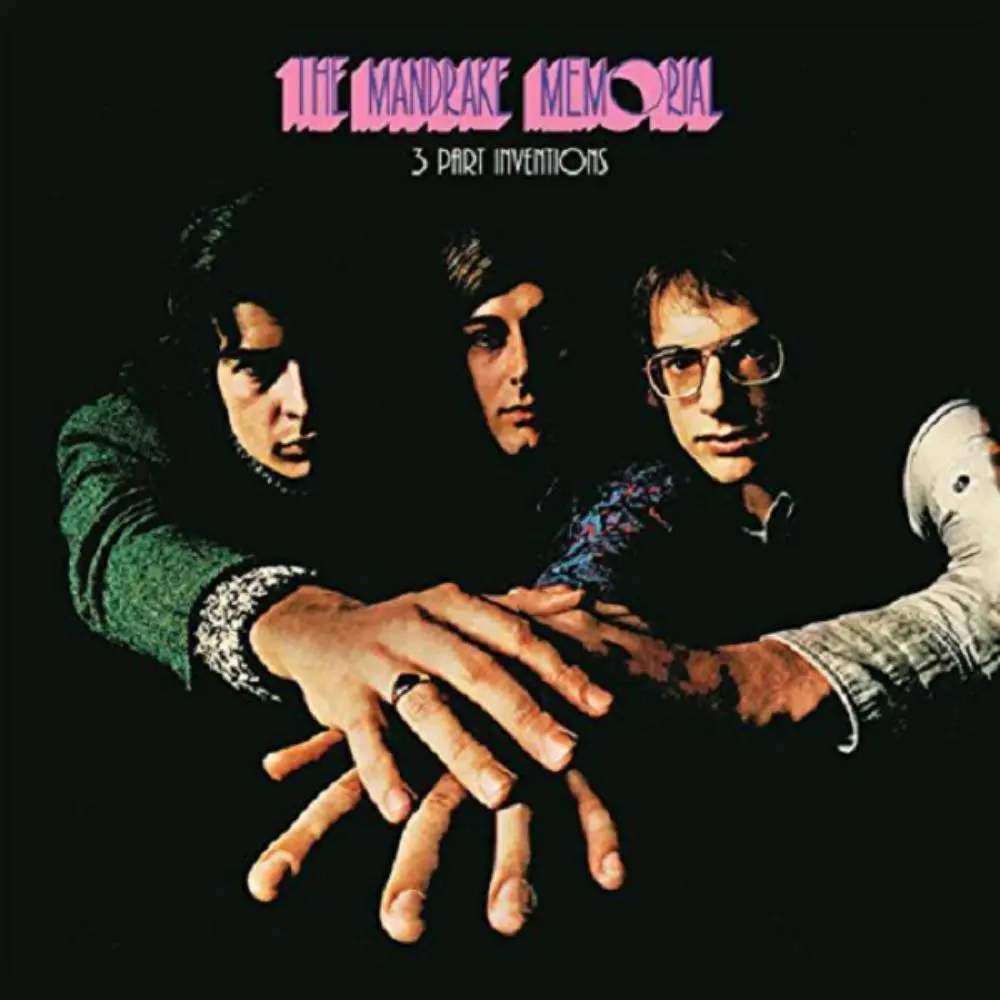 In 2016, archivists Flashback Records released 3 Part Inventions, the lost 1969 all-acoustic album by Mandrake Memorial.
3 Part Inventions was recorded in mid-1969 as their projected third album. The trio—Craig Anderton (guitar), Randy Monaco (bass), and Kevin Lally (drums)—cut the album in London with veteran producer Shel Talmy, following the amicable departure of keyboardist Michael Kac. Talmy abandoned the project midway, reportedly objecting to the material. Without union backing or further label support, the band completed the all-acoustic album independently. Though announced in the UK press, 3 Part Inventions was shelved when the label requested a rerecording, which yielded the electric followup Puzzle. Flashback salvaged the lost album from surviving tapes and acetates, supplemented with two unreleased outtakes and a radio interview.
The album opens with three acoustic numbers—“The Puzzle,” “Ocean’s Daughter,” and “Tadpole”—that were later reworked for Puzzle. These are followed by the extended “Part of My Dreams,” an early application of primitive synthesizers and phased textures that mark the band’s pivot toward immersive, electronically tinged arrangements. “Wouldn’t You Like It?” channels the band’s concise side with driving percussion and urgent phrasing, while the 7-minute “Bucket of Air” and 10-minute “Witness the End” (a reimagining of the Medium track) stretch across longform sequences, mixing rhythmic suspension with phased effects and tonal contrast. These two tracks comprised the intended Side B. The bonus tracks include the previously unheard “Cassandra” and “The 12th Brigade,” an outtake from Medium that centers on focused rhythmic thrust and layered fuzz-tones.
1. “The Puzzle” (2:53)
2. “Ocean’s Daughter” (2:57)
3. “Tadpole” (2:33)
4. “Part of My Dreams” (5:49)
5. “Wouldn’t You Like It?” (2:11)
6. “Bucket of Air” (7:30)
7. “Witness the End” (10:03)
Bonus tracks:
8. “Cassandra” (4:52)
9. “The 12th Brigade” (5:12)
10. “Rock Stars interview” (2:39)
3 Part Inventions offers a rare look at the transitional phase between the structured psych of Medium and the more radical compositions of Puzzle. Its archival character preserves the band’s unfiltered experimentation at a critical juncture.
Discography:
- The Mandrake Memorial (1968)
- Medium (1969)
- Puzzle (1969)
- “Something in the Air” / “Musical Man” (1970)
- 3 Part Inventions (archival, 2016)
Sources:
- Discogs: Mandrake Memorial
- RYM: Mandrake Memorial
- 45cat: Mandrake Memorial
- ProgArchives: Mandrake Memorial
Artist/Album Pages:
Continuum was a UK-based instrumental ensemble formed by Hungarian multi-instrumentalist Yoel Schwar...
The Mahavishnu Orchestra was a multinational jazz-rock ensemble headed by English guitarist John M...
Il Rovescio della Medaglia was an Italian symphonic/hard-rock quartet that released the 1971/72 al...
Cherry People were an American pop-psych/bubblegum band that released a self-titled album on Heritag...
Susan Phillips (December 17, 1946 - September 21, 2022) was an American soul singer who recorded ...
Joe Haider is a German jazz pianist and bandleader with 100-plus album credits since the late 1960...
Fields was an English organ-rock trio that released a self-titled album on CBS in 1971. They were fo...
Sume was a post-psych band formed in Denmark by students from Greenland. They released three album...
Eiliff was a German Krautrock band behind the 1971/72 Philips albums Eiliff and Girlrls! Members:...
The Stark Reality was an American jazz-rock/psych band from Boston that released the 1970 double-...
L'Infonie was a Québécois avant-jazz/psych collective that released two albums on Polydor in 1969 ...
Boz Scaggs is an American vocalist, musician, and songwriter who emerged in the late-sixties incar...