

Uncle Chapin was an American brass-rock band from New York that released a 1971 self-titled album on Polydor.
Members: Donny Olson (lead vocals, bass), Angelo Ficara (lead vocals, guitar, acoustic guitar), Mike Mattia (trumpet, flugelhorn, piano, percussion), Carl Shickler (guitar, trombone, flute), John Briganti (drums), James Rosolino (lead vocals, trumpet), Paul Mergingoff (piano, organ, lead vocals), Ed Covi (alto saxophone, tenor saxophone, baritone saxophone, soprano saxophone, flute)
Background
Uncle Chapin assembled in Manhattan, where guitarist Angelo Ficara, keyboardist Paul Meringoff, and trumpeter James Rosolino merged with five Bo Diddley sidemen: bassist Donny Olsen, drummer John Briganti, reedsman Ed Covi (saxophones, flute), and multi-instrumentalists Mike Mattia (trumpet, flugelhorn, piano, percussion) and Carl Shickler (guitar, trombone, flute). The latter five played on Diddley’s 1971 album Another Dimension.
Uncle Chapin
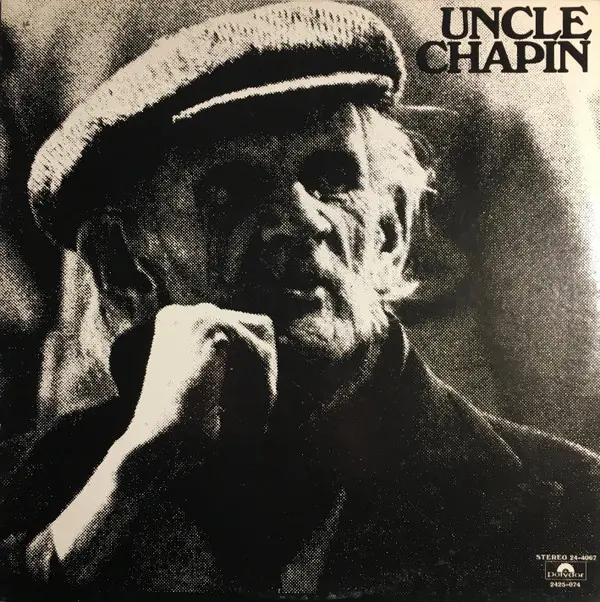 Uncle Chapin released their self-titled album in August 1971 on Polydor.
The album fuses rock intensity and funk propulsion with soulful vocals and punchy brass arrangements: a blend akin to brass-rock contemporaries Ambergris, Ballin’Jack, Trifle, and early Tower of Power. The instrumentation — saxophones in four registers, trumpet, flugelhorn, trombone, organ, and dual guitars — facilitates syncopated horn charts, jazz breaks, and cross-genre solos with taut rhythmic arrangements. Three members (Ficara, Rosolino, Meringoff) share lead vocal duties
Tracks shift between clipped, urgent pacing and looser, expansive passages, with vocals that alternate between declarative and reflective. The sequencing builds from compact statements like “Wrong From Right” to longer, episodic tracks such as “Do It” and “If You Quit Me,” which open space for ensemble improvisation.
A1. “Wrong From Right” (4:28)
A2. “Do It” (7:25)
A3. “Time Is Wastin’ Away” (6:05)
B1. “Lo and Behold” (5:26)
B2. “Changes” (3:51)
B3. “If You Quit Me” (7:05)
B4. “You Must Help Yourself” (5:33)
Uncle Chapin was engineered by George Sterma and Bob Dorsa, with remixes by Brooks Arthur.
The cover features a sepia-toned Depression-era portrait of an elderly man in a flatcap: an image at odds with the album’s youthful, funky core.
Despite its accomplished sound and high-profile backing, the album slipped under the radar and remains a rare, cult entry in the brass-rock canon.
Discography:
- Uncle Chapin (1971)
Sources:
Artist/Album Pages:
Chu Kosaka — 小坂忠 (July 8, 1948 — April 29, 2022) — was a Japanese singer/songwriter who emerged as...
Aura Urziceanu (born Dec. 14, 1946) is a U.S.-based Romanian jazz singer who made eight albums bet...
Ardo Dombec was a German jazz-rock band that released a 1971 self-titled album on Pilz. Members:...
Aphrodite's Child was a Greek symphonic/psych-rock band that released numerous singles and three a...
Olivia Newton-John (Sept. 26, 1948 – Aug. 8, 2022) was an English-born Australian singer, actress, a...
Billy Preston (1946–2006) was an American R&B singer and keyboardist who released 24 albums be...
José Cid is a Portuguese keyboardist, vocalist, and composer who emerged with Estoril psych legend...
Louise Forestier is a Québécois chanson singer and actress who debuted with a 1967 self-titled alb...
Lobby Loyde — aka John Baslington Lyde (May 18, 1941 — April 21, 2007) — was an Australian blues-r...
Kellee Patterson is an American singer who released the 1973 album Maiden Voyage on Black Jazz Rec...
Giles Giles and Fripp were the English pop-psych trio behind the 1968 Deram album The Cheerful Ins...
Fire was a Yugoslav hard-rock/psych trio that released the 1973 album Could You Understand Me. M...