

Conventum was a Québécois avant/symphonic-folk band that released the 1977–79 albums À l’affût d’un Complot and Le Bureau Central des Utopies.
Members: Jean-Pierre Bouchard (acoustic guitar, tenor recorder), Bernard Cormier (violin, metallophone), André Duchesne (classical guitar), Charles Kaczynski (violin, alto violin, viola), Jacques Laurin (electric bass, double bass), René Lussier (electric guitar, 12-string acoustic guitar, mandolin), Michel Therrien (oboe, alto saxophone, maracas)
Background
In May 1972, guitarist André Duchesne left the École de Musique de Québec and relocated to Montreal, where he connected with filmmaker Jean Gagné. Through Gagné, Duchesne met several figures in Montreal’s countercultural scene, including Jean-Pierre Bouchard, Michel Tremblay (“Mike T.”), and Jean-Pierre Bouchard. By spring 1973, Duchesne and Gagné secured a venue at 1237 Saint-Laurent, formerly home to the École du Nouveau Monde, which became the permanent base for L’Association des Sculpteurs du Québec and the “Centre d’Essai Le Conventum” (CEC).
The earliest Conventum lineup coalesced in fall 1973 when Duchesne returned to Saguenay. Joined by Mike T. on percussion, Jean-Pierre Tremblay on clarinet, and Jean-Pierre Bouchard on electric guitar, the group began with improvisational sessions and original material. Guitarist Michel Robidoux and other members of the Jazz Libre du Québec also participated. Bernard Cormier joined on violin in 1974, completing the nucleus of Conventum’s formative period.
By 1975, the CEC became an interdisciplinary hub for musicians, writers, and filmmakers. The group, now built around the interwoven guitar work of Duchesne and Bouchard — backed by bassist Jacques Laurin (a L’Orchestre Sympathique co-founder), drummer Mathieu Léger, and Jean-Pierre Tremblay and his saxophonist brother Michel Tremblay — evolved toward acoustic orchestration and theatrical live presentations.
Their breakthrough came on March 8, 1976, at Cégep Vieux Montréal, where they performed an avant-garde rock piece with orchestral elements. The event earned them public attention via a Le Devoir article titled “Extraordinaire Conventum,” and their profile grew through appearances at the 1976 Montreal Olympics cultural program.
In August 1977, Duchesne and Bouchard joined forces with René Lussier and poet Alain-Arthur Painchaud for a new phase of Conventum. Backed by Jacques Laurin and Bernard Cormier, the group performed original pieces developed for film soundtracks, fusing folk-classical instrumentation with spoken word. After a two-month performance circuit across Quebec and a concert in Massy, France, they recorded their debut album.
À l’affût d’un Complot
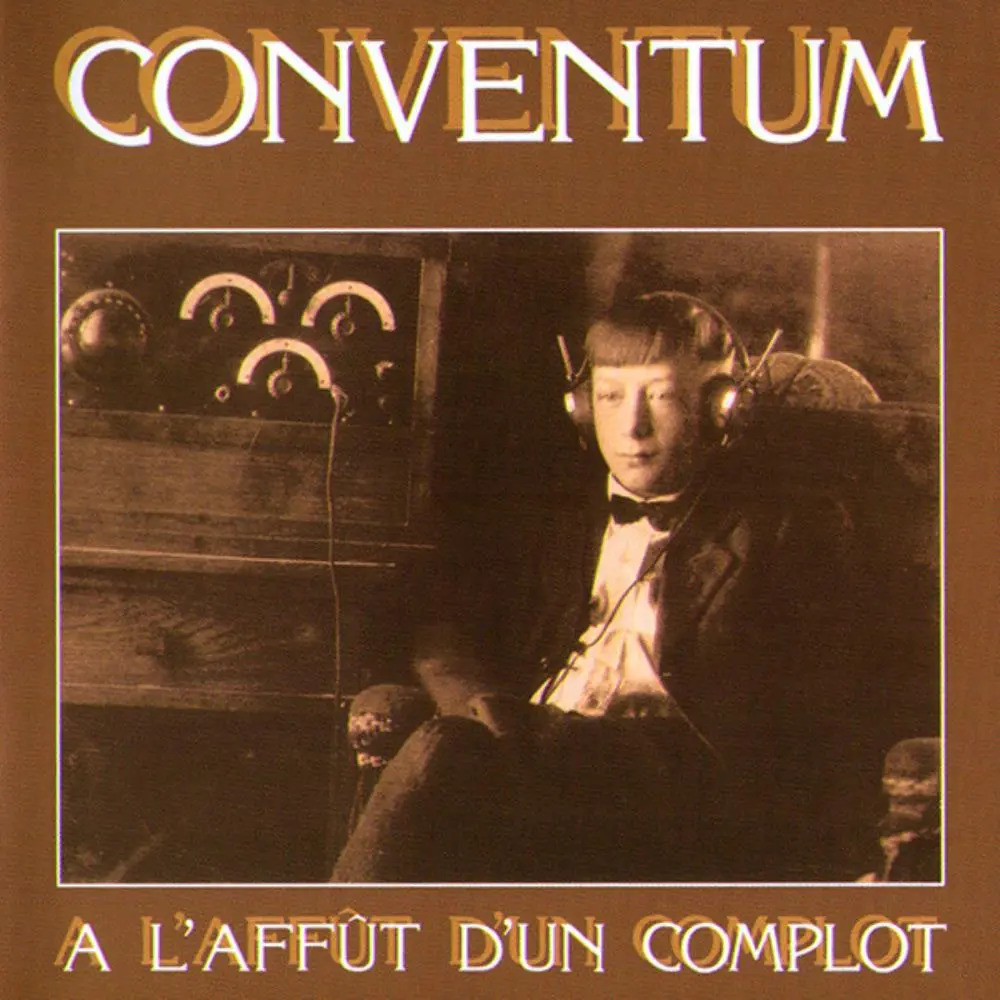 Conventum released their first album, À l’affût d’un Complot, on October 11, 1977, on Disques Le Tamanoir.
The album blends Québecois folk traditions with chamber ensemble interplay and avant-garde arrangements. Conventum’s music emphasizes contrapuntal textures and spoken texts over rhythmic momentum, using acoustic instrumentation, modal motifs, and theatrical staging that draws equally from vernacular heritage and modernist subversion.
The studio lineup featured core members André Duchesne (classical guitar, vocals), Jean-Pierre Bouchard (acoustic guitar, recorder), René Lussier (electric and twelve-string guitars, mandolin), Jacques Laurin (bass), Bernard Cormier (violin, metallophone), and Alain-Arthur Painchaud (voice, text). They were joined by guests including Charles Kaczynski (strings), Michel Therrien (oboe, saxophone), Mathieu Léger and Pierre Cormier (percussion), and singers Louise Forestier, Sylvie Choquette, and others. Yves Laferrière produced the album; Conventum handled realization.
Duchesne authored or co-authored nine pieces; Bouchard, Lussier, Laurin, and Painchaud contributed across various compositions. The group arranged all material collectively.
A1. “La Valse des fous” [The Waltz of Fools] (1:17)
A2. “Les Criticotteuses” [The Nitpickers] (5:18)
A3. “À l’affût d’un complot” [Lurking for a Plot] (6:03)
A4. “La Bataille” [The Battle] (5:38)
A5. “Le Piège” [The Trap] (2:48)
B1. “Le Sablier et les petits travaux” [The Hourglass and the Small Tasks] (2:15)
B2. “Les Réels du Conventum” [The Conventum Reels] (4:51)
B3. “La Première Pièce (21 Juillet)” [The First Piece (July 21st)] (6:19)
B4. “Ronde” [Round] (6:06)
The brief opening waltz leads into “Les Criticotteuses,” where arpeggiated guitar cascades intersect with piccolo flute and saxophone, framing a vocal duet shadowed by strings. The title track follows with heightened tension and more angular interplay, carrying lyrics of theatrical grandeur. “La Bataille” and “Le Piège,” drawn from film scores, conjure somber, cinematic moods—alternating between elegiac string passages and sudden choral surges. The second side pivots into instrumental terrain: “Le Sablier…” and “Les Réels…” draw from dance motifs reworked into chamber forms, while “Ronde” closes with an expansive reimagining of the jig, layered in violin-led counterpoint.
Sessions took place August 11–31, 1977, at Studio St-Charles, with Réal Leblanc as engineer and Al cutting the lacquer at Disques SNB. Vallier April handled graphic design and photography; André Duchesne contributed liner notes. The gatefold sleeve features Charles-Eugène Tremblay listening to a handmade radio, photographed in St-Jérôme, Lac St-Jean.
Also in 1977, Laurin and Bouchard played on L’Île Où Vivent les Loups, the first of two albums by Tamanoir labelmates L’Engoulevent, who purveyed a mistier chamber-folk style. In 1978, Lussier backed Laferrière on the ex-Contraction bassist’s self-titled solo album. Meanwhile, Charles Kaczynski cut Lumière de la Nuit, a self-performed solo album with fifteen pieces for violin, cello, guitar, bass, keyboards, and woodwinds.
Le Bureau Central des Utopies
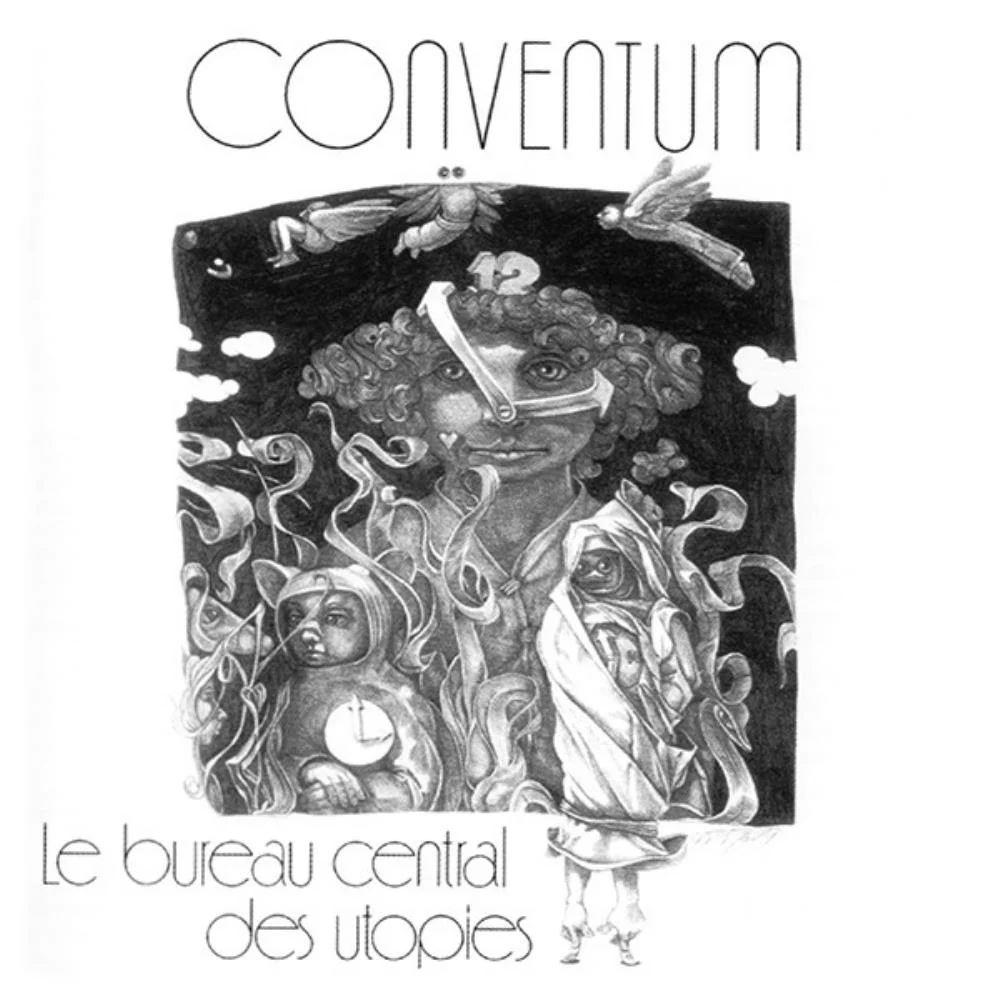 Conventum released their second album, Le Bureau Central des Utopies, in November 1979 on Les Disques Cadence.
The album continues the ensemble’s exploration of acoustic chamber-folk structures, interweaving dueling string motifs, processional themes, and surreal spoken passages. Recorded live-in-house over one week, the compositions draw from material commissioned for Quebecois films and memorial dedications. The tone alternates between elegiac minimalism and sudden flares of rhythmic dissonance, filtered through a lens of theatrical détournement.
André Duchesne performs acoustic guitar, dulcimer, and vocals. René Lussier plays electric and twelve-string acoustic guitars, mandolin, and percussion. Jacques Laurin handles electric bass. Bernard Cormier plays violin and percussion. Jean Derome plays flute on “Atelier I et IV.” The group arranged all material and shared production duties with engineer Denis Houle.
Duchesne authored or co-authored all compositions. Cormier and Lussier contribute to five tracks. All pieces were arranged and realized collectively by the band.
A1. “Le Reel des Élections” [The Election Reel] (2:44)
A2. “Atelier I et IV” [Workshop I and IV] (4:08)
A3. “Fondation” [Foundation] (6:13)
A4. “Chorégraphie lunaire” [Lunar Choreography] (8:13)
A5. “La Belle Apparence” [The Beautiful Appearance] (2:16)
B1. “Fanfare” (4:22)
B2. “Trois Petits Pas…” [Three Little Steps…] (4:19)
B3. “Le Reel à Mains” [The Reel by Hand] (3:24)
B4. “Le Bureau Central des Utopies” [The Central Bureau of Utopias] (10:03)
The album was recorded September 24–30, 1979, at the home of Gilles Garant in St-Damase using Guillaume Bengle’s mobile studio. Denis Houle engineered and mixed the sessions. Louis-Pierre Bougie designed the artwork; Roger Belle-Isle handled graphic layout.
Postlude
In 1983, René Lussier surfaced with Fin du Travail (Version 1), the inaugural release on Ambiances Magnétiques, the label he co-founded with André Duchesne, who in turn went solo with the 1984 AM release Le Temps des Bombes. In 1987, they formed Les 4 Guitaristes de l’Apocalypso-Bar, an avant-garde guitar ensemble with Etron Fou Leloublan bassist Ferdinand Richard. Lussier also teamed with Fred Frith on the 1987 improvised live disc Nous Autres.
Discography:
- À l’affût d’un Complot (1977)
- Le Bureau Central des Utopies (1979)
Sources:
Artist/Album Pages:
Robin Trower (born March 9, 1945) is an English rock/blues guitarist with a musical career that date...
John Abercrombie (Dec. 16, 1944 — Aug. 22, 2017) was an American jazz guitarist who played in the ...
Webster Lewis (September 1, 1943 — November 20, 2002) was an American keyboardist, composer, arrange...
Uriah Heep are an English hard-rock band that released twenty-five albums between 1970 and 2023. T...
François Guy (1947–2023) was a Québécois singer-songwriter from Montreal who fronted the Sixties g...
The Softones were an American soul group from Baltimore that released a self-titled album on Avco ...
Flax was a Norwegian hard-rock band that made the 1976 Vertigo album One, followed by the 1980 Har...
Caldera was an American Latin jazz-rock band that released four albums between 1976 and 1980 on Ca...
Hummingbird was an English-American jazz-funk band that released three albums between 1975 and 197...
Keiko Maruyama — 丸山圭子 (born May 10, 1954) — is a Japanese singer-songwriter from Saitama who debut...
Yellow Autumn was an American folk-psych trio from Compton, California, that released the album C...
Byron Morris & Unity were an American avant-garde jazz ensemble from N.Y.C. that released two ...