

Råg i Ryggen was a Swedish hard-rock/psych band that released a 1975 self-titled album on Rondo.
Members: Björn Aggemyr (bass), Björn “Nysse” Nyström (guitar), Christer Sjöborg (organ, keyboards), Jan Aggemyr (guitar), Jonas Warnerbring (vocals, flute, 1974-76), Peter Sandberg (drums, 1971-76), Bo Lantz (vocals, 1976), Jonas Edgren (drums, 1976)
Background
Råg i Ryggen formed in 1971 in Stockholm with brothers Björn and Jan Aggemyr on bass and guitar, joined by guitarist Björn “Nysse” Nyström, organist Christer Sjöborg, and drummer Peter Sandberg. In 1974, they added vocalist and flutist Jonas Warnerbring, a Malmö native who had sung in the Skåne blues-rock group Nederlaget before relocating to Stockholm for studies. Warnerbring, son of popular singer Östen Warnerbring, joined the band after being noticed at a local talent contest.
The name “Råg i Ryggen” — “Rye In the Back,” a Swedish idiom for resilience in the face of challenges — reflected the band’s heavy, defiant sound rooted in hard rock and early psych influences. By 1975, they secured a deal with Rondo Records and recorded their sole, self-titled album.
Råg i Ryggen (the album)
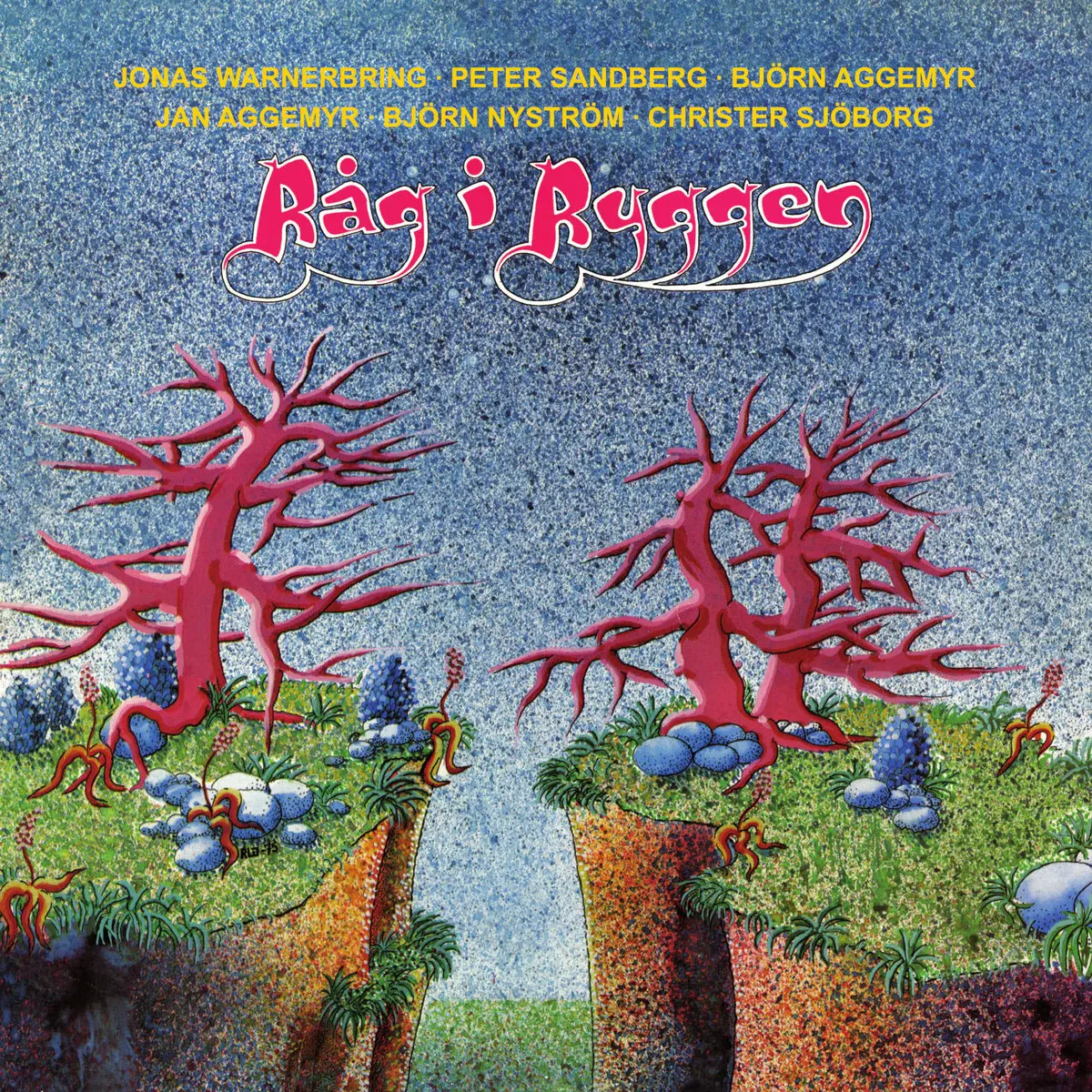 Råg i Ryggen released their self-titled album in April 1975 on Rondo.
The album features seven tracks split between Swedish and English lyrics, with heavy guitar interplay, extended instrumental sections, and layered organ and synthesizer textures.
The lineup consists of Jonas Warnerbring on vocals and transverse flute, Peter Sandberg on drums, Björn Aggemyr on bass, Jan Aggemyr and Björn “Nysse” Nyström on guitars, and Christer Sjöborg on organ, synthesizer, and string synthesizer. All music and lyrics are credited to the band.
Råg i Ryggen opens with “Det kan väl inte vara farligt,” where fuzz-toned guitar coils around a sharp unison riff and locked-in organ chords, then breaks open with a distorted solo pitched high and ragged, smearing across the upper registers while bass and drums hammer a steady foundation. “You Know It Ain’t Easy” drops to a slower pace with voice-forward phrasing and compact chord cycles, followed by “Spångaforsens brus,” an instrumental that starts restrained but surges with layered guitars and percussion, building toward a climactic phrasing run despite a noted misstep in the solo’s execution.
“Jan Banan” rides a brisk tempo and houses the album’s most expansive organ section—long, modulating runs that shift over thick fuzzed guitar drones panned to the left. “Naked Man” leans into a call-and-response between voice and lead guitar, grounded by a stomping rhythmic pattern. The closer “Sanningsserum” returns to dual-lead figures with heightened tension, propelled by a swirling Hammond break that stretches over the track’s midpoint. Throughout the album, the band balances tightly arranged ensemble passages with eruptive solo sections, switching frequently between churning fuzz textures and piercing high-register leads. Flute appears in the opening track and subtle transitional spots, adding brief contrast to the dominant organ–guitar framework.
A1. “Det kan väl inte vara farligt” [It Can’t Be Dangerous, Can It?] (5:43)
A2. “You Know It Ain’t Easy” (7:27)
A3. “Spångaforsens brus” [The Roar (rapids) of Spångaforsen] (5:58)
B1. “Jan banan” [Jan the Banana] (5:16)
B2. “Naked Man” (6:18)
B3. “Queen of Darkness” (4:38)
B4. “Sanningsserum” [Truth Serum] (6:42)
The arrangements favor layered density over open space, with each player contributing to a thick, full-band dynamic shaped by distortion, saturated tones, and breakneck pacing.
Sessions took place in Stockholm with Kjell Gradin as producer and Lars Rosin as technician. Robert Liljegren-Jegenstam illustrated the front cover, and Beman handled the layout design. Photography is credited to Keittels. The album appeared in a single pressing and remained the band’s sole release before disbanding the following year.
Postlude
After Råg i Ryggen, vocalist Jonas Warnerbring launched a long and varied career in Swedish music. In the late 1970s, he formed the pop-rock duo Spray with guitarist Gunnar Nilsson, followed by a stint as a producer for Polar Music starting in 1981. He later formed the synthpop duo Can-Can, releasing the single “Playing Girls,” and pursued a solo career with Swedish and English-language releases, including a localized version of “Major Tom” and the 1985 single “The Heat Is Killing Me.”
In 1987, Warnerbring co-founded the studio project French Revolution with producer Paris Edvinsson; their single “The Light From Fantasia” received national airplay, and the 1988 album Fantasia featured contributions from Björn J:son Lindh. Warnerbring later wrote songs for Swedish artists including Siw Malmkvist, Troll, Erika, Jan Johansen, and Jill Johnson.
Guitarist Björn “Nysse” Nyström joined Strix Q, a Stockholm-based group formed in 1977 after touring as Magnus Uggla’s backing band. Strix Q released four albums between 1978 and 1982 before disbanding in 1983. Nyström briefly attempted a solo career and later played with Pugh Rogefeldt and Staffan Birkenfalk in the group Good Clean Fun. He revived Strix Q as strixq.nu in the 2000s while also running a business outside of music.
Discography:
- Råg i Ryggen (1975)
Sources:
Artist/Album Pages:
Space was a French electro/space-funk band that released four albums between 1977 and 1980 on Vogu...
Sea Level was an American jazz-rock band from Macon, Georgia, formed in 1976 by musicians from the...
Fruupp was an Irish symphonic-rock band that released four albums on Dawn between 1973 and 1975. ...
Babylon was an American symphonic-rock band from Florida that self-released a 1978 eponymous album...
Ashford & Simpson were an American soul-pop duo from N.Y.C. comprising the husband-and-wife mu...
Tuca — aka Valeniza Zagni da Silva (Oct. 17, 1944 — May 8, 1978) — was a Brazilian samba-pop/psych...
ZZ Top is an American hard-rock/blues trio from Houston that formed in 1969 and built its first run ...
Tomorrows People were an American soul group from Chicago that released the 1976 album Open Soul....
Messengers were a German jazz-funk big band behind the 1975 Red Point album First Message, followe...
Phyllis Hyman (July 6, 1949 — June 30, 1995) was an American soul singer who released two albums o...
Das Waldemar Wunderbar Syndikat was a German all-star jazz-funk jamboree assembled for the 1976 Te...
Lifestyle was an American soul group that released a 1977 self-titled album on MCA. Members: Je...