

Dedalus was an Italian jazz-rock band that released two albums in 1973/74 on Trident.
Members: Fiorenzo Michele Bonansone (keyboards, cello, accordion, vocals, 1972-79, 1990-present), Marco Di Castri (guitar, saxophone, 1972-79, 1990-99), Furio Di Castri (bass, 1972-74), Enrico Grosso (drums, 1972-77, 1990-97)
Background
Dedalus formed in early 1973 in Pinerolo, a town near Turin. The original lineup comprised keyboardist/cellist Fiorenzo Michele Bonansone, guitarist/saxist Marco Di Castri, bassist Furio Di Castri, and drummer Enrico Grosso. They developed a jazz-rooted instrumental style with emphasis on electric keys, processed tones, and free-form structure.
In spring 1973, they performed at the Festival di Avanguardia e Nuove Tendenze in Naples, where a major journalist named them the festival’s standout act. Soon after, Trident signed the band for an album. Sessions began later that year.
Dedalus
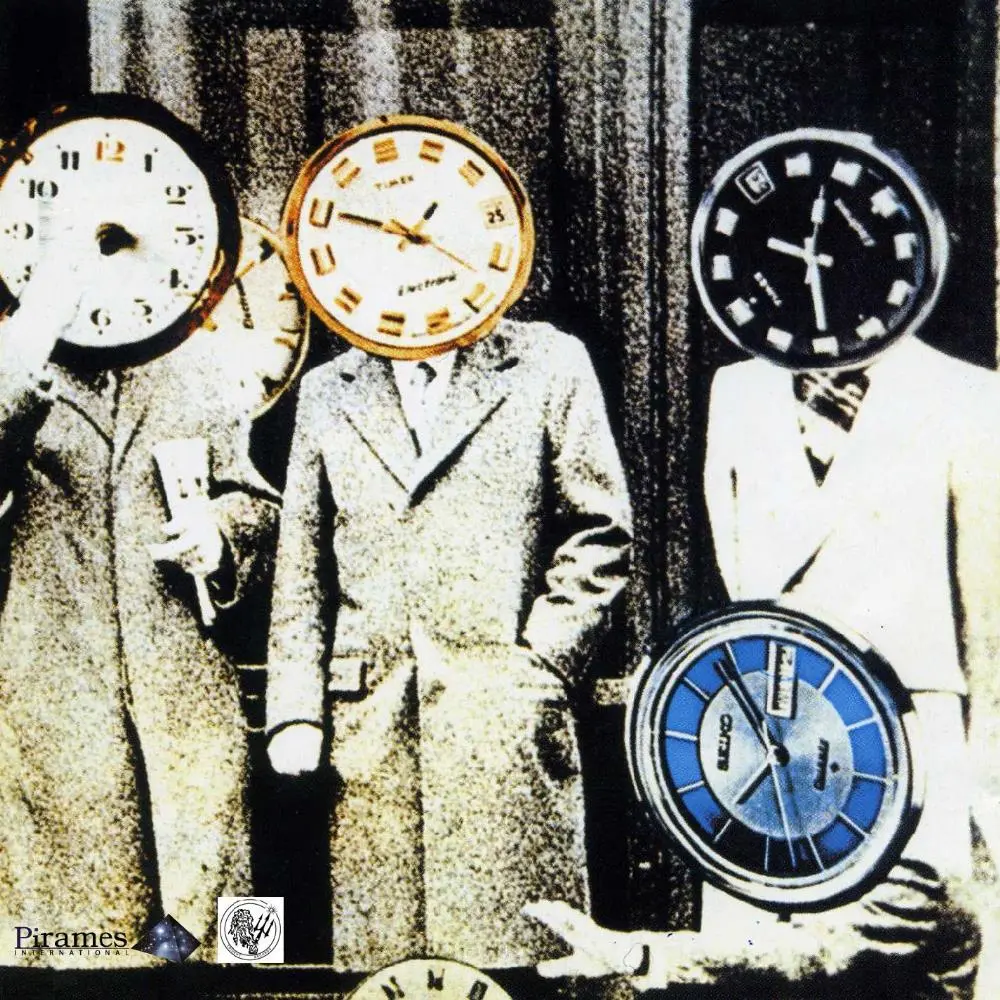 Dedalus released their self-titled album in 1973 on Trident.
The album features the original quartet with guest percussionist René Mantegna. It emphasizes layered textures, interlocking motifs, and electric instrumentation rooted in jazz-rock abstraction.
Fiorenzo Bonansone juggles electric cello and Fender Rhodes electric piano, plus synthesizer on the track “Conn.” His input counters the guitar and tenor sax exchanges of Marco Di Castri, both underpinned by the rhythm section of Furio Di Castri and Enrico Grosso.
Dedalus moves through sharply contrasted blocks rather than extended narrative arcs. “Santiago” opens at brisk pace with linear guitar phrases and electric piano comping, then drops into a suspended middle section where tempo thins out and electrified cello and electronics stretch time before the rhythm snaps back late. “Leda” alternates buoyant ensemble passages with weightless interludes, using echoed keys and sax to create a drifting surface that periodically tightens into faster cycles.
“Conn” favors fragmentation: short bursts of sax and percussion give way to collaged textures and abrupt shifts, with cello entering as a destabilizing voice rather than a lead. The long-form “C.T.6” unfolds episodically, beginning with sparse electronics, moving through successive lead rotations—guitar, sax, piano—over a steady but pliable pulse, and breaking the motion several times with pauses and reduced density before reassembling near the close. “Brilla” relaxes the pressure, setting sax and piano into a measured, low-intensity frame that gradually accelerates, introduces angular guitar lines, then resolves by returning to its opening restraint.
A1. “Santiago” (9:13)
A2. “Leda” (4:30)
A3. “Conn” (3:48)
B1. “C.T.6” (14:02)
B2. “Brilla” [It Shines] (5:39)
Dedalus recorded the album with producer Maurizio Salvadori, a soundman on 1973/74 titles by Garybaldi, The Trip, and Biglietto Per L’Inferno.
Dedalus appeared in a laminated gatefold sleeve with inner and outer artwork. The front cover features a grey-toned photo of suited figures with wristwatch faces superimposed over their heads. The band name appears in light blue sans-serif type across the lower torso of the central figure. The inner gatefold presents an abstract long-exposure photo of curved light trails in blue, white, and magenta tones against a dark background, with credits printed at upper right and lower left in white type.
Materiale per tre esecutori e nastro magnetico
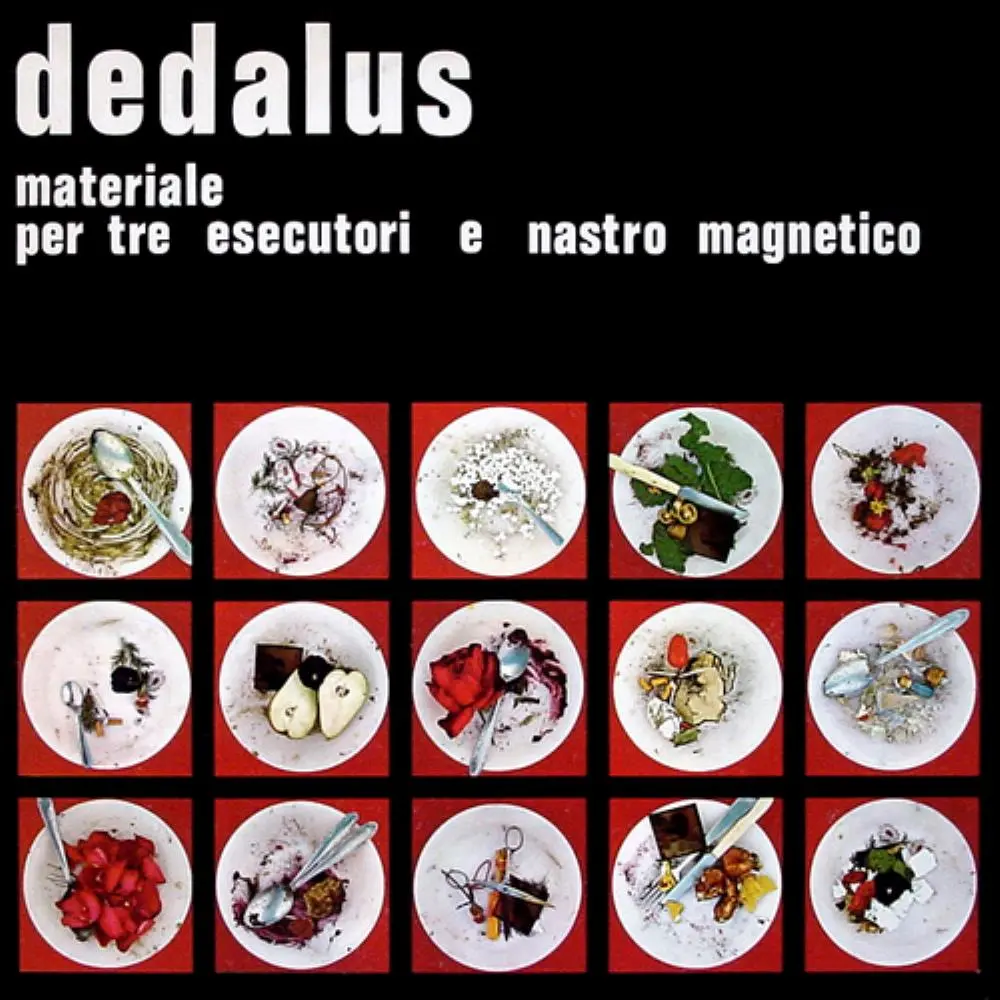 Dedalus released their second album, Materiale per tre esecutori e nastro magnetico, in 1974 on Trident. The title translates as Material for Three Performers and Magnetic Tape, referencing their new trio arrangement since the departure of bassist Furio Di Castri.
The album presents nine short-form pieces and one extended improvisation composed, arranged, and prepared for tape and acoustic/electric instrumentation by Fiorenzo Bonansone with key contributions from guitarist/saxist Marco Di Castri and drummer Enrico Grosso.
Bonansone plays multiple keyboards (piano, accordion, Fender Rhodes electric) and string instruments (cello, mandolin). Di Castri co-prepared the magnetic tape components.
Materiale abandons sustained pulse in favor of short, sharply etched sound events. Several tracks function as brief studies built from isolated gestures—bursts of sax, struck piano clusters, scraped strings, percussive noise—placed in open space with little connective tissue. Pieces such as “Rumore Bianco” and the paired “Emergenza” segments pass quickly, emphasizing density changes rather than development. Longer entries stretch the method: “Spazio di sei note” fixes attention on a narrow pitch set that repeats in uneven cycles while texture thickens and thins, and “Esserci” expands duration without stabilizing tempo, allowing instruments to surface and recede independently.
Side two alternates between compressed forms and extended confrontation. “Accordanza” layers sustained tones and abrupt accents into a tense, slowly shifting mass, while the closing improvisation pushes duration and intensity through continuous interaction between cello, sax, drums, and percussion, favoring collision and overlap over resolution. Throughout, pacing feels unsettled and volatile, with motion driven by contrast, interruption, and accumulation rather than forward momentum.
A1. “Rumore Bianco” [White Noise] (0:31)
A2. “Emergenza A” [Emergency A] (1:53)
A3. “Emergenza B” [Emergency B] (4:41)
A4. “Discorso Su Due Piani” [Discourse on Two Planes] (2:15)
A5. “Spazio Di Sei Note” [Space of Six Notes] (5:30)
A6. “Esserci” [To Be There] (7:15)
B1. “La Bergera, Da Un Canto Popolare Anonimo” [The Shepherdess, from an Anonymous Folk Song] (1:53)
B2. “Con Più Frequenza” [With More Frequency] (2:46)
B3. “Accordanza” [Harmonization] (7:32)
B4. “Improvvisazione Per Violoncello, Sassofono Tenore, Batteria E Percussioni” [Improvisation for Cello, Tenor Saxophone, Drums and Percussion] (8:28)
Bonansone engineered the album with mixing technician Danilo Pennone, a subsequent soundman for Living Life.
Materiale per tre esecutori e nastro magnetico features a non-gatefold cover dominated by a grid of 16 photographic panels depicting white dishes filled with various remains—spoons, leaves, petals, bits of food—set against a red background. The title appears above in all lowercase sans-serif type, split across two lines in white.
Postlude
Dedalus continued briefly as a duo after Grosso’s 1977 departure, collaborating with international jazz artists before disbanding in 1979.
In 1990, Bonansone, Di Castri, and Grosso reconvened the Materiale lineup and began recording new material with bassist Domenico Sciaino. The resulting album, Pia visione, appeared in 1997 as a privately issued CD. It introduced vocals and rearranged traditional songs, expanding their palette with subtle folk inflections.
In 2001, Bonansone launched a new ensemble under the name Bonansone Dedalus Group, with flute, trombone, and percussion arrangements that emphasized chamber-like minimalism. Their first album, Nomos Apache Alpha, appeared in 2004 on BTF/Vinyl Magic and included new versions of material from Pia visione.
In 2017, the full Dedalus catalog appeared in the retrospective box set Le ricordanze, which also featured a booklet with interviews and archival photos.
Discography:
- Dedalus (1973)
- Materiale per tre esecutori e nastro magnetico (1974)
Sources:
Artist/Album Pages:
Joe Henderson (April 24, 1937 — June 30, 2001) was an American tenor saxophonist with a forty-year...
Lobby Loyde — aka John Baslington Lyde (May 18, 1941 — April 21, 2007) — was an Australian blues-r...
Arti & Mestieri was an Italian jazz-rock band that released the 1974/75 albums Tilt (Immagini ...
Cory Braverman is an American soul-rock vocalist who released the 1976 album Fire Sign. In 1982, s...
Nono Söderberg is a Finnish guitarist who emerged in the mid-1960s on the local R&B/beat scene...
Buon Vecchio Charlie were an Italian symphonic-rock band that was active circa 1970/71, recording ...
Steely Dan was an American jazz-rock/pop band that released six studio albums on ABC between 1972 an...
Alain Kan (born Sept. 14, 1944) is (or was) a French singer who first released a round of chanson-po...
Ronnie McNeir is an American soul singer, songwriter, keyboardist, arranger, and producer who rele...
Zé Ramalho is a Brazilian singer/songwriter who collaborated with Lula Côrtes on the 1975 album Pa...
Druid was an English symphonic-rock band that released the 1975–76 albums Toward the Sun and Fluid...
Alessandro Brugnolini (born Dec. 1, 1931) is an Italian composer and saxophonist who released nume...