

Albert Marcœur is a French musician, composer, and arranger who released ten albums between 1974 and 2008. His first four albums — Albert Marcœur, Album à Colorier, Armes & Cycles, and Celui où y’a Joseph — contain Zappa-esque fusions of avant-garde rock, big band, and zolo music. Along with Etron Fou Leloublan, he foreshadowed the 1980s French RIO sound of the ReR-affiliated AYAA Disques label.
Background
Albert Marcœur was born on December 12 1947, in Dijon, France, and studied clarinet at the National Academy of Music and Dance of Dijon with Roger Desoomer. His first group, The Jazz Babies, played at Lycée Hippolyte Fontaine in Dijon with pianist Claude Carrasco, guitarist Patrice Buttard, drummer Alain Buttard, and Marcœur on clarinet.
Marcœur moved from clarinet to alto and tenor saxophone in The Lake’s Men, a Burgundy group that played regional contests and sought work beyond the local circuit. The group pursued Paris club dates, foreign engagements, support work for American singers, and original material.
Marcœur moved to Le Fidelaire in Eure in 1970, where arranger Jacques Denjean kept resident musicians at Studio Frémontel for visiting clients. He worked there with Kapak, a studio-based group with guitarist Patrice Tison, keyboardist François Bréant, and bassist Pascal Arroyo. Kapak used vacant studio hours for its own recordings, and Marcœur learned multitrack technique on Frémontel’s four-track Ampex and two-track Scully machines.
In 1972, he drummed (uncredited) on the Chaland Records release Rock Anthology 1, an album of Led Zeppelin covers credited to The Phoenix (also released on Disques Look For as A Tribute to Led Zeppelin and Actual Rock). In 1974, he played alto saxophone and clarinet on two tracks (“Black Art,” “Bouleau Bleu”) on Doin’ Nuthin’, the second of two albums by French jazz-rockers Nemo.
Albert Marcœur
 Albert Marcœur released his self-titled debut album in 1974 on French Atlantic.
Marcœur frames six original pieces and one traditional adaptation through spoken-song phrasing, woodwind figures, bottle percussion, and studio-collage edits. He sings and plays drums, percussion, clarinets, alto and soprano saxophones, pipes, bird calls, horns, and whistles, joined by multi-instrumentalist Patrice Tison (bass, guitars, organ, percussion, charango, bird calls, horns, whistles), trombonist Robert Lafont, bottle players Claude Marcœur, Popeye, Didier Perrier, and Gérard Marcœur, with chorus voices from François Bréant and Christian Sarrel.
“C’est raté, c’est raté” lurches through a lopsided backbeat, stray metallic clatter, and a blunt chorus that snaps the narrated verses shut. “Simone” opens on alarm-siren unease, then coils around wheezy clarinet phrases, repeating recorder turns, and a calmer bell-touched coda. “Tu tapes trop fort” chatters through quick circus accents, noisemaker saxophone figures, and a hammered-wood chorus tied to the title command. “Appalderie” scatters traffic samples and siren traces before dissonant ensemble bursts split the passage.
“Que le temps est long” softens into an intimate vocal line, then breaks its poise with shouted group entries and trombone interruptions. “Mon père avait un p’tit champ d’pommes” jerks from spoken exchange into dissonant short-form motion and sharp violin turns. “Qu’est-ce que tu as?” drifts from slow flute and organ haze into repetitive staccato accents, multi-voice entries, and an abrupt final turn.
A1. “C’est Raté, C’est Raté” [It’s Botched, It’s Botched] (3:40)
A2. “Simone” [Simone] (4:10)
A3. “Tu Tapes Trop Fort” [You’re Hitting Too Hard] (3:37)
A4. “Appalderie” [Appalderie] (4:29)
B1. “Que le Temps est Long” [How Long Time Feels] (5:39)
B2. “Mon Père Avait un P’tit Champ d’Pommes” [My Father Had a Little Apple Field] (3:15) – traditional; arranged by Marcœur
B3. “Qu’est-ce que tu as?” [What’s Wrong?] (7:44)
Marcœur recorded the album in 1974 at Studio Frémontel with producer Jacques Denjean and sound engineers Michel Roy, Didier Perrier, and Claude Sahakian.
François Bréant illustrated the cover with a mechanical figure assembled from brass instruments, drums, cables, and round eye forms against a blue field. Jacques Denjean photographed the package.
Album à Colorier
 Albert Marcœur released his second album, Album à Colorier, in 1976 on French Atlantic.
He wrote the texts, music, and arrangements for ten of the eleven titles, with Pierre Vermeire credited for “Fermez la porte.” Marcœur builds the album from short vocal pieces, instrumental miniatures, and ensemble passages for clarinets, bugle, bassoon, saxophones, trumpet, percussion, guitars, flute, bandoneon, piano, bass, pipeaux, and chorus.
The ensemble includes guitarist Christian Leroux, bassist Pascal Arroyo, drummer/saxophonist Claude Marcœur, trumpeter/bugle player Gérard Nouvel, multi-instrumentalist Vermeire, percussionist Gérard Marcœur, bassoonist Denis Brély, reed/flute player François Lasalle, vocalists Monique Lorillard and Françoise Noirot, bandoneonist Michel Cousin, guitarist François Ovide, pianist François Bréant, alto saxophonist Marc Duconseille, and the children’s choir Les enfants de Sébécourt.
“Monsieur Lépousse” jolts from live-recorded car horns into saccadé vocal phrasing, abrupt meter turns, and a mock-radio coda. “Le Fugitif” accelerates after its party-talk opening, with the lead voice set close against rapid bass motion and a harsh reed fanfare. “Le Nécessaire à chaussures” slips between pinched mutter and rapid-fire outburst, then answers the lost-object narrative with short brass collisions.
“Le Père Grimoine” recedes into soft piano, wavering vocal lines, and a small chorus set against a plaintive deathbed vignette. “Doctorine” turns a clipped percussion prelude into flute-led modal motion, then swells toward strained low-reed accents and high group voices. “Le Jus d’abricot” erupts from guitar-and-bass entry into a bright fanfare, fast recitation, and a clean refrain that briefly straightens the song form.
“La Cueillette des noix” chants its nut-gathering ritual through nursery-rhyme-like softness, spoken passages, sudden tempo lift, and dissonant pipe figures. “Elle était belle” parodies lovesick ballad phrasing with male chorus replies and comic-operatic inflection. “Fermez la porte” cuts spoken-room noise into a door-slam interruption and a brass-band miniature. “Là d’dans” barrels through rough vocal shouts, quarrelling chorus entries, and jagged ensemble replies. “Ouvre-toi” closes on light brass-band phrasing and a plainspoken monologue.
A1. “Monsieur Lépousse” [Mr. Lépousse] (1:19)
A2. “Le Fugitif” [The Fugitive] (3:16)
A3. “Le Nécessaire à chaussures” [The Shoe-Care Kit] (1:53)
A4. “Le Père Grimoine” [Father Grimoine] (3:31)
A5. “Doctorine” [Doctorine] (2:57)
A6. “Le Jus d’abricot” [Apricot Juice] (2:31)
B1. “La Cueillette des noix” [The Walnut Gathering] (3:47)
B2. “Elle était belle” [She Was Beautiful] (3:34)
B3. “Fermez la porte” [Close the Door] (1:29) – Vermeire
B4. “Là-d’dans” [In There] (4:28)
B5. “Ouvre-toi” [Open Up] (2:10)
Marcœur recorded Album à Colorier in 1976 at Studio Frémontel in Le Fidelaire with producer Jacques Denjean and sound engineer Michel Roy.
Album à Colorier features illustration by François Bréant with photography by Bruno Le Trevidic; the cover image shows a dense mechanical figure assembled from screens, cables, utensils, and instrument parts against a yellow field.
Armes & Cycles
 Albert Marcœur released his third album, Armes & Cycles, in 1979 on Philips.
Marcœur wrote the texts, music, and arrangements for all ten titles. He tightens the ensemble format around compact instrumental writing, chorus vocals, tape sounds, guitar passages, and clustered wind figures.
The album brings back multi-instrumentalist Pierre Vermeire, reedist Denis Brély, guitarist/pianist François Ovide, guitarist/bassist Jacques Garret, drummer/percussionist Claude Marcœur, and percussionist/multi-instrumentalist Gérard Marcœur, with organist Jacqueline Thibault and chorus voices from Annick Champeau, Aline Claude, and Patrice Calamel.
“Ici” jolts from a difficult opening into nervous vocal bursts and clipped guitar-led motion. “Emploi du temps” tightens the album’s brisk chamber-sized language around compact solo breaks. “La Dame qui est assise à côté de moi” swerves through odd vocal phrasing, then steadies into a firmer instrumental close. “Linge sale” jolts across sharp zolo turns, leading into the piano line of “Histoire d’offrir.” “Histoire d’offrir” clips near-spoken phrases into bustling accents, small harmony clusters, and a pointed solo break.
“Ampoule grillée” turns folk-dance inflection into a miniature prelude for “Réveil,” where stacked voices replace the ensemble. “Son sac” starts from strummed guitar and close vocal placement, then overlaps the voices into a canon passage across the second half. “Micheline” murmurs through rain-window imagery and warped everyday detail, while “Bonjour Monsieur Monsieur” closes on acoustic-guitar contrast, relaxed lead lines, and brief section lift.
A1. “Ici” [Here] (2:36)
A2. “Emploi du temps” [Schedule] (3:25)
A3. “La dame qui est assise à côté de moi” [The Woman Sitting Next to Me] (5:21)
A4. “Linge sale” [Dirty Laundry] (2:12)
A5. “Histoire d’offrir” [Just to Offer] (3:35)
B1. “Ampoule grillée” [Burned-Out Bulb] (1:34)
B2. “Réveil” [Alarm Clock] (1:24)
B3. “Son sac” [Her Bag] (6:20)
B4. “Micheline” [Micheline] (3:30)
B5. “Bonjour Monsieur Monsieur” [Hello, Mr. Mister] (4:35)
Marcœur recorded Armes & Cycles in November 1978 at Château d’Hérouville in Hérouville with Laurent Thibault handling recording and mixing, assisted by Gabriel Lévy.
Armes & Cycles features visual credits by François Bréant; the cover illustration scatters tools, household objects, mechanical parts, and inset black-and-white image panels across a blue-green field.
Celui où y’a Joseph
 Albert Marcœur released his fourth album, Celui où y’a Joseph, in 1983 on Le Chant du Monde.
Marcœur wrote the texts, music, and arrangements for ten titles. He sets spoken-song delivery, chamber winds, guitar, bass, drums, percussion objects, and chorus within compact song forms and short instrumental passages.
Joseph retains Garret, Brély, Vermeire, Gérard Marcœur, and Claude Marcœur from the prior album, with guitarist Bernard Morain joining the group. Marcœur himself plays clarinets, alto saxophone, and drums.
“Éveil matin suivi d’apéritif dansant” wakes through plain morning motion and quick celebratory turns. “Téléphone privé” creeps at a heavier crawl, with the vocal line placed inside a narrow chamber-dense register. “Joseph” circles a repetitive beat while harmonium drone darkens the long-form chant. “Con que j’étais” knots bassoon color, low-register reed figures, and sinister harmonic drag into the album’s darkest passage.
“Ballade à Jean” hurries through complex ensemble turns and percussive accents tied to its tight-clothing vignette. “Poussez pas” rattles its title command through clipped vocal bursts and compact section changes. “Velouté d’asperges” staggers in a slower brass-centered miniature. “Non long” cuts a short verbal idea into quick instrumental replies. “Bonne Entente” hurries through hectic chamber-rock motion and close-set vocal turns. “Comme avant” recedes into familiar Marcoeur phrasing, with brisk ensemble figures and a final return to sour everyday comedy.
A1. “Éveil matin suivi d’apéritif dansant” [Morning Alarm Followed by a Dancing Aperitif] (2:47)
A2. “Téléphone privé” [Private Telephone] (2:04)
A3. “Joseph” [Joseph] (8:32)
A4. “Con que j’étais” [What an Idiot I Was] (4:32)
B1. “Ballade à Jean” [Ballad for Jean] (4:07)
B2. “Poussez pas” [Don’t Push] (3:16)
B3. “Velouté d’asperges” [Cream of Asparagus Soup] (1:57)
B4. “Non long” [Not Long] (2:19)
B5. “Bonne entente” [Good Understanding] (3:52)
B6. “Comme avant” [Like Before] (3:20)
Marcœur recorded Celui où y’a Joseph between March 1981 and December 1983 at Studio de Saint-Nom-la-Bretèche. Marcœur produced the album, while Christian Gence recorded and mixed the sessions.
Crapule! designed the package with illustration by Pascal Doury. The front image shows a dense mechanical cluster of colored instrument parts and angular forms against a black field.
Ma vie avec elles
 Albert Marcœur released his fifth album, Ma vie avec elles, in 1990 on Baillemont Productions.
Marcœur wrote the texts and music for eight titles and arranged the album. He narrows the setting around voice, keyboards, saxophone, clarinet, bass, drums, pianos, and harmonicas, with flute, organ, guitar, percussion, winds, brass, and strings in the surrounding ensemble.
The recording retains Ovide, Morain, Gérard Marcœur, Claude Marcœur, Vermeire, and Brély, with vocalist/flutist/organist Élise Caron, violinists Howard Davis and Peter Pople, violist Roger Best, and cellist David Smith.
“Compte-rendu d’analyse” starts from a 7/8 piano figure, adds synthetic chromaticism in crescendo, and brings woodwind counterpoint into a long first-theme statement. “40-15” scores tennis language as match-count recitation, with string writing placed around the point-by-point refrain. “Bouge pas” freezes its bedroom command lines into close comic repetition and clipped vocal timing. “Caresse-moi” compresses the relationship address into a short, direct miniature. “Le gosse et les pianos” narrows the album’s domestic scenes to child-and-piano detail, while “Le monde à l’envers” closes on inversion imagery and compact final-song form.
1. “Les Laveurs de carreaux” [The Window Washers] (6:22)
2. “Se souvenir, verbe pronominal” [To Remember, a Pronominal Verb] (7:47)
3. “Caresse-moi” [Caress Me] (2:25)
4. “Bouge pas” [Don’t Move] (4:35)
5. “Compte-rendu d’analyse” [Analysis Report] (8:38)
6. “Le Gosse et les pianos” [The Kid and the Pianos] (4:50)
7. “40-15” [40–15] (5:57)
8. “Le Monde à l’envers” [The World Upside Down] (4:56)
Marcœur arranged Ma vie avec elles. Claude Marcœur recorded and mixed the album, and Hansjürg Meier mastered the disc.
Crapule! designed the package, with Jean Tholance credited on the sleeve. The digipack image places eyeglass forms over large pale title lettering.
Sports et percussions
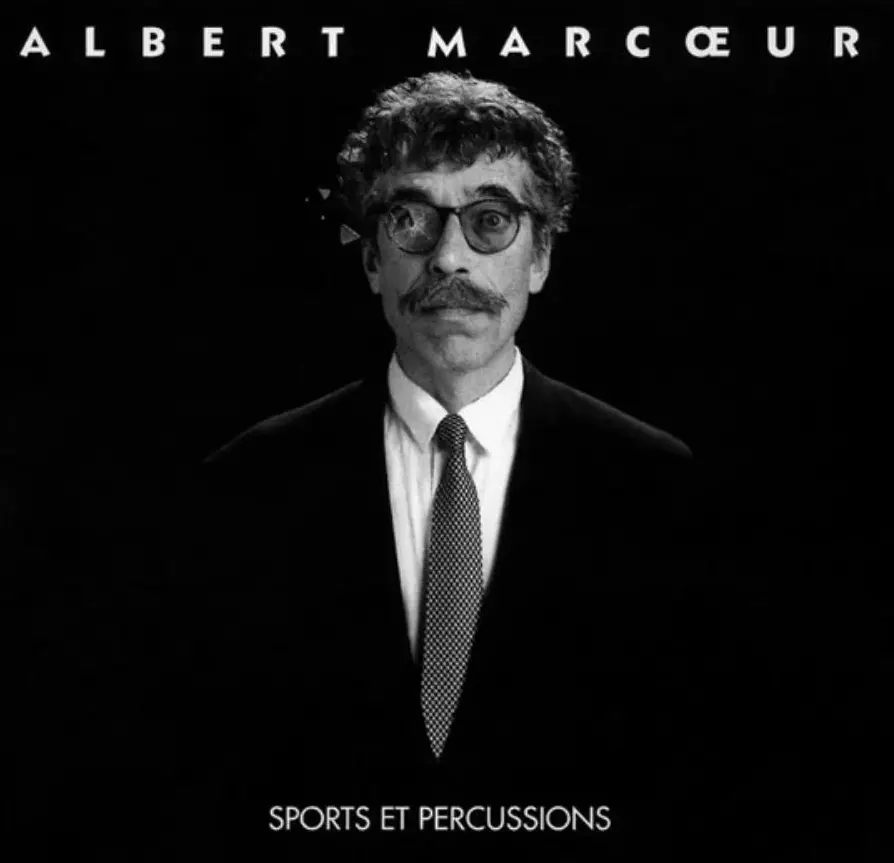 Albert Marcœur released his sixth album, Sports et percussions, in 1994 on Disques Concord.
Marcœur shaped the eight-title program from sports sound material, stadium sound, bicycle mechanics, and motor-racing pitch shifts. He scores the material for guitars, bass, keyboards, drums, and percussion.
The recording group includes returning guitarist François Ovide, guitarist Stéphane Salerno, bassist Farid Khenfouf, drummer/keyboardist Marcœur, drummer/percussionist Claude Marcœur, and percussionist Gérard Marcœur.
“Les gonfleurs de bicyclette” inflates bicycle sound into pitched taps, mechanical squeaks, and variable body resonance. “Tchécoslovaquie-Écosse 0-0” treats the stadium hymn as a massed chant problem, enlarging ensemble force against crowd-scale rhythm. “Cher Roger” places a child’s recorded letter inside a Schubert-derived clarinet transcription, with the spoken phrases dropped against slow harmonic turns.
“Formule un” dopplers engine passes into descending interval shapes and clipped velocity bursts. “Formule deux” extends the motor-sport construction into a second compact sequence. Sports et percussions works as scored sound-comic: sport material supplies the objects, but Marcœur converts those objects into rhythm, interval, and staged interruption.
1. “Boxe à mainte reprise” [Boxing Over Many Rounds] (5:37)
2. “Les Gonfleurs de bicyclette” [The Bicycle Pumpers] (5:09)
3. “Sports hasardeux” [Risky Sports] (7:52)
4. “Tchécoslovaquie-Écosse 0-0” [Czechoslovakia–Scotland 0–0] (7:55)
5. “Sports en plein air” [Outdoor Sports] (4:55)
6. “Cher Roger” [Dear Roger] (1:42)
7. “Formule un” [Formula One] (3:55)
8. “Formule deux” [Formula Two] (4:53)
Crapule! designed the package. The cover shows Marcœur in a dark suit and tie against a black field, with the album title placed beneath the portrait.
Discography:
- Albert Marcœur (1974)
- Album à Colorier (1976)
- Armes & Cycles (1979)
- Celui où y’a Joseph (1983)
- Ma vie avec elles (1990)
- Sports et percussions (1994)
- (M,a,r, et cœur comme cœur) (1998)
- Plusieurs cas de figure (2001)
- L’Apostrophe (2005)
- Travaux Pratiques (2008)
Sources:
Artist/Album Pages:
Dane Donohue is an American singer and songwriter who made a 1978 self-titled album on Columbia, s...
Dave Mason (May 10, 1946 – April 19, 2026) was an English singer-songwriter who emerged as the guita...
Player was an American adult-oriented rock band from Los Angeles that released the 1977/78 RSO alb...
Solution was a Dutch jazz-rock-soul band that released the 1971–72 Harvest albums Solution and Div...
Mikael Ramel (Jan. 19, 1949) is a Swedish singer/songwriter behind the 1972–74 Ljudspår albums Til...
Adrian Belew is an American art-rock guitarist and composer from Covington, Ken., who emerged in ...
Peter Frampton (born April 22, 1950) is an English guitarist and singer who released a string of 1...
The Planets was an English new wave band that released the 1979–80 Rialto albums Goon Hilly Down and...
Stephen Dees is an American musician and songwriter who served as the mid-Seventies touring bassis...
Charly García (born Oct. 23, 1951) is an Argentinian multi-instrumentalist, vocalist, and songwrit...
Арсенал (Arsenal) are a Russian jazz-rock big band, active from 1973 in Moscow. Inspired by the U....
Jan Akkerman (born Dec. 24, 1946) is a Dutch guitarist who achieved global renown as a member of F...