

Men at Work were an Australian new wave band that achieved global fame with their 1981 debut album Bushiness as Usual and the back-to-back international chart-toppers “Who Can It Be Now?” and “Down Under.” Their 1983 followup Cargo spawned further evergreens with “Dr. Heckyll & Mr. Jive,” “Overkill,” and “It’s a Mistake.” They matched deadpan lyrical humor — often steeped in screwball vignettes and regional references — with musical elements of jazz-pop, ethno-pop, and reggae.
Members: Colin Hay (vocals, guitar), Ron Strykert (bass, guitar, vocals, 1979-85), Greg Sneddon (keyboards, 1979), Jerry Speiser (drums, vocals, 1979-84), John Rees (bass, 1979-84), Greg Ham (saxophone, keyboards, vocals, flute, harmonica, 1979-85)
Background
Men at Work formed in late 1979 when singer–guitarist Colin Hay and then-bassist Ron Stryker assembled Melbourne musicians for a proper band. The pair first performed in 1978 as an acoustic duo.
Hay was born on June 29, 1953, in Saltcoats on the west coast of North Ayrshire, Scotland. His father, James, had a song-and-dance career in Glasgow. In 1967, the Hay family migrated to Melbourne, where Colin’s parents ran a music shop.
Strykert (b. August 18, 1957) made frequent performances with Hay at the Cricketer’s Arms Hotel in Richmond, Victoria, where they soon welcomed drummer Jerry Speiser (b. August 12, 1953), whose prior session work included Mind Stroll, the 1974 Mushroom Records release by symphonic-rock keyboardist Greg Sneddon. Most recently, Speiser drummed in a local band named Numbers.
Just as the new band took root, Sneddon asked Hay, Speiser, and Strykert to play in the pit band for Riff Raff, an original musical that Sneddon arranged with writer Jan McDonald. The recorded work, with eleven songs and five credited performers, appeared in 1979 as Riff-Raff (A Rock Musical), a self-pressed album credited to W.E.S.T. (West Community Theatre).
Hay next approached keyboardist and multi-reedist Greg Ham, who Colin first met in 1972 through their mutual friend, comedian Kim Gyngell. Ham completed his music degree and joined Hay’s band in October. Soon after, Speiser brought in his bassist friend John Rees, whose presence allowed Strykert to concentrate on lead guitar. Rees hailed from Chetarca, a piano-based symphonic-rock band that cut a 1975 self-titled album on WEA–Atlantic.
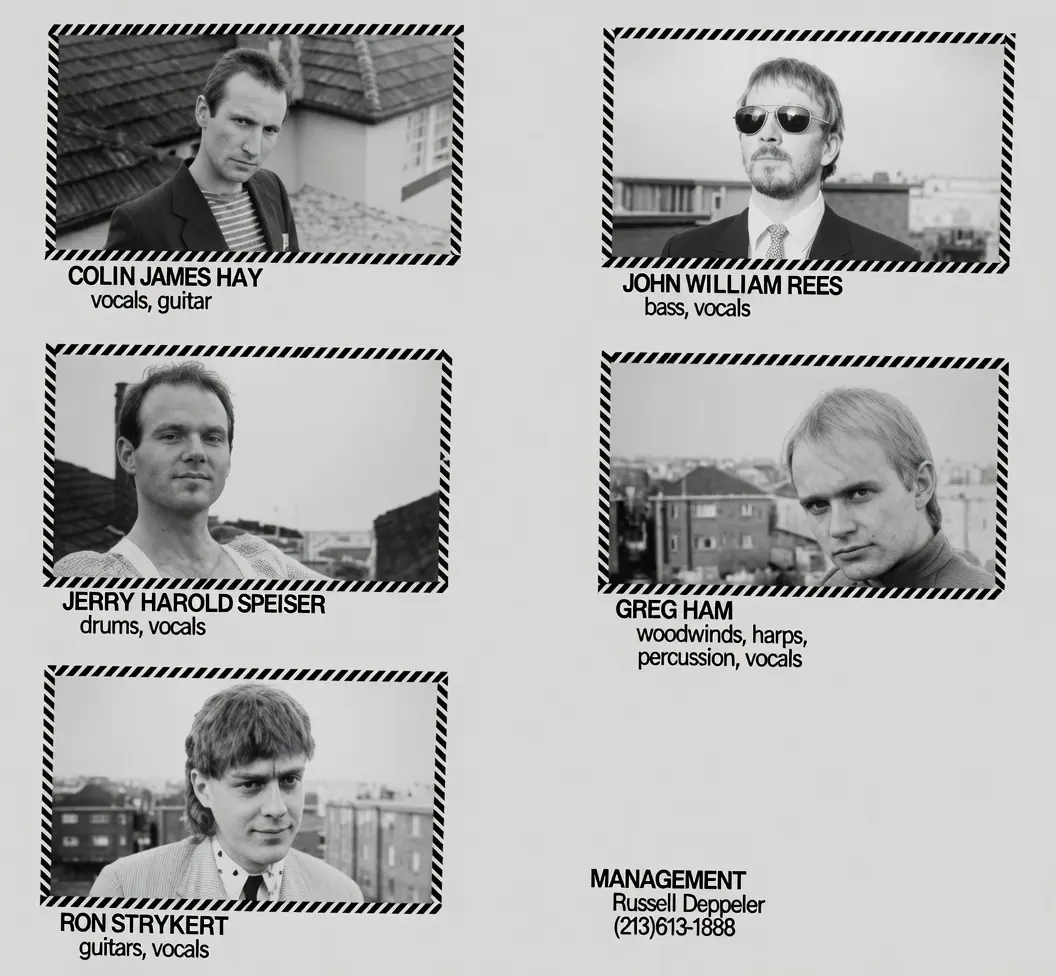 Before the new band’s stage debut in Richmond at the Cricketer’s Arms Hotel, they entered possible band names into a hat. Hay submitted Men at Work, a description of their situation as an unsigned act on the hustle. Strykert seconded Hay’s idea.
In 1980, Men at Work released their debut single: “Keypunch Operator” backed by “Down Under,” both Hay–Strykert originals. They self-financed the single on one-press MAW Music.
By Christmas, Men at Work gained an avid live following. In early 1981, they signed with CBS Records and recorded their first album with Los Angeles producer Peter McIan.
Business as Usual
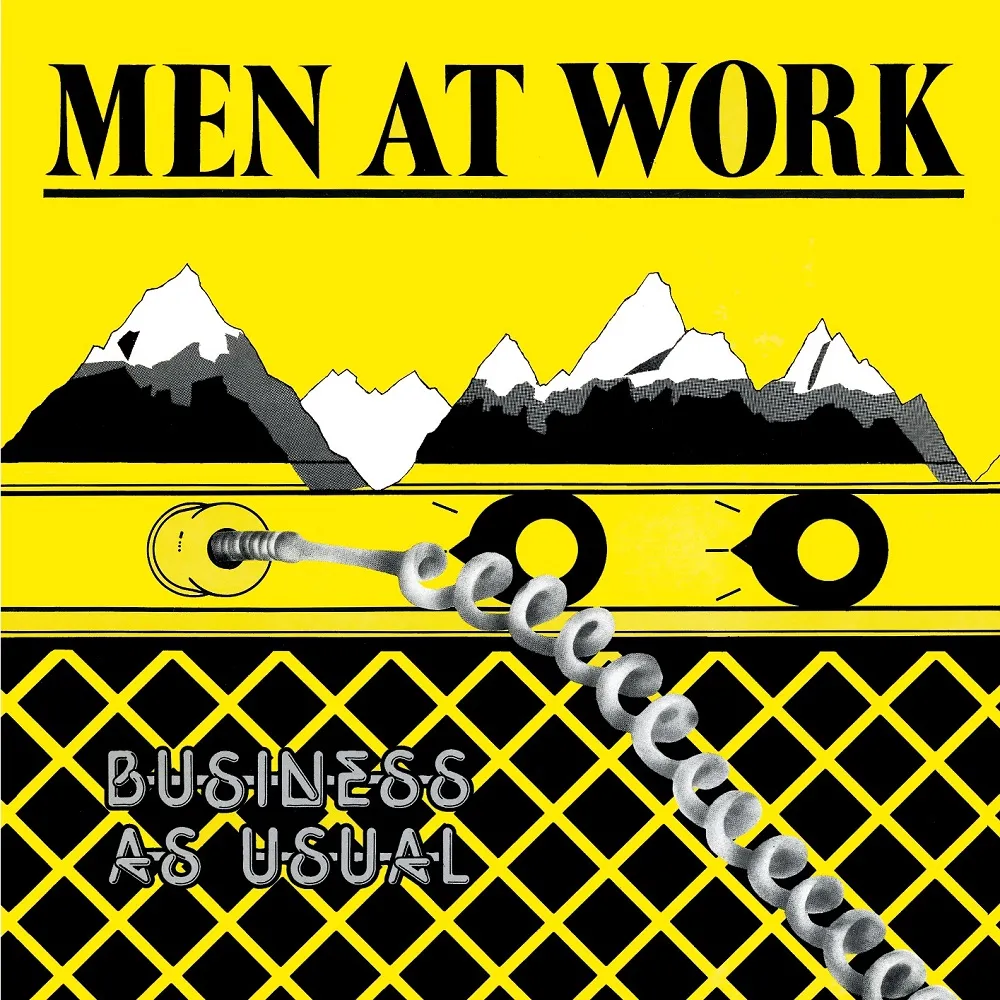 Men at Work released their debut album, Business as Usual, on November 9, 1981, on CBS.
Business as Usual presents the five-piece lineup that took shape after Rees moved Strykert from bass to guitar. Hay wrote four songs alone and co-wrote three with Strykert, Ham, and Speiser in varying combinations. Ham wrote and sings “Helpless Automaton,” while Strykert wrote “People Just Love to Play with Words.”
“Who Can It Be Now?” barges in with Ham’s saxophone tag, tightens around Hay’s shut-in vocal and clipped title answers, then climaxes as repeated title calls give way to urgent reed breaks. “I Can See It in Your Eyes” drives under high synth tones and a compact lead break. “Down Under” lopes on a springy off-beat pattern and fixes its travelogue verses to Ham’s flute tag. “Underground” darts through Strykert’s riff and sudden rhythmic turns.
“Helpless Automation” jitters under Ham’s deadpan vocal and machine-character text. “Be Good Johnny” bounces through spoken instructions and jittery keyboard accents. “Touching the Untouchables” twists horn figures around dynamic vocal turns. “Catch a Star” starts from simple low-end rudiments and widens into a mild off-beat lilt. “Down by the Sea” relaxes into a drawn-out, laid-back close.
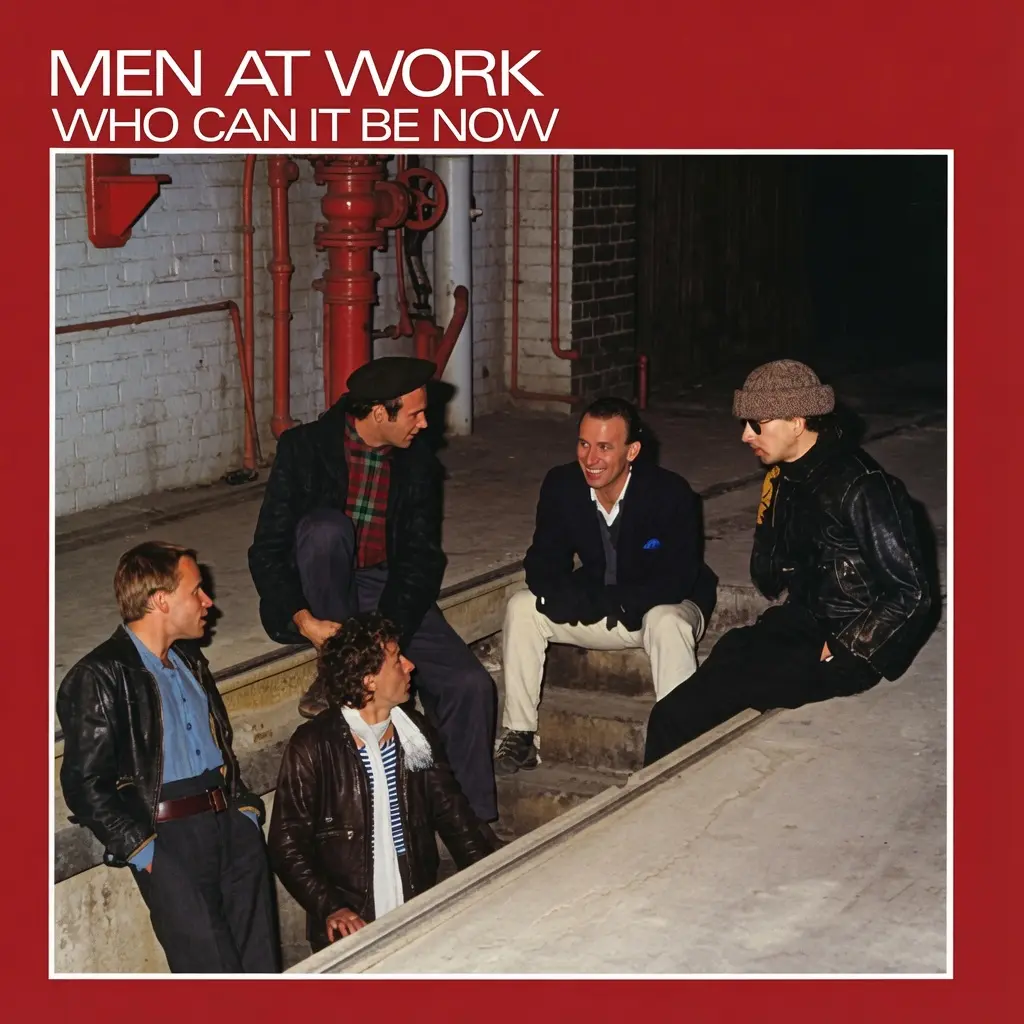 A1. “Who Can It Be Now?” (3:21) – Hay; a late-night knock triggers defensive retreat, then expands into a fear of pursuit and confinement. The telling line is the narrator’s admission that the threat may be fantasy, which turns the doorway scene into a mental-health spiral.
A2. “I Can See It in Your Eyes” (3:29) – Hay; a breakup unfolds through domestic misfires, restaurant silence, old school photographs, storm dreams, and cold-weather memory. The strongest line places the other person’s gaze on the floor, a small physical detail that confirms emotional departure before the final admission.
A3. “Down Under” (3:42) – Hay, Strykert; the lyric follows an Australian traveler through comic, dislocated encounters in a Kombi, Brussels, and Bombay. The telling image is the “vegemite sandwich,” which turns national identity into a deadpan exchange item.
A4. “Underground” (3:03) – Hay; the song frames class shelter, scarcity, weapons, ration lines, and public reassurance as a disaster script. The line about “castles underground” fixes the target: protected elites below ground while everyone else reads the warning signs too late.
A5. “Helpless Automaton” (3:21) – Ham; presents a shut-in speaker who translates desire through machine imagery, robot identity, video screens, and bureaucratic paper. The telling line replaces the desired face with a screen, so the mechanical persona becomes a failed substitute for contact.
B1. “People Just Love to Play with Words” (3:29) – Strykert; treats language as evasion, game, crossword, and social reflex. The “two down and four across” line makes the wordplay literal, reducing argument and meaning to puzzle-box maneuvering.
B2. “Be Good Johnny” (3:35) – Hay, Ham; gives Johnny a child’s viewpoint under adult correction from home and school, with daydreaming framed as misbehavior. The telling detail is the schoolward “skip de skip” motion: the line keeps the child physically lively before authority closes in.
B3. “Touching the Untouchables” (3:39) – Hay, Strykert; speaks from street-level exclusion: borrowed money, weathered skin, torn clothes, phone booths, park benches, cigarettes, and a body bent by time. The “leather face” image supplies the most direct human surface, then the song asks why this visible person still disappears from view.
B4. “Catch a Star” (3:28) – Hay; moves through rough youth detail, hotel atmosphere, intoxication, film imagery, traffic rows, and distance between two people. The “cigarette-stained hands” line gives the song its lived-in texture before it shifts toward infatuation and unreachable projection.
B5. “Down by the Sea” (6:53) – Hay, Ham, Speiser, Strykert; a long coastal memory built from docks, ships, crates, rats, cliffs, a sandbar, moving ice, and a private romantic refrain. The “yonnies in the wind” line grounds the scene in Australian slang and turns the shore into a weather-beaten, tactile place.
Men at Work recorded Business as Usual between March and September 1981 at Richmond Recorders, Melbourne, with producer–engineer Peter McIan. Jim Barbour also engineered the album, with Paul Ray in an additional engineering role.
 Business as Usual appeared in a sleeve with a front-cover illustration by John Dickson. The Australian cover uses a black-and-white worker-sign image; some international copies recast the same artwork in black and yellow.
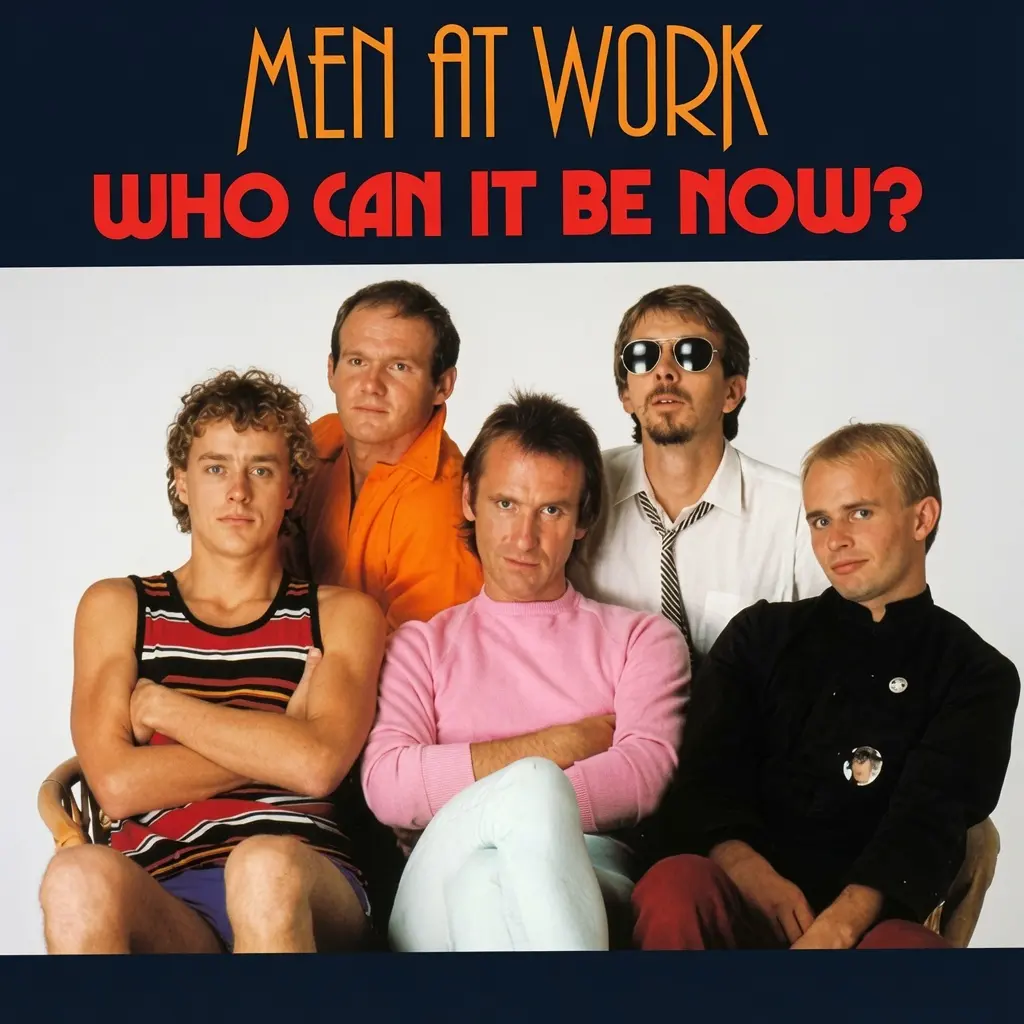
CBS opened the Australian rollout with “Who Can It Be Now?” in June 1981, backed with the non-album instrumental “Anyone for Tennis.” Tony Stevens’ video places Hay inside a locked-room comic setup, with doorway and window shots around the band. “Who Can It Be Now?” reached No. 2 in Australia and No. 45 in New Zealand.
On November 2, 1981, “Down Under” became the second Australian single, backed with “Crazy.” European copies used “Helpless Automaton,” while Canadian copies used “Anyone for Tennis.” The Stevens video follows the lyric’s travel route through Kombi-van scenes, café shots, desert imagery, and the coffin sequence filmed at Cronulla sand dunes. “Down Under” reached No. 1 in Australia and New Zealand.
In April 1982, “Be Good Johnny” became the third Australian single, backed with “F-19.” The Stevens video uses a schoolboy daydream premise, with classroom, family, and sports-field scenes around the title character. “Be Good Johnny” reached No. 8 in Australia and No. 3 in New Zealand.
Columbia launched Men at Work in North America after the Australian singles sequence had already run its course. “Who Can It Be Now?” appeared in the United States in May 1982, entered the Hot 100 in July, and reached Canada’s Top 10 before the American peak. MTV exposure gave the Stevens clips a second life, while Men at Work reinforced the campaign with “Who Can It Be Now?” and “Down Under” on the October 23, 1982 episode of Saturday Night Live.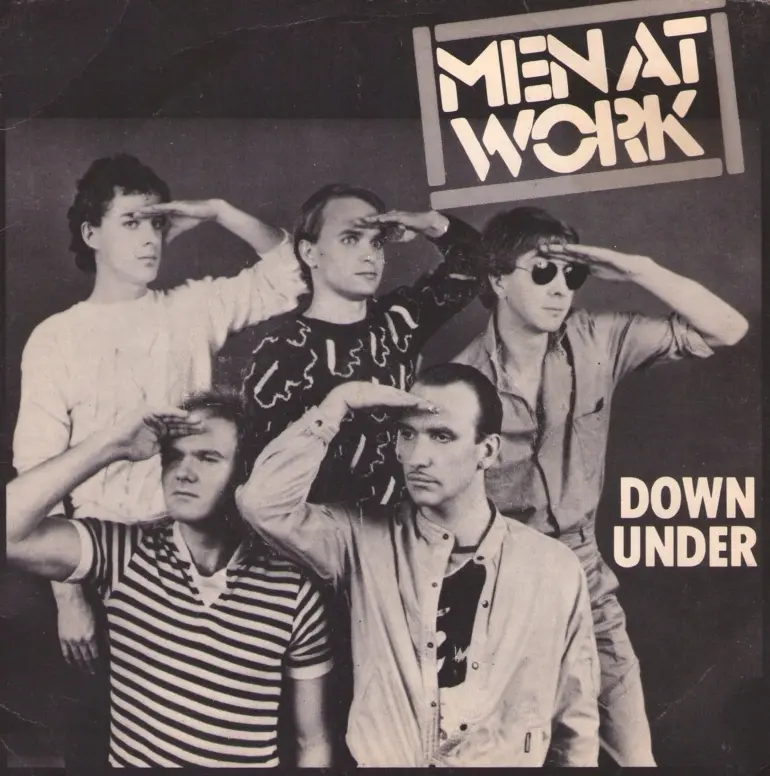
On the week of October 30, 1982, “Who Can It Be Now?” reached No. 1 on the US Billboard Hot 100, where it ousted “Jack & Diane” by John Cougar. Men at Work held the summit for one week before Joe Cocker and Jennifer Warnes took over with “Up Where We Belong.”
“Down Under” followed as the second American single on October 19, 1982, backed with “Crazy.” The single reached No. 1 in Canada before its US peak and then crossed to the UK, Ireland, and Switzerland. On the week of January 15, 1983, “Down Under” reached No. 1 on the US Billboard Hot 100, where it ousted “Maneater” by Hall & Oates. Men at Work held the summit for three weeks before Toto displaced them with “Africa,” then returned for one further week before Patti Austin and James Ingram took over with “Baby, Come to Me.” The two Business as Usual singles gave Men at Work five total weeks at No. 1 on Billboard within four months.
Business as Usual reached No. 1 in Australia, New Zealand, Norway, the UK, Canada, and the United States.
Cargo
 Men at Work released their second album, Cargo, on April 29, 1983, on CBS.
Cargo retains the original five-piece recording lineup and the McIan production team. Hay wrote six songs alone, including the singles “Dr. Heckyll & Mr. Jive,” “Overkill,” “It’s a Mistake,” and “High Wire.” Strykert wrote “Settle Down My Boy” and “I Like To,” and supplied the music for “Upstairs in My House.”
“Dr. Heckyll and Mr. Jive” skitters through a fast off-beat opening and drops into slower three-step title phrases. “Overkill” tightens a restless pattern under Hay’s grave lead, with saxophone and pale synth color after the vocal line. “Settle Down My Boy” swivels through alternating keys and a room-brightened guitar break. “Upstairs in My House” hurries through high-strung vocal lines and a neat solo break. “No Sign of Yesterday” darkens through spare accent jolts and a drawn-out lead break.
“It’s a Mistake” chops picked chords against light off-beat accompaniment, then opens into a shouted coda. “High Wire” drives through a heavier arrangement and diverts into a carnival-tinted middle break. “Blue for You” flickers with percussive effects and bright keyboard touches. “I Like To” needles Ham’s exaggerated vocal over crowded studio-jam density. “No Restrictions” opens through effect-bright accents and leaves Ham’s flute for the late solo turn.
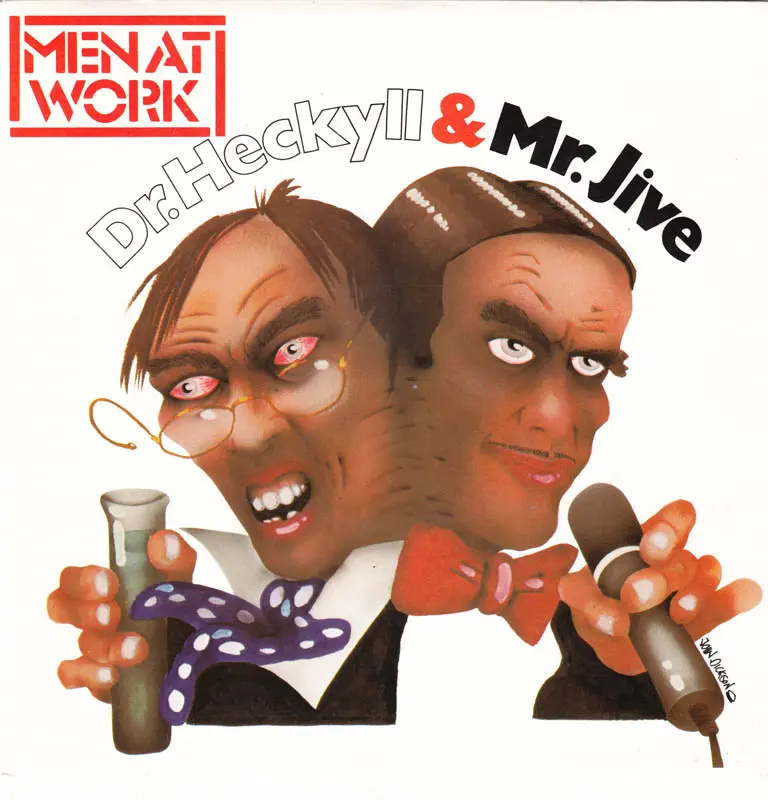
A1. “Dr. Heckyll & Mr. Jive” (4:38) – Hay; a laboratory comic fable turns self-experiment into social fantasy, with the scientist using chemical transformation to reach confidence and release. The telling line casts him as his own “guinea pig,” which makes the split identity both absurd and self-inflicted.
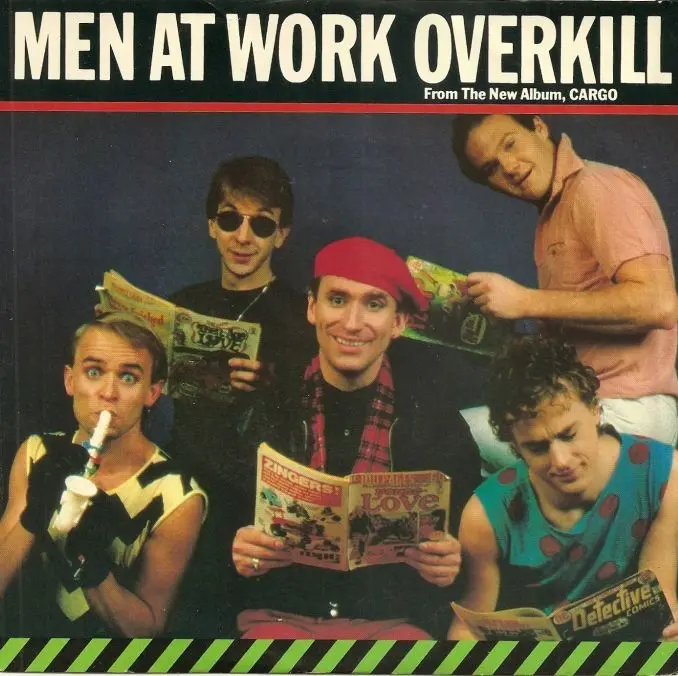 A2. “Overkill” (3:47) – Hay; maps insomnia into anxious repetition: private worry returns by night, then forces the speaker into the street for relief. The “ghosts” line gives the fear a visible cycle: it appears, recedes, and returns without resolution.
A3. “Settle Down My Boy” (3:31) – Strykert; parental voice compresses adulthood into food, work, marriage, savings, and obedience. The “peas and gravy” detail sharpens the song’s domestic pressure before the lecture turns toward job security and old age.
A4. “Upstairs in My House” (4:03) – Hay, Strykert; uses a rooftop vantage point to frame St Kilda scenery, amusement-park light, Sunday commerce, seabirds, wind, and bridge traffic. The “red sky” image fixes the view as both local and cinematic, turning the house into a private observation deck.
A5. “No Sign of Yesterday” (6:15) – Hay; the speaker tries to erase residue after loss through cleaning, drainage, burial imagery, and failed reception of a remembered voice. The “metal ships” image interrupts the domestic clean-up with a larger collapse, then the stalled car returns the damage to ordinary machinery.
B1. “It’s a Mistake” (4:34) – Hay; stages war as command rhetoric, bunker panic, gun preparation, and official evasion. The line that asks the commander whether the world stands on the brink exposes the song’s central target: power dressed as procedure.
B2. “High Wire” (3:02) – Hay; describes physical hangover, exclusion, fragility, and the need to assemble a public face before nightfall. The pillow-blood line gives the instability a blunt morning-after image before the balance metaphor takes over.
B3. “Blue for You” (3:55) – Hay; sits in post-loss inertia: sinking feeling, unreachable friends, old memories, and the return of songs or attachments that intensify absence. Hay later described the song as a memory of loneliness after something has gone and cannot return, which fits the repeated old-memory trigger in the lyric.
B4. “I Like To” (4:03) – Strykert; turns habit into deadpan inventory: draining bathwater, scanning pictures without reading, muted television, stereo sound, channel changing, and overbuilt sandwiches. The bathtub-plug line gives the song its clearest image of idle fascination: attention fixed on a small, pointless household action.
B5. “No Restrictions” (4:31) – Hay; follows a self-protective loner through drinking, garbage-bin observation, coffee, cricket on television, roadway hypnosis, and late-night return. The line about cat’s-eye reflections on the road turns personal freedom into freeway drift, with motion replacing any stable destination.
Men at Work recorded Cargo during 1982 at AAV Studios, Melbourne; Paradise Studios, Sydney; and Westlake Audio, Los Angeles. McIan produced and engineered the album with Paul Ray. David Price served as assistant engineer.
 Cargo appeared in a sleeve with cover artwork by Ron Strykert and inner-sleeve photography by Greg Noakes. Strykert’s cover image places the album title inside a stylized freight-and-travel scene.
CBS lifted “Dr. Heckyll & Mr. Jive” in October 1982, backed with “Shintaro” on Australian copies. U.S. Columbia copies later paired the song with a live version of “I Like To.” Greg Ham’s video places the split-character premise inside a Los Angeles house setting, with Ham as the doctor, Speiser as his assistant, and the band in Boy Scout and party-guest roles. “Dr. Heckyll & Mr. Jive” reached No. 6 in Australia, No. 16 in New Zealand, No. 31 in the UK, No. 28 on the Billboard Hot 100, and No. 12 on Billboard Top Tracks.
In March 1983, “Overkill” became the second Australian single and first American single from Cargo, backed with “Till the Money Runs Out.” The video uses St. Kilda locations, including the Esplanade Hotel and St. Kilda Pier. “Overkill” reached No. 5 in Australia, No. 3 on the Billboard Hot 100, No. 6 in Canada, No. 9 in Ireland, No. 5 in Norway, and No. 21 in the UK.
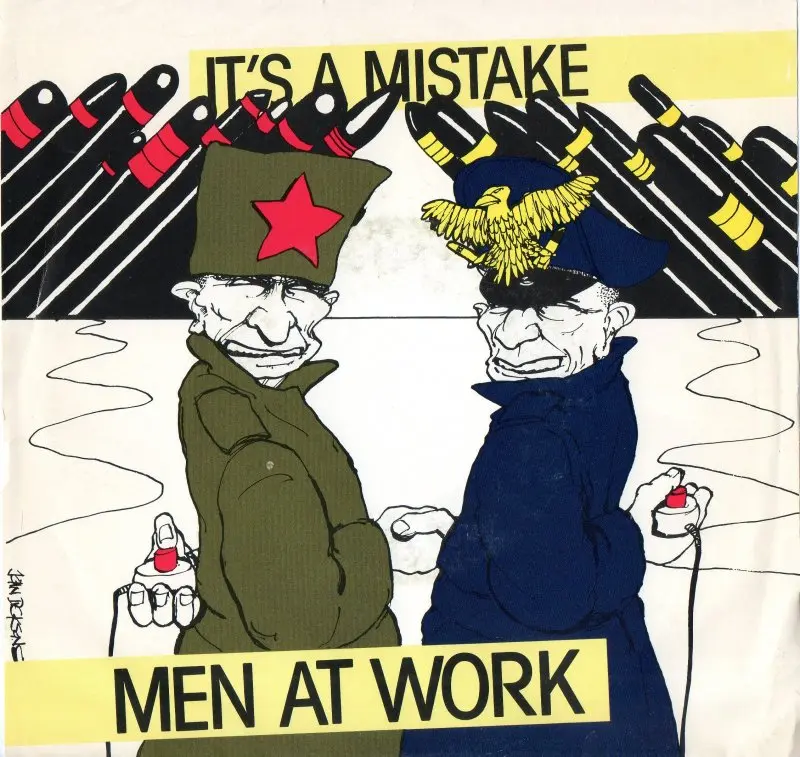 “It’s a Mistake” followed in June 1983, backed with “No Restrictions” in Australia and “Shintaro” in international markets. The video satirizes Cold War escalation with toy-soldier animation, drafted civilians, military-party scenes, and a bunker sequence built around a nuclear button gag. “It’s a Mistake” reached No. 34 in Australia, No. 6 on the Billboard Hot 100, No. 10 on Billboard Adult Contemporary, No. 19 in Germany, No. 11 in Ireland, and No. 33 in the UK.
In November 1983, “High Wire” appeared as the fourth single, backed with a live version of “I Like To.” The Australian 12″ also adds a live version of “Fallin’ Down.” The video frames the band in a performance setup with circus imagery tied to the title. “High Wire” reached No. 89 in Australia and No. 23 on Billboard Top Tracks.
Cargo reached No. 1 in Australia, No. 2 in New Zealand, No. 3 on the Billboard 200, and No. 8 on the UK Albums Chart.
Two Hearts
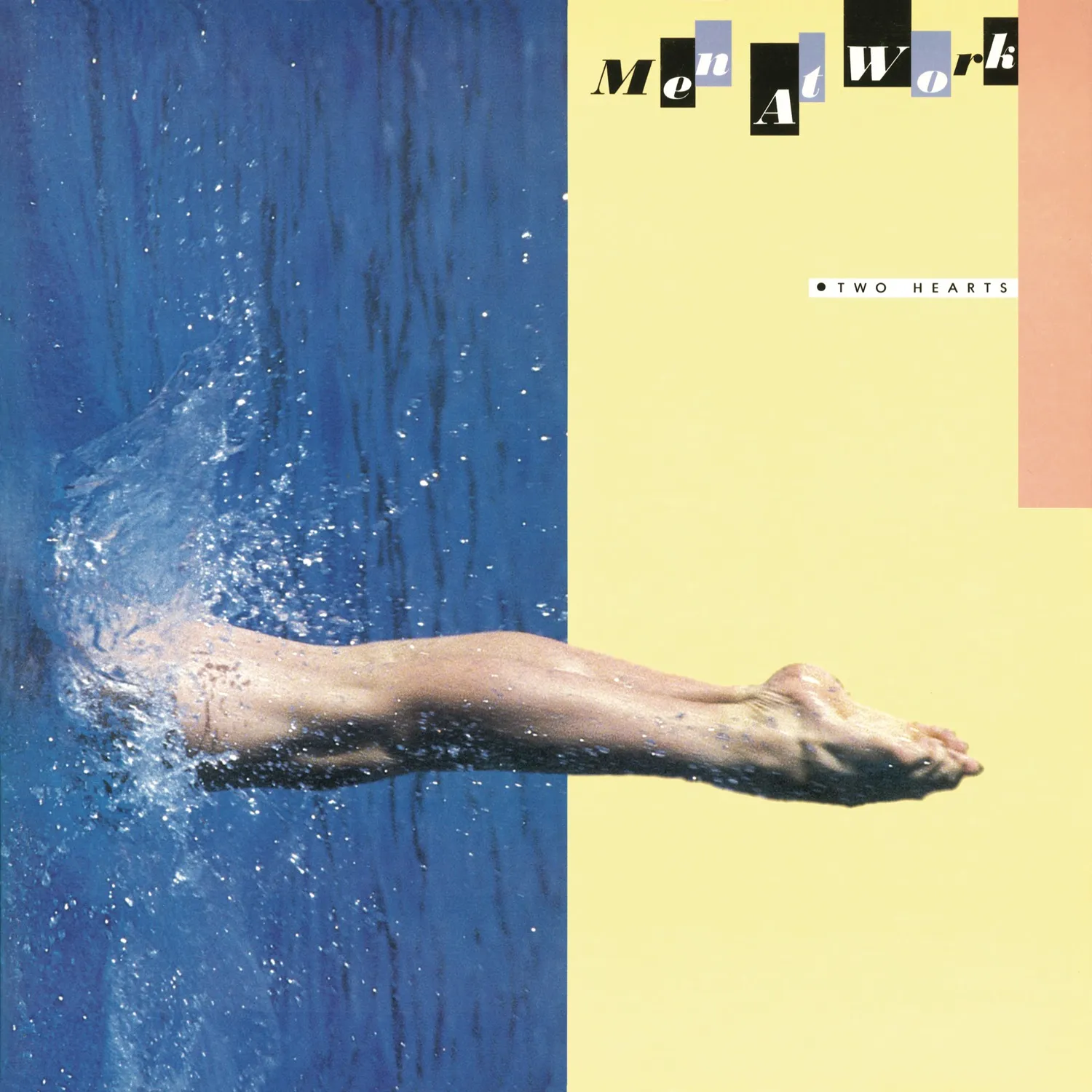 Men at Work released their third album, Two Hearts, on April 23, 1985, on CBS.
Two Hearts marks the band’s contraction after Rees and Speiser left before the album sessions. Strykert appears on most of the finished album but left before completion. Hay and Ham produced the album and share the recorded core with session bassist Jeremy Alsop and drummer Mark Kennedy. Select tracks feature guitarist James Black, bassist Paul Gadsby, slide guitarist Phil Colson, accordionist George Butrumlis, drummer–percussionist J.J. Hackett, singer Kate Ceberano, and singer Renée Geyer.
“Man with Two Hearts” places Hay’s lead beside marimba color and Strykert’s low-end part. “Giving Up” threads Ham’s lead through a programmed pattern, with Kate Ceberano on backing replies. “Everything I Need” pairs Hay’s lead with Ham’s backing part and Phil Colson’s slide-guitar accent.
“Maria” sets Hay’s electric sitar and Strykert’s acoustic part around Renée Geyer’s lead-vocal feature. “Stay at Home” gives Ham the lead with Ceberano behind him. “Hard Luck Story” narrows to Hay on bass, piano, and kit. “Snakes and Ladders” pins Ham’s lead to programmed motion and James Black’s track-specific part. “Still Life” closes Ham’s lead-vocal run against programmed motion.
A1. “Man with Two Hearts” (3:54) – Hay
A2. “Giving Up” (3:25) – Ham
A3. “Everything I Need” (3:35) – Hay
A4. “Sail to You” (3:24) – Ham, Hay, Strykert
A5. “Children on Parade” (3:36) – Hay
B1. “Maria” (4:34) – Hay
B2. “Stay at Home” (3:07) – Ham
B3. “Hard Luck Story” (3:43) – Hay
B4. “Snakes and Ladders” (3:17) – Ham
B5. “Still Life” (3:53) – Ham
Men at Work recorded Two Hearts between September 1984 and February 1985 at Fast Forward Studios, Melbourne. Hay and Ham produced the album. Tim Kramer engineered the sessions with assistant engineer Karen Hewitt. Hay, Ham, and Bob Clearmountain mixed most of the album; Kramer joined Hay and Ham on the “Children on Parade” mix.
Two Hearts appeared in a sleeve with cover design by Clyde Terry. The gatefold layout presents the reduced band identity with a symbolic two-heart image and an interior credit spread.
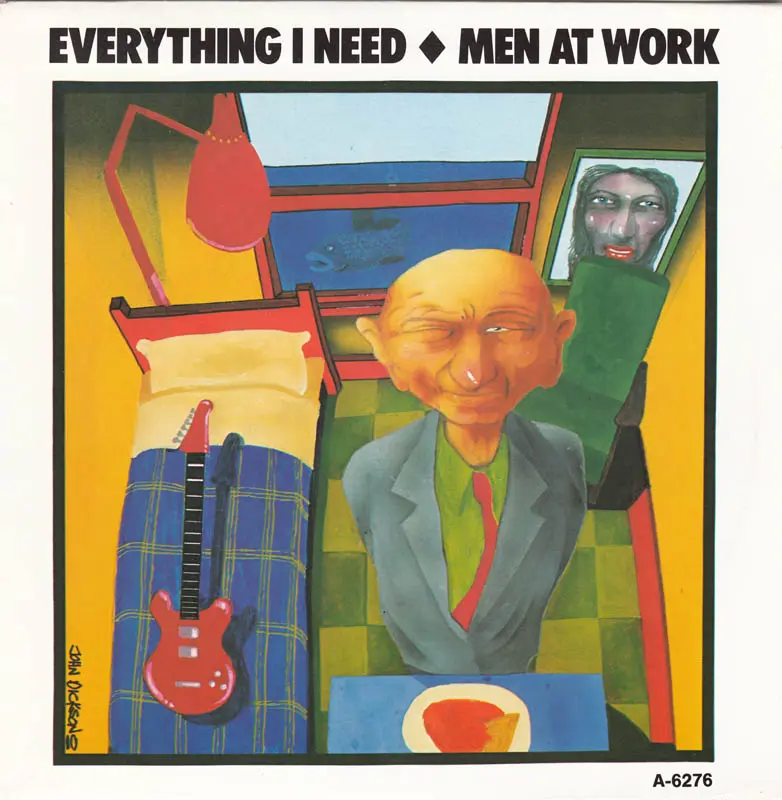 Columbia lifted “Everything I Need” in May 1985, backed with “Sail to You” on UK 7″ copies. The U.S. 12″ pairs the extended version with the single version. The Rich Kids’ video places Hay and Ham inside a stylized performance clip, with slide-guitar shots and close band framing. “Everything I Need” reached No. 37 in Australia, No. 47 on the Billboard Hot 100, and No. 28 on Billboard Top Tracks.
“Maria” followed in 1985. The video places Hay’s lead part inside a dramatic narrative setting, with Geyer’s guest vocal framed as a separate character presence.
“Hard Luck Story” appeared as a 1985 single in the United States, backed with “Snakes and Ladders.” “Sail to You” followed in Australia in October 1985.
Two Hearts reached No. 16 in Australia, No. 48 in Canada, and No. 50 on the Billboard 200.
Ham left during the 1985 tour. Later dates used jazz saxophonist Paul Williamson in his place, and Men at Work ended their original run by early 1986.
Postlude
Speiser and Rees exited before Two Hearts; Strykert left during the album sessions. After the April 1985 release, Hay toured with Ham, bassist Jeremy Alsop, and drummer Chad Wackerman. Colin Bayley and James Black joined on guitar. During later 1985 dates, Paul Williamson replaced Ham on saxophone and keyboards. By early 1986, Hay retired the Men at Work name.
Hay made his solo-album debut under the Colin James Hay credit with the 1987 Columbia album Looking for Jack. Robin Millar produced the album, which retained Alsop and Wackerman. His 1990 followup, Wayfaring Sons, appeared on MCA under the Colin Hay Band billing. On his 1992 album Peaks & Valleys, Hay pared the format to one-take acoustic performances. In 1994, Topanga returned Hay to a band setting and introduced “Waiting for My Real Life to Begin.”
Speiser remained active in bands through the late eighties and early nineties, including FX, Ross Hannaford’s One World, The City, Frost, and Where’s Claire? Ham remained active in Melbourne music work and later played saxophone with Nudist Funk Orchestra. Rees taught music in Gippsland and played local dates with Beggs 2 Differ. Strykert reappeared much later with the 2003 solo album Paradise.
Hay and Ham revived Men at Work in 1996 for South American dates with guitarist Simon Hosford, bassist Stephen Hadley, and drummer John Watson. BMG Brazil issued the 1997 live album Brazil ’96 from those dates. Columbia issued the expanded 1998 international version Brazil with the studio track “The Longest Night.” The reunited band toured through the late nineties and played “Down Under” at the closing ceremony of the 2000 Sydney Olympics. Hay and Ham made occasional later appearances under the name, including a 2009 telethon performance. Ham died in Melbourne on April 19, 2012. Since 2019, Hay has used the Men at Work banner for a Los Angeles-based touring band.
Discography:
- Business as Usual (1981)
- Cargo (1983)
- Two Hearts (1985)
Sources:
Artist/Album Pages:
Der Eiserne Vorhang was an Austrian new wave band from Niederösterreich that issued a single apiec...
Alex Band was a Polish jazz-funk orchestra from Poznań, formed in 1977 as a backing group for singer...
Apollo was an American soul-funk band from Los Angeles that released a 1979 self-titled album on M...
Master Cylinder was an American jazz-rock band that released the album Elsewhere in 1981. Member...
Olivia Byington is a Brazilian singer/songwriter who debuted with the 1978 Continental album Corra...
BB Gabor — aka Gabor Hegedus (1948 — Jan. 17, 1990) — was a Hungarian-born/Canada-based singer, gu...
The Style Council was an English sophisti-pop band fronted by ex-Jam leader Paul Weller. Starting ...
Cybotron was an Australian electronic combo from Melbourne that released a 1976 self-titled album ...
Gordi was a Yugoslav hard-rock/metal band from Beograd, Serbia, formed by veteran Dah guitarist Zl...
Syreeta Wright (1946–2004) was an American R&B singer who began as a backing vocalist at Motown,...
Stephanie Mills is an American R&B singer and actress who emerged (at 17) with the 1974 ABC rele...
The Jones Girls were an American soul group from Detroit, formed in 1965 as a gospel trio by siste...