

The Southside Movement was an American soul-funk band from Chicago that made a 1973 self-titled album on Wand Records, charting with “I’ Been Watchin’ You” and “Can You Get to That.” They followed with the 1974/75 albums Movin’ and Moving South on 20th Century Records.
Members: Melvin Moore (vocals), Bobby Pointer (guitar), Morris Beeks (keyboards), Ronald Simmons (bass), Willie Hayes (drums), Milton Johnson (alto saxophone), Stephen Hawkins (trumpet), Bill McFarland (trombone)
Background
The Southside Movement entered the Chicago soul-funk record circuit in 1973 when the Tea Boxes, the band behind Simtec & Wylie, took a new name for Wand Records. The group paired singer Melvin Moore with guitarist Bobby Pointer, keyboardist Morris Beeks, bassist Ronald Simmons, drummer Willie Hayes, alto saxophonist Milton Johnson, trumpeter Stephen Hawkins, and trombonist Bill McFarland.
Simtec Simmons formed the Tea Boxes Band in 1964 with bassist Ronald Simmons. Wylie Dixon worked with guitarist Bobby Pointer in the Big Wheels and the Wheels during the mid-sixties. The Tea Boxes then worked as Wylie Dixon & The Tea Boxes Revue, a backing band for touring singers.
Simtec cut 1967 Maurci sides with Ronald and Pointer as Simtec Simmons & The Mechanical Monster. The same trio masqueraded as Computer & The Little Fooler for “S-W-W-W-I-S-S-S-H” b/w “Computing,” then returned to the Simtec Simmons & Band name for two further 1967 sides. Simtec Simmons and Wylie Dixon formed the Simtec & Wylie duo in 1969 after WVON disc jockey Rodney E. Jones helped place “Sockin’ Soul Power” b/w “Stay With Mefor Better or Worst” on Toddlin’ Town Records.
Simtec & Wylie followed two Shama singles with a Mister Chand run that ended on the 1973 release “Cross That Bridge” b/w “What’s Good to You.” After that single, the Tea Boxes became the Southside Movement and linked with Wand Records.
The South Side Movement
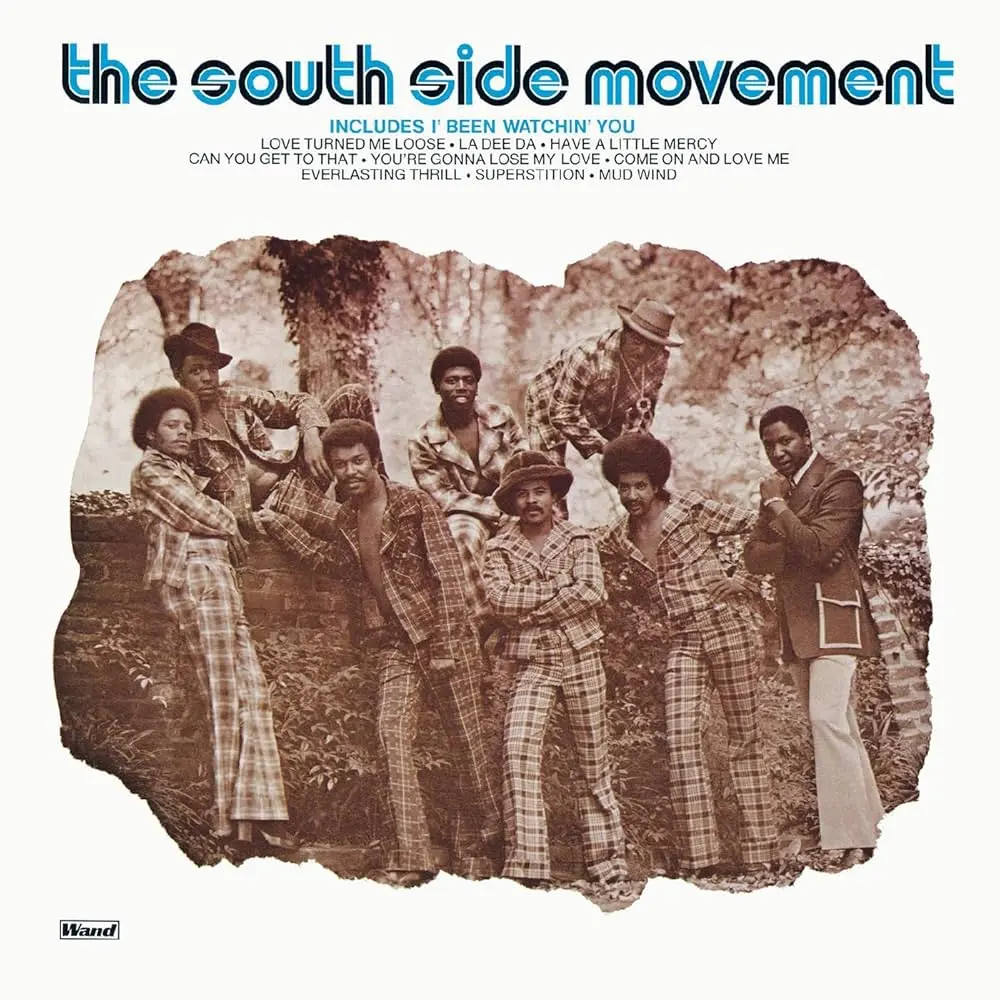 The South Side Movement released their self-titled debut album in 1973 on Wand.
Its ten-song program contains five James Vanleer compositions, four Vanleer co-writes, and the Stevie Wonder cover “Superstition.” Singer Melvin Moore fronts the lineup with guitarist Bobby Pointer, keyboardist Morris Beeks, bassist Ronald Simmons, drummer Willie Hayes, reedist Milton Johnson, trumpeter Stephen Hawkins, and trombonist Bill McFarland.
“I’ Been Watching You” lopes on a low-slung pulse and direct lead calls. “Love Turned Me Loose” coils around an earthy midtempo refrain. “Have a Little Mercy” snaps through brisk accents and short vocal replies. “You’re Gonna Lose My Love” scuffs its wah-scraped guitar figure against a blunt backbeat. “Superstition” follows a familiar verse-refrain route under a rougher tonal finish. “Mud Wind” locks the band into a compact instrumental coda.
A1. “I’ Been Watching You” (3:03) – Rush / Vanleer
A2. “Love Turned Me Loose” (2:10) – Vanleer
A3. “La Dee Da” (2:55) – Vanleer / Pointer
A4. “Have a Little Mercy” (4:55) – Moore / Vanleer
A5. “Can You Get to That” (3:07) – Vanleer / Hawkins
B1. “You’re Gonna Lose My Love” (3:22) – Vanleer
B2. “Come On and Love Me” (2:26) – Vanleer
B3. “Everlasting Thrill” (3:01) – Vanleer
B4. “Superstition” (4:03) – Wonder
B5. “Mud Wind” (4:40) – Vanleer / Hawkins
James Vanleer produced The South Side Movement with engineer Rich Adler. Waddell Loflin photographed the cover, whose front image shows the eight members in coordinated plaid suits beneath a blue title logo.
Wand issued “I’ Been Watchin’ You” as a January 1973 single (b/w “Have A Little Mercy”), which reached No. 61 on the Billboard Hot 100 and No. 14 on the Billboard R&B chart.
“Can You Get To That” followed in August 1973 (b/w “Mud Wind”) and reached No. 56 on the Billboard R&B chart.
Movin’
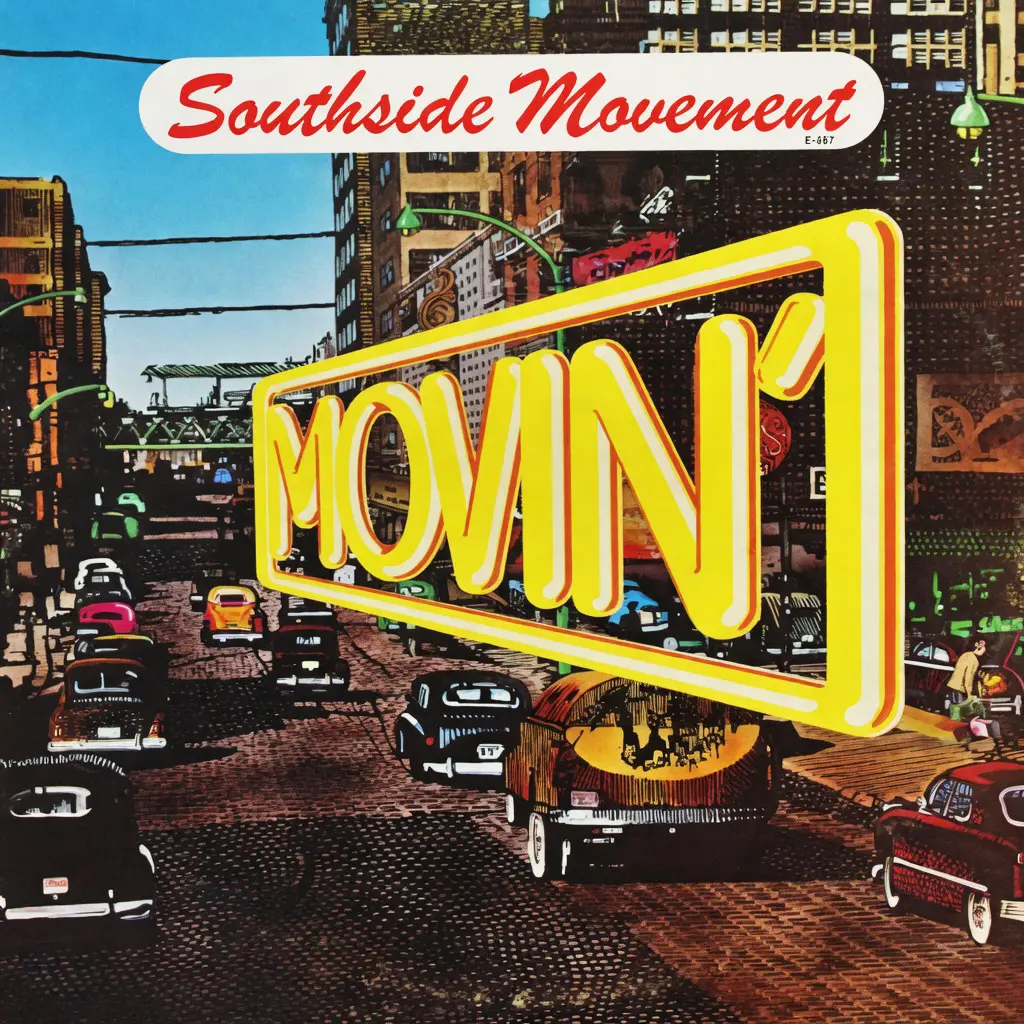 Southside Movement released their second album, Movin’, in 1974 on 20th Century.
The album contains nine James Vanleer songs and “Gotta Get Over The Hump,” a Bobby Pointer, Ronald Simmons, S. Simmons, and Wylie Dixon composition. Movin’ retains Moore, Pointer, Beeks, Ronald Simmons, Hayes, Johnson, Hawkins, and McFarland from the Wand album.
“Mississippi Cutback” barrels through a mud-caked refrain and heated lead vocal. “It’s You I’m Needin'” pushes the midtempo pulse with a deep-set chant. “Hey, Baby” saunters across a lighter pace while the lead vocal stays thick in the center. “Ain’t Gonna Watch You No Mo'” sinks into a heavier, slower backbeat. “Gotta Get Over the Hump” punctuates the verse with blunt brass. “Only a Man” spreads its slow tempo under string-laced swells. “Save the World” stomps through a break passage and percussive accents. “Pay My Dues” drags a blues-stained cadence across the close.
A1. “Mississippi Cutback” (2:42) – Vanleer
A2. “It’s You I’m Needin’” (3:10) – Vanleer
A3. “Hey, Baby” (3:05) – Vanleer
A4. “Ain’t Gonna Watch You No Mo’” (3:31) – Vanleer
A5. “Funky Way to Treat Your Woman” (2:48) – Vanleer
A6. “Gotta Get Over The Hump” (3:06) – Pointer / R. Simmons / S. Simmons / Dixon
B1. “Only a Man” (4:39) – Vanleer
B2. “Save The World” (5:27) – Vanleer
B3. “A Poor Man” (4:30) – Vanleer
B4. “Pay My Dues” (4:24) – Vanleer
Vanleer Productions produced Movin’. Ben Wright, James Vanleer, and Southside Movement arranged the album.
Glenn Ross directed the sleeve art, and Louis Lanzano photographed the cover package. The front cover places a large yellow title sign over a downtown street image.
In April 1974, 20th Century issued “It’s You I’m Needin’” (b/w “Mississippi Cutback”). The label also paired non-album “Johnny Porter” with “Save The World” as a 1974 single.
Moving South
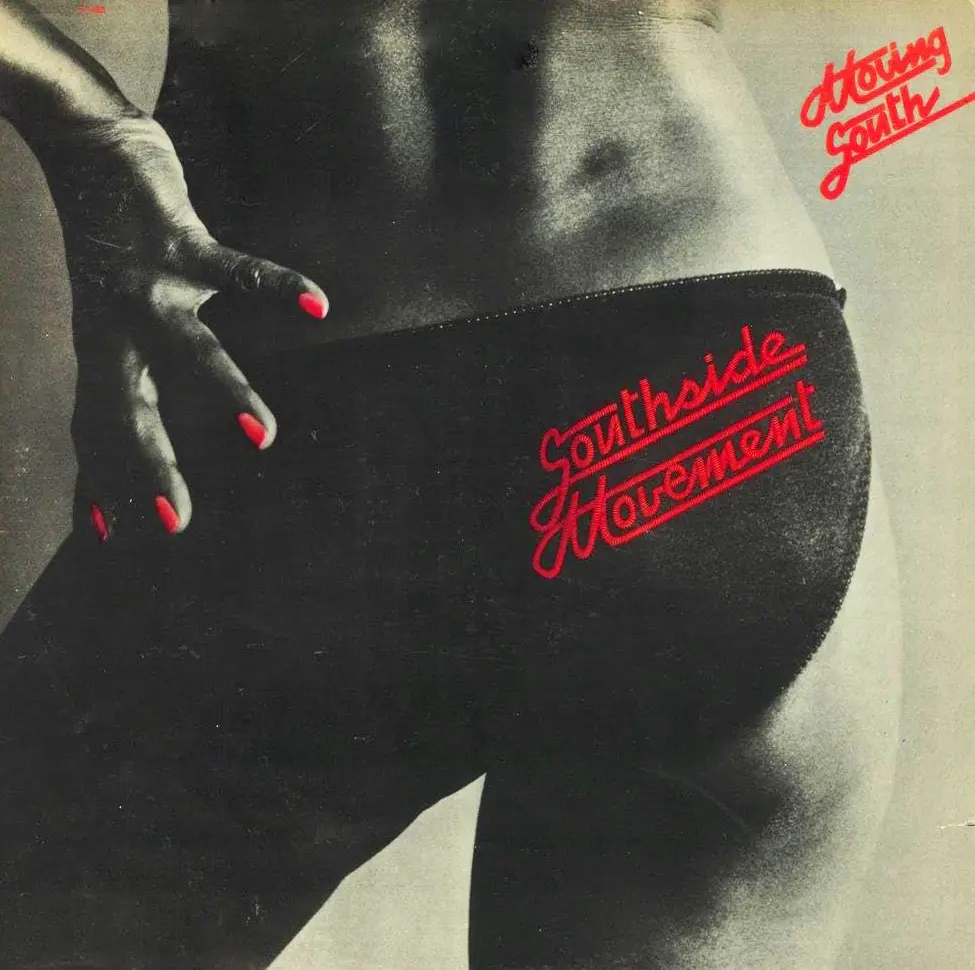 Southside Movement released their third album, Moving South, in 1975 on 20th Century.
The album contains three Vanleer compositions, two Milton Johnson songs, one Bobby Pointer piece, and outside or shared songs by Arthur Peyton, A. Rivers, Billy Perry, and Bobby Rush. South retains Movin’ players Pointer, Beeks, Ronald Simmons, Hayes, Johnson, Hawkins, and McFarland.
Musically, Moving South sharpens the band’s ensemble attack with fuzz-edged guitar color, stepping bassline motion, hard horn punctuation, and direct vocal placement. “I’ve Been Watching You” pivots from the earlier cut into a longer version with electric-piano flickers. The album’s clipped side favors short ensemble phrases, blunt section hits, and measured backbeat stress.
A1. “Ain’t Gonna Watch You No Mo’” (6:11) – Vanleer
A2. “Do It to Me” (3:20) – Peyton / Southside Movement
A3. “Funk Talk” (2:45) – Rivers
A4. “Ain’t It a Shame” (3:05) – Perry
A5. “Love Is for Fools” (4:34) – Johnson
B1. “I’ve Been Watching You” (5:20) – Rush / Vanleer
B2. “Only Time Has Changed” (4:48) – Peyton
B3. “Country Girl” (2:43) – Vanleer
B4. “Just Moving” (3:41) – Johnson
B5. “Acknowledge the Mind” (2:52) – Pointer
Vanleer Productions produced Moving South. Southside Movement and James Vanleer arranged the album, with Ben Wright arranging “Do It To Me.”
Eddie Douglas directed the sleeve art. The 20th Century package uses a black-and-white group photograph on the front cover.
In February 1975, 20th Century issued “Do It to Me” (b/w “Ain’t Gonna Watch You No Mo’”). In October, the label paired non-LP “Bus Stop” with “Love Is For Fools.”
Postlude
Singer Melvin Moore cut the 1977 Brainstorm Records singles “Rain Go Away” and “I’ve Been Watchin You” (b/w “How Does It Feel to Be a Big Wheel”). In 1981, he issued the Sky Hero single “All of a Sudden” (b/w “Tennessee”), a W. Johnson–Moore song pair with an S. Gallo arrangement.
Drummer Willie Hayes worked with Koko Taylor, Junior Wells, Luther Allison, Buddy Guy, B.B. King, Muddy Waters, Otis Clay, the Temptations, and Big Twist & The Mellow Fellows. His 1982 appearance with Koko Taylor reached album form on Blues Explosion. Hayes later recorded for Delmark and led the Willie Hayes Band. The Chicago Blues Hall of Fame inducted him in 2014, and he last appeared onstage at the Chicago Blues Festival in 2022.
Trumpeter Stephen “Steve” Hawkins and trombonist Bill McFarland appeared on the 1976 Leroy Hutson album Feel the Spirit. Hutson retained McFarland for the 1976 album Hutson II. McFarland led the Chicago Horns on the nineties albums Fire Horns and Fire Horns Alive & Live. He also recorded or arranged for Albert Collins, Son Seals, Fenton Robinson, Lonnie Brooks, Aretha Franklin, Etta James, Koko Taylor, and Otis Clay.
Keyboardist Morris Beeks formed Himalaya in Los Angeles in 1986 with percussionist Landers Pierce and guitarist Keith Andrew. He wrote material for Himalaya and served as a musical director. Beeks later contributed keyboards, organ, and voice to Blinddog Smokin’ on High Steppin’.
Discography:
- The South Side Movement (1973)
- Movin’ (1974)
- Moving South (1975)
Sources:
- Discogs: Southside Movement
- RYM: The Southside Movement
- 45cat: Southside Movement
- MusicBrainz: Southside Movement
Artist/Album Pages:
Stardrive was an American electro-jazz/funk band that released the album Intergalactic Trot on Ele...
Crooked Oak was an English folk-rock band that released the 1976 album From Little Acorns Grow on ...
Masahiko Sato — 佐藤允彦 (born Oct. 6, 1941) — is a Japanese jazz pianist and composer with credits on...
Exit 9 was an American soul-funk band that released the album Straight Up on Brunswick-subsidiary ...
Guy Skornik (born 1947) is a French art-pop musician and songwriter who released two EPs on in 196...
Peter Michael Hamel is a German composer and electroacoustic musician behind the 1972/73 Vertigo t...
The Kinks were an English rock band that released twenty-four studio albums between 1964 and 1993. S...
Pleasure was an American soul-funk band from Portland, Ore., that released six albums on Fantasy b...
Stealers Wheel was a Scottish folk-pop band that released three albums on A&M: Stealers Wheel ...
Jan Garbarek (March 4, 1947) is a Norwegian saxophonist who emerged in the 1960s through work with...
Guilherme Lamounier (Nov. 25, 1950 — Aug. 7, 2018) was a Brazilian folk-psych singer/songwriter wh...
Barbara Mason is an American soul singer and songwriter, best known for her 1965 hit "Yes, I'm Rea...