
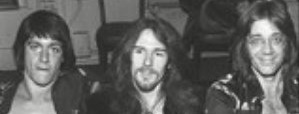
Phantom was an American hard-rock/psych band from Detroit that released the album Phantom’s Divine Comedy, Part 1 on Capitol in 1974. Earlier recordings were later released by archivists Flash and Ghost. The group morphed into the Happy Dragon Band for a further album on the Fiddlers Music Company label in 1978.
Members: Phantom [aka Tom Carson] (vocals, guitar, piano), W [aka Gary Meisner] (bass), X [aka John Bdanjeck] (drums, percussion), Y [aka Dennis Craner] (bass), Z [aka Mike DeMartino] (piano, organ)
Background
The group played Michigan clubs, recording demos that caught the attention of producer Gary Gawinek at Hideout Records. Gawinek brought the demos to producer Punch Andrews, known for Bob Seger’s albums. Andrews shaped their sound to echo The Doors, leading to a 1973 single release, “Calm Before the Storm” b/w “Black Magic, White Magic” (Hideout H-1080). Capitol Records bought out the contract, reissued the single (Capitol 3857), and financed the 1974 album Phantom’s Divine Comedy, Part 1. Capitol’s marketing leaned into rumors that Pendragon was Jim Morrison, who died in 1971, prompting legal threats from Elektra Records, the Doors’ label. This halted promotion, scrapped tour plans, and froze album funds, leading to the band’s dissolution after the release.
Pendragon later led another band, Pendragon, recording 1978 demos released as a bootleg, The Lost Album, in 1990.
Phantom’s Divine Comedy, Part 1 (1974)
 Phantom released their only album, Divine Comedy, Part 1, in March 1974 on Capitol Records.
The album blends psychedelic rock with progressive and early metal elements, structured around a loose concept inspired by Dante’s Inferno. Tracks like “Tales From a Wizard” and “Spiders Will Dance (On Your Face While You Sleep)” deliver a tense, ominous pace with jagged guitar riffs and pulsing organ lines. “Devil’s Child” shifts to a brisk, funky strut, while “Stand Beside My Fire” and “Welcome to Hell” push into heavier, proto-metal territory with layered keyboard textures.
Vocalist/guitarist/keyboardist Arthur Pendragon wrote all eight songs. Backing musicians included drummer James Roland, bassist Harold Breedless, and keyboardist Russ Klatt.
Tracks fall into two camps: mystical, wizard-themed pieces and darker, hard-rock cuts. “Tales From a Wizard” opens with a slow, bluesy build, driven by Pendragon’s baritone and Klatt’s organ swells. “Spiders Will Dance (On Your Face While You Sleep)” pairs a jittery rhythm with vivid, unsettling imagery of spiders crawling. “Calm Before the Storm” carries a contoured melody and a sharp guitar solo, evoking a radio-ready polish. “Devil’s Child” surges with swampy vocals and a compact, punchy riff. “Merlin” stumbles with a spoken-word intro but recovers with a brooding guitar line. “Welcome to Hell” closes with a molten, overdriven churn, its vocals echoing in a cavernous mix.
A1. “Tales From a Wizard” (5:21) — A slow, ominous blues-rock opener with Pendragon’s Morrison-like vocals and Klatt’s organ swells, building to a searing guitar climax. Lyrics conjure a wizard’s cryptic journey.
A2. “Devil’s Child” (2:21) — A funky, uptempo rocker with swampy vocals and a taut guitar riff, depicting a rebellious spirit.
A3. “Calm Before the Storm” (3:26) — A contoured melody with a fluid guitar solo and steady percussion, evoking a tense prelude to chaos.
A4. “Half a Life” (4:06) — A somber ballad with introspective lyrics about loss, carried by Pendragon’s restrained vocals and Klatt’s soft organ.
A5. “Spiders Will Dance (On Your Face While You Sleep)” (4:11) — A jittery rhythm underpins disturbing imagery of nocturnal spiders, with Pendragon’s guitar slicing through Roland’s crisp percussion.
B1. “Black Magic/White Magic” (3:18) — A psychedelic shuffle with angular organ and guitar interplay, exploring themes of duality in magic.
B2. “Merlin” (5:24) — A spoken-word intro about the wizard Merlin precedes a brooding guitar-driven track with mystical lyrics.
B3. “Stand Beside My Fire” (5:31) — A heavy, dark rocker with grinding riffs and urgent vocals, urging unity in defiance.
B4. “Welcome to Hell” (5:12) — A molten, proto-metal closer with churning guitars and echoing vocals, painting a vivid descent into a fiery underworld.
Sessions occurred at an unlisted Detroit studio with producers Gary Gawinek and Punch Andrews.
Capitol Records promoted Phantom’s Divine Comedy, Part 1 with “Calm Before the Storm” b/w “Black Magic/White Magic” in 1973, first on Hideout Records, then reissued on Capitol. The single failed to chart.
The Lost Album (1990, Bootleg)
 Phantom’s 1978 demos, recorded as Pendragon, surfaced as a bootleg in 1990, misleadingly titled The Lost Album.
The demos shift between Doors-like psychedelia and hard rock. “Your Life: Tales From the Wizard” revisits the wizard theme with raspy, Morrison-like vocals and jagged guitar. “Queen of Air,” “Lone Wolf,” “Storms,” and “The Music Rolls On” lean into earthy, narrative-driven rock with prominent bass and synth textures. “Release Me” and “Sailing Away” return to a mystical, Doors-adjacent sound with wistful lyrics.
Vocalist/guitarist/keyboardist Arthur Pendragon wrote all seven songs. Backing musicians remain uncredited, though Pendragon’s guitar tone matches Phantom’s Divine Comedy, Part 1.
“Your Life: Tales From a Wizard” kicks off with a wizard’s tale, its angular guitar and raspy vocals echoing the 1974 album. “Sailing Away” closes with a reflective, sea-bound narrative over a lilting organ line.
1. “Your Life: Tales From the Wizard” — A mystical rocker with raspy vocals and sharp guitar, continuing the wizard narrative.
2. “Queen of Air” — A narrative-driven rock track with a pulsing bassline, depicting a celestial figure.
3. “Lone Wolf” — An earthy rocker with storytelling lyrics, driven by steady drums and synth accents.
4. “Storms” — A midtempo track with a stormy metaphor, featuring prominent bass and layered guitars.
5. “The Music Rolls On” — A reflective rock song with a driving rhythm, celebrating music’s endurance.
6. “Release Me” — A mystical, Doors-like track with a pleading vocal and swirling organ.
7. “Sailing Away” — A wistful closer with sea imagery, carried by Pendragon’s emotive vocals and gentle guitar.
Sessions occurred in 1978 at an unlisted studio, with no producer credited.
Pendragon reportedly died by suicide in March 1999.
Discography:
- Phantom’s Divine Comedy, Part 1 (1974)
- The Lost Album [archival] (1990)
Sources:
- Discogs: Phantom’s Divine Comedy
- RYM: Phantom’s Divine Comedy
- BadCatRecords: Phantom’s Divine Comedy
Artist/Album Pages:
Nine Days’ Wonder were a German Krautrock band active from 1970 to 1976 with four albums on Bacill...
Quazar was an American funk band that released a 1978 self-titled album on Arista. Singer Kevin Go...
Archimedes Badkar was a Swedish ethno/jazz-rock big band that was active for eight years, starting...
First Aid was an English symphonic-rock band that released the album Nostradamus on Decca in 1976. T...
Dick Khoza is a Malawi-born Afro-jazz/funk musician who released the album Chapita on the South Af...
Chilli Willi & The Red Hot Peppers were an English rustic-rock band that released the album Ki...
Ablution was a Swedish jazz-rock band that released a self-titled album in 1974 on CBS. Four of it...
Skaldowie are a Polish rock band, active since 1965 in numerous iterations. Between 1967 and 1989,...
Passport was a German jazz-rock ensemble led by saxophonist, keyboardist, and composer Klaus Doldi...
Dog Soldier was an English hard-rock supergroup from Preston, Lancashire, that released a 1975 sel...
Ian Thomas is a Canadian songwriter, guitarist, and singer who released six albums on GRT between ...
Selda Bağcan is a Turkish folk-pop singer/songwriter who cut twelve singles between 1971 and 1974,...