

Curtis Mayfield (June 3, 1942 — December 26, 1999) was an American soul-funk musician, composer, and producer from Chicago who co-founded The Impressions in 1958 and served as the group’s lead vocalist and musical director for twelve years. His songwriting and arrangements combined smooth vocal lines with intricate guitar work, establishing a template for politically engaged soul music.
Mayfield launched a solo career that encompassed funk, progressive soul, and cinematic soundscapes, beginning with his 1970 self-titled debut Curtis, followed by Roots and the 1972 Super Fly soundtrack. He experimented with orchestral R&B on the mid-Seventies albums Got to Find a Way and There’s No Place Like America Today, while his concert album Curtis/Live! captured the immediacy and intensity of his performances. As a composer/arranger, he scored soundtrack works fronted by Aretha Franklin, Gladys Knight & The Pips, and the Staple Singers.
Early Life
He was born Curtis Lee Mayfield on June 3, 1942, one of five children. He was raised by his mother and maternal grandmother in Chicago’s housing projects, where he learned piano and sang with the Northern Jubilee Gospel Singers. As a tween, he taught himself guitar, influenced by bluesman Muddy Waters and Spanish classical guitarist Andres Segovia.
Mayfield formed his first group, The Alphatones, in 1956 at age 14. The following year, he joined The Roosters with fellow ex-Northern Jubilee Gospel singer Jerry Butler.
The Impressions
In 1958, The Roosters changed their name to The Impressions and signed to Vee-Jay Records, scoring hits with “For Your Precious Love” and “Come Back My Love.” After Butler’s 1960 departure for a solo career, Mayfield — after co-writing and playing guitar on Butler’s first solo hit “He Will Break Your Heart” — became the group’s new frontman and songwriter.
Between 1961 and 1966, Mayfield led The Impressions through a string of soul-pop hits on ABC-Paramount, including “Gypsy Woman,” “Keep On Pushing,” “It’s All Right,” and “People Get Ready.” He also wrote and arranged songs for Jan Bradley (“Mama Didn’t Lie”), Major Lance (“Um,Um,Um,Um,Um,Um,” “The Monkey Time”), and further hits for Butler (“He Will Break Your Heart,” “Find Another Girl,” “I’m A-Tellin’ You”).
In 1968, Mayfield co-founded Curtom Records and steered The Impressions into album-oriented maximalist soul on their seminal release This Is My Country and its 1969 followup The Young Mods’ Forgotten Story. During this period, Mayfield’s songs were covered by artists as diverse as Aretha Franklin, The Hollies, Vanilla Fudge, and The Bards. After the completion of the 1970 Impressions release Check Out Your Mind, Mayfield left the group for a solo career.
Curtis
 Curtis Mayfield released his debut solo album, Curtis, in September 1970 on Curtom.
Curtis marked a stylistic shift from Mayfield’s work with The Impressions, embracing funk and psychedelic soul with lyrical focus on social and political issues. The album’s arrangements combine dense orchestration, driving percussion, and layered vocals, allowing Mayfield’s falsetto and guitar to navigate both sharp and gliding passages.
The album opens with the funk-driven “(Don’t Worry) If There’s a Hell Below, We’re All Going to Go,” with fuzz bass, wah-wah guitar, and conga accents supporting lyrics warning of systemic oppression and social unrest. “Move On Up” delivers an extended, celebratory brass-and-percussion arrangement encouraging persistence and self-affirmation. Softer numbers like “The Makings of You” and “Give It Up” provide romantic and reflective counterpoints, while “We the People Who Are Darker Than Blue” and “The Other Side of Town” explore social inequities with lush orchestrations and shifting dynamics. “Miss Black America” and “Wild and Free” return to themes of empowerment and self-awareness.
A1. “(Don’t Worry) If There’s a Hell Below, We’re All Going to Go” (7:50) – Opening with a spoken passage from Revelation, Mayfield thrusts listeners into a furious vision of social unrest, underscored by fuzz bass, wah-wah guitar, and layered percussion. The lyrics warn of shared downfall across racial and class lines, delivered with both urgency and theatrical command.
A2. “The Other Side of Town” (4:01) – A slow, mournful ballad where Mayfield reflects on poverty and neglect in inner-city life. Strings and horns frame his falsetto, lending weight to images of hunger, unemployment, and isolation.
A3. “The Makings of You” (3:34) – A tender meditation on love and intimacy, distinguished by harp and gentle orchestration. Mayfield sets aside political commentary to describe the qualities that give a relationship its depth and warmth.
A4. “We the People Who Are Darker Than Blue” (6:05) – Addressing divisions within the Black community, the song pleads for unity while acknowledging pain and conflict. Shifting from restrained soul passages to a charged funk section, it mirrors the tension in its lyrics.
B1. “Move On Up” (8:45) – Driven by brisk percussion and soaring horns, the track channels perseverance and uplift through its anthemic refrain. Its extended instrumental passage highlights the momentum of its rhythm section, balancing celebration with determination.
B2. “Miss Black America” (2:53) – A concise tribute to Black pride and identity, the lyrics present self-affirmation as a response to societal marginalization. The arrangement keeps the message direct and unadorned.
B3. “Wild and Free” (3:16) – Brightly orchestrated with harp and brass, the track envisions liberation beyond racial and cultural barriers. Its pacing conveys optimism and lightness, contrasting the record’s heavier themes.
B4. “Give It Up” (3:49) – Closing the album, Mayfield reflects on the dissolution of love with understated emotion. The restrained rhythm and subdued strings allow his falsetto to carry the sense of resignation.
Sessions occurred at RCA Studios, Chicago, with Curtis Mayfield producing and Riley Hampton and Gary Slabo mixing. Recording engineers were R.J. Anfinson and Tom Flye.
Record label promoted Curtis with “(Don’t Worry) If There’s a Hell Below, We’re All Going to Go” (b/w “The Makings of You”), which reached No. 3 on the Billboard R&B chart and No. 29 on the Hot 100. “Move On Up” followed in 1971 as a UK single (b/w “Brother of Mine”), peaking at No. 12.
“We the People Who Are Darker Than Blue” was later covered by British rock band Babe Ruth.
Curtis/Live!
In May 1971, Curtom issued Curtis/Live!, a document of Mayfield’s January 1971 concerts at The Bitter End nightclub in New York City.
The album captures Mayfield’s early solo material alongside reimagined versions of his Impressions hits, blending funk, soul, and socially conscious commentary. The music balances taut rhythms, expressive guitar, and percussion-led textures with Mayfield’s falsetto delivering incisive, topical lyrics on race, drugs, and inner-city life.
Core backing players included Craig McMullen (guitar), Joseph “Lucky” Scott (bass), Tyrone McCullen (drums), and Master Henry Gibson (percussion, congas, bongos).
Mayfield wrote the majority of the album’s 16 tracks, though he incorporates songs by Paul Williams and Roger Nichols (“We’ve Only Just Begun”) and revisits earlier Impressions material including “Mighty Mighty (Spade and Whitey),” “We’re a Winner,” “People Get Ready,” and “Gypsy Woman.”
The set mixes new solo material and extended live arrangements of previous hits. Funk-driven tracks like “(Don’t Worry) If There’s a Hell Below, We’re All Going to Go” and “Stone Junkie” contrast with contemplative, soulful interpretations of “The Makings of You” and “We the People Who Are Darker Than Blue.” Audience interaction and Mayfield’s interstitial raps on social and political issues enhance the live immediacy.
A1. “Mighty Mighty (Spade and Whitey)” (6:56) — from the Impressions’ The Young Mods’ Forgotten Story (1969)
Rap – 0:26
A2. “I Plan to Stay a Believer” (3:16) — first release. Opens with a measured, deliberate rhythm underlined by Henry Gibson’s percussion, letting Mayfield’s vocals and guitar interplay dominate. Lyrics emphasize persistence in faith and self-belief.
A3. “We’re a Winner” (4:47) — from the Impressions’ We’re a Winner (1968)
B1. “Rap” (0:51)
B2. “We’ve Only Just Begun” (3:44) — a recent Carpenters hit, written by Paul Williams and Roger Nichols. Stripped-down R&B arrangement with fluid pacing, allowing Mayfield’s guitar and voice to take prominence; the lyrics convey themes of black self-help and new beginnings.
B3. “People Get Ready” (3:47) — from the Impressions’ People Get Ready (1965)
B4. Rap – 0:34
B5. “Stare and Stare” (6:12) — first release. Minimalist wah-wah guitar repeats through a hypnotic, steady rhythm, evoking paranoia and tension in both music and lyrical content.
C1. “Check Out Your Mind” (3:53) — from the Impressions’ Check Out Your Mind! (1970)
C2. “Gypsy Woman” (3:48) — from the Impressions’ The Impressions (1963)
C3. “The Makings of You” (3:28) — from Mayfield’s Curtis (1970)
Rap – 2:01
C4. “We the People Who Are Darker Than Blue” (6:46) — from Mayfield’s Curtis (1970)
D1. “(Don’t Worry) If There’s a Hell Below, We’re All Going to Go” (9:27) — from Mayfield’s Curtis (1970)
D2. “Stone Junkie” (8:05) — first release. Sparse instrumentation frames Mayfield’s vocals over a deliberate, patient pace, addressing the impact of drugs in urban life.
Production sessions occurred live at The Bitter End in New York City and the album was mixed primarily with Eddie Kramer at Electric Lady Studios. Mayfield produced the release himself.
The album revisits Mayfield’s Impressions hits and his early solo work in stripped-down, percussion-led arrangements, highlighting his socially conscious songwriting and expressive guitar. Henry Gibson’s percussion drives the rhythm throughout, while Mayfield’s vocals deliver both political commentary and personal reflection.
Curtis/Live! reached No. 21 on the Billboard 200, No. 3 on the R&B Albums chart, and No. 9 on the Jazz chart.
Roots
 Curtis Mayfield released his second solo album, Roots, in October 1971 on Curtom.
The album builds on the expansive, socially conscious sound of his debut, merging funk, progressive soul, and orchestrated arrangements with pointed lyrics on race, unity, and societal issues. Mayfield balances extended song forms with tight instrumental interplay, producing both raucous funk and reflective ballads. Mayfield composed six tracks and co-write “Now You’re Gone” with bassist Joseph Scott.
Musically, the album divides between funk-driven statements and soulful, orchestrated compositions. “Get Down” and “Underground” feature deep, pulsating bass and percussive intensity with lyrics critiquing social decay and urban malaise. “Keep on Keeping On” and “We Got to Have Peace” employ warm horn arrangements and motivating lyrical themes. “Beautiful Brother of Mine” expands on layered percussion and electric textures, while “Now You’re Gone” explores brooding blues with extended instrumental passages. The closing “Love to Keep You in My Mind” provides a reflective, gentle counterpoint.
A1. “Get Down” (5:45) – Opens with a driving, rumbling funk undercurrent, layered with slithering bass and percussive accents. Mayfield’s vocals trace darkly humorous images of human excess, mixing social critique with rhythmic intensity.
A2. “Keep On Keeping On” (5:08) – Mid-tempo and horn-driven, the song delivers an exhortation to perseverance. Shifts in rhythm punctuate the message of resilience while lush backing vocals support Mayfield’s falsetto.
A3. “Underground” (5:15) – A post-apocalyptic vision conveyed through stabbing fuzz guitar, elastic bass, and complex percussion. Lyrics depict environmental and societal collapse, blending protest with chaotic sonic textures.
A4. “We Got to Have Peace” (4:44) – Falsetto-led and string-accented, the track advocates unity and reconciliation. The arrangement balances warmth with a measured rhythmic flow that underscores the lyrical plea.
B1. “Beautiful Brother of Mine” (7:23) – Expansive and funk-laden, the song examines Black solidarity and social awareness. Shifting rhythms and textured instrumentation mirror the urgency and pride of its message.
B2. “Now You’re Gone” (6:50) – A brooding, blues-infused meditation on loss and separation. Contoured guitar lines and a measured pace accentuate the reflective tone of the lyrics.
B3. “Love to Keep You in My Mind” (3:48) – Gentle and orchestral, the closing track celebrates enduring love and devotion. Mayfield’s vocals glide over soft, contoured arrangements, providing a sense of resolution.
Core backing players included Craig McMullen (guitar), Joseph “Lucky” Scott (bass), Tyrone McCullen (drums), Henry Gibson (percussion), and background vocalists Leroy Hutson and Michael Hawkins. Arrangements were handled by Johnny Pate and Riley Hampton.
Sessions occurred at RCA Studios in Chicago with Curtis Mayfield producing.
Roots reached No. 40 on the Billboard 200, No. 6 on the R&B Albums chart.
Super Fly
 On July 11, 1972, Curtis Mayfield released Super Fly, the soundtrack to Gordon Parks’ Blaxploitation film starring Ron O’Neal.
The album blends deep funk, psychedelic soul, and cinematic arrangements, framing the inner-city struggles and drug trade depicted in the film with socially conscious lyrics. Mayfield’s signature wah-wah guitar, orchestral strings, and brass punctuate each track, creating a layered, immersive soundscape that alternates between ominous tension and measured sensuality.
Musically, the album divides between narrative-driven vocal tracks and vivid instrumentals. “Little Child Runnin’ Wild” introduces the album with distorted guitar, haunted keyboards, and crashing horns to depict inner-city hardship. “Pusherman” layers wah-wah guitars and precise conga fills under lyrics exposing the drug dealer as a businessman. “Freddie’s Dead” combines sweeping strings and flutes to portray a life cut short by the streets. The instrumentals “Junkie Chase” and “Think” provide tension and release, with sharp brass accents and interplay between piano and guitar. Tracks like “Give Me Your Love (Love Song)” offer brief sensuality, while “Eddie You Should Know Better” and “No Thing on Me (Cocaine Song)” deliver cautionary and self-affirming perspectives. The title track “Superfly” closes the album with a bass-driven, brass-heavy funk jam reflecting the central character’s hustle.
A1. “Little Child Runnin’ Wild” (5:23) – Opens with distorted keyboards and guitar, accompanied by crashing horns and pizzicato strings, portraying the harsh realities of inner-city youth. The lyrics trace the lives of children navigating violence, poverty, and survival in urban streets.
A2. “Pusherman” (5:04) – Propulsive wah-wah guitars and sharp conga fills underpin a vivid depiction of the city’s drug dealers. Mayfield positions the hustler as both predator and product of his environment, balancing menace with rhythmic drive.
A3. “Freddie’s Dead” (5:27) – A dark funk arrangement of bass, flutes, and strings underscores the tragic fate of Fat Freddie. Lyrics examine societal indifference to the lives lost to drugs and poverty.
A4. “Junkie Chase” (1:36) – Staccato brass and wah-wah guitar punctuate a tense, cinematic pursuit. Percussion and piano interact in quick bursts, reflecting the chaos of the chase.
B1. “Give Me Your Love (Love Song)” (4:20) – A slower, sensual track with jazzy riffs and plodding beat, exploring intimacy amid urban turmoil. Strings and restrained brass create a tender counterpoint to the album’s darker moments.
B2. “Eddie You Should Know Better” (2:16)– Ominous brass and woodwinds frame a cautionary tale of betrayal and consequence in street life. Lyrics offer a moralized observation without sermonizing.
B3. “No Thing on Me (Cocaine Song)” (4:53) – Mid-tempo, brass-heavy instrumentation supports Mayfield’s assertion of personal integrity and rejection of illicit lifestyles. Lyrics emphasize self-reliance and natural highs.
B4. “Think” (3:43) – Clarinet-led passages and spacious arrangements offer a reflective, almost whimsical pause. Piano and strings converse in gentle counterpoint, creating a calm, thoughtful space.
B5. “Superfly” (3:55) – Bass-driven funk and percussion punctuate a commentary on hustling and ambition. The song balances rhythmic assertiveness with lyrical scrutiny of the main character’s cunning and the futility of his exploits.
Core backing players include guitarist Craig McMullen, guitarist Phil Upchurch, bassist Joseph “Lucky” Scott, percussionist Master Henry Gibson, drummer Morris Jennings (all tracks except “Pusherman”), and drummer Tyrone McCullen (“Pusherman”). Johnny Pate arranged and orchestrated the album.
Sessions occurred at RCA Studios in Chicago and Bell Sound Studios in New York City, produced by Curtis Mayfield with Roger Anfinsen engineering.
Super Fly features artwork directed by Glen Christensen, with packaging by Milton Sincoff.
Curtom Records promoted the album with the singles “Freddie’s Dead” (b/w “Underground”), which reached No. 2 on the R&B chart and No. 4 on the Hot 100, and “Superfly” (b/w “Love to Keep You in My Mind”), which reached No. 5 R&B and No. 8 Pop.
In the film Super Fly, O’Neal portrays Youngblood Priest, a Harlem cocaine dealer seeking to leave the underworld. While trying to retire after a major deal, Priest navigates betrayal, corruption, and violent threats from both law enforcement and criminal rivals. Curtis Mayfield’s soundtrack avoids glorifying crime, instead providing social commentary on drug culture, poverty, and urban survival, with each song illuminating different aspects of the characters’ lives.The soundtrack complements the film by portraying the harsh realities and moral ambiguities of inner-city life, often contrasting with the movie’s glorification of the hustler lifestyle.
Back to the World
 Curtis Mayfield released his fourth studio album, Back to the World, in May 1973 on Curtom.
Back to the World follows the success of Superfly, delivering socially conscious soul with richly layered arrangements and falsetto-led vocals. Mayfield blends reflections on returning Vietnam veterans, social inequities, and ecological concerns with sharp guitar lines and complex horn and keyboard textures.
Songs on the album divide between socially aware commentary and personal reflection. The title track chronicles a Vietnam veteran’s return to civilian life, layered with sophisticated guitar and horn arrangements. “Future Shock” channels Alvin Toffler’s futurist themes over energetic wah-wah guitar and lively brass. “Right On for the Darkness” expands from sparse acoustic beginnings into dense orchestrations, highlighting Mayfield’s arranging skill.
Lighter tracks include “If I Were Only a Child Again,” which opens side two with optimistic horns and bright melodies. “Keep on Trippin’” maintains a breezy, easygoing pace, while “Future Song (Love a Good Woman, Love a Good Man)” draws on Mayfield’s Gospel roots for an uplifting finale. “Can’t Say Nothin’” offers a looser, incidental feel that contrasts the set’s more structured numbers.
A1. “Back to the World” (6:48) – Opens with sustained strings and subtle wah-wah guitar, tracing the return of a Vietnam veteran to urban life. Lyrics explore disorientation, alienation, and the struggle to reconnect with civilian society.
A2. “Future Shock” (5:24) – Horns and punctuated guitar accent a tense, shifting rhythm reflecting rapid societal and technological change. The song examines dislocation and anxiety in a world accelerating beyond comprehension.
A3. “Right On for the Darkness” (7:30) – Begins with sparse acoustic guitar before expanding into dense orchestrations. Lyrics consider personal and societal challenges, weaving a narrative of unease and reflection.
B1. “If I Were Only a Child Again” (2:53) – Breezy horns and buoyant piano accompany a contemplative perspective on innocence and lost simplicity. The song envisions speaking for children and the possibility of a more compassionate world.
B2. “Can’t Say Nothin'” (5:20) – Layered guitars and gentle percussion underscore a critique of silenced voices. Lyrics convey frustration at societal indifference and the struggle to be heard.
B3. “Keep on Trippin'” (3:16) – Relaxed tempo and fluid instrumentation frame a reflection on urban life and resilience. Falsetto vocals provide expressive emphasis on endurance and personal insight.
B4. “Future Song (Love a Good Woman, Love a Good Man)” (5:00) – Uplifting piano and gospel-inflected harmonies support a meditation on love and human connection. Lyrics advocate integrity and commitment as guiding principles.
Core backing players include guitarist Phil Upchurch, bassist Joseph “Lucky” Scott, keyboardist and arranger Rich Tufo (organ, piano), percussionist Henry Gibson (congas), and drummer Quinton Joseph.
Sessions occurred at Curtom Studios in Chicago, Illinois with Mayfield producing and Roger Anfinsen engineering.
Back to the World features art direction by Glen Christensen, illustration by Gary Wolkowitz, and packaging by Milton Sincoff.
Curtom promoted the album with the singles “Future Shock” (b/w “The Other Side of Town”), reaching No. 39 on the pop chart; “If I Were Only a Child Again” (b/w instrumental), peaking at No. 71; and “Can’t Say Nothin'” (b/w “Future Song (Love a Good Woman, Love a Good Man)”), reaching No. 88. “Kung Fu” b/w “Right On for the Darkness” followed in 1974.
Claudine (OST w/ Gladys Knight & the Pips)
In early 1974, Curtis Mayfield wrote and produced Claudine, the soundtrack by Gladys Knight & The Pips for the 20th Century Fox romantic comedy-drama starring James Earl Jones and Diahann Carroll, and Lawrence Hilton-Jacobs. The album combines Knight’s vocal power with Mayfield’s edgy R&B arrangements, including a remake of his earlier “The Makings of You.”
Buddah (the Pips’ label) lifted “On and On” (b/w “Claudine Theme”) as the first single, which reached No. 2 R&B and No. 5 on the Billboard Hot 100. The soundtrack accompanies the film Claudine, which follows a Harlem single mother navigating welfare restrictions, raising six children, and developing a romantic relationship with garbage collector Rupert “Roop” Marshall amid family tensions and financial pressures.
Sweet Exorcist
 Curtis Mayfield released his fifth solo studio album, Sweet Exorcist, in May 1974 on Curtom.
Sweet Exorcist combines progressive soul with elements of Chicago funk, featuring falsetto vocals, wah-wah guitar, and string arrangements. Several tracks revisit Mayfield’s earlier material, while new compositions like “Kung Fu” and “Sweet Exorcist” reflect contemporary trends in rhythm and thematic content.
Mayfield wrote six of the seven tracks and co-wrote “Suffer” with Donny Hathaway.
The album blends socially conscious statements, personal reflection, and stylized funk. “Ain’t Got Time” opens with wah-wah guitar and Latin-flavored percussion, establishing Mayfield’s signature rhythmic intensity. The title track, “Sweet Exorcist,” offers a haunting, down-tempo arrangement with velvety vocals. “To Be Invisible” presents introspective lyrics over a slinky ballad frame. “Power to the People” delivers optimistic, punchy rhythms paired with socially aware lyrics. “Kung Fu” injects hard-driving Chicago funk, while “Suffer” channels sophisticated jazz-soul textures. The closing track, “Make Me Believe in You,” combines light funk with lush string lines, rounding out the set.
A1. “Ain’t Got Time” (5:11) – Layered wah-wah guitar and Latin-flavored percussion drive a tense, undulating rhythm. Lyrics assert urgency and determination in confronting life’s pressures.
A2. “Sweet Exorcist” (3:53) – Eerie, down-tempo instrumentation frames a reflective meditation on human struggles. Background vocals add a haunting texture to the contemplative lyrics.
A3. “To Be Invisible” (4:13) – Slender strings and smooth guitar underline a poignant ballad on isolation and unnoticed presence. Lyrics convey longing and the desire for recognition.
A4. “Power to the People” (3:29) – Buoyant horns and sharp, punctuated guitar propel a spirited call for agency and collective action. Lyrics emphasize empowerment and social engagement.
B1. “Kung Fu” (6:12) – Hard-hitting percussion and syncopated guitar establish a kinetic, assertive pace. Lyrics blend playful references with a deeper commentary on mastery and resilience.
B2. “Suffer” (4:04) – Softly layered keyboards and restrained percussion support a somber narrative of emotional hardship. Lyrics explore heartbreak and relational struggle.
B3. “Make Me Believe in You” (5:28) – Smooth strings and gently driving rhythm accompany an appeal for trust and affirmation. Lyrics focus on faith in love and human connection.
Core backing players include guitarist Phil Upchurch, bassist Joseph “Lucky” Scott, keyboardist Rich Tufo (organ, piano), percussionist Henry Gibson (congas), and drummer Quinton Joseph.
Sessions occurred at Curtom Studios in Chicago, Illinois with Mayfield producing. Engineering was handled by R. Anfinsen and J. Janus. Rich Tufo arranged all tracks except “Power to the People,” “Kung Fu,” and “Suffer,” which were arranged by Gil Askey.
Sweet Exorcist features artwork by Bill Ronalds, depicting men resembling Greek gods holding planets above a sea of human skeletons. Packaging and creative design were coordinated by Milton Sincoff.
Curtom promoted the album with the singles “Kung Fu” in June 1974 and “Sweet Exorcist” in October 1974. “Kung Fu” provided a Top 40 hit and showcased Mayfield’s Chicago funk style.
Got to Find a Way
 Curtis Mayfield released his sixth solo studio album, Got to Find a Way, in November 1974 on Curtom.
The album fuses funk and soul with crisp arrangements and tightly structured performances. Compared with its predecessor, Sweet Exorcist, it favors coherent, focused compositions and showcases Mayfield’s falsetto over intricate basslines, wah-wah guitar, and restrained string lines.
Mayfield wrote all six tracks, drawing on his lyrical and compositional skills to combine romantic reflection with subtle social commentary.
Side A opens with the funk-driven “Love Me (Right in the Pocket),” featuring tight bass and clav interplay and rhythmic wah-wah guitar. “So You Don’t Love Me” slows the pace into a lamenting ballad highlighted by flute lines, followed by the gentle, contemplative “A Prayer.” Side B shifts to denser funk textures: “Mother’s Son” channels rock-influenced, psych-leaning funk with ominous drumming and intricate bass; “Cannot Find a Way” continues with slinky rhythms and restrained strings; the album closes with “Ain’t No Love Lost,” a deceptively upbeat number that underscores Mayfield’s lyrical subtlety.
A1. “Love Me (Right in the Pocket)” (7:20) – Stinging guitar and intricate bass and clav interplay drive a persistent, layered rhythm. Strings sit back in the mix, emphasizing the kinetic energy of the track.
A2. “So You Don’t Love Me” (5:50) – Warm, lamenting ballad with a standout flute solo, moving at a gentle, flowing pace.
A3. “A Prayer” (4:06) – Tastefully arranged with restrained strings and measured instrumentation, maintaining a calm, contemplative momentum.
B1. “Mother’s Son” (6:04) – Hard-funk rhythm with intricate basslines and ominous percussion, creating a spaced-out psych funk atmosphere reminiscent of Parliament.
B2. “Cannot Find a Way” (7:04) – Slower, slinky pace supported by strings that emphasize a brooding, reflective tone.
B3. “Ain’t No Love Lost” (3:27) – Deceptively upbeat rhythm underlies a tight, funky arrangement, balancing energy and subtle depth.
Core backing players include guitarist Gary R. Thompson (lead guitar), bassist Joseph “Lucky” Scott, keyboardist Rich Tufo (organ, keyboards, arrangements), percussionist Henry Gibson (congas), and drummer Quentin Joseph. Curtis Mayfield performs all vocals and second guitar and also produced the album.
Sessions occurred at Curtom Studios in Chicago, Illinois with Mayfield producing and Roger Anfinsen engineering.
Got to Find a Way features cover art and painting by William S. Harvey, with creative packaging designed by Milton Sincoff.
Curtom promoted the album with the single “Mother’s Son” b/w “Love Me (Right in the Pocket)” in 1974.
Let’s Do It Again (OST, w/ The Staple Singers)
In September 1975, Curtis Mayfield wrote and produced Let’s Do It Again, the Staple Singers’ soundtrack for the action comedy starring Sidney Poitier, Bill Cosby, and Jimmie Walker. The album blends the group’s gospel-rooted harmonies with Mayfield’s Southern soul production, with side one featuring vocal tracks led by Mavis Staples and side two mostly instrumentals for the film’s narrative, arranged by Gil Askey and Rich Tufo. Mayfield composed the album’s eight tracks.
The title track, issued as a single with “After Sex,” reached No. 1 on both the Billboard Hot 100 and Hot Soul Singles charts, becoming the Staple Singers’ final major hit. Sessions occurred at Curtom Studios in Chicago, and the soundtrack accompanied a film in which two friends use hypnosis to rig a boxing match, navigating rival gangsters in Atlanta and New Orleans.
There’s No Place Like America Today
 Curtis Mayfield released his seventh solo studio album, There’s No Place Like America Today, in May 1975 on Curtom.
The album blends soul and funk with socially conscious themes, combining Mayfield’s falsetto over fluid guitar, tight bass, and layered horn and keyboard arrangements. It balances pointed social commentary with personal reflection, highlighting his compositional control and vocal clarity.
Side A opens with “Billy Jack,” a socially conscious track underscored by punchy horns and dynamic bass. “When Seasons Change” shifts to reflective balladry with subtle gospel inflections. The album’s standout, “So in Love,” pairs slinky vocals with incisive horn lines and returned Mayfield to the charts. Side B alternates between commentary and funk: “Jesus” features a church-influenced arrangement but underwhelms in execution, while “Blue Monday People” and “Love to the People” convey critique through slinky rhythms and precise instrumentation. “Hard Times” revisits Mayfield’s own composition for Baby Huey & the Babysitters with a sleeker, funkier approach.
A1. “Billy Jack” (6:10) – Bass lines open decisively as Mayfield’s guitar and vocals unfold over a tight, varied rhythm. The lyrics address the dangers faced by young urban Black men, continuing themes from Superfly, with horns entering around the three-minute mark for added intensity.
A2. “When Seasons Change” (5:28) – Thoughtful, contoured vocal lines ride over a smooth, flowing pace, blending elements of gospel and contemporary soul to reflect on urban life.
A3. “So In Love” (5:15) – Slinky and fluid instrumentation supports Mayfield’s expressive vocals, with a prominent horn arrangement; lyrics frame the song as a romantic first-dance celebration.
B1. “Jesus” (6:13) – Starts with a ruminative, free-form vocal segment before evolving into a measured rhythm with choir backing, though the structure remains sparse.
B2. “Blue Monday People” (4:50) – Articulates systemic flaws through sharp, dynamic vocal phrasing over a steady, flowing rhythm.
B3. “Hard Times” (3:45) – Slower, slinky pace emphasizes resilience and reflection, differing from the rockier original Baby Huey version.
B4. “Love to the People” (4:07) – Crisp drumming and precise instrumentation underline lyrics of social commentary, with the rhythm balancing a lightly insistent pulse.
Core backing players include guitarist Gary Thompson, guitarist Phil Upchurch, bassist Joseph “Lucky” Scott, keyboardist Rich Tufo (keyboards, arrangements), drummer Quinton Joseph, percussionist Henry Gibson, and woodwinds by Harold Dessent. Mayfield performed vocals, guitar, keyboards, and produced the album.
Sessions occurred at Curtom Studios in Chicago, Illinois with Mayfield producing and Roger Anfinsen engineering.
The album cover adapts Margaret Bourke-White’s 1937 photograph At the Time of the Louisville Flood, highlighting the contrast between advertised American ideals and social reality, with art direction by Ed Thrasher and illustration by Peter Palombi.
Curtom promoted the album with the singles “So in Love” b/w “Hard Times” and “Love to the People” b/w “Only You Babe” in 1975.
Give, Get, Take and Have
 Curtis Mayfield released his eighth solo studio album, Give, Get, Take and Have, in June 1976 on Curtom.
The album leans toward funk-inflected soul with occasional pop and disco elements, emphasizing tighter arrangements over the expansive orchestrations of his earlier work. It balances romantic ballads with socially aware tracks, though the pacing favors streamlined instrumentation.
Mayfield wrote all tracks on the album, integrating themes of romance, social awareness, and celebratory rhythm.
The album opens with “In Your Arms Again (Shake It),” a funk-driven track with a sharp guitar riff that sets the tone. “This Love Is Sweet” and “P.S. I Love You” adopt orchestrated, romantic textures, while “Party Night” and the title track “Give a Little Bit (Give, Get, Take and Have)” favor upbeat, rhythmic motion. “Soul Music” and “Mr. Welfare Man” deliver tighter, percussion-forward arrangements emphasizing Mayfield’s rhythmic sensibility.
A1. “In Your Arms Again (Shake It)” (4:27)
A2. “This Love Is Sweet” (3:11)
A3. “P.S. I Love You” (4:00) — later featured in Superbad soundtrack
A4. “Party Night” (3:48)
B1. “Give a Little Bit (Give, Get, Take and Have)” (3:36)
B2. “Soul Music” (4:01)
B3. “Only You Babe” (4:23)
B4. “Mr. Welfare Man” (5:36)
Core backing players include guitarists Curtis Mayfield, Gary Thompson, and Phil Upchurch; keyboardists Floyd Morris and Rich Tufo (keyboards, arrangements); bassist Joseph “Lucky” Scott; drummer Donnell Hagan; and percussionist/conguist Henry Gibson. Mayfield provided vocals, guitar, and production.
Sessions occurred at Curtom Studios in Chicago, Illinois with Mayfield producing and Fred Breitberg and Roger Anfinsen engineering.
Ed Thrasher handled art direction and photography for the album packaging.
Sparkle (OST, w/ Aretha Franklin)
Mayfield backs Aretha Franklin on Sparkle, the 1976 soundtrack to the Harlem-set period musical starring Irene Cara and Philip Michael Thomas. Mayfield wrote and produced all tracks, blending R&B and soul with his signature lush arrangements, detailed percussion, and layered keyboard and string textures. The album opens with the mid-tempo “Sparkle” and includes “Hooked on Your Love” and “Look into Your Heart,” which sustain rhythmically nuanced, harmonized textures throughout. Atlantic promoted the album with “Something He Can Feel,” which reached No. 1 on the Billboard R&B chart.
Never Say You Can’t Survive
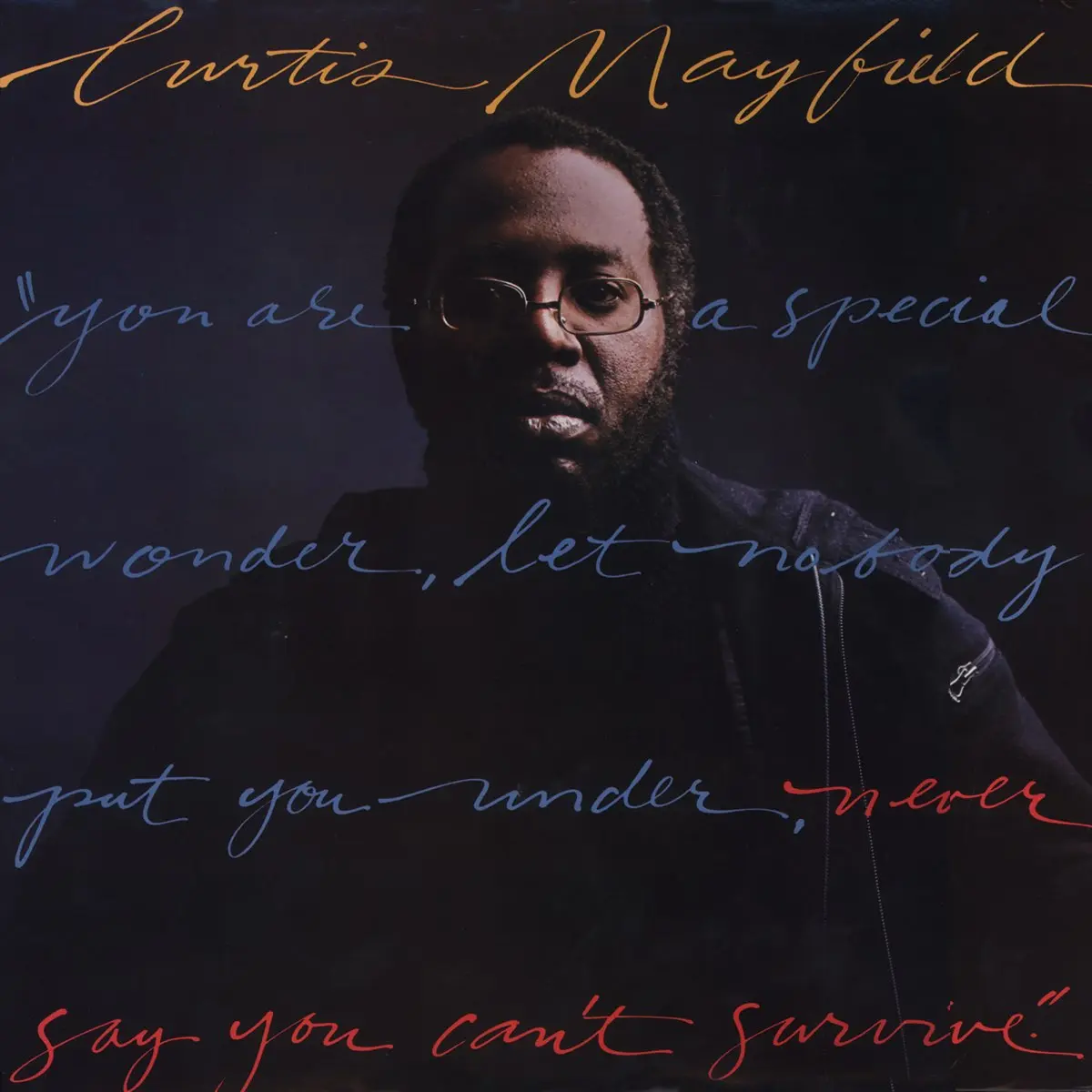 Curtis Mayfield released his ninth solo studio album, Never Say You Can’t Survive, in February 1977 on Curtom.
The album continues Mayfield’s exploration of soul and funk, featuring layered, multisectioned arrangements that emphasize horns, keyboards, and percussion. The instrumentation favors tightly structured rhythms with occasional expansive sections, framing Mayfield’s vocals over dynamic textures.
Mayfield wrote all tracks on the album. Track eight, “Sparkle,” also appears on the soundtrack to the 1976 film Sparkle, for which Mayfield served as composer and producer.
The arrangements on Never Say You Can’t Survive vary from song to song. “Show Me Love” opens with layered horns and propulsive rhythms. Ballads such as “Just Want to Be with You” and “When You Used to Be Mine” rely on contoured keyboard lines and subtle percussion. Mid-tempo tracks like “Never Say You Can’t Survive” and “I’m Gonna Win Your Love” employ interweaving guitar, bass, and saxophone lines, while “All Night Long” builds tension through rhythmic layering and horn punctuations.
A1. “Show Me Love” (5:16)
A2. “Just Want to Be with You” (3:14)
A3. “When We’re Alone” (5:27)
A4. “Never Say You Can’t Survive” (3:22)
B1. “I’m Gonna Win Your Love” (4:43)
B2. “All Night Long” (4:15)
B3. “When You Used to Be Mine” (3:41)
B4. “Sparkle” (4:02) — also featured on the Sparkle soundtrack
Core backing players include lead guitarist and vocalist Curtis Mayfield, rhythm guitarist Gary Thompson, keyboardists Floyd Morris and Rich Tufo, bassist Joseph Scott, drummer Donnell Hagan, and percussionist/conguist Henry Gibson. Tenor saxophonists Cliff Davis and Sonny Seals add wind textures, with Kitty and the Haywoods providing backing vocals. Rich Tufo and James Mack handled arrangements.
Sessions occurred at Curtom Studios in Chicago, Illinois with Mayfield producing. The album emphasizes intricate, multi-layered arrangements that foreground horns, keyboards, and percussion, framing Mayfield’s vocals with rich, rhythmically varied textures.
Short Eyes (OST)
 In October 1977, Curtis Mayfield released Short Eyes, the soundtrack to the title-sake prison drama by playwright Miguel Piñero.
The album blends soul and funk with cinematic textures, emphasizing layered instrumentation and dramatic pacing to reflect the film’s tense, confined setting. It features prominent percussion, interlocking bass and guitar lines, and horn-tinged keyboard arrangements that heighten both intensity and emotional nuance.
Mayfield wrote all tracks except for “Break It Down,” credited to H.P. Denenberg and Martin Hirch. The music mixes socially conscious lyrics with funk rhythms, as in the hit single “Do Do Wap is Strong in Here.”
The arrangements vary across the album. “Do Do Wap is Strong in Here” drives forward with syncopated rhythms, layered keyboards, and percussive accents. Mid-tempo tracks like “Back Against the Wall” and “Need Someone to Love” rely on textured keyboards, interwoven guitar lines, and rhythmic shifts to convey tension and release. Instrumental passages, including “Father Confessor,” focus on sparse melodic motifs supported by tight bass and percussion. The title track suite, “Short Eyes/Freak, Freak, Free, Free, Free,” integrates shifting tempos and vocal interplay to underscore the film’s narrative drama.
A1. “Do Do Wap is Strong in Here” (5:28)
A2. “Back Against the Wall” (6:34)
A3. “Need Someone to Love” (3:11)
A4. “A Heavy Dude” (4:07)
B1. “Short Eyes/Freak, Freak, Free, Free, Free” (5:40)
B2. “Break It Down” (4:17) — written by H.P. Denenberg and Martin Hirch
B3. “Another Fool in Love” (3:20)
B4. “Father Confessor” (2:40) — instrumental
Core backing players include Mayfield on vocals and lead guitar, Gary Thompson on rhythm guitar, Floyd Morris and Rich Tufo on keyboards (with Tufo also arranging), Joseph Scott on bass, Donnell Hagan on drums, and Henry Gibson on bongos and congas. Background vocals come from LeRoy Hutson, Alfonso Surrett, Ricki Linton, and Mystique, reinforcing the harmonic layers.
Sessions occurred at Curtom Studios in Chicago, Illinois with Mayfield producing and Rich Tufo arranging.
The album includes the funk-oriented single “Do Do Wap is Strong in Here.” Short Eyes emphasizes intricate, multi-layered arrangements that combine percussive propulsion, keyboard textures, and interwoven vocal lines, reflecting the tense atmosphere of the prison setting while maintaining Mayfield’s signature funk and soul sensibilities.
Do It All Night
 Curtis Mayfield released his eleventh solo studio album, Do It All Night, in July 1978 on Curtom.
The album blends disco, funk, and soul, with several extended tracks emphasizing percussion, string accents, and layered keyboards. Mayfield retains his signature guitar work and smooth tenor vocals while exploring a tighter, more rhythmically intense disco framework.
Core backing players include Mayfield on lead vocals and guitar, Gary Thompson on rhythm guitar, Joseph “Lucky” Scott and Keni Burke on bass, Donelle Hagan on drums, Henry Gibson on bongos and congas, Floyd Morris and Rich Tufo on keyboards, with The Jones Girls, Kitty Haywood, and the Haywood Singers providing backing vocals. Gil Askey arranged strings and horns throughout the album.
Mayfield wrote or co-wrote all tracks, collaborating with Gil Askey on the first three songs: “Do It All Night,” “No Goodbyes,” and “Party, Party.” He wrote the remaining tracks solo, including “Keeps Me Loving You,” “In Love, In Love, In Love,” and “You Are, You Are,” the latter originally composed for Linda Clifford.
The album opens with the title track, a simmering disco piece with deliberate pacing and layered instrumentation. “No Goodbyes” drives forward with fast-paced rhythms, prominent bongos, and bright string flourishes. “Party, Party” delivers a frenetic funk-disco hybrid wrapped in smooth textures. The final three tracks shift toward soul balladry: “Keeps Me Loving You” features buoyant guitar and near-reggae rhythmic accents, “In Love, In Love, In Love” centers on warm bass, glinting synthesizer, and heartfelt vocals, while “You Are, You Are” maintains a four-on-the-floor pulse supporting Mayfield’s exhaled, ecstatic delivery.
A1. “Do It All Night” (8:17)
A2. “No Goodbyes” (7:40)
A3. “Party, Party” (7:54)
B1. “Keeps Me Loving You” (3:24)
B2. “In Love, In Love, In Love” (4:20)
B3. “You Are, You Are” (3:38) — also recorded by Linda Clifford for her 1978 album If My Friends Could See Me Now
Sessions occurred at Wally Heider Studios in Los Angeles, the Las Vegas Recording Center, and Curtom Studios in Chicago with Mayfield producing. Jim Burgess handled mixing.
Record label promoted Do It All Night with the single “No Goodbyes.”
Discography:
- Curtis (1970)
- Roots (1971 • Curtis)
- Curtis/Live! (1971)
- Superfly (OST, 1972)
- Back to the World (1973)
- Curtis in Chicago (live, 1973)
- Sweet Exorcist (1974)
- Got to Find a Way (1974)
- Let’s Do It Again (OST, 1975 • The Staple Singers & Curtis Mayfield)
- There’s No Place Like America Today (1975)
- Give, Get, Take and Have (1976)
- Short Eyes (OST, 1977)
- Never Say You Can’t Survive (1977)
- Do It All Night (1978)
- Heartbeat (1979)
- The Right Combination (1980 • Linda Clifford & Curtis Mayfield)
- Something to Believe In (1980)
- Love Is the Place (1981)
- Honesty (1982)
- We Come in Peace With a Message of Love (1985)
Sources:
Artist/Album Pages:
Prelude were a Belgian symphonic-rock band from Verviers, Liège, that released the album Voyage on...
O'Donel Levy (September 20, 1945 – March 14, 2016) was an American R&B guitarist who released ...
The Floaters were an American soul group from Detroit that made three albums between 1977 and 197...
The Fox was an English pop-psych band from Brighton that made the 1970 Fontana album For Fox Sake....
Streetheart was a Canadian melodic-rock band that released the 1978/79 Atlantic albums Meanwhile B...
Starter was a Swiss minimal-wave synth trio from Bern that released a 1981 self-titled album on Re...
The Neon Philharmonic was an American pop-psych band from Nashville that released two 1969 albums...
Bandolero were a Puerto Rican psych-rock band that released a self-titled album on small-press Tru...
Corpus was an American hard-rock/psych band that released the 1971 album Creation a Child on Acorn...
Weather Report was a multinational jazz-funk/fusion ensemble that released fourteen studio albums be...
The National Head Band was an English blues-psych band that released the album Albert 1 on Warner...
The Steve Miller Band are an American classic-rock band from San Francisco that released fourteen...