

Joan Armatrading is a Caribbean-British singer-songwriter who released fourteen albums between 1972 and 1992 on A&M. She scored a UK hit with “Love and Affection” from her 1976 self-titled third album, her first of seven Top 20 albums on the UK Albums chart. Her 1980 release Me Myself I marked the pinnacle of her global popularity.
Early Life
She was born Joan Anita Barbara Armatrading on December 9, 1950, in Basseterre, a town on the south coast of Saint “Kitts” Christopher, a then-British colony in the Lesser Antilles. Joan spent her early childhood in Antigua with her grandmother. At age seven, she joined her family in Birmingham, England, where her parents migrated in 1954.
Joan’s father (a carpenter) played in a band as a teenager but forbid guitar-playing among his six children. However, Joan’s mother (a housewife) purchased a piano as a household furnishing. At 14, Joan started writing music to limericks on the piano. Soon after, her mother pawned off two prams in exchange for a guitar, which Joan learned to play by ear. She left school at 15 and found work as a typist but got terminated for playing her guitar on job breaks.
At 16, Joan performed for her brother’s event at Birmingham University, where she played all originals apart from a special request for “The Sound of Silence” by Simon & Garfunkel. She gigged for a year on the Midlands coffee-house circuit. In 1968, she joined a UK road production of the American counter-cultural musical Hair. She befriended cast-mate Pam Nestor, a Guyanese-born actress and singer who grew up in Muswell Hill, England.
Pam wrote lyrics to Joan’s music. Their songs formed the basis for Joan’s first album, a project greenlit for Cube Records, the nascent indie of music mogul David Platz.
Whatever’s for Us
 Joan Armatrading released her debut album, Whatever’s for Us, in November 1972 on Cube.
The album documents Armatrading’s brief but prolific partnership with lyricist Pam Nestor, who co-wrote most of the material. Compared to her later inward-focused ballads, these early songs reflect broader themes of kinship, urban disillusionment, and social tension, with brief durations and sparse instrumentation. Cube credited Armatrading solely despite Nestor’s contributions to eleven of the fourteen songs.
Armatrading sings and plays acoustic guitar, piano, and harmonium. She’s accompanied by guitarist Davey Johnstone, bassist Larry Steele, and percussionist Ray Cooper. Gerry Conway and Henry Spinetti split drum duties; Jean Alain Roussel adds organ on one track. Del Newman handles string and horn arrangements; Chris Hughes supplies brass parts on two songs.
Armatrading wrote three songs alone (“City Girl,” “Spend a Little Time,” “Conversation”); Nestor co-wrote the remaining eleven. “Visionary Mountains” was later covered by Manfred Mann’s Earth Band. “My Family” and “City Girl” reappeared in later compilations. The 2001 reissue includes “Lonely Lady” and “Together in Words and Music,” originally issued as a 1973 single.
“City Girl” opens with descending piano phrases and acoustic strums that shadow the vocal phrasing. “Visionary Mountains” uses high-register piano clusters and tremolo sitar tones under a low alto delivery. “It Could Have Been Better” builds slowly with measured piano voicings, bowed strings, and distant horns, gradually intensifying over five minutes. “Alice” shifts between verse piano cadences and a middle section with harmonium and vibraphone accents. “Head of the Table” moves briskly with clipped acoustic lines and layered hand percussion, then settles into a closing cycle of half-resolved piano chords. “Mean Old Man” contrasts bright acoustic runs with interjected electric riffs, then yields to brass bursts under the final refrain.
A1. “My Family” (3:08)
A2. “City Girl” (3:58)
A3. “Spend a Little Time” (2:23)
A4. “Whatever’s for Us, for Us” (2:11)
A5. “Child Star” (2:31)
A6. “Visionary Mountains” (1:49) — later covered by Manfred Mann’s Earth Band on Nightingales & Bombers (1975)
A7. “It Could Have Been Better” (4:19) — used in Kill List (2011) and the Burberry 2012 A/W fashion show
B1. “Head of the Table” (2:30) — depicts racial tension in a mixed-heritage household, drawn from Nestor’s own experience
B2. “Mister Remember Me” (2:15)
B3. “Gave It a Try” (2:08)
B4. “Alice” (3:29)
B5. “Conversation” (2:15)
B6. “Mean Old Man” (2:33) — lyric casts the world as “semi-mad,” reflecting social alienation
B7. “All the King’s Gardens” (2:58) — title inspired by a West Hampstead address Armatrading glimpsed from a bus
Sessions occurred in mid-1972 at Château d’Hérouville in Oise, France, with additional work at Trident and Marquee Studios, London, under producer Gus Dudgeon and engineers Robin Geoffrey Cable, Ken Scott, Roy Baker, and Phil Dunne.
Whatever’s for Us features cover art by Sumiko Davies, who illustrated a pastoral, multicultural scene with drawings of Armatrading and Nestor. Armatrading holds a Santa mascot gifted to her by Nestor.
Cube issued “Lonely Lady” (b/w “Together in Words and Music”) in June 1973. Both songs appear on the 2001 Metro reissue.
Back to the Night
 Joan Armatrading released her second album, Back to the Night, in April 1975 on A&M.
The album marked her first solo-authored studio effort following the dissolution of her partnership with lyricist Pam Nestor. It introduced a more rhythmically adventurous and stylistically varied palette, incorporating Afro-Caribbean textures, jazz voicings, and clipped acoustic rhythms. Unlike the fragile tones of her debut, Armatrading sings with firmer phrasing and greater personal focus.
Armatrading sings and plays acoustic, electric, and twelve-string guitars, and contributes piano on several tracks. Keyboardist Jean Roussel supplies organ, Moog, and piano parts. Guitarist Pete Gage also serves as producer, with Colin Pincott, Andy Summers, and Bernie Holland contributing additional guitar. Steve York and Phil Chen alternate on bass, joined by double-bassist Ron Mathewson. Tony Carr, John Halsey, and Tony Newman split drum duties, supported by percussionists Shamsi Sarumi, Gaspar Lawal, and others. Roussel and Armatrading share most of the arranging duties.
Armatrading wrote ten of the twelve songs. The closing two tracks—“Dry Land” and “Come When You Need Me”—carry over from her collaboration with Pam Nestor. “Dry Land” was later released as a standalone single and included on multiple compilations. “Cool Blue Stole My Heart” and “Steppin’ Out” also gained attention through live recordings and reissues.
“Travel So Far” moves in clipped cycles with dry 12-string rhythm, punctuated by Afro percussion and midrange piano accents. “Steppin’ Out” layers syncopated congas over alternating rhythm guitar and electric leads, with overlapping organ figures and tempo lifts in the chorus. “Dry Land” uses wide-spaced piano voicings under an exposed vocal line, with rising Moog tones filling the center channel on later refrains.
“Cool Blue Stole My Heart” progresses from solitary acoustic phrasing to doubled piano-and-Moog swells, underpinned by bass motion that shifts from plucked figures to long bowed tones. “Back to the Night” builds on clipped guitar interjections and a high-register Moog break, finishing on call-and-response phrases between rhythm section and vocal.
A1. “No Love for Free” (3:28)
A2. “Travel So Far” (3:07)
A3. “Steppin’ Out” (4:03) — later included on Steppin’ Out (1979) and performed on Rockpalast
A4. “Dry Land” (4:19) — co-written with Pam Nestor; released as a single on 28 Nov. 1975; favored by DJ John Peel
A5. “Cool Blue Stole My Heart” (5:32) — composed in Amsterdam; later performed live at Rockpalast
B1. “Get in Touch with Jesus” (3:39)
B2. “Body to Dust” (4:19)
B3. “Back to the Night” (4:02) — later remixed as B-side to “Heaven” (1983)
B4. “So Good” (3:26)
B5. “Let’s Go Dancing” (2:03)
B6. “Come When You Need Me” (3:44) — co-written with Pam Nestor; included in multiple anthologies
Sessions occurred in 1974 at Rockfield Studios (Monmouthshire), Morgan Studios, and Basing Street Studios (London) with producer Pete Gage and engineers Phill Brown, Phil Ault, and Robin Black. Gage also performed guitar and percussion.
Back to the Night features silhouette photography by Clive Arrowsmith at Armatrading’s request, with design direction by Fabio Nicoli. Armatrading refused a full-face cover image, opting for shaded profile shots instead.
A&M issued “Dry Land” (b/w “Body to Dust”) as a single in November 1975. A remixed version of the title track later appeared as the B-side of “Heaven” in 1983.
Joan Armatrading
 Joan Armatrading released her self-titled third album in July 1976 on A&M.
The album marked a decisive shift from the folk-inflected stylings of her first two records toward a leaner, more assertive vocal presence and sharper rhythmic articulation. Producer Glyn Johns emphasized tonal clarity and instrumental separation, stripping away ornate elements in favor of tight interplay. Armatrading’s vocal phrasing grew more clipped and conversational, underscoring the tension and resilience in her songwriting.
Armatrading sings and plays six- and twelve-string acoustic guitar across the album. Guitarist Jerry Donahue provides electric and acoustic leads, with Dave Markee on bass and Dave Mattacks and Kenney Jones splitting drum duties. Glyn Johns assembled additional players from the UK roots scene: Peter Wood adds Hammond and electric piano; Bryn Haworth contributes slide guitar and mandolin; Graham Lyle and B. J. Cole appear on select tracks. Jimmy Jewell adds alto sax on the lead single. Clarke Peters and Leroy Champaign provide backing vocals on two cuts. String parts appear on one track, arranged by Brian Rogers.
Armatrading wrote all ten songs. “Love and Affection” became her first UK Top 10 single and remains her signature track. “Down to Zero” opened many of her concerts and gained renewed attention through reissues and sync licenses.
“Down to Zero” opens the album with descending guitar phrases against a clipped backbeat and curling pedal steel runs. “Love and Affection” juxtaposes a hushed verse with abrupt horn stabs and layered harmony vocals, building intensity through suspended chord phrasing. “Water with the Wine” uses piano counterlines and staggered entrances to mirror the lyrical uncertainty. “Like Fire” shifts between broken-down rhythmic verses and molten refrains with distorted slide guitar and extended saxophone phrasing. “Tall in the Saddle” rides a mid-tempo swing pattern that supports staccato couplets and call-and-response instrumental breaks, stretching past five minutes without recapitulation.
A1. “Down to Zero” (3:51) — released as a single in December 1976 (b/w “Like Fire”); features pedal steel by B.J. Cole and drums by Kenney Jones
A2. “Help Yourself” (4:04) — B-side to “Love and Affection”
A3. “Water with the Wine” (2:48)
A4. “Love and Affection” (4:28) — Armatrading’s first UK Top 10 hit; features alto sax by Jimmy Jewell and backing vocals by Clarke Peters
A5. “Save Me” (3:35)
B1. “Join the Boys” (4:48)
B2. “People” (3:30)
B3. “Somebody Who Loves You” (3:33)
B4. “Like Fire” (5:12) — B-side to “Down to Zero”; features slide guitar by Bryn Haworth
B5. “Tall in the Saddle” (5:43)
Sessions occurred in early 1976 at Olympic Studios, London, with Glyn Johns producing and engineering. The album was mixed and mastered under Johns’ direction.
Joan Armatrading features cover photography by Clive Arrowsmith, who captures Armatrading in full profile while performing on an Ovation guitar. Fabio Nicoli handled art direction, with layout design by Nick Marshall.
A&M issued “Love and Affection” (b/w “Help Yourself”) in October 1976; it reached No. 10 on the UK Singles Chart and No. 16 in Ireland. “Down to Zero” followed in December 1976 but did not chart. Both songs appeared in live form on Steppin’ Out (1979).
“Like Fire” and “Tall in the Saddle” reappeared on compilations and live releases. The album earned a Gold certification and critical praise across the UK and Commonwealth territories.
Show Some Emotion
 Joan Armatrading released her fourth album, Show Some Emotion, in September 1977 on A&M.
The album refines the stripped-back sound of its predecessor with looser rhythmic flow and warmer instrumental textures. Armatrading pares her phrasing into clipped, syncopated bursts and trades metaphor-heavy lyrics for direct appeals. Producer Glyn Johns brings greater ambient space into the mixes, opening her acoustic frames with electric timbres and layered percussion.
Armatrading sings and plays acoustic guitar throughout, and adds thumb piano on the opening track. Jerry Donahue returns on electric guitar and slide. Bassists Dave Markee and Bryan Garofalo split duties across tracks. Drums are handled by David Kemper, Henry Spinetti, and Kenney Jones. Keyboards alternate between Georgie Fame (Fender Rhodes), John “Rabbit” Bundrick (Hammond), and Tim Hinkley (piano, organ). Mel Collins contributes saxophone on two tracks. Clarke Peters and Joe Scott provide backing vocals. Brian Rogers arranged and conducted strings on one song.
Armatrading wrote all ten songs. “Willow,” the lead single, became one of her most beloved ballads despite minimal chart impact. “Show Some Emotion” and “Mama Mercy” reappeared in live settings and on compilations. “Opportunity” and “Kissin’ and a Huggin’” were frequently cited for their rhythmic verve.
“Woncha Come On Home” opens with a thumb piano motif and voice alone, then builds into clipped phrases and staggered harmony. “Never Is Too Late” opens slowly, then climbs through rhythmic fragmentation into a rolling chorus with circular guitar phrases and rising dynamics. “Peace in Mind” centers on a piano-driven chant over sustained chords and slow cymbal motion. “Opportunity” uses descending electric lines, staggered vocal phrasing, and a compact solo break under a jazz-funk rhythm. “Willow” opens in soft Rhodes pulses, gradually layering acoustic guitar and strings behind a restrained vocal that crescendos only in the final stanza. “Kissin’ and a Huggin’” finishes the album with a fast backbeat, layered vocals, and tight sax accents over piano-led changes.
A1. “Woncha Come On Home” (2:40) — features thumb piano (mbira) played by Armatrading
A2. “Show Some Emotion” (3:31) — appeared on Steppin’ Out (1979); released as a single in 1978
A3. “Warm Love” (3:04) — features strings arranged by Brian Rogers
A4. “Never Is Too Late” (5:32)
A5. “Peace in Mind” (3:19) — features piano and organ by Tim Hinkley
B1. “Opportunity” (3:25) — features slide guitar by Jerry Donahue and backing vocals by Clarke Peters
B2. “Mama Mercy” (2:47) — performed live on Steppin’ Out (1979); features sax by Mel Collins
B3. “Get in the Sun” (3:19) — features backing vocals by Clarke Peters and Joe Scott
B4. “Willow” (4:53) — issued as lead single in October 1977; B-side “No Way Out”; features Georgie Fame on Rhodes
B5. “Kissin’ and a Huggin’” (4:42) — features sax by Mel Collins and piano by Tim Hinkley
Sessions occurred in 1977 at Olympic Studios, London, with Glyn Johns producing and engineering. Jon Astley served as assistant engineer.
Show Some Emotion features sleeve photography by David Montgomery, with art direction by Fabio Nicoli and design by Nick Marshall.
A&M issued “Willow” (b/w “No Way Out”) in October 1977. Though it missed the charts, it gained BBC airplay and became a live favorite. “Show Some Emotion” followed as the second single in 1978.
Show Some Emotion reached No. 6 on the UK Albums Chart and earned wide critical acclaim for its expressive range and emotional subtlety.
To the Limit
 Joan Armatrading released her fifth album, To the Limit, on September 28, 1978, on A&M.
The album marks her final studio collaboration with producer Glyn Johns and departs from the layered studio textures of prior records in favor of minimal overdubs, live-in-studio arrangements, and a reduced ensemble. Armatrading balances sharp lyrical observation with conversational phrasing and delivers some of her most direct and fluidly paced songs to date.
Armatrading sings and plays acoustic guitar across the album. Guitarist Phil Palmer adds clean-toned electric lines; Red Young plays piano, and Dick Sims provides organ and accordion. Bassist Dave Markee and drummer Henry Spinetti return from prior albums, while Quitman Dennis adds saxophone, flute, and lyricon textures. The stripped-down ensemble emphasizes space, flow, and continuity between tracks.
Armatrading wrote all ten songs. “Barefoot and Pregnant” and “Bottom to the Top” were released as singles and adopted by feminist circles and radio DJs respectively. “You Rope You Tie Me” was reprised on Steppin’ Out and “Taking My Baby Up Town” carried over the rhythm and subject matter of earlier songs like “Kissin’ and a Huggin’.” Several tracks appeared in her Rockpalast (1979) setlist.
“Barefoot and Pregnant” opens with clipped phrasing over strummed acoustic figures and builds into a steady pulse with spacious keyboard stabs. “Am I Blue for You” stretches into slow 12-bar motion with vocal inflection changes on each verse cycle. “Your Letter” opens with gentle piano arpeggios and intersperses melodic keyboard runs between vocal lines. “You Rope You Tie Me” sustains a blues-gospel cadence with percussive syncopation and rising vocal declarations. “Bottom to the Top” uses single-take reggae phrasing, with guitar on the upbeat and unpredictable drumming that resists fixed bar resolution. “Wishing” unfolds in five long verses, pausing at midpoint for sustained piano voicings and a vocal restatement, then circles back into its closing cadence.
A1. “Barefoot and Pregnant” (3:40) — issued as a single in January 1979 (b/w “Your Letter”); adopted as a feminist anthem
A2. “Your Letter” (3:40) — inspired by a conversation with Bonnie Raitt; appears as B-side to both singles
A3. “Am I Blue for You” (4:24) — extends blues phrasing and modal variation
A4. “You Rope You Tie Me” (4:08) — included in Rockpalast (1979) and Steppin’ Out (1979)
A5. “Baby I” (4:52)
B1. “Bottom to the Top” (3:34) — recorded in one take with reggae pulse; issued as a single in November 1978
B2. “Taking My Baby Up Town” (3:25) — revisits themes from “Kissin’ and a Huggin’”; performed on Rockpalast
B3. “What Do You Want” (3:44)
B4. “Wishing” (4:48) — described by Armatrading as her first piece of poetry
B5. “Let It Last” (4:57) — closes with a gospel-styled slow fade
Sessions occurred in 1978 at Olympic Studios, London, with Glyn Johns producing and engineering. Doug Sax mastered the album at The Mastering Lab, Los Angeles.
To the Limit features photography by Annie Leibovitz, who spent four days capturing Armatrading at her home in Sutton. Art direction is by Michael Ross; design by Nick Marshall.
A&M issued “Bottom to the Top” (b/w “Your Letter”) on November 10, 1978, followed by “Barefoot and Pregnant” (b/w “Your Letter”) in January 1979. Though neither single charted, both gained significant UK radio airplay. To the Limit reached No. 13 on the UK Albums Chart.
Steppin’ Out
 In August 1979, Joan Armatrading released Steppin’ Out, a document of her recent US tour.
The album presents live renditions of material from her last four studio albums, performed with a full electric band on her 1979 North American tour. It includes two songs not found on prior studio releases: “How Cruel” and “Love Song.”
Backing players include guitarist Richard Hirsch, keyboardist Red Young, bassist Bill Bodine, saxophonist Lon Price (alto, flute), and drummer Richie Hayward. Armatrading handles vocals and rhythm guitar. Her interplay with Hayward’s driving pulse and Price’s sax fills defines the band’s dynamic arc.
Armatrading wrote all nine songs, including the two previously unreleased tracks. The live set omits songs from her 1972 debut Whatever’s for Us, but draws from Back to the Night, Joan Armatrading, Show Some Emotion, and To the Limit.
“Mama Mercy” opens with firm vocal phrasing over syncopated stops, giving space to an alto sax solo that surges before the final chorus. “Cool Blue Stole My Heart” expands across seven minutes, shifting from sparse chords to extended blues phrasing and a winding modal saxophone break. “How Cruel” compresses lyrical commentary into clipped phrases over a tight rhythmic frame. “Love and Affection” unfolds in slow pulse, suspending vocal lines in a gospel-inflected arc. “You Rope You Tie Me” and “Kissin’ and a Huggin’” appear in a single sequence with accelerating drum fills and continuous saxophone motion. Closer “Tall in the Saddle” modulates dynamics across blues, jazz, and rock idioms, culminating in an extended vocal climax over rising chords.
A1. “Mama Mercy” (3:45) – originally from Show Some Emotion (1977)
A2. “Cool Blue Stole My Heart” (7:12) – originally from Back to the Night (1975)
A3. “How Cruel” (2:30) – confronts racial prejudice through clipped phrasing and rhetorical commentary
A4. “Love Song” (3:38)
A5. “Love and Affection” (4:52) – originally from Joan Armatrading (1976)
B1. “Steppin’ Out” (3:31) – solo-guitar version with extended instrumental section
B2. “You Rope You Tie Me” (4:36) – originally from Show Some Emotion (1977)
B3. “Kissin’ and a Huggin’” (5:59) – originally from Show Some Emotion (1977)
B4. “Tall in the Saddle” (6:31) – originally from Show Some Emotion (1977)
Sessions occurred during Armatrading’s 1979 US tour and were produced and engineered by Glyn Johns.
The album features cover photography by Annie Leibovitz and stage logo design by Maggie Butler.
A&M promoted the album with “How Cruel” and later issued it as the title track of a 1979 EP. A US CD reissue appeared in 2006 as a limited edition.
A 2004 DVD titled Steppin’ Out contains two full concerts recorded by German TV: Cologne (1979) and Essen (1980). It includes nearly all album tracks plus songs from Me Myself I and earlier albums.
How Cruel (EP)
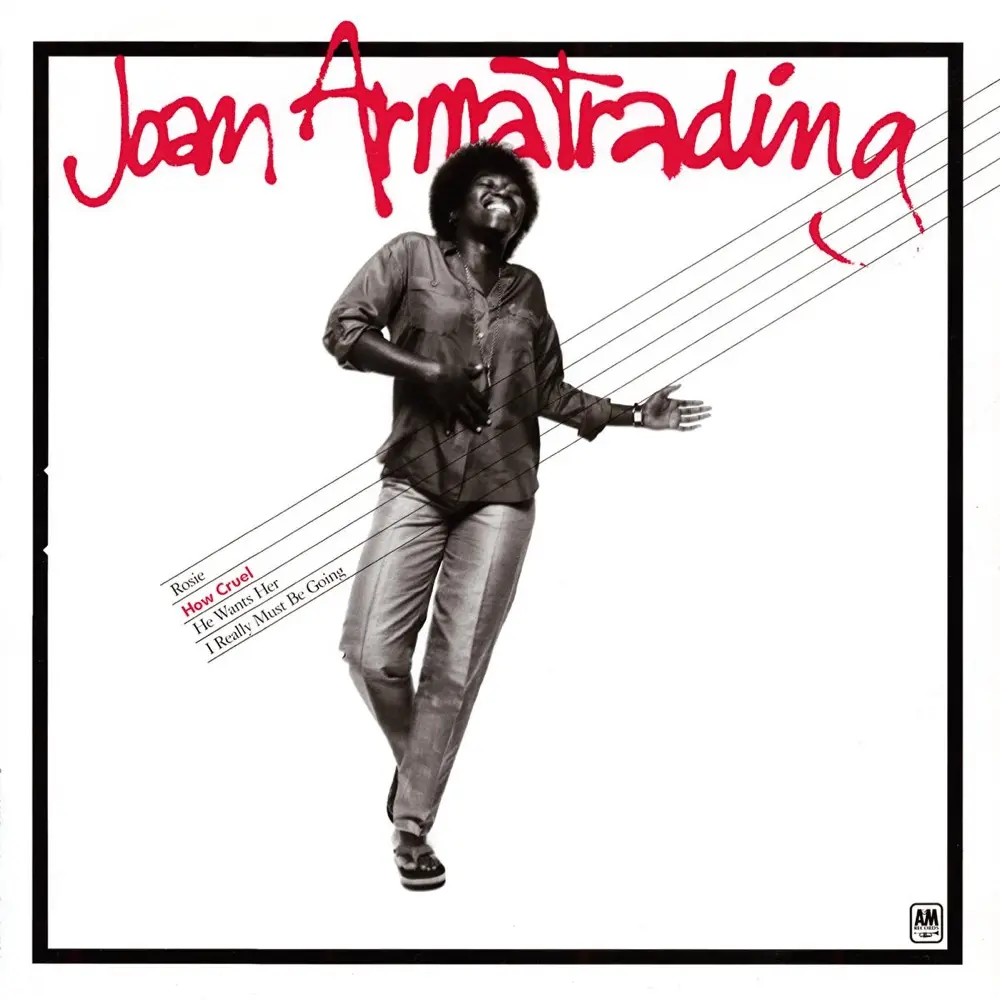 In November 1979, Joan Armatrading released How Cruel, a four-song EP on A&M.
This one-sided 12-inch served as a stopgap release in territories where Steppin’ Out was unavailable, notably the United States. It features the studio version of “How Cruel,” plus three additional non-album tracks, all recorded after the To the Limit tour and ahead of her 1980 comeback with Me Myself I.
Backing players include guitarists Richard Hirsch and Winston Delandro, keyboardists Red Young, James Lascelles, and Mike Storey, bassist Bill Bodine (alongside Ben Adkins and Durban Betancourt-Laverde), and drummers Gary Mallaber and Richard Bailey. Lon Price contributes saxophone on the title track. Armatrading sings and plays acoustic guitar across the EP.
Armatrading wrote all four tracks. “How Cruel” had previously appeared in live form on Steppin’ Out. The other three songs—“Rosie,” “He Wants Her,” and “I Really Must Be Going”—appear only on this release and subsequent compilations.
“Rosie” juxtaposes descending piano phrasing with a clipped vocal line that stretches the refrain across a tight rhythmic grid. “He Wants Her” uses interlocking keyboard and guitar textures to convey the emotional tension in its clipped phrases. “I Really Must Be Going” unfolds in slow tempo with fading electric piano chords, minimal bass movement, and a lyric that gradually discloses a personal and final farewell.
A1. “Rosie” (3:10) — appeared on Track Record and The Very Best of Joan Armatrading
A2. “How Cruel” (3:04) — first studio version of the song introduced on Steppin’ Out
A3. “He Wants Her” (3:15)
A4. “I Really Must Be Going” (4:27)
Sessions occurred in mid-to-late 1979 at Morgan Studios in London and A&M Studios in Hollywood with Joan Armatrading and Henry Lewy producing.
The EP was not issued in the UK but reached No. 10 in the Netherlands and No. 19 in Norway. It earned a Grammy nomination for Best Female Rock Vocal Performance.
A&M issued “Rosie” (b/w “How Cruel”) as a single in late 1979. It charted at No. 49 in the UK and No. 52 in Australia.
Me Myself I
 Joan Armatrading released her sixth studio album, Me Myself I, in May 1980 on A&M.
This marked a stylistic shift from the acoustic intimacy of her Glyn Johns-produced albums to a more amplified, assertive sound shaped by New York rock producer Richard Gottehrer. Armatrading embraced a harder electric edge, aligning herself with a studio band drawn from the US session circuit.
Armatrading sings and plays 12-string acoustic guitar. Guitars are handled by Chris Spedding and Hiram Bullock, with Richard Hirsch featured on “Friends.” Keyboard duties are divided among Paul Shaffer, Danny Federici (organ), Clifford Carter, Phillip St. John, and Tom Sowell (synthesizer). Will Lee and Marcus Miller share bass credits, and Anton Fig handles drums throughout. Clarence Clemons contributes saxophone, and George Kerr and Sammy Turner supply background vocals on “Turn Out the Light.”
Armatrading wrote all ten tracks. Her lyrics shift between introspective themes and bolder statements of autonomy, sometimes lightened by humor or misdirection. The album spans concise vignettes, extended narratives, and assertive declarations.
“Me Myself I” opens with clipped vocal phrasing over a tight rhythm section, reinforcing the lyrical self-containment with ascending chorus phrasing. “Turn Out the Light” unfolds across a slow build, layering backup vocals and electric keyboard swells into a climactic final refrain. “All the Way from America” opens with sustained keyboard chords underlining a steady march rhythm; as the verses unfold, the vocal line softens then surges with the promise of reunion, resolving in a sharp fade. “Simon” shifts between sparse verses and saxophone interludes that highlight the narrator’s emotional distance. “I Need You” ends the album with terse phrasing and a falling cadence that echoes the title refrain.
A1. “Me Myself I” (3:16) — expresses self-containment and independence through clipped phrasing and driving rhythm
A2. “Ma-Me-O-Beach” (3:00)
A3. “Friends” (3:05)
A4. “Is It Tomorrow Yet” (3:31)
A5. “Turn Out the Light” (4:19) — crescendos with multi-layered harmonies and background vocals
B1. “When You Kisses Me” (3:14)
B2. “All the Way from America” (4:49) — conveys transatlantic longing in gradually expanding lines and guitar fills
B3. “Feeling in My Heart (For You)” (3:36)
B4. “Simon” (3:40) — contrasts subdued verses with anxious saxophone interjections
B5. “I Need You” (2:44)
Sessions occurred in March 1980 at the Record Plant in New York City with producer Richard Gottehrer and engineer Thom Panunzio.
The cover features front photography by Brian Hagiwara and back photography by Anton Corbijn.
A&M issued three singles: “Me Myself I” (b/w “When You Kisses Me”), which reached No. 21 UK; “All the Way from America” (b/w “Is It Tomorrow Yet”), which peaked at No. 54 UK; and “Simon” (b/w “He Wants Her”), which charted on UK airplay.
Walk Under Ladders
 Joan Armatrading released her seventh studio album, Walk Under Ladders, on September 4, 1981, on A&M.
Ladders marked a stylistic pivot toward synthetic textures and layered production, shaped by Steve Lillywhite. Armatrading departed from the tight structures of Me Myself I to embrace rhythmic fragmentation, ambient keyboard overlays, and a rotating cast of session players drawn from UK, US, and Jamaican rock and reggae spheres.
Armatrading sings lead throughout and plays acoustic guitar on three tracks, adding electric piano to “Only One.” Synthesizers dominate the arrangements, handled primarily by Thomas Dolby, with additional parts by Nick Plytas. Hugh Burns rotates guitar parts with XTC frontman Andy Partridge (on two tracks), Gary Sanford, and Kirby (ex-Stretch). Tony Levin plays bass and Chapman stick, with Robbie Shakespeare appearing once. Drummers Jerry Marotta and Sly Dunbar appear alongside percussionists Ray Cooper and Julian Diggle. Mel Collins plays sax on two tracks; Dick Cuthell (Trifle, Specials) and Rico Rodriguez contribute horns on “Romancers.”
Armatrading wrote all ten tracks. Her lyrical tone is more emotionally distanced than before, favoring elliptical phrasing, conceptual ambiguity, and moments of sharp clarity. The sequencing alternates between fragmented uptempo pieces and stark, mood-driven confessions.
“I’m Lucky” opens with a sustained synth loop over a motoric drum pattern, vocal lines staggered across tightly metered phrasing. “Romancers” settles into a rolling mid-tempo cadence colored by horns, foregrounding themes of fleeting connection. “I Wanna Hold You” rides a pulsing guitar pattern through clipped chorus refrains and wordless vocal swells.
“The Weakness in Me” isolates piano under Armatrading’s restrained delivery, each line paced to highlight the tension between desire and remorse. “At the Hop” moves in bursts of percussion and interjections, its chord changes traced through shifting accents. “Eating the Bear” hinges on a staccato synth motif with mock-heroic phrasing and unexpected tonal shifts. Closer “Only One” stretches its melody line over descending keyboard layers, underlining the lyric’s bare resolve.
A1. “I’m Lucky” (3:05) — opens with looped synth phrasing and fragmented vocal lines
A2. “When I Get It Right” (3:03) — explores frustration with rhythmic displacements and sax inflections
A3. “Romancers” (3:48) — glides through horn textures over syncopated guitar
A4. “I Wanna Hold You” (3:46) — builds from rhythmic guitar repetition to layered vocal refrains
A5. “The Weakness in Me” (3:33) — expresses emotional conflict with piano-led restraint
B1. “No Love” (3:58) — overlays vocal intensity with organ and saxophone breaks
B2. “At the Hop” (3:26) — rides percussive starts and stops through abrupt tonal shifts
B3. “I Can’t Lie to Myself” (3:23) — blends reggae rhythms with descending synth figures
B4. “Eating the Bear” (2:59) — features dry vocal phrasing over minimal synth bursts
B5. “Only One” (4:15) — resolves through subdued keyboards and spare rhythmic lines
Sessions occurred in July 1981 at The Town House in London with producer Steve Lillywhite and engineer Steve Brown.
Cover photography is by Tony McGee and Graham Hughes, with sleeve design by Michael Ross and Simon Ryan.
A&M issued five singles: “I’m Lucky” (b/w “Shine”), which peaked at No. 46 UK; “When I Get It Right” (b/w “Crying”), which reached No. 89 in Record Business; “No Love” (b/w “Dollars”), which charted at No. 50 UK; “I Wanna Hold You” (b/w “Shine”); and “The Weakness in Me” (b/w “Crying” and “Dollars”), released in select territories. Videos for the first and fourth singles were directed by Godley & Creme.
The Key
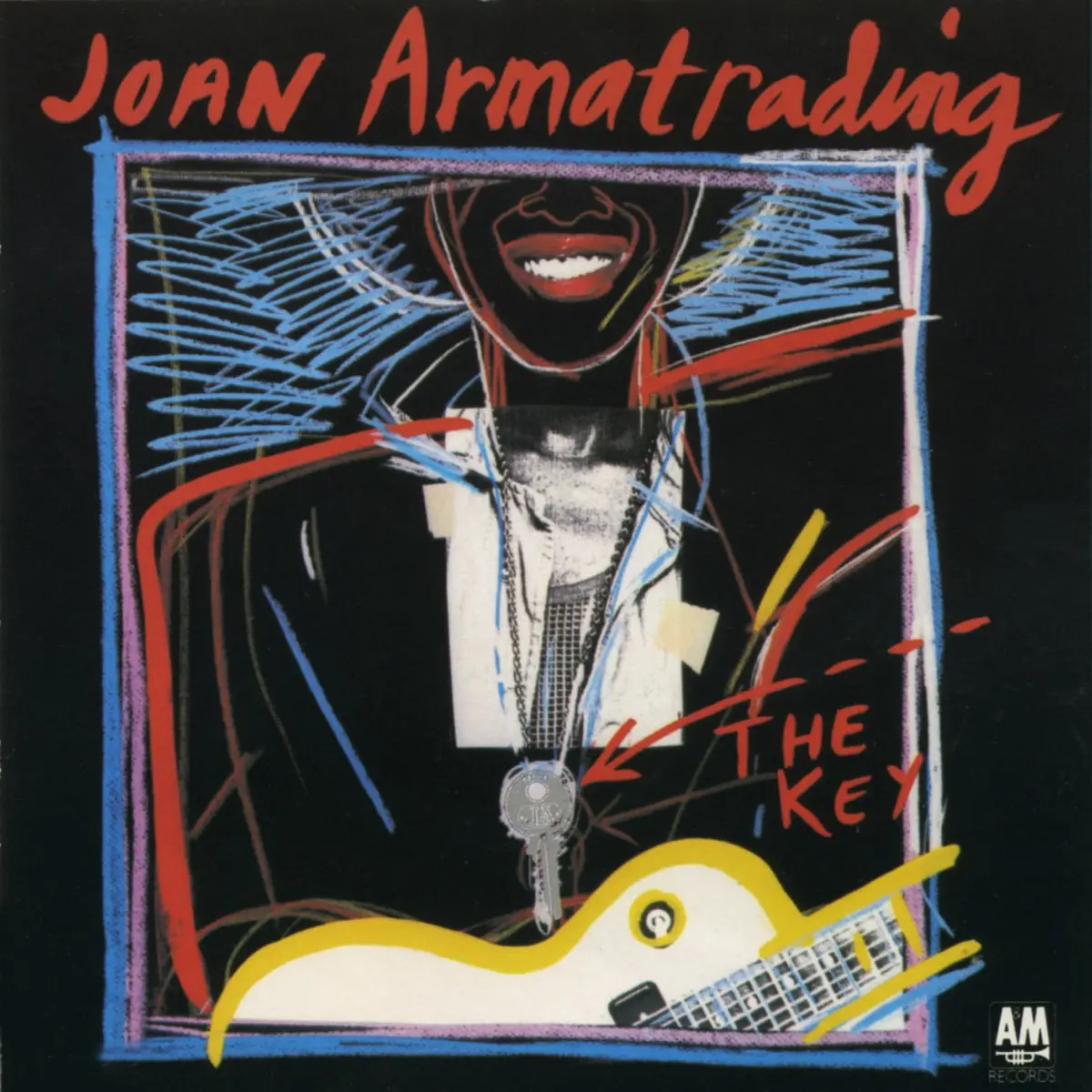 Joan Armatrading released her eighth studio album, The Key, on February 28, 1983, on A&M.
Key consolidates the harder, punchier sound first explored on Walk Under Ladders, but with greater tonal variance and commercial intent. Most tracks were produced by Steve Lillywhite in London and Stockholm, but A&M prompted Armatrading to write two additional singles, produced separately in New York by Val Garay with a different band. The result is her most varied album to date, alternating taut guitar-led rock with layered synth-pop and sparse balladry.
Armatrading sings and plays electric and acoustic guitar and piano across the album. The main sessions feature bassist Tony Levin, drummer Jerry Marotta, synthesist Larry Fast, and guitarists Adrian Belew and Daryl Stuermer, with contributions from Police drummer Stewart Copeland, saxist Mel Collins, trombonist Annie Whitehead, trumpeter Guy Barker, and percussionist Julian Diggle. The New York tracks — “Drop the Pilot” and “What Do Boys Dream” — feature bassist Bryan Garofalo, keyboardist Steve Goldstein, drummer Craig Krampf, and guitarists Craig Hull and Tim Pierce.
Armatrading wrote and arranged all eleven tracks. Her lyrics retain themes of romantic duality and internal conflict, but with brighter hooks and a more rhythm-forward approach. “Drop the Pilot” and “Call Me Names” highlight her pivot to tightly constructed pop singles, while “The Key” and “The Dealer” explore darker, harmonically angular textures.
“Call Me Names” pairs clipped phrasing with pulsing bass and jagged guitar breaks, overlaying a lyric about antagonistic affection with Belew’s angular solo. “Foolish Pride” contrasts steady rhythm guitar with a stepping bassline and recurring vocal motif. “Drop the Pilot” opens with syncopated guitar lines under a brisk vocal cadence that tightens on the refrain. “The Key” rides a clipped rhythm with layered brass and shifting harmonic centers.
“Everybody Gotta Know” softens the pace with delayed vocal entry and looping phrasing. “The Dealer” builds across overlapping chord changes, overlaying stark lyrics with electric guitar spikes. “I Love My Baby” closes with minimal phrasing and open harmonic space, ending the album on a quietly enigmatic note.
A1. “(I Love It When You) Call Me Names” (4:23) — driven by clipped phrasing and angular guitar over aggressive rhythm
A2. “Foolish Pride” (3:16) — follows descending vocal patterns over persistent rhythm guitar
A3. “Drop the Pilot” (3:41) — constructed as a brisk, concise single with layered guitar figures
A4. “The Key” (4:01) — expands on rhythmic fragmentation and dynamic brass textures
A5. “Everybody Gotta Know” (3:48) — unfolds through delayed vocal entry and circular lyric phrasing
B1. “Tell Tale” (2:31)
B2. “What Do Boys Dream” (2:55) — balances rhythmic drive with ambiguous lyrical tone
B3. “The Game of Love” (3:34)
B4. “The Dealer” (3:19) — alternates sharp verses and low-register chorus phrasing
B5. “Bad Habits” (3:43)
B6. “I Love My Baby” (3:29) — slows tempo and strips arrangement to its barest layers
Sessions occurred in 1982 at The Town House in London, Polar Studios in Stockholm, and an unnamed studio in New York. Steve Lillywhite produced the UK and Swedish sessions; Val Garay produced the two New York tracks.
Cover painting is by Donna Muir, with photography by Jamie Morgan and art direction by Michael Ross. Armatrading wears the titular key around her neck in all promo material.
A&M issued “Drop the Pilot” (b/w “Business Is Business”) in January 1983; it reached No. 11 UK, No. 6 Australia and New Zealand, and No. 1 in South Africa. “Call Me Names” followed in May (b/w “For the Best”), charting in Australia (No. 20) and New Zealand (No. 43). “What Do Boys Dream” appeared later in 1983 as a third single.
Track Record
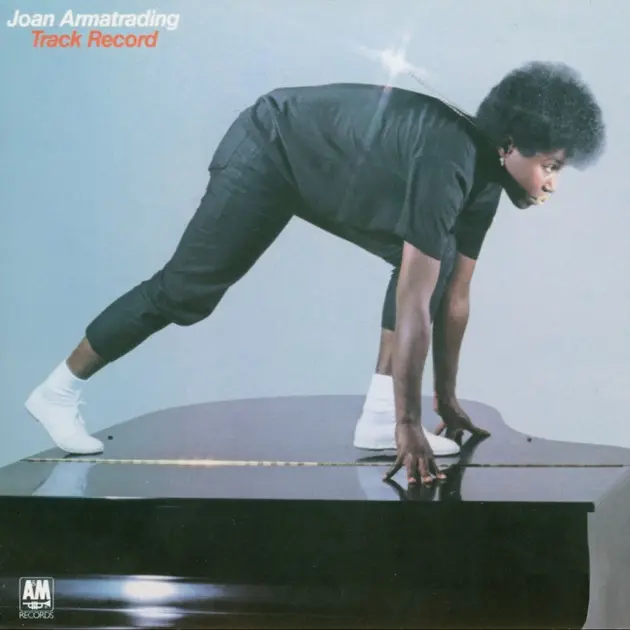 In 1983, A&M Records issued Track Record, the first compilation of Joan Armatrading material. It draws from five of her earlier albums—Joan Armatrading (1976), Show Some Emotion (1977), Me Myself I (1980), Walk Under Ladders (1981), and The Key (1983)—and also includes the song “Rosie” from the How Cruel EP (1979) along with two newly recorded tracks, “Frustration” and “Heaven.”
Armatrading self-produced the new songs “Frustration,” “Heaven,” and “Rosie.” Val Garay handled production and engineering on “Drop the Pilot.” Richard Gottehrer produced “Me Myself I.” Glyn Johns produced “Down to Zero,” “Love and Affection,” and “Show Some Emotion,” also engineering “Love and Affection.” Steve Lillywhite produced six tracks from Walk Under Ladders and The Key, including “Call Me Names” and “The Weakness in Me.” Frank de Luna mastered the compilation. Moshe Brakha supplied the cover photography and Michael Ross directed the design.
Track Record reached number 4 in Australia, number 11 in New Zealand, number 18 on the UK Albums Chart, and number 113 on the US Billboard 200.
Secret Secrets
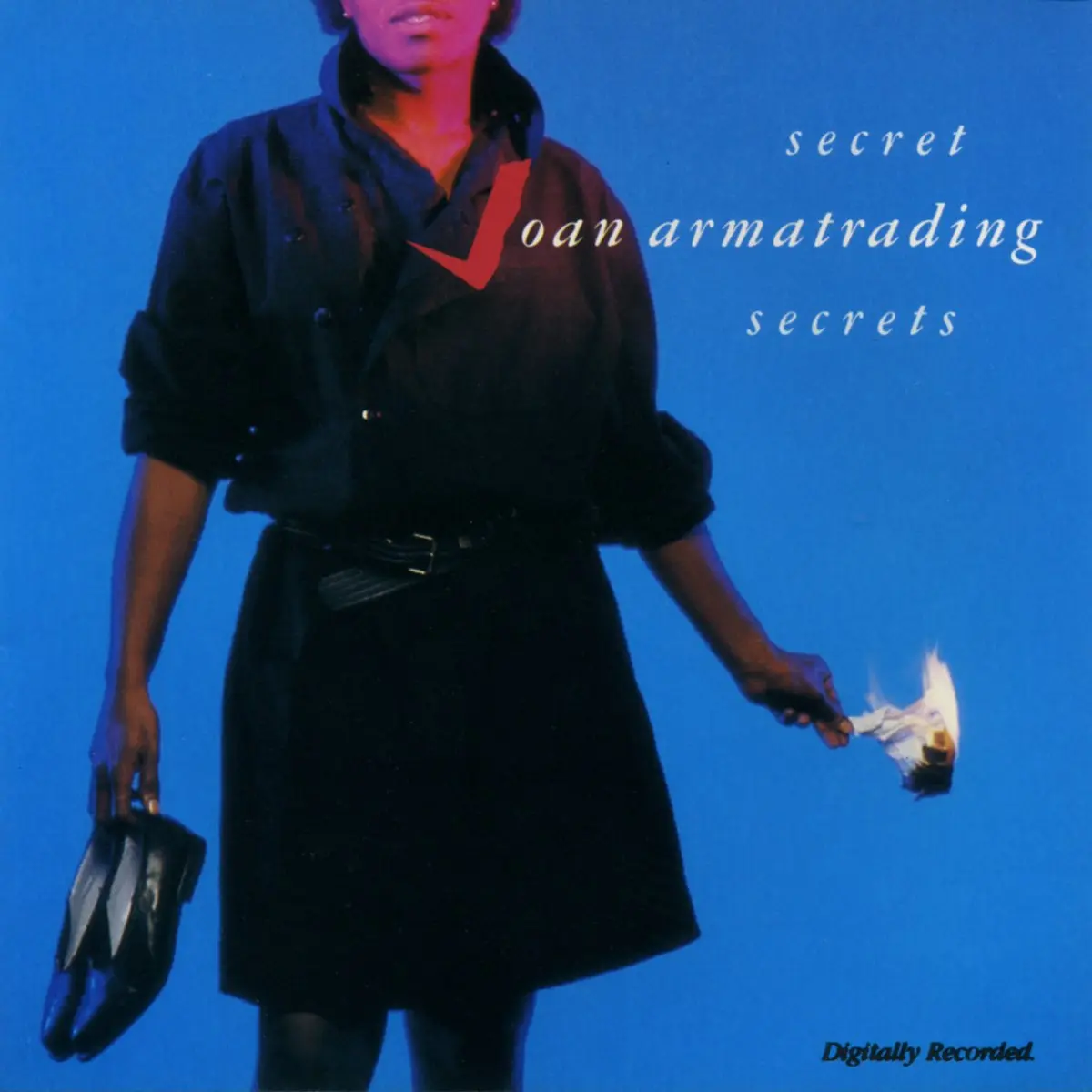 Joan Armatrading released her ninth studio album, Secret Secrets, on February 4, 1985, on A&M.
This album marked her final collaboration with an outside producer, Mike Howlett, and embraced crystalline modern pop. Armatrading fused her arrangements with the sonic textures of Howlett’s recent synth-based clients. The album highlighted her ongoing lyrical range, from personal introspection to socio-emotional commentary.
Armatrading sings and plays acoustic guitar and harmonica. Joe Jackson guests on piano for “Love by You.” Guitarists David Rhodes and Alan Murphy split rhythm and lead duties. Pino Palladino provides fretless bass throughout. Keyboards and synths are handled by Nick Plytas and Adrian Lee. The brass section includes David Bitelli (sax), Steve Sidwell and Paul Spong (trumpets), Rick Taylor (trombone), and Raul D’Oliveira (flugelhorn). Mel Gaynor plays drums and timpani.
Armatrading wrote and arranged all ten songs. Her lyrics probe love, loneliness, self-control, and the tension between intimacy and distance. Several songs explore conflict indirectly, focusing instead on desire, resilience, or emotional resilience. Stylistically, the material ranges from brass-driven pop to slow ballads and brooding hybrids.
“Persona Grata” builds gradually with rhythm guitar and melodic brass under a vocal that modulates between half-sung lines and sustained refrains. “Temptation” overlays synth stabs and choral phrasing with syncopated trumpet breaks. “Talking to the Wall” spaces its jazz chords around Joe Jackson’s piano part and subdued brass interjections. “Moves” features a rare blues harmonica solo by Armatrading and a double-pulse rhythmic structure.
“Love by You” reduces instrumentation to piano and voice, expanding only on chorus cadences. “Thinking Man” juxtaposes lyrical frustration with descending bass runs and bright horn jabs. “Secret Secrets” swings on staggered phrases and tight horn breaks, while “Strange” ends the album with echo-laced vocals over sparse harmonic changes.
A1. “Persona Grata” (4:44) — arranges brass, rhythm guitar, and vocals into a stately dramatic arc
A2. “Temptation” (4:03) — uses sharp horn bursts and synth overlays to elevate clipped refrains
A3. “Moves” (4:12) — pairs blues harmonica and syncopated rhythm in one of Armatrading’s few harmonica-led tracks
A4. “Talking to the Wall” (4:31) — centers Joe Jackson’s piano with layered horns and a romantic slow-jazz phrasing
A5. “Love by You” (3:13) — sparse ballad of vulnerability, backed only by Jackson’s piano
B1. “Thinking Man” (4:05) — charts emotional resistance with trumpet accents and descending lines
B2. “Friends Not Lovers” (4:00)
B3. “One Night” (4:59)
B4. “Secret Secrets” (3:28) — tight vocal phrasing framed by punk-tinged guitar and a clipped brass chart
B5. “Strange” (3:52) — closes the album with ambient harmonics and suspended phrasing
Sessions occurred in 1984 at Battery Studios (formerly Morgan Studios) in London with producer Mike Howlett and engineer Bryan “Chuck” New.
The album’s cover was photographed by Robert Mapplethorpe, marking the first time Armatrading appeared on an album cover in a dress. Design was by Moira Bogue under art director Michael Ross.
A&M released three singles: “Temptation” (b/w “Talking to the Wall”), which peaked at No. 65 UK; “Thinking Man” (b/w “Love Grows”), which charted in Australia; and “Love by You” (b/w “Read It Write”), a UK-only release featuring Joe Jackson on piano.
Sleight of Hand
 Joan Armatrading released her tenth studio album, Sleight of Hand, on May 12, 1986, on A&M.
This album marked Armatrading’s first full venture into self-production, recorded at her newly built Bumpkin Studio in Surrey. Sleight of Hand alternates between hard-edged pop rock and intimate balladry, with leaner production and a more focused palette than her previous three albums.
Armatrading plays all electric and acoustic guitars as well as harmonica and vocals. Her core band includes keyboardist Alex White, bassist Steve Greetham, and drummer Geoff Dugmore, all veterans of her Secret Secrets tour. Mel Gaynor plays drums on “Kind Words (And a Real Good Heart),” with Ray Cooper on percussion. Wesley Magoogan adds saxophone to select tracks, while Eddie Golga plays guitar on “Laurel and the Rose.” Jim Ross provides backing vocals. Steve Lillywhite mixed the album.
Armatrading wrote and arranged all ten tracks. Lyrically, she oscillates between romantic vulnerability and assertive detachment. She draws on themes of betrayal (“Kind Words”), romantic idealism (“Don Juan”), inner turmoil (“Russian Roulette”), and quiet resignation (“Jesse”). The sound alternates between stripped-down, tension-building ballads and clipped, rhythm-forward uptempo tracks. Synths and percussion serve as atmospheric elements rather than leading textures.
“Kind Words (And a Real Good Heart)” opens with pulsing bass, clipped phrasing, and dynamic drum breaks. “Killing Time” follows with stacked rhythm guitar, syncopated accents, and a compressed vocal motif. “Laurel and the Rose” overlays fingerpicked electric guitar with floating pads and modal vocal shifts. “One More Chance” paces slow harmonic changes against open snare punctuation, while “Don Juan” frames a descending vocal line around minimalist accompaniment.
“Russian Roulette” centers on a spiraling harmonic loop with staggered phrasing and dynamic modulation. “Figure of Speech” uses tight call-and-response interplay, while “Angel Man” balances jagged guitar with lyrical abstraction. “Jesse” and “Reach Out” provide opposing closers — one subdued and inward, the other rhythmically declarative.
A1. “Kind Words (And a Real Good Heart)” (3:46) — opens with clipped guitar bursts, pounding drums, and sharp vocal refrains
A2. “Killing Time” (3:54) — layers electric rhythm lines under percussive phrasing and repeated guitar interjections
A3. “Reach Out” (4:15) — channels 1960s soul cadence into a tightly patterned rhythm song
A4. “Angel Man” (3:41) — shifts between clipped verses and open refrains over syncopated drums
A5. “Laurel and the Rose” (3:46) — features interwoven guitar and ambient layers under a rising chorus line
B1. “One More Chance” (5:14) — unfolds across slow chord changes with carefully placed snare punctuation
B2. “Russian Roulette” (4:33) — spirals around a circular guitar motif and dynamic phrasing
B3. “Jesse” (3:26) — balances sparse guitar and voice in a restrained arrangement
B4. “Figure of Speech” (3:25) — stacks rhythmic guitar phrases around a clipped vocal cadence
B5. “Don Juan” (5:14) — resolves around descending lines with slow vocal pacing and soft layering
Sessions occurred from November 1985 to March 1986 at Bumpkin Studio in Surrey, with Joan Armatrading producing and Mark Wallis engineering. Steve Lillywhite handled mixing.
The cover features photography by Snowdon. Design credits are unlisted.
A&M issued three singles: “Kind Words (And a Real Good Heart)” (b/w “Figure of Speech”), which reached No. 81 UK and No. 37 US Mainstream Rock; “Reach Out” (b/w “The River’s on Fire”), which charted on UK airplay; and “Jesse” (b/w “The River’s on Fire”). “Reach Out” was performed live with an all-star band at the Prince’s Trust 10th Anniversary Concert.
The Shouting Stage
 Joan Armatrading released her eleventh studio album, The Shouting Stage, on June 28, 1988, on A&M.
Her eleventh studio album marked a return to minimal production and an introspective songwriting focus after the heavier textures of Sleight of Hand. Armatrading once again produced the album herself at her Bumpkin Studio, allowing for greater deliberation in arrangement and instrumentation. The result is a spare but precise collection of songs that revisit her recurring themes of emotional distance, romantic conflict, and quiet resilience, with instrumentation shaped around mood and lyric over musical excess.
Armatrading sings and plays guitar throughout, including solos on “The Devil I Know” and “Straight Talk.” The backing players include several returning collaborators: guitarist Phil Palmer, saxophonist Wesley Magoogan, and bassist Pino Palladino. Drums are split between Dave Mattacks, Jamie Lane, Mark Brzezicki, and Manu Katché. Dire Straits members Mark Knopfler and Alan Clark contribute guitar and keyboards respectively on select tracks. Bob Noble and Jody Linscott return from earlier sessions on keys and percussion. Notably, David Rhodes of Peter Gabriel’s band adds backing vocals.
Most of the songs explore psychological friction and unresolved tension, often from a first-person or observational perspective. “The Devil I Know” addresses romantic mistrust using Armatrading’s own name—her only lyric to do so. “The Shouting Stage” references a metaphorical impasse in relationships, inspired by both personal observation and a magazine article. “Did I Make You Up” incorporates a choppy riff suggested by Knopfler, while “Living for You” adapts to a rhythm-box idea proposed by drummer Jamie Lane. The album’s slower cuts—including “Dark Truths,” “All a Woman Needs,” and “Stronger Love”—deal in quiet moments of pain, hope, and equivocation, with string pads and spare harmonic phrasing.
A1. “The Devil I Know” (4:13) — self-referential lyric set to a rolling groove and electric guitar solo
A2. “Living for You” (4:14) — horn-accented mid-tempo track with a relaxed groove and steel-drum synth textures
A3. “Did I Make You Up” (3:45) — based on Mark Knopfler’s riff, uses sharp rhythm guitar over a 6/8 pulse
A4. “Stronger Love” (5:07) — ballad with string pads and vocal harmonies layered over a slow harmonic build
A5. “The Shouting Stage” (5:27) — centerpiece song with open voicing, clipped phrasing, and an unfolding lyrical narrative
B1. “Words” (3:46)
B2. “Innocent Request” (3:08) — (included on CD editions)
B3. “Straight Talk” (4:02) — Armatrading guitar solo punctuates clipped vocal lines and sparse groove
B4. “Watch Your Step” (3:58)
B5. “All a Woman Needs” (5:01) — slow, sustained chord sequence under a narrative vocal arc
B6. “Dark Truths” (2:09) — brief closer with layered synthesizer textures and reflective lyric phrasing
Sessions took place between September 1987 and May 1988 at Bumpkin Studio, with final mixing by Joan Armatrading and Graham Dickson at Olympic Studios.
The artwork was designed by Sarah Southin with cover art by David Band and photography by Andrew Catlin.
A&M issued three singles: “The Shouting Stage” (b/w “I Really Must Be Going”), which peaked at No. 89 UK; “Living for You” (b/w “Innocent Request”), which reached No. 98 UK and No. 30 on the US Modern Rock chart; and “Stronger Love,” which did not chart.
Armatrading supported the album with a UK and European tour, including a filmed performance at Hammersmith Odeon.
Hearts and Flowers
 Joan Armatrading released her twelfth studio album, Hearts and Flowers, on June 4, 1990, on A&M.
Flowers finds Armatrading returning to themes of emotional resolve and intimate vulnerability, echoing her early albums Whatever’s for Us and Back to the Night. The tone oscillates between gospel resolve, quiet tension, and blues inflection, anchored by stripped-down arrangements and a renewed focus on solo instrumentation.
Armatrading performs most of the guitars and vocals herself and plays all instruments on two tracks. Don Freeman adds keyboards across much of the album, supported by a rotating rhythm section that includes bassist Mick Karn and drummer Steve Jansen, both known for their work in Japan. Pino Palladino and Manu Katché handle rhythm duties on select tracks. Dave Koz and Andy Sheppard provide sax solos on “Free” and “Something in the Air Tonight,” respectively.
The album explores shifting emotional terrain through compact arrangements that emphasize phrasing, tone, and lyrical insight. “More Than One Kind of Love” builds slowly around a circular keyboard motif, reinforced by Karn’s fretless counterpoint and Ramzy’s shaker rhythms. “Hearts and Flowers” strips the instrumentation to solo guitar and voice, allowing the phrasing to carry unresolved tension. “Promise Land” unfolds in short vocal cycles over a softly lurching rhythm section.
“Free” layers gospel cadences with a sharp sax solo, while “Something in the Air Tonight” contrasts Armatrading’s restrained vocal with an airy, syncopated reed line. “Good Times” invokes the stomp of earlier blues-rooted material but filtered through a tighter rhythmic grid. The final track, “The Power of Dreams,” offers a quietly optimistic close with steady hi-hat emphasis and light chord phrasing.
A1. “More than One Kind of Love” (5:32) — A warning to those who discard friendships in the glow of new romance; emphasizes companionship as a sustaining force: “Good friendships seldom die”.
A2. “Hearts and Flowers” (3:40) — Armatrading plays all instruments on this stripped-back song, which meditates on romantic disillusion and self-reliance.
A3. “Promise Land” (4:00)
A4. “Someone’s in the Background” (3:55)
A5. “Can’t Let Go” (4:36) — Solo Armatrading performance; a plea against emotional drift in a relationship beginning to wane.
B1. “Free” (3:20) — Draws from gospel form to express release from emotional restraint; features a driving sax solo by Dave Koz.
B2. “Something in the Air Tonight” (4:32) — Features a jazzy sax solo by Andy Sheppard; addresses romantic miscommunication with a fragile vocal tone.
B3. “Always” (1:56)
B4. “Good Times” (4:23) — Revisits the tough blues style of “Mean Old Man” from Whatever’s for Us, with a raw rhythmic pulse and clipped phrasing.
B5. “The Power of Dreams” (3:08)
Armatrading recorded Hearts and Flowers at her home studio, Bumpkin, and enlisted Tom Lord-Alge to mix the album at The Grey Room in Los Angeles with assistant engineer Micajah Ryan. Ted Jensen mastered the final version at Sterling Sound in New York. Graham Dickson engineered the sessions.
Stylorouge directed the album’s visual presentation, collaborating with Jeremy Pearce on art direction and handling the final design. Richard Haughton shot the cover and promotional photographs.
Armatrading issued “More Than One Kind of Love” as the lead single on May 7, 1990, backed with a live version of “Love and Affection” recorded at Hammersmith. The CD and 12-inch versions added a second live track, “I’m Lucky,” and the album cut “Good Times.” She promoted the single with televised appearances on Wogan (May 11) and TV-am (May 16), while the accompanying video aired on Record Guide and BET in the US. The single reached number 75 in the UK, marking her first chart entry there in five years. A second single, “Free,” followed but failed to chart.
Between June and August 1990, Armatrading toured the UK and US in support of the album, including a three-night run at the Beacon Theatre in New York and two nights at the Wiltern Theatre in Los Angeles. She cancelled scheduled concerts in Sydney and Melbourne on medical advice.
Hearts and Flowers reached No. 29 on the UK Albums Chart and No. 56 in Australia.
Discography:
- Whatever’s for Us (1972)
- Back to the Night (1975)
- Joan Armatrading (1976)
- Show Some Emotion (1977)
- To the Limit (1978)
- Steppin’ Out (live, 1979)
- Me Myself I (1980)
- Walk Under Ladders (1981)
- The Key (1983)
- Secret Secrets (1985)
- Sleight of Hand (1986)
- The Shouting Stage (1988)
- Hearts and Flowers (1990)
Sources:
Artist/Album Pages:
Cheryl Dilcher (1949–2005) was an American singer/songwriter who emerged with the 1970 Ampex relea...
The 20th Century Steel Band was a Trinidadian calypso-funk ensemble behind the 1976/77 albums Yell...
Earl Rodney is a Trinidadian calypso vocalist, bassist, and steel-pan drummer who was primarily ac...
Melissa Manchester is an American singer–songwriter who released two 1973–74 albums on Bell Record...
Chris Rea is an English singer, guitarist, and songwriter who released nine albums between 1978 an...
Carita Holmström is a Finnish singer/songwriter who made the 1973/74 EMI albums We Are What We Do ...
Michael Franks (born Sept. 18, 1944) is an American singer/songwriter who released eleven studio a...
Al Stewart is a Scottish singer/songwriter who emerged from the British folk boom of the mid-1960s. ...
Mossy Davidson (aka Mairiis Kilcher) is an American singer/songwriter and multi-instrumentalist fr...
Peter Allen — aka Peter Richard Woolnough (Feb. 10, 1944 — June 8, 1992) — was an Australian pianist...
John Kongos (b. 1945) is a South African pop/rock musician, vocalist, and songwriter who was activ...
Claire Hamill is an English singer–songwriter who debuted at seventeen with the 1971 Island releas...