

Bonfire was the Dutch avant-garde jazz-rock band behind the 1975 EMI album Bonfire Goes Bananas.
Members: Cees Meerman (drums), Eugene den Hoed (guitar, flute), Kees den Hoed (bass), Frank Witte (organ, piano, flute)
Background
Bonfire formed in 1974 in Bergen op Zoom, Noord-Brabant, as an instrumental jazz-rock quartet. The lineup comprised keyboardist Frank Witte (Fender Rhodes, grand piano, vibraphone, recorders), guitarist Eugène den Hoed (guitar, flute), bassist Kees den Hoed (bass, gong), and drummer Cees Meerman.
Witte was born in Amsterdam in 1951 and studied at a conservatory. He played organ in Labyrinth, a Bergen op Zoom group active from 1968 to 1970 with progressive pop and jazz repertory. Eugène den Hoed was born in 1946 and took early guitar lessons from Tjaard Olthuis at the Municipal School of Music in Bergen op Zoom. He continued at the Brabants Conservatorium with Jan Goudswaard and Balthazar Benitez and completed the program in the year of the Bonfire album.
Kees den Hoed was born Dionisius Cornelis den Hoed in 1952 in Bergen op Zoom, the younger of two sons in a musical household. His father played trombone and directed The Goldstars and the Ambassadors/Bill Bounders Big Band. Den Hoed received a bass guitar from his father at age fourteen and taught himself the instrument. At seventeen, he played bass in Labyrint, then worked from 1970 to 1972 in Road.
Cees Meerman was born in Vlissingen and later lived in Goes. He began his drum career in 1970 with Amsterdam groups Bismarck and World, then played in Temple and Smyle before Bonfire. Eugène den Hoed came from the West Brabant groups The Sparks and Clover Leaf before he joined Road in 1971.
The den Hoed brothers had shared Road before Bonfire. In 1971, Road contacted JR Productions in Roosendaal and reached the Veronica Top 40 with “Never Leave Me Lonely.” After Road ended, Eugène and Kees den Hoed joined Jan Blok & The Blockheads and then appeared in Lois Malone and Vuurstaal.
Bonfire Goes Bananas
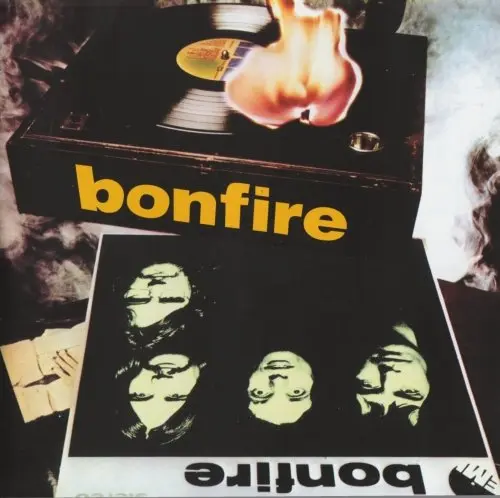 Bonfire released their singular album, Bonfire Goes Bananas, in 1975 on EMI.
The album contains six instrumental pieces: five compact Side A titles and the five-part Side B suite “The Sage of the Running Nose.” Bonfire recorded the album as a quartet with multi-instrumentalist Frank Witte (keyboards, vibraphone, grand piano, recorder), bassist Kees den Hoed, multi-instrumentalist Eugène den Hoed (guitar, flute), and drummer Cees Meerman.
“Delirium” jolts from odd opening sounds into a fast instrumental charge, with quick section shifts and a hard-edged guitar break. “Contrast” glides through a softer opening figure, then pivots between brighter uptempo passages and later vocalized lines. “Vuurstaal Part II” curls piano-led cadence into airy flute phrases before the lead line turns more pointed. “Chinese in Europe Part I” darts from a divided main riff into softer interludes, female vocal tones, and a compact closing passage. “Circle” settles into sparse keyboard space before intricate rhythm changes and a sharper solo break lift the second half.
“The Sage of the Running Nose” reprises its opening march material through the “Running Nose” sections, folds “Cabaret” into calmer chamber-like passages, and lets “Third Eye” stretch the long-form center through shifting lead roles and repeated piano figures.
A1. “Delirium” (3:08)
A2. “Contrast” (5:05)
A3. “Vuurstaal Part II” (3:10)
A4. “Chinese in Europe Part I” (3:13)
A5. “Circle” (6:13)
B. “The Sage of the Running Nose” (14:51)
— a. “Running Nose” (2:05)
— b. “Cabaret” (2:30)
— c. “Third Eye” (6:15)
— d. “Cabaret Again” (2:46)
— e. “Running Nose II” (1:15)
Bonfire recorded Bonfire Goes Bananas between November 18 and December 5, 1974, at Morgan Studios in Brussels.
EMI lifted “Contrast” as a 1975 single (b/w “Circle”).
Discography:
- Bonfire Goes Bananas (1975)
Sources:
Artist/Album Pages:
Andraé Crouch & The Disciples were an American soul-gospel group that released seven albums o...
Michelle Phillips (born June 4, 1944) is an American singer and actress from Long Beach, Californi...
Miroslav Vitous (born Dec. 6 1947) is a Czech jazz-rock bassist, active on the international scene...
Mr Brown was a Swedish symphonic/folk-rock band behind the 1977 album Mellan Tre Ögon on FLY KHAN....
Seikatsu Kojyo Iinkai (生活向上委員会) was a Japanese free-jazz collective formed by reedist Kazutoki Ume...
Jimmy McGriff (April 3, 1936 — May 24, 2008) was an American soul-jazz/funk organist who helped d...
Karin Krog is a Norwegian jazz singer from Oslo who made her recording debut on Metropol Jazz in 1...
Moacir Santos (April 8, 1924 — August 6, 2006) was a Brazilian composer, saxophonist, arranger, an...
Zerosen was a Japanese jazz-funk/soul band that released the 1976/77 Victor albums Asphalt and Sun...
Rough Diamond was an English hard-rock band that released a self-titled album in 1977 on Island Reco...
Moxy was a Canadian hard-rock band that released four albums between 1975 and 1978 on Polydor|Merc...
Conventum was a Québécois avant/symphonic-folk band that released the 1977–79 albums À l'affût d'u...