

Afterglow was an American psych-rock band from Chico, California, that released a self-titled album on MTA Records in 1968.
Members: Larry Alexander (drums), Ron George (bass guitar), Gene Resler (vocals), Roger Swanson (keyboards), Tony Tecumseh (guitar)
Background
Afterglow evolved from the Medallions, a garage-beat combo formed in 1965 by guitarist Tony Tecumseh, drummer Larry Alexander, and bassist Mike, all students at Chico State. They later enlisted vocalist Gene Resler, a music major at nearby Oregon State University. After a brief run of local gigs, the band disbanded for college.
In 1966, Tecumseh, Alexander, and Resler regrouped with Oregon State classmates Ron George (bass) and Roger Swanson (organ). The new five-piece rehearsed and wrote original material in Corvallis before entering Golden State Recorders in San Francisco with engineer–producer Leo Kulka.
Afterglow (the album)
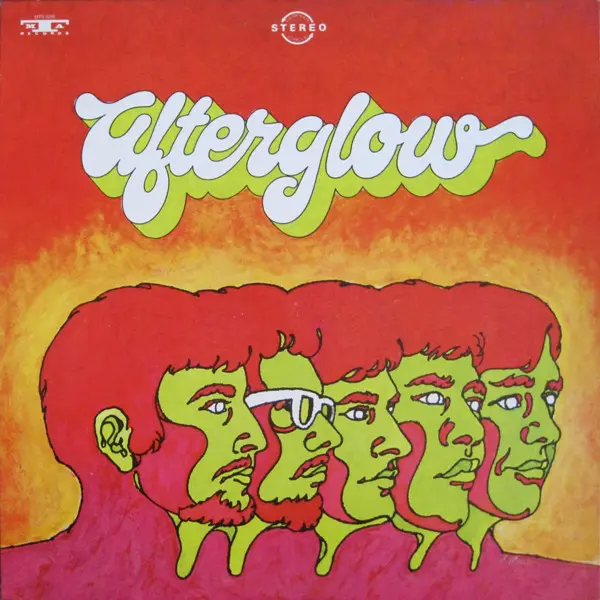 Afterglow appeared in October 1968 on the New York-based MTA label. Tecumseh wrote all but two songs, with vocals mostly handled by Resler.
The album presents concise organ-led tracks defined by the bright, effusive tone of Swanson’s Farfisa. Alexander’s crisp snare patterns and George’s taut, minimal basslines anchor the arrangements.
Tracks like “Morning,” “Dream Away,” and “Chasing Rainbows” proceed at brisk tempos with winding vocal contours and sudden harmonic turns. “Susie’s Gone,” the lone outside contribution, veers into experimental psychedelia with fragmented pacing and vocal detachment.
A1. “Riding Home Again” (2:29) – Midtempo opener with brushed snares and echo-laden vocals that dissolve into a repeating figure.
A2. “Morning” (2:02) – Circular Farfisa riffing and tiered vocal lines carried by steady ride cymbal work.
A3. “Dream Away” (2:29) – Sharp key changes offset by wistful keyboard phrasing and staccato bass.
A4. “Susie’s Gone” (2:28) – Off-kilter pacing and spoken-word delivery underlaid by slow pulse and phased organ swells.
A5. “It’s a Wonder” (2:18) – Pacing alternates between stop-start verses and flowing refrains with descending progressions.
A6. “Afternoon” (1:50) – Brief vignette with minor-chord voicings and loopy organ loops over a brushed shuffle.
B1. “Meadowland of Love” (2:17) – Arcing vocal melody and drone organ lines on a steady downbeat.
B2. “Love” (2:57) – Downtempo track with staggered phrasing and light modulations in keyboard voicing.
B3. “Chasing Rainbows” (1:48) – Bouncy two-chord motif and clipped vocal cadence underpinned by rolling toms.
B4. “Mend This Heart of Mine” (2:32) – Resler-penned ballad with elongated phrasing and off-beat rhythmic placement.
B5. “By My Side” (1:52) – Closing number with upward progressions and clustered vocal inflections over a snapping backbeat.
The album’s cover presents a psychedelic rendering of Afterglow’s head-to-head profile promo shot, rendered on the backside as a line sketch. Designer Jack Martin illustrated the image for the Patterson & Hall graphics firm: the team behind 1968 covers for The Maze and fellow Oregon psychsters Neighb’rhood Childr’n and The Other Half.
Postlude
Ron George later played in Steals, the backing band of Armand Schaubroeck, a Sixties teenage convict turned Seventies shock-rock performance artist. Larry Alexander co-engineered Janis Ian’s 1975 comeback album Between the Lines and played percussion on the opening track, “When the Party’s Over.” Gene Resler issued a solo single, “Only Love” (b/w “Soon I’ll Be There”), in 1979.
Discography:
- Afterglow (1968)
Sources:
Artist/Album Pages:
Trust In Men Everywhere, commonly billed under the acronymic moniker T.I.M.E., was an American ps...
Mánar was an Icelandic post-psych band that released two singles and a 1971 self-titled album. M...
Bloodstone was an American soul-psych group from Kansas City that released eight albums on Decca/L...
Zoo was a French brass-rock band that released three albums between 1969 and 1972 on Riviera. M...
David Essex (born July 23, 1947) is an English vocalist, songwriter, and actor who first recorded a ...
Pirana was an Australian Latin jam-rock band from Sydney that released the 1971–72 albums Pirana and...
Boscoe was an American soul-funk band from Chicago that released a self-titled album on Kingdom of...
Baby Huey (1944–1970) was an American soul singer who recorded an album in 1970 just prior to his ...
Al Kooper (born Feb. 5, 1944) is an American musician, producer, and composer from Brooklyn who emer...
De De Lind was an Italian post-psych/symphonic band that cut three singles and a 1972 album on Mer...
Lonnie Smith (July 3, 1942 – September 28, 2021) was an American soul-jazz/funk organist. He emer...
The Pretty Things were an English rock band, originally formed in 1963 by guitarist/vocalist Dick Ta...