

Larry Ridley (born Sept. 3, 1937) is an American jazz bassist from Indianapolis who released the album Sum of the Parts on Strata-East in 1975.
Background
Larry Ridley was born September 3, 1937, in Indianapolis and began violin lessons at age five with Ruth McArthur, whose school supported African American students amid segregation. Early classical training laid a foundation for Ridley’s musical development. He encountered jazz and blues through Ben Hollman and studied bass with Monk Montgomery, gaining early exposure to jazz forms that shaped his improvisational skills.
After Shortridge High, Ridley enrolled at Indiana University in 1955 on a violin scholarship, performing with the David Baker Band, the symphony, and student jazz groups. He practiced regularly with peers and learned from visiting European-trained musicians. In 1957 he formed the Jazz Contemporaries with Freddie Hubbard and others, performing six nights a week.
Ridley held annual tribute concerts at the Schomburg Center for Duke Pearson, Sonny Clark, and Kenny Drew, combining performance and education to honor their legacies and preserve African American jazz history.
Early Credits
By the early 1960s, Ridley relocated to New York City, integrating into the professional jazz scene. He quickly became a sought-after bassist, appearing on sessions with Freddie Hubbard (Hub Cap, 1961; Blue Spirits, 1965; The Night of the Cookers, 1965), Jackie McLean (Destination… Out!, 1963; Jacknife, 1965), Hank Mobley (Dippin’, 1965), Lee Morgan (Cornbread, 1965), Horace Silver (The Jody Grind, 1966), Roy Haynes (Cracklin’, 1963; Cymbalism, 1963), and Slide Hampton (Somethin’ Sanctified, 1960).
Additional credits included work with Bill Barron (Hot Line, 1962), Al Cohn (Play It Now, 1975), Red Garland (The Nearness of You, 1961), Dexter Gordon (The Panther!, 1970), Stéphane Grappelli and Joe Venuti (Venupelli Blues, 1969), Bunky Green (My Babe, 1960), Wes Montgomery and Wynton Kelly (Maximum Swing: The Unissued 1965 Half Note Recordings), and James Moody (Feelin’ It Together, 1973). He also held positions with Duke Ellington and Thelonious Monk, expanding his versatility across styles and ensembles.
In 1971 he joined Rutgers University as a professor, helping establish the jazz faculty and Institute for Jazz Studies. He recruited top jazz musicians as instructors and emphasized jazz’s spiritual and African American roots in the curriculum. Ridley earned a Bachelor’s in Music Education from NYU, a Master’s in Cultural Policy at Empire State College, and a Doctor of Performing Arts at University of Maryland Eastern Shore. He stressed humility, storytelling, and spiritual expression as central to jazz performance and pedagogy.
Sum of the Parts
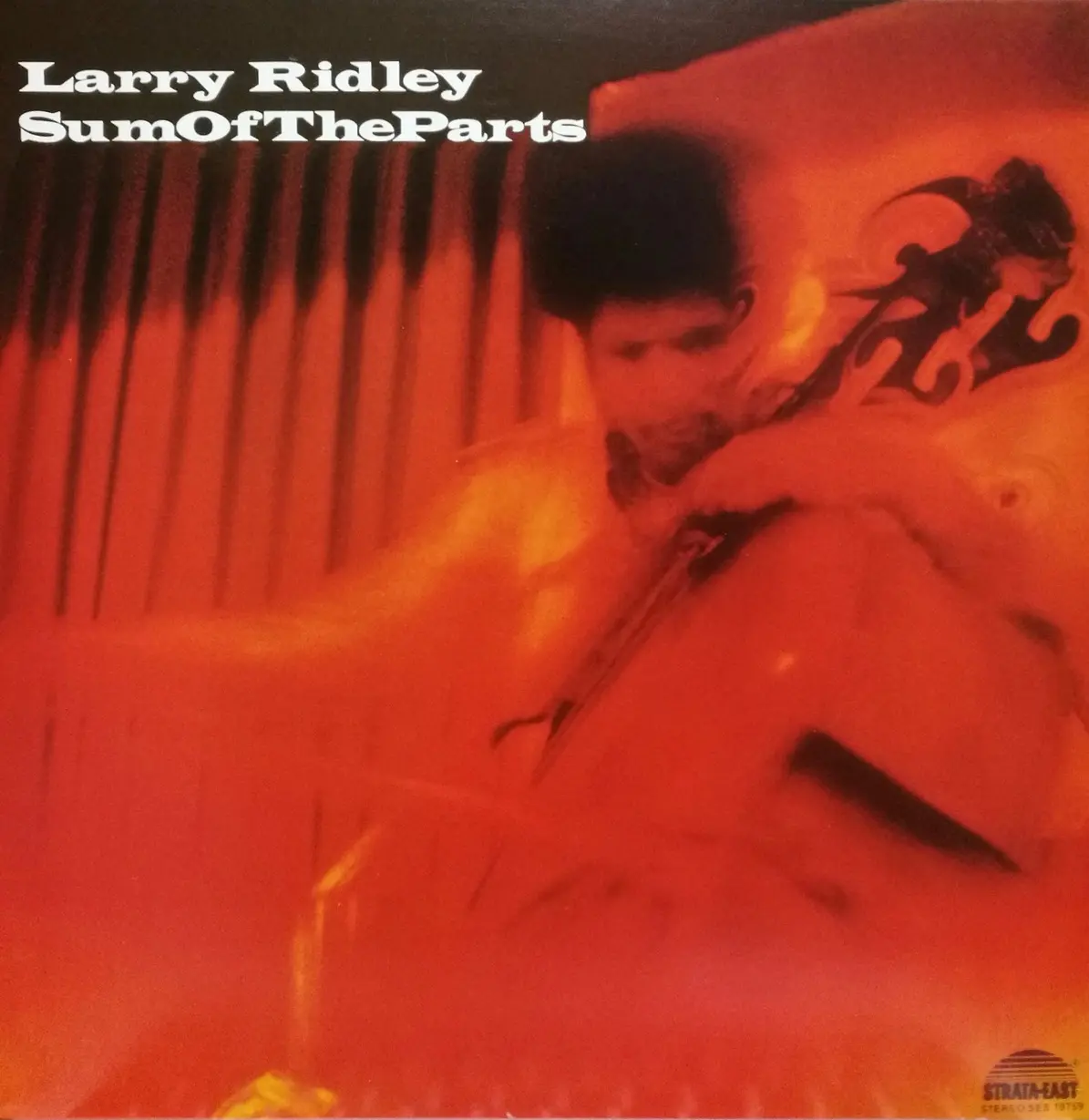 Larry Ridley released his first bandleader album, Sum of the Parts, in late 1975 on Strata-East.
The album blends acoustic and electric bass-led arrangements with understated Latin, funk, and blues textures. Ridley emphasizes spacious, empathetic interplay with low-density arrangements. Keyboardist Onaje Allan Gumbs shapes the harmonic and textural framework with an arsenal comprised of piano, electric piano, clavinet, and string synthesizer.
Ridley wrote “Indiana Avenue” while Gumbs contributed “Changa Chikuyo.” The remaining tracks are interpretations of works by Ervin Drake (“It Was a Very Good Year”), Thelonious Monk (“Well You Needn’t”), Louis Armstrong (“Go Down Moses”), Kenny Altman (“Feelin’ Blue”), Duke Ellington (“In a Sentimental Mood”), and Clifton Davis (“Never Can Say Goodbye”).
“Changa Chikuyo” opens with Latin-Funk rhythms and electric piano colors, while “Indiana Avenue” delivers Ridley’s soulful blues. Monk’s “Well You Needn’t” receives a sparse, electric-bass-driven funk treatment, and “Feelin’ Blue” combines soprano sax and subtle string synthesizer. Two solo bass performances—“Go Down Moses” with four overdubbed bass tracks, and Ellington’s “In a Sentimental Mood” pizzicato—highlight Ridley’s melodic and textural range. Standards such as “It Was a Very Good Year” and “Never Can Say Goodbye” are reimagined with bowed or plucked bass and complementary ensemble textures.
Ridley arranged the material, supported by Gumbs, guitarist Cornell Dupree, drummer Grady Tate, percussionist Errol “Crusher” Bennett, and reedist Sonny Fortune, who plays flute, alto and spoprano saxophone.
A1. “Changa Chikuyo” (4:02)
A2. “It Was a Very Good Year” (5:34)
A3. “Well You Needn’t” (8:18)
A4. “Go Down Moses” (1:16)
B1. “Feelin’ Blue” (5:53)
B2. “Indiana Avenue” (5:47)
B3. “In a Sentimental Mood” (2:16)
B4. “Never Can Say Goodbye” (7:46)
Sessions occurred June 9, 10, 11, and 30, 1975 at Generation Sound Studios, New York City, with producer Elliot Meadow and engineer Tony May. The cover design and red-lit photography were by Art Krasinsky.
Fortune made his recent bandleader debut with the 1974 Strata-East title Long Before Our Mothers Cried. Grumbs played on 1973/74 albums by Birthright, Carlos Garnett, Cecil McBee, Charles Sullivan, and Norman Connors. Dupree appeared on twenty-one albums in 1975 alone, including titles by Joe Cocker, Kimiko Kasai, Margie Joseph, Zulema, and Rahsaan Roland Kirk.
Discography:
- Sum of the Parts (1975)
Sources:
Artist/Album Pages:
Lady Lake was a Dutch instrumental band that released the album No Pictures on Q Records in 1977. ...
Ayers Rock was an Australian jazz-rock band from Melbourne that released two albums on Mushroom: B...
Michael Farneti is an American singer, songwriter, and multi-instrumentalist from Palm Beach Shore...
Band X was an American jazz-rock/space-rock band from Massachusetts that released an album titled ...
Heikki Sarmanto is a Finnish jazz-rock pianist and composer who led the Serious Music Ensemble on ...
Donald Byrd (1932–2013) was an American post-bop trumpeter who apprenticed with the Jazz Messenger...
Jefferson Airplane was an American rock band from San Francisco that rose to fame during the counter...
Lucio Dalla (March 4, 1943 — March 1, 2012) was an Italian singer/songwriter with a career that sp...
Esther Phillips (Dec. 23, 1935 — Aug. 7, 1984) was an American soul singer from Galveston, Tex. A...
Taste was an Australian hard-rock band from Melbourne that debuted as Cloud Nine, then made the 1976...
Lesley Duncan (Aug. 12, 1943 — March 12, 2010) was an English singer/songwriter who made the 1971/...
Sahara was a German symphonic-rock band that evolved from Subject ESQ. As Sahara, they made the 19...