

The Smoke was an American pop-psych band from Los Angeles that released a 1968 self-titled album on Sidewalk/Capitol. WCPAEB co-founder Michael Lloyd masterminded the project and also produced October Country.
Members: Michael Lloyd (vocals, keyboards, guitar, bass, arrangements), Stan Ayeroff (guitar), Steve Baim (drums)
For the English mod/freakbeat band, click here.
Background
New York–born Michael Lloyd studied classical piano and guitar as a child before relocating to Beverly Hills, where he formed his first band while attending high school. By thirteen, he was composing, studying theory, and submitting demos to Los Angeles labels. At Tower Records, he connected with A&R man Eddie Ray, who paired him with Mike Curb; another source credits Kim Fowley, who had Lloyd under a publishing contract.
Lloyd recorded surf instrumentals with the New Dimensions—featuring future Three Dog Night keyboardist Jimmy Greenspoon—and then joined forces with Danny and Shaun Harris in the Laughing Wind. That group evolved into the West Coast Pop Art Experimental Band, a baroque-psych unit funded by TV personality Bob Markley. Lloyd played on their 1967 debut Part One, and later contributed to their 1969 release Where’s My Daddy?
During this period, he also arranged and produced Kim Fowley’s Love Is Alive and Well, worked on the psychedelic cult album by St. John Green, arranged October Country’s lone LP, and scored Steven Spielberg’s first film, Amblin’. With access to Curb’s Hollywood studio, Lloyd recorded The Smoke in 1967 with guitarist Stan Ayeroff and drummer Steve Baim, both of whom played in the studio group Max Frost & the Troopers. Curb greenlit Lloyd’s project for Sidewalk, a subsidiary of Capitol Records.
The Smoke (1968 album)
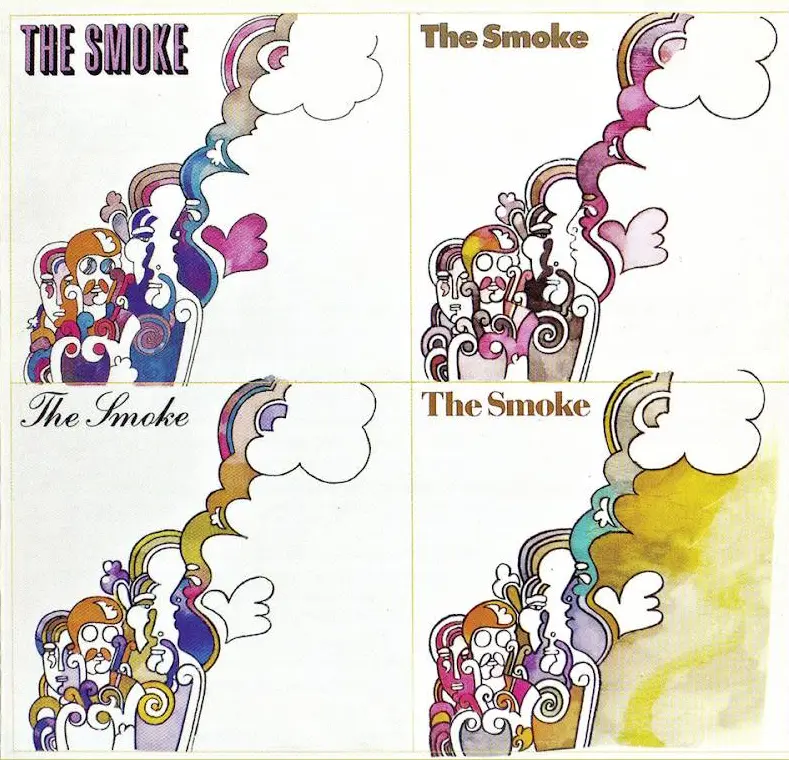 The Smoke released their self-titled album in April 1968 on Sidewalk.
The Smoke is a studio-based chamber-psych album conceived and largely executed by Michael Lloyd, who wrote or co-wrote all tracks and handled most instrumentation. The project includes guitarist Stan Ayeroff and drummer Steve Baim, with Lloyd crafting an interconnected set of brief, stylistically varied pieces framed by baroque instrumentation and abrupt sectional shifts. The album balances orchestral cues, transitional sketches, and theatrical passages with compressed psychedelic arrangements.
Across thirteen tracks, The Smoke juxtaposes tightly segmented chamber pop with dissonant brass, backward tape effects, and abrupt rhythmic detours. Harpsichord, strings, and compressed guitar tone figure prominently, while vocals remain subdued and evenly mixed. Recurring motifs—short piano intervals, orchestral punctuation, and shifting tempos—give the album a suite-like continuity. It stands as a self-contained document of post-Pet Sounds studio psych, filtered through Lloyd’s precise compositional control.
A1. “Cowboys and Indians” (2:37) – Alternates organ-heavy protest motifs with chamber-style phrasing.
A2. “Looking Thru the Mirror” (1:45) – Waltz-time reverie with minor-key transitions.
A3. “Self-Analysis” (2:47) – Bass-forward vignette with brass filigree and vocal restraint.
A4. “Gold Is the Colour of Thought” (3:07) – Expands from voice-and-strings to full orchestration with abrupt metric shifts.
A5. “The Hobbit Symphony” (4:05) – Multi-movement guitar-led passage with tonal departure from surrounding material.
A6. “The Daisy – Intermission” (0:23) – Solo piano link with unresolved cadence.
B1. “Fogbound” (2:22) – Mid-tempo track with fragmented phrases and wistful tone.
B2. “Song Thru Perception” (1:51) – Abstract intervals between brass and string lines.
B3. “Philosophy” (0:45) – Brief motif built on isolated string patterns.
B4. “Umbrella” (2:23) – Contoured phrasing and light rhythmic lilt.
B5. “Ritual Gypsy Music Opus 1” (0:15) – Fragmented transition piece.
B6. “October Country” (2:40) – Harpsichord-led remake of Lloyd’s earlier arrangement.
B7. “Odyssey” (3:40) – Multi-textural closer with eastern motif and layered resolution.
The album was produced and arranged by Michael Lloyd, who also contributed vocals, guitar, keyboards, and bass. Sessions took place in Hollywood under Sidewalk’s production wing, with string and brass parts arranged to Lloyd’s specifications. Capitol distributed the release and gave it modest promotional backing; the LP was issued in mono and stereo editions.
The Smoke appeared in a single sleeve with four-panel variations of a psychedelic band illustration, backed with photo-negatives of a group pic and liner notes by Kim Fowley. They dedicated the album to the late Stu Sutcliffe, who played bass in the 1960 Hamburg-era Beatles lineup.
In tandem with The Smoke, Lloyd produced versions of “October Country” and “Cowboys and Indians” with the band October Country for their 1968 album.
The Smoke marked a high point in Lloyd’s early studio career, preceding his re-involvement in the WCPAEB and later teen-pop projects. Though uncharted at release, the album has since drawn retrospective attention for its compositional precision and condensed execution, standing apart from more improvisational or effects-heavy psych of the period.
Postlude
In late 1969, Mike Curb became president of MGM Records and installed Lloyd, then twenty, as head of A&R. He signed and produced Lou Rawls’ A Natural Man and launched several studio projects, including the trio Cotton, Lloyd & Christian. He co-wrote and produced Japanese pop act Pink Lady’s U.S. debut, and later helmed Belinda Carlisle’s 1986 solo debut, Belinda.
Lloyd served as music supervisor for Dirty Dancing (1987), producing the Oscar- and Grammy-winning “(I’ve Had) The Time of My Life” along with Patrick Swayze’s hit ballad “She’s Like the Wind.”
Discography:
- The Smoke (1968)
Sources:
Artist/Album Pages:
Dreams were an American brass-rock band from New York that released the 1970–71 Columbia albums Dr...
Komintern was a French avant-psych/trad band behind the 1971 Harvest album Le Bal du Rat Mort. M...
John Edwards (December 25, 1944 — May 9, 2025) was an American soul singer from St. Louis who rele...
Paul Kelly (born June 19, 1940) is an American soul singer from Miami, best known for the 1970 hi...
Heads Hands & Feet were an English rustic-rock band that released three albums between 1971 an...
Donald Byrd (1932–2013) was an American post-bop trumpeter who apprenticed with the Jazz Messenger...
Black Sugar was a Peruvian Latin-funk band behind two albums in 1971/72 on Sono Radio. They evolved ...
Pete Brown & Piblokto! were an English post-psych band that released two albums on Harvest in 19...
Peter Ivers (September 20, 1946 — March 3, 1983) was an American musician and songwriter from Bos...
Yaqui was an American Latin-rock band from Los Angeles that released a 1973 self-titled album on ...
Dana Gillespie is an English singer and actress who made the 1968 album Foolish Seasons on London ...
Quincicasm was an English avant-garde jazz combo that made a self-titled album in 1973 on Saydisc...