

Magic Carpet was an English raga-folk combo from London that released a self-titled album on Mushroom in 1972. Glaswegian sitarist Clem Alford followed up the project with a 1974 solo album, Mirror Image: The Electronic Sitar of Clem Alford, on Columbia (EMI).
Members: Clem Alford (sitar, esraj, Indian tambura), Alisha Sufit (vocals, guitar), Jim Moyes (guitar), Keshav Sathe (tabla, percussion)
Background
Magic Carpet formed in London in 1971 when guitarist Jim Moyes recruited singer-guitarist Alisha Sufit to join Sargam members sitarist Clem Alford and tabla player Keshav Sathe.
Alford was born Oct. 2, 1945, in Glasgow and first studied bagpipes before he took up sitar in London under Manesh Chandra Kansara. The Glaswegian musician traveled overland to India in
1968 to study with Pandit Sachindranath Saha at Midnapore Music College in West Bengal. Keshav Sathe was born Jan. 31, 1928, in Bombay and began professional work in his home city with vocalist Kelkar. Sathe moved to Britain in 1956 and joined the Asian Music Circle run by Ayana Deva Angadi. The tabla player worked with Bhaskar Chandavarkar before he joined composer John Mayer and saxophonist Joe Harriott for the Indo-Jazz Fusions recordings of the 1960s.
Alisha Sufit was born in 1946 in Hampstead, London, and studied dance and drama at Arts Educational School before she pursued painting and etching at Chelsea College of Art. Sufit began singing and playing guitar after art school and performed original songs with acoustic guitar and Appalachian dulcimer in London clubs and colleges. She also busked at Portobello Road market and London Underground stations.
Alford formed Sargam in 1970 with guitarist Moyes and tabla player Sathe. The trio developed instrumental material around sitar, guitar, and tabla. The owner of Windmill Records invited Sargam to perform and recorded the group at the engagement. He issued the recordings as Pop Explosion Sitar Style! under the misspelled name Sagram. Mushroom owner Vic Keary subsequently offered Sargam an album project on condition that the trio add a singer.
Moyes contacted Sufit, whom he knew from art studies at Regent Street Polytechnic and Chelsea College of Art. Sufit joined with a repertory of songs written in open guitar tunings compatible with sitar tuning. Magic Carpet combined those songs with instrumental pieces developed by Sargam and introduced the quartet with a performance at the 100 Club in London. Keary recorded the self-titled debut over two or three days at Chalk Farm Studios in the winter of 1971–72 as all four members played together in the room.
Magic Carpet
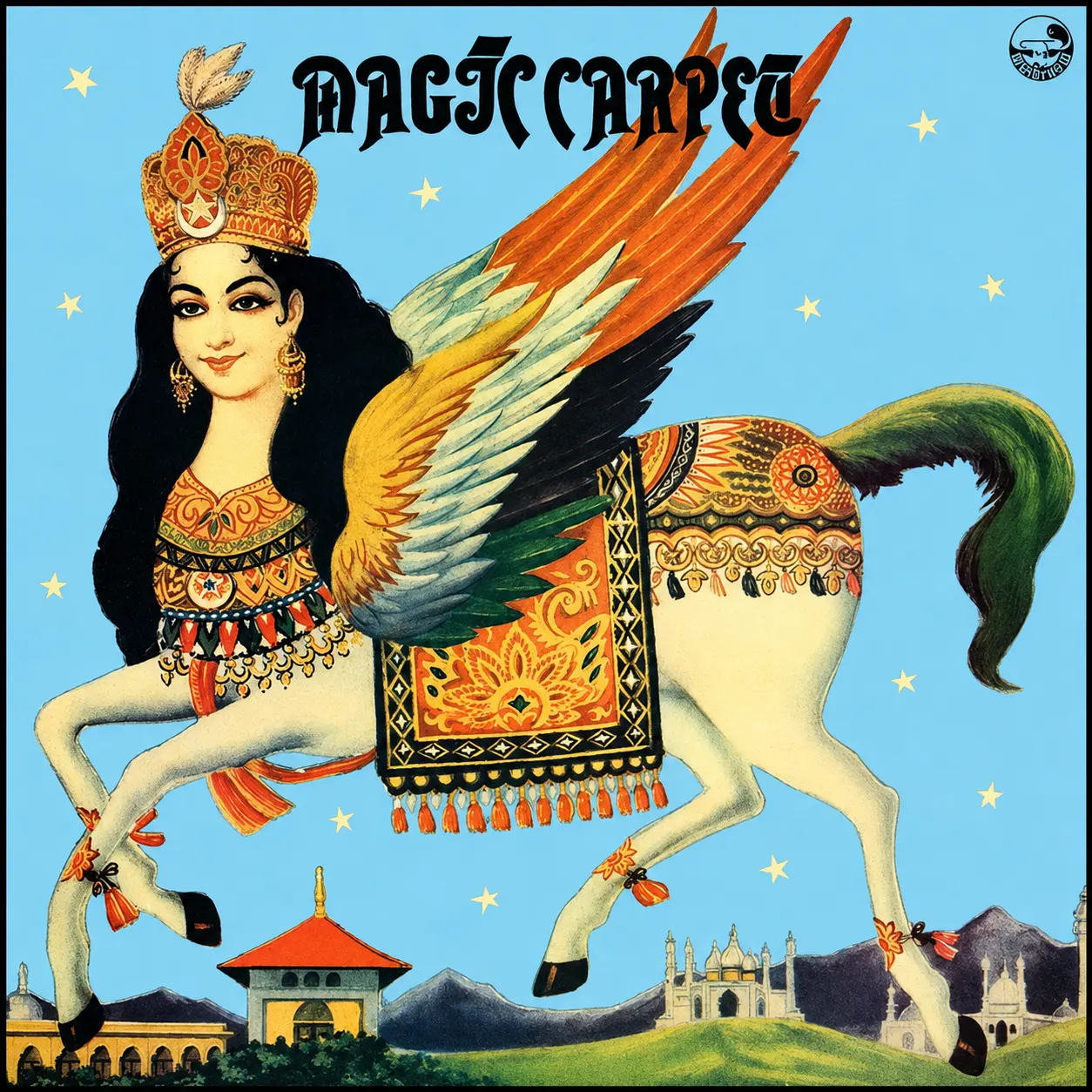 Magic Carpet released their self-titled singular album in June 1972 on Mushroom.
The album joins Sufit songs in open modal guitar tunings with material developed by the earlier Sargam trio. Seven Sufit compositions use tunings compatible with sitar intonation, while three instrumentals retain the Alford–Moyes–Sathe configuration. Alford expands his sitar role with esraj and tamboura, while Sufit sings nine of the twelve tracks.
“The Magic Carpet” circles an Indian-theme motif through resonant sitar ornament and repeating raga figures. “The Phoenix” glides through open-modal accompaniment as phoenix-from-ashes phrases return across successive stanzas. “Harvest Song” threads recurring reap-and-sow phrases through another open-modal setting.
“Father Time” lingers on repeated time-and-identity phrases, with Clem Alford’s tune reshaped to accommodate Sufit’s text. “La La” loops an Indian-theme tune through a more traditional raga-derived pattern. “Peace Song” murmurs repeated invocations of peace, silence, light and joy across open-modal accompaniment. “Take Away Kesh” settles into a more traditional Indian setting that foregrounds Keshav Sathe’s tabla. “The Dream” glides through open-modal accompaniment beneath Sufit’s text of longing and love.
A1. “The Magic Carpet” – Alford, Sathe, Moyes
A2. “The Phoenix” – Sufit
A3. “Black Cat” – Sufit
A4. “Alan’s Christmas Card” – Alford, Sathe, Moyes
A5. “Harvest Song” – Sufit
A6. “Do You Hear the Words” – Alford, Sathe, Moyes
B1. “Father Time” – Sufit, Alford, Sathe, Moyes
B2. “La La” – Alford, Sathe, Moyes
B3. “Peace Song” – Sufit
B4. “Take Away Kesh” – Alford, Sathe, Moyes
B5. “High Street” – Sufit
B6. “The Dream” – Sufit
Sessions occurred in winter 1971/72 at Chalk Farm Studios in London with Vic Keary as producer and engineer. The quartet recorded live around shared microphones and used few overdubs. Keary worked in sequence on Mushroom albums by Second Hand (Death May Be Your Santa Claus) and Chillum (Chillum).
Sufit designed the cover around an Indian print of Buraq and assembled the layout with Letraset; artist Glyn Boyd Harte drew the Magic Carpet nameplate. Gabriel Weissmann photographed the monochrome back cover, which shows the quartet seated on a patterned carpet with instruments.
Magic Carpet Records reissued the album in 1995 on CD and a limited 1,000-copy vinyl edition. The CD adds the 20-minute traditional “Raga,” arranged by Alford.
Postlude
Magic Carpet parted company in 1972 after less than a year together. Alisha Sufit resumed solo performances and recorded sixteen songs at R.G. Jones Studios in August 1974 after producer Nick Sykes heard her at Portobello Road market. She withheld the recordings until their release as Love and the Maiden in 1994. Clem Alford taught sitar at Bharatiya Vidya Bhavan in London from 1972 through 1976. He recorded Mirror Image for Columbia in 1974 with Keshav Sathe on tabla for two traditional ragas, then appeared with Indian singer Lakshmi Shankar at the Royal Albert Hall in 1975.
Sufit continued club and concert work through the 1970s and expanded her repertoire to jazz standards in the following decade. She established Magic Carpet Records in late 1993 to control the original group tapes and reissue Magic Carpet. The label released the album on CD with the twenty-minute bonus piece “Raga” and pressed a limited run of 1,000 vinyl copies from the original tapes.
The four members eventually met again after renewed interest in the album, but Jim Moyes had stopped public performance and Sathe had retired. Sufit and Alford revived the name as Magic Carpet II for Once Moor in 1996. Sufit sang and played guitar with Alford on sitar and tamboura, while Pandit Dinesh and Esmail Sheikh supplied tabla percussion. Magic Carpet Records issued the album on CD and vinyl, with an additional full-length raga on the CD edition.
Discography:
- Magic Carpet (1972)
Sources:
Artist/Album Pages:
Dramatis was an English electro/art-pop band that released the 1981 album For Future Reference on ...
Leroy Hutson (born June 4, 1945) is an American R&B singer, songwriter, and producer from Newa...
Steamhammer was an English blues-rock band that released the 1969/70 albums Steamhammer (aka Refle...
Bachdenkel was an English post-psych band based in France. In 1970, they recorded Lemmings, which ...
Mandrake Memorial was an American psych-rock band from Philadelphia that released three albums be...
Howard Jones (born Feb. 23, 1955) is an English keyboardist, singer, and songwriter who released f...
The JoBoxers were an English new wave soul-pop quintet drawn from the latter-day Subway Sect lineu...
The Advancement was an American jazz-psych band from Hollywood that released a self-titled album ...
Alan Tarney (born Nov. 19, 1945) is an English-born musician and songwriter who first emerged in t...
François Guy (1947–2023) was a Québécois singer-songwriter from Montreal who fronted the Sixties g...
Tadeusz Woźniak (March 6, 1947 – July 8, 2024) was a Polish singer-songwriter from Warsaw who emer...
The Long Hello was a side-project put together in 1972 by instrumentalists from a temporarily halted...