

Magog was a Swiss jazz-rock band that issued a live set on Evasion Disques, recorded at the 1973 Montreux Jazz Festival. In 1976, the band released a self-titled album on Japo Records.
Members: Hans Kennel (trumpet, percussion, flute), Andy Scherrer (soprano saxophone, tenor saxophone, flute, percussion), Paul Haag (trombone, percussion), Klaus Koenig (piano, electric piano, percussion), Peter Frei (bass), Peter Schmidlin (drums, percussion)
Background
Pianist Klaus Koenig formed Magog in Switzerland as an outgrowth of his Jazz Live Trio, the Swiss Radio inhouse rhythm unit he had led since 1964. The group paired Koenig with bassist Peter Frei and drummer Peter Schmidlin, then added trumpeter Hans Kennel, reedist Andy Scherrer, and trombonist Paul Haag.
Koenig worked for Swiss Radio DRS Studio Zürich since 1962 and led the Jazz Live Trio across more than 100 broadcasts with visiting American and European soloists. Frei, a JLT member since 1970, studied bass under Ernst Kunz at Tonhalle Zürich. Schmidlin, a self-trained drummer since childhood, grew up near Basel and joined JLT in the early 1970s.
Kennel (b. 1939) was born in Schwyz and trained as a classical trumpeter at the Fribourg and Zürich conservatories. He played 1960s jazz dates with George Gruntz and Irène Schweizer. Scherrer (b. 1946) came from Brunnadern and taught himself saxophone at fifteen and studied at the Basel music academy. Haag completed the three-horn front line.
Magog made its first public appearance at the 1973 Montreux Jazz Festival during the “Jazz in Switzerland” program at the Congrès Montreux.
Live in Montreux ’73
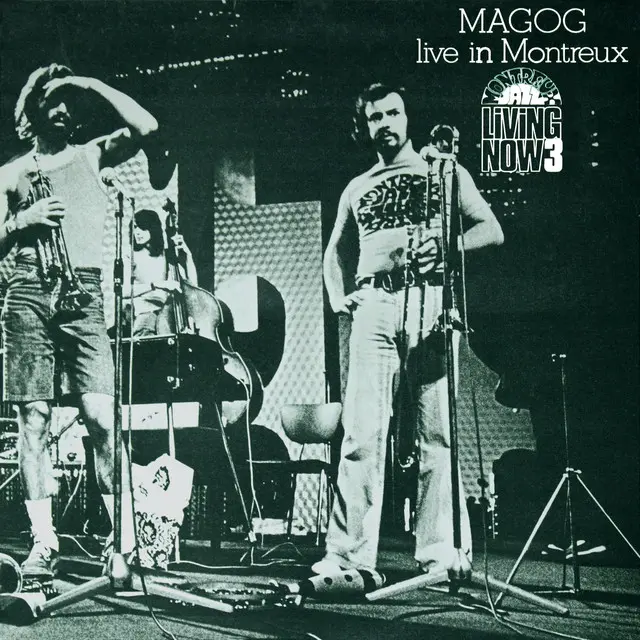 Magog released the live album Live in Montreux ’73 in 1973 on Evasion Disques.
The set contains seven pieces from the Swiss sextet in concert at the Montreux Jazz Festival.
“Magog” emerges from a blurred cluster into firmer ensemble statements as the register expands and the brass gains definition. The longer pieces fracture fixed themes into pantonal solo space, then snap back through hard accents and collective transition figures.
A1. “Magog (One – Two – Three)” (7:00)
A2. “One for Lucky Luke” (10:23)
A3. “Tell (One)” (9:05)
B1. “Tell (Two – Three)” (6:08)
B2. “Ganz Zum Überfluss Meinte Eusebius Noch Folgendes” (6:35)
B3. “Mini Rock” (5:37)
B4. “See Waldi” (8:05)
Magog performed the set on July 3, 1973, at the Centre des Congrès in Montreux with engineer Chris Pennycate. Evasion Disques issued the LP as the third title in the Living Now series.
Studiopizz laid out the sleeve, with cover photography by Franz Glose. The front cover shows Kennel and Haag at the stage microphones, with Koenig seated behind them at the piano and the Living Now logo at upper right.
After the Montreux appearance, Magog continued as the Koenig trio plus Kennel, Scherrer, and Haag. They recorded six pieces in late 1974 and entered 1975 with a completed studio album.
Magog
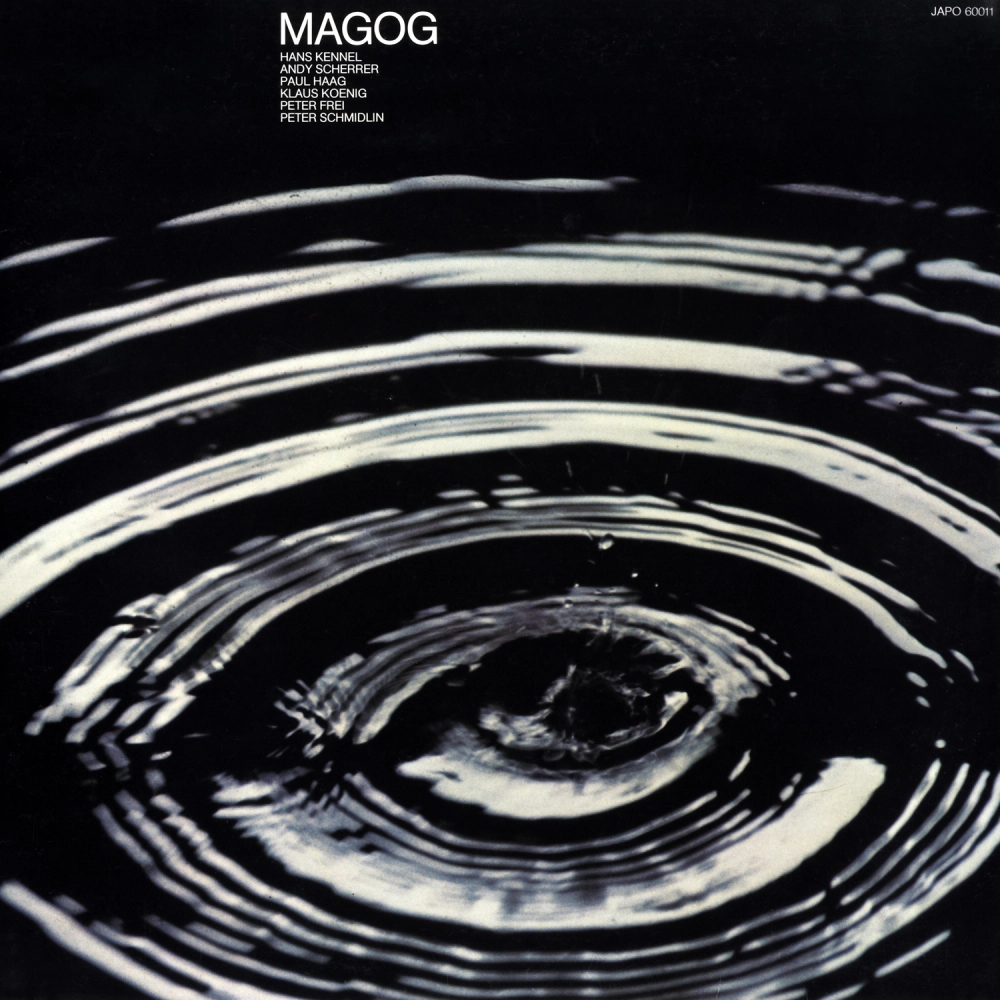 Magog released their self-titled studio album in February 1976 on JAPO.
The album contains six pieces in a sextet format. Magog retained Kennel, Scherrer, Haag, Koenig, Frei, and Schmidlin from Live in Montreux ’73, with Scherrer featured on soprano saxophone and flute.
“Lock” digs into a taut low figure while layered horn entries rise in stages. “Gogam” surges from bubbling theme-work into a fast middle section with hard ensemble traction. “Rhoades” threads a tight piano maze through rough brass calls and a late bass solo. “Der Bachstelzer” lingers on sustained chords while separate front-line turns cross a spare, shifting rhythm. “Summervogel” drifts through vocalized cries and suspended phrases before “New Samba” lopes through syncopated figures and clipped cadence returns.
A1. “Lock” (4:17) – Paul Haag
A2. “Gogam” (8:12) – Andy Scherrer
A3. “Rhoades” (7:10) – Klaus Koenig
B1. “Der Bachstelzer” (6:18) – Koenig
B2. “Summervogel” (7:32) – Hans Kennel
B3. “New Samba” (8:28) – Kennel
Magog recorded the album on November 1 and 2, 1974, at Tonstudio Bauer in Ludwigsburg with engineers Martin Wieland and Carlos Albrecht. Solitron Productions produced the session for JAPO.
JAPO housed Magog in a black-and-white sleeve whose front shows concentric water ripples beneath the title, member names, and catalog number. The back cover places a small studio photograph above the tracklist and session text.
Discography:
- Live in Montreux (1973)
- Magog (1976)
Sources:
Artist/Album Pages:
The Five Stairsteps were an American sibling soul group from Chicago that released six albums and...
Energy was a Swedish jazz-rock band behind a 1974 self-titled album on Harvest. Drummer Björn Inge...
Full Moon Trio was a Belgian avant-jazz/rock band behind a 1975 self-titled album on Dwarf Records...
Vitamin E was an American soul-funk combo from Oakland that released the 1977 Buddah album Sharing...
Deniece Williams is an American soul singer and songwriter with a musical career that dates back to ...
Kalevala was a Finnish art-rock/psych band from Helsinki that made the 1972 Finnlevy album People ...
Laurence Vanay is a French keyboardist and composer who made the 1974 album Galaxies on SFP. In 19...
Agnes Strange was an English hard-rock trio behind the 1975 BirdsNest album Strange Flavour, follo...
Elliott Fisher is an American violinist and arranger who worked extensively in Los Angeles film an...
Brân was a Welsh-language rock group active from 1974 through 1979. The group issued a four-song E...
Penetration was an English rock band that cut the 1977 Virgin single "Don't Dictate" and the 1978 ...
Glatter Wahnsinn was a German jazz-rock band that released a 1980 self-titled album on Anvil Recor...