

Sensitiva Immagine was an Italian symphonic-rock band of the mid-Seventies. Their intended 1976 album, E Tutto Comincio Cosi…, later surfaced on Melos.
Members: Alfredo Olivieri (vocals), Massimo Buriani (guitar), Stefano Bertonazzi (keyboards), Andrea Pavinato (bass), Franco Buriani (drums)
Background
Sensitiva Immagine formed in 1975 in Bologna. They built a modest following through local concerts that featured elaborate theatrical staging, including the use of costumes in the style of early Genesis. Their repertoire combined Italian symphonic traditions with evident English influences, particularly in the instrumentation and arrangement approach.
The lineup featured singer Alfredo Olivieri, guitarist Massimo Buriani, keyboardist Stefano Bertonazzi, bassist Andrea Pavinato, and drummer Franco Buriani. They recorded a six-track album, privately issued on cassette and sold at live performances. The original tape included no credits and remained obscure for more than a decade.
E Tutto Comincio Cosi…
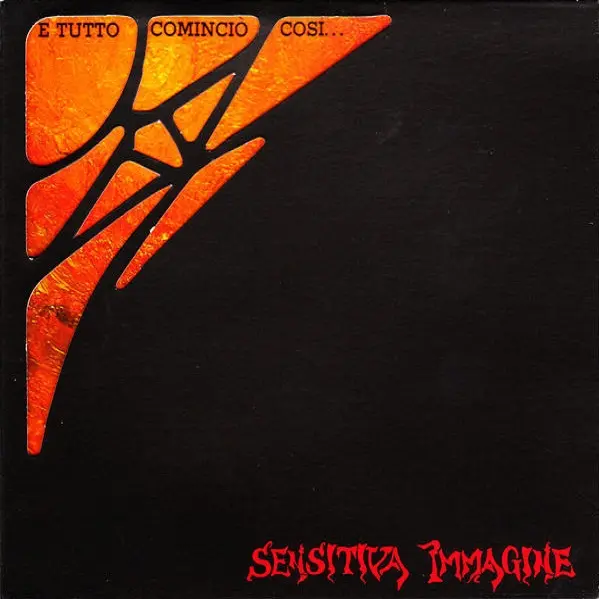 In 1991, Melos unearthed E Tutto Comincio Cosi…, the intended 1976 album by Sensitiva Immagine.
The album combines theatrical ensemble interplay with a dramatic, keyboard-forward symphonic style rooted in the early Genesis model. Passages alternate between elaborately layered sections and piano-led vocal segments, with occasional bursts of acoustic balladry or instrumental aggression.
Massimo Buriani plays both electric and acoustic guitar in sharp tremolo phrases and Hackett-inspired figures, veering from gentle interludes to contoured solos. Stefano Bertonazzi commands organ, Moog, harpsichord, and piano textures, anchoring transitions and driving harmonic shape. Andrea Pavinato defines the low-end pulse, alternating sustained tones with nimble runs. Franco Buriani supplies metric shifts and tom-heavy motion with steady snare restraint. Alfredo Olivieri sings in declaratory tenor, focusing phrasing around dramatic arc and Italian diction.
E Tutto includes the extended multi-part compositions “Overture” and “Ai confini del mondo,” both centered on instrumental build-up, lyrical suspension, and sectional variation. “Harlem” contrasts synth-heavy runs with sharply phrased electric organ breaks. “La favola di narcisio ed eco” and the title track close the sequence with contrasting modes—one operatic and sprawling, the other concise and fully instrumental. Bonus material includes the balladic “Quel che resta,” the brisk “La giornata,” and a 1976 alternate version of “Harlem.”
1. “Intro” (Bonus) (2:17)
2. “Overture” (8:32) — cycles through Moog fanfares, layered rhythms, and acoustic breaks before vocals enter halfway
3. “Harlem” (6:57) — features organ-dominant counterpoint, alternating electric and acoustic sections
4. “Ai confini del mondo” [To the Ends of the Earth] (10:23) — opens with field effects, unfolds in melodic arcs with lyrical passages and classical motifs
5. “Intro” (Bonus) (0:38)
6. “Storia di…” (3:35) — shorter song with upbeat phrasing and lighter structure
7. “La favola di narcisio ed eco” [The Fable of Narcissus and Echo] (6:27) — begins balladic, expands into layered instrumental storytelling
8. “E tutto cominciò così…” [And It All Began Like This…] (4:52) — concise instrumental finale with focused electric guitar motifs
Bonus Tracks (Kaliphonia, 1998):
9. “Quel che resta” [What Remains] (3:31)
10. “La giornata” [The Day] (4:22) — includes extended drum solo
11. “Harlem (1st Version 1976)” (5:52)
12. “E tutto cominciò così… (Live reprise)” (1:50)
Sensitiva Immagine recorded E Tutto Cominciò Così… in 1976 but issued it only as a cassette sold at local concerts. Melos gave the tape its first official release on CD in 1991; Kaliphonia reissued it in 1998 with six bonus tracks, including live and early versions.
Discography:
- E Tutto Comincio Cosi… (1991, recorded 1976)
Sources:
- Discogs: Sensitiva Immagine
- MusicBrainz: Sensitiva Immagine
- RYM: Sensitiva Immagine
- ItalianProg: Sensitiva Immagine
- ProgArchives: Sensitiva Immagine
Artist/Album Pages:
Marius Popp (Sept. 21, 1935 — Nov. 8, 2016) was a Romanian jazz pianist who released three albums ...
Hawkwind are an English space-rock band, originally led by guitarist Dave Brock and reedist Nik Tu...
Chaka Khan (born March 23, 1953) is an American soul singer who first emerged as the featured voca...
Semuta was an English Latin-jazz/rock band that released a 1979 self-titled album on Lee Lambert R...
The Good Rats were an American hard-rock band from Jamaica, Queens, that released nine albums betw...
Bullfrog was the German hard-rock band behind the 1976/77 Sky albums Bullfrog and High in Spirits ...
Jimmy Owens is an American jazz-funk trumpeter, composer, and arranger who emerged as a mid-Sixti...
Prince Jazzbo — aka Linval Roy Carter (September 3, 1951 – September 11, 2013) — was a Jamaican re...
Gloria Mundi was an English art-rock/punk band from London that released two albums on RCA Victor ...
Aalon was an American soul-funk band behind the 1977 Arista album Cream City. Namesake frontman/g...
Japan was an English new wave band that released five albums between 1978 and 1981. They formed in 1...
Julian Priester (born June 29, 1935), also known as Pepo Mtoto, is an American trombonist from Ch...