

Ping Pong was an Italian sax-rock band that released the 1971–73 albums About Time and Ping Pong.
Members: Mauro Falzoni (guitar, vocals), Celso Valli (keyboards), Paride Sforza (saxophone, clarinet), Alan Taylor (bass, vocals), Vittorio Volpe (drums), Giorgio Bertolani (vocals, 1973-74)
Inception
Ping Pong formed in 1971 in Emilia-Romagna. Though often presented as a foreign act, the band was Italian apart from English bassist Alan Taylor, formerly of the beat-era Casuals. In their earliest phase (1970–71), they performed in Greece under the name The Eden Rocs and recorded material that surfaced years later on various archival compilations.
About Time
 Ping Pong released their first album, About Time, in 1971 on Emiliana. The album contains compact tracks with contrasting sections and English vocals.
Guitarist Mauro Falzoni sings on select tracks, circled by pianist/organist Celso Valli, and reedist Paride Sforza, doubled in places by guest saxist Alan King. Bassist Alan Taylor and drummer Vittorio Volpe anchor proceedings with alternate jazz and rock frameworks, yielding at times to sedate ballad structures.
About Time balances contrast-heavy miniatures with a fluid sense of motion. Tracks like “About Time” and “You and Me” pivot between tense and tranquil moods, trading organ thrust for woodwind softness, and balancing declarative vocal lines with reflective acoustic sequences. “Dark Morning Skies” and “Confusion” work in tighter motion, the former brisk and urbane with overlapping flute and sax gestures, the latter circling on a taut rhythmic cell while piano and flute volley sharp phrases across its odd-meter base.
“Someway” and “Diamond Seller” offer gentler counterpoints, built on pliant acoustic patterns and softened by airy flute interjections. “Banshee” escalates from misty restraint to a more jagged interplay of reeds and guitar, while “Funny Wife” bursts with propulsion, driven by stabbing sax, shifting meters, and an open-frame drum solo. The album sustains momentum through contrast, layering chamber textures atop a lean, rhythmic foundation.
A1. “About Time” (3:47) — organ fade-in with fluttering flute that tightens and frames an urgent vocal passage (in Dm), which cuts to a pastoral acoustic sequence of classical guitar, joined by vocals and flute before the urgency returns, capped by a 2/4 jig-like melody.
A2. “You and Me” (4:04) — somber piano ballad (in Am7) with call-and-response harmonies, flute/vibe interplay, and taut Tull-like breaks.
A3. “Dark Morning Skies” (2:40) — brisk post-bop number in 3/4 with busy brush snare, ride cymbals, Brubeck-like piano accents, flute/sax tradeoffs, and debonair mezzo croon (ala Brainchild).
A4. “Daft” (3:32)
A5. “Confusion” (3:03) — 5/4 ostinato (in Em) with tight piano/flute tradeoffs and a brief vocal mid-section.
B1. “Drinking” (3:46)
B2. “Someway” (2:42) — finger-picked acoustic ballad (in Em) with flute/piano filigree across roaming chordal passages; brisk strummed midsection with hyperactive flute.
B3. “Banshee” (2:46) — soft intro of flute and cymbal mist, cut to a tighter organ theme with aggressive drumming, gruff mezzo verses, rising guitar/reed bridges, trebly expressive sax break.
B4. “Diamond Seller” (2:41) — acoustic finger-picked ballad (in Am) with a flowing, flute-laden chorus (in D).
B5. “Funny Wife” (4:20) — galloping high-speed instrumental with poking sax across a staccato rhythmic mixed meter (3+3+2), intercut by a lengthy drum solo.
Sessions occurred in 1971 for the Bologna-based label Emiliana.
The front cover combines handprint iconography with saturated op-art swirls beneath a cloud horizon. A black palm stamp marked “About Time” appears foregrounded against a colorburst spiral of yellows, reds, and blues that widen into atmospheric rays above the clouds. A logo in the upper right corner credits Emiliana’s graphic studio “L+H.”
Ping Pong
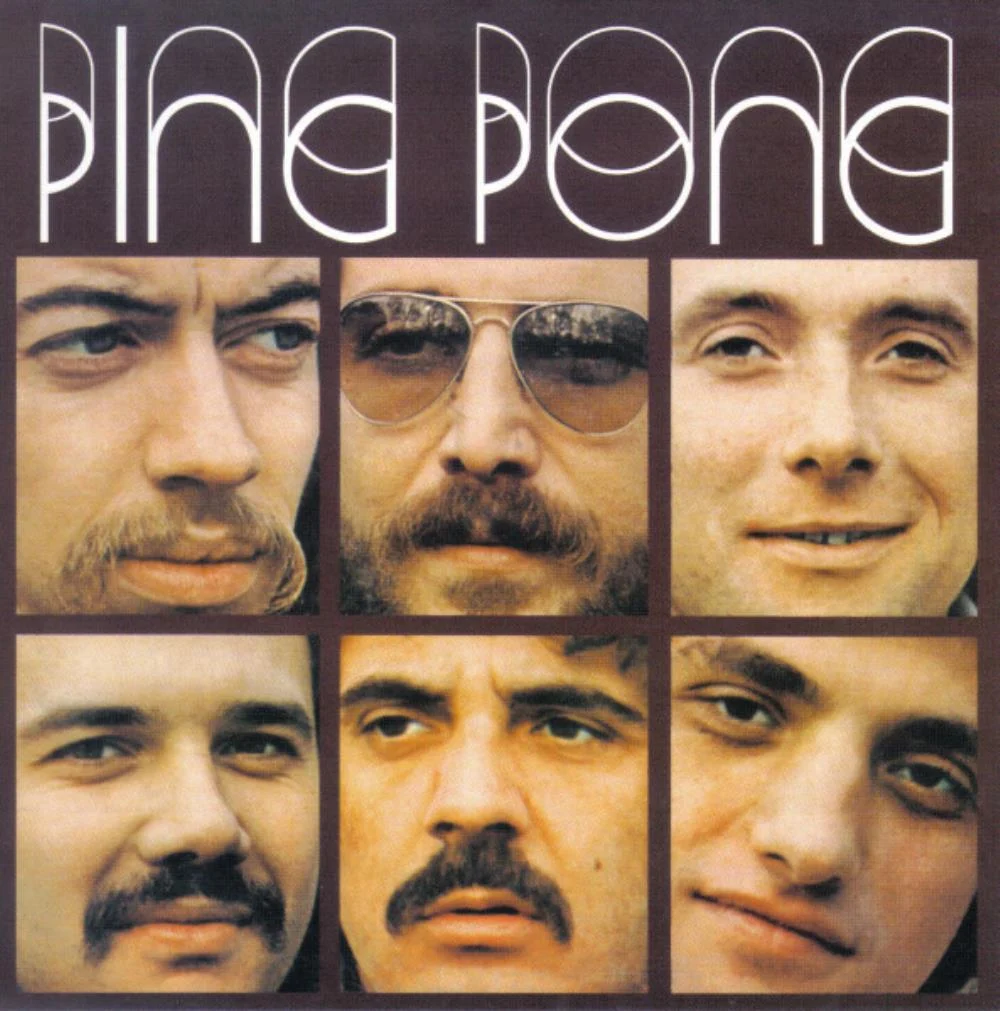 Ping Pong released their self-titled second album in 1973 on Spark. The album presents a six-piece lineup with Italian singer Giorgio Bertolani.
Bassist Alan Taylor and drummer Vittorio Volpe drive and challenge the elaborate trade-offs and interplay of guitarist Mauro Falzoni, reedist Paride Sforza (flute, saxophone, clarinet), and keyboardist Celso Valli, who commands an arsenal of piano, organ, and Moog synthesizer.
Valli co-composed everything with Falzoni and Taylor apart from “Caro Giuda,” an Italian-language adaptation of “Time for Winning,” a recent Blue Mink hit.
Ping Pong shifts between whirlwind ensemble bursts and sudden lyrical retreats, often within the span of a single track. “Il miracolo” swings from subdued piano verses to choruses that crest with thick organ and climbing vocal lines, while “Il castello” piles frantic bass and shouted syllables atop a thicket of drums and horns before cutting to drifting sax, then plunging back with a tom-heavy solo. “Plastica e petrolio” threads a crisp rhythmic line through airy cymbals and pointed harmonies, eventually breaking into asymmetrical cycles shaped by flute and violin.
“Suite in 4 tempi” unfolds in scenic succession: delicate flute gives way to a brief acoustic vocal section, which fractures into baroque layers of guitar and harpsichord, then surges into brisk-motion reed soloing over martial drums. Elsewhere, “Viene verso di me” offers a descending acoustic figure softened by flute, before tightening around staccato piano phrasing and swelling organ lines that recede into haze. The album’s dynamic pull rests in its ability to pivot quickly between ornate ensemble motion and quieter, chamber-like spaces.
A1. “Il miracolo” [The Miracle] (4:22) — ballad that veers between plaintive piano/vocal verses and swelling organ-fueled choruses with soaring vocals.
A2. “Plastica e petrolio” [Plastic and Petroleum] (3:41) — brisk syncopated number with misty ride cymbals, Yes/CSN harmonies, channeled verses, tight reed breaks, and a 7/8 ostinato with slithering violin.
A3. “Cresciuta in un paese” [Raised in a Town] (3:36)
A4. “Il castello” [The Castle] (3:46) — hyperactive bass ostinato interlocked with galloping syncopated drum patter, overlaid with shouted rapid fire vocals and blaring horn charts; cuts to fluid soprano sax break with cross-channel abandon, followed by a balladic interlude and tom-laden drum solo that reintroduces the song proper.
A5. “Il villaggio” [The Village] (2:28)
B1. “Suite in 4 tempi” [Four-Movement Suite] (10:01) — multi-part piece with a mixed-meter piano intro and a fluid sequence of flute and ride cymbals, followed by an acoustic/vocal passage engulfed in reeds, then a baroque sequence of classical guitar and harpsichord, cut to a galloping 3/4 flute riff that ushers a solo by Volpe, whose martial fills link back to the intro.
B2. “Viene verso di me” [He Comes Toward Me] (4:28) — acoustic finger-picked ballad with a descending motif (in Cm) filled with light flute and vibes; urgent mid-section with staccato piano/vocal bars and a stormy organ/flute passage that dissolves in feedback.
B3. “Caro Giuda (A Time for Winning)” [Dear Judas] (3:15) — Italian-language version of Blue Mink’s 1972 single.
Sessions occurred in 1973 for the English label Spark, which lifted “Caro Giuda” as a single (b/w “Il castello”), followed by “Il miracolo” (b/w “Plastica e petrolio”).
Postlude
In 1975, Volpe cleared for drummer, Roberto Poli. This lineup issued two pop-rock albums as Bulldog (not to be confused with the American hard-rock band). For the UK market, Spark issued a double 7-inch set titled Introducing New Wine in 1976 under the pseudonym New Wine.
Alan Taylor released a 1977 solo single, “Song for Magdalena,” and produced the first three albums (1978–80) by Italian singer Vasco Rossi. Taylor remained in Italy until his death in 2011.
Celso Valli became a prominent arranger and producer with an extensive studio career that continued until his death in 2025.
Discography:
- About Time (1971)
- Ping Pong (1973)
Sources:
- Discogs: Ping Pong
- MusicBrainz: Ping Pong
- RYM: Ping Pong
- ItalianProg: Ping Pong
- ProgArchives: Ping Pong
Artist/Album Pages:
Alamo was an American hard-rock band from Memphis that released a 1971 album on Atlantic. Membe...
Bandolero was a Puerto Rican psych-rock band behind a 1970 self-titled album on Truth Records. M...
Jeronimo was a German hard-rock band behind the 1970/71 Bellaphon albums Cosmic Blues and Jeronimo...
Labelle was an American soul-funk trio best known for their 1974 hit "Lady Marmalade." The three w...
LaMont Johnson (Oct. 1, 1941 — Oct. 21, 1999) was an American jazz pianist and composer who releas...
Percy Sledge (Nov. 25, 1940 — April 14, 2015) was an American soul singer who released ten albums on...
Franz K. was a German political hard-rock/blues band that released ten albums and assorted singles...
Pentangle was an English folk-rock band from London that released six albums between 1968 and 1972...
Zimbo Trio was a Brazilian samba-jazz combo that released six albums between 1964 and 1969 on RGE,...
Stud was an English/Irish jazz-rock/jam band from London that released a self-titled album on Decc...
Guns & Butter was an American sax-rock/psych band from Boston that released a self-titled alb...
Ballin’jack was an American brass-rock band behind the 1970–72 Columbia albums Ballin' Jack and B...