The album features eight tracks, including a five-part suite titled “Invitation to a River.” Trumpeter Bill Chase handled most of the arrangements and contributed to six of the album’s compositions, often in collaboration with lead vocalist Terry Richards (“Get It On,” “River”) or lyricist L. Raub. Three of the album’s four trumpeters — Ted Piercefield, Jerry Van Blair, and Alan Ware — also assisted with vocal and arranging duties.
Musically, the album melds jazz virtuosity with rock intensity. Opener “Open Up Wide” and the Brown-inspired “Get It On” showcase the band’s multi-trumpet dynamism and the driving interplay between bassist Dennis Johnson and keyboardist Phil Porter. “Livin’ in Heat” injects wah-wah guitar and bluesy vocals à la David Clayton-Thomas. Richards handles most of the vocals, with Van Blair taking lead on the soul-jazz number “Hello Groceries,” and Piercefield contributing vocals to “Handbags and Gladrags” and “Boys and Girls Together,” the latter composed by guitarist/singer Jim Peterik of fellow brass-rockers the Ides of March.
The 14-minute centerpiece “Invitation to a River” unfolds as an ambitious five-part suite, progressing through swinging vocal jazz (“Two Minds Meet”), ethereal psych-soul (“Stay”), syncopated jazz-funk (“Paint It Sad”), cinematic pomp (“Reflections”), and a climactic, vocal-charged finale (“River”).
A1. “Open Up Wide” (3:47)
A2. “Livin’ in Heat” (2:53) is an early songwriting credit for Russ Turner, a future keyboardist/arranger for Smokey Robinson.
A3. “Hello Groceries” (2:56) was composed by one Dave O’Rourke.
A4. “Handbags and Gladrags” (3:21) originated as a 1967 single by Chris Farlowe, written by Manfred Mann vocalist Mike D’Abo and covered since by Rod Stewart.
A5. “Get It On” (2:57)
B1. “Boys and Girls Together” (2:49)
B2. “Invitation to a River” (13:17)
a. “Two Minds Meet” (2:47)
b. “Stay” (1:40)
c. “Paint It Sad” (2:40)
d. “Reflections” (2:39) is credited to “Ad Lib.”
e. “River” (3:31)
Chase recorded the album in Chicago during November and December 1970 with Ides of March producers Frank Rand and Bob Destocki for Lee Productions. The album cover features psychedelic typography by Milton Glaser and photography by Bob Amft. Village Voice jazz columnist Nat Hentoff wrote the album’s liner notes.
“Get It On” became the band’s breakout single, charting for thirteen weeks on the Billboard Hot 100 and peaking at No. 24 in July 1971. The success of the single helped drive the album to a No. 22 peak on the Billboard 200 and push sales past 400,000 copies — a rare feat for a jazz-rock release. A quadraphonic version appeared in 1972, and the album has since been reissued on CD and SACD with the band’s final release, Pure Music.
Ennea
 Chase released their second album, Ennea, in March 1972 on Epic.
Side A features six compact tracks that reflect a shift toward tighter arrangements and a stronger funk and soul influence. Ennea opens with “Swanee River,” a hard-driving adaptation of the Stephen Foster classic reworked by Bill Chase. New vocalist G.G. Shinn (ex-Boogie Kings) joined after the completion of “So Many People,” a Paul Williams cover with original singer Terry Richards.
Trumpeter Ted Piercefield sings his own contribution, “Night,” a brief but punchy cut with syncopated horn charts. Keyboardist Phil Porter collaborated with outside partner Geraldine J. Soukup on “It Won’t Be Long,” a Chase trumpet showcase. Guitarist Angel South adds the brisk and bluesy “I Can Feel It,” while the outside composition “Woman of the Dark” stretches out with a call-and-response gospel intensity and unrestrained brass improvisation.
Side B comprises the six-part conceptual suite “Ennea,” written by Bill Chase with lyrics by longtime partner Erin Adair. The movement titles correspond to Greek gods, with the album title itself—Ennea—taken from the Greek word for nine, symbolizing the band’s nine-member lineup. Chase composed the music for all six parts, collaborating with John Palmer on “Cronus,” which opens the suite with layered funk riffing and blistering trumpet lines. “Zeus” follows with a cathedral-like Hammond solo from Phil Porter. “Poseidon” delivers a brassy eruption of shifting rhythms. Van Blair’s dreamy flugelhorn textures shape both parts of “Aphrodite,” the first serene and balmy, the second pulsing with exotic, Eastern modal inflections. “Hades” concludes the suite with layered rhythms, aggressive vocals, and high-powered horn stabs, showcasing the band’s ability to marry fusion dynamics with mythic drama.
A1. “Swanee River” (3:10)
A2. “So Many People” (2:44) originated on Someday Man, the 1970 debut solo album by Paul Williams, who co-wrote the song with Roger Nichols.
A3. “Night” (2:38)
A4. “It Won’t Be Long” (3:06)
A5. “I Can Feel It” (2:51)
A6. “Woman of the Dark” (5:56) is credited to Tim Riley and Tom Szollosi, an otherwise undocumented songwriting team.
B1. “Cronus (Saturn)” (4:46)
B2. “Zeus (Jupiter)” (4:36)
B3. “Poseidon (Neptune)” (2:27)
B4. “Aphrodite Part I (Venus)” (2:02)
B5. “Aphrodite Part II (Venus)” (3:36)
B6. “Hades (Pluto)” (3:34)
Sessions occurred at two intervals between August 31 and December 9, 1971, at CBS Studios in San Francisco with Frank Rand and Bob Destocki. Midway through recording, Gary Smith replaced original drummer Jay Burrid while Shinn stepped in for Richards. According to the band’s attorney, production costs overshot the budget by $120,000. Ennea lists four engineers, including Roy Segal (Boz Scaggs, Laura Nyro), Mike Fusaro (Cal Tjader, David Wiffen), and Mike Larner (Mad River, Santana) — all three credited on the 1971 It’s a Beautiful Day release, Choice Quality Stuff / Anytime.
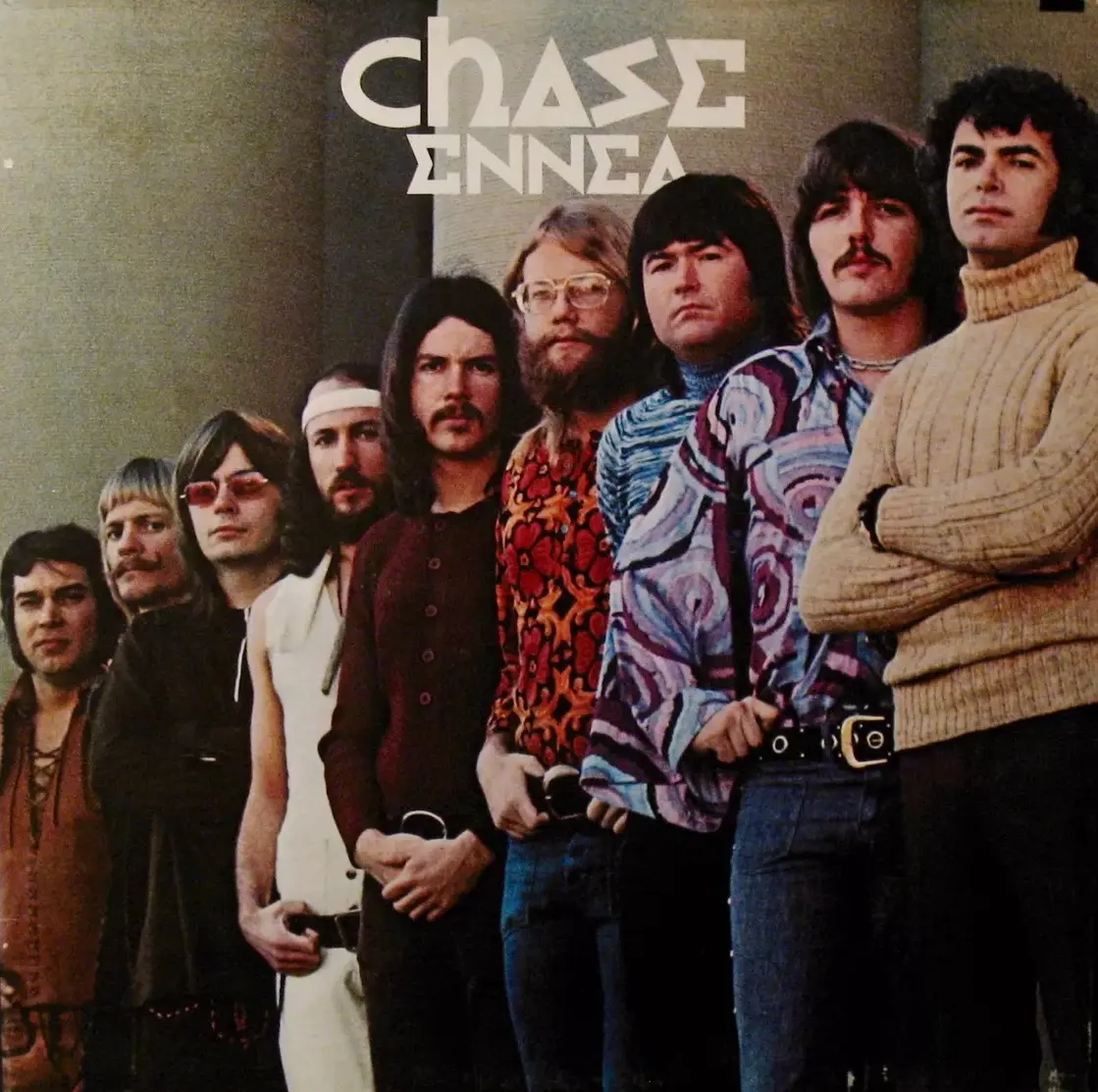
Ennea spent twelve weeks on the Billboard 200. The album reflected Chase’s increasing interest in long-form, thematic composition. The cover photo, taken by Jim Marshall in San Francisco’s Golden Gate Park, visually aligns Chase with the album’s mythological themes.
Pure Music
 Chase released their third album, Pure Music, on February 28, 1974, on Epic.
This release marked a sharp stylistic pivot from the vocal-heavy material of the band’s first two albums. Trumpeter Bill Chase composed or co-composed all six tracks, four of which are extended instrumentals. The new lineup featured fresh faces across the board, including keyboardist Wally Yohn, guitarist John Emma, bassist Dartanyan Brown, and a revamped trumpet section with Jay Sollenberger, Jim Oatts, and Joe Morrissey. The album emphasizes instrumental complexity and improvisational interplay, pushing Chase toward the emerging fusion idiom.
Opener “Weird Song #1” uses electric trumpet and analog synth to create a buzzing, syncopated soundscape. The emotive “Twinkles” follows with a lyrical flugelhorn melody, acoustic piano arpeggios, subtle bass commentary, and soft guitar filigree. “Bochawa,” a crowd favorite on the road, drives an Afro-funk rhythm with layered brass and organ flourishes, while closer “Close Up Tight” hurtles forward on brisk rhythms and contrapuntal horn volleys, complete with solos for electric guitar, trumpet, and Moog synthesizer.
The album includes two vocal numbers co-written by Bill Chase and Jim Peterik of the Ides of March. “Run Back to Mama” is a ballsy declaration of boundaries in a toxic relationship, set to a propulsive rhythm with call-and-response female backing vocals. “Love Is on the Way,” solely penned by Peterik, adopts a smoother, Motown-inflected vibe with co-lead vocals from Peterik and Brown.
A1. “Weird Song #1” (5:38)
A2. “Run Back to Mama” (3:11)
A3. “Twinkles” (7:12)
B1. “Bochawa” (5:47)
B2. “Love Is on the Way” (3:45)
B3. “Close Up Tight” (7:36)
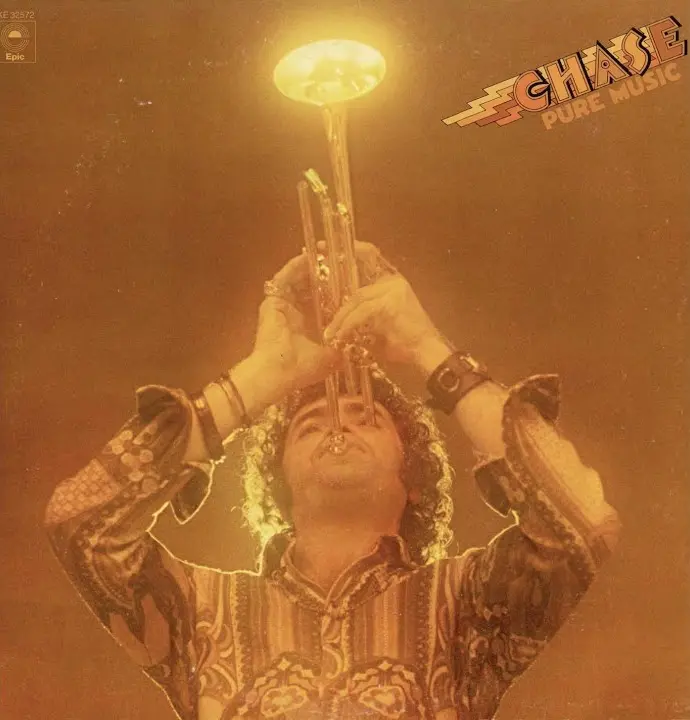
Chase recorded Pure Music between October and December 1973 at Universal Recording Studios in Chicago with longtime producer Frank Rand. The engineering team included Murray Allen and recordist Larry Huerta. The cover features a dramatic gold-lit photo of Bill Chase with his trumpet, while the back cover presents candid studio shots of each band member.
Pure Music was reissued in 2018 on SACD by Dutton Vocalion alongside the band’s debut. Though it charted modestly upon release, the album found a lasting following among jazz-rock musicians and students, thanks to its seamless fusion of brass firepower and progressive composition.
Final Year and Aftermath
In 1974, Chase began work on a fourth album that aimed to build on the Pure Music aesthetic with additional fusion-oriented material. Among the new pieces performed that year was “Ode to a New England Jellyfish,” a melodic flugelhorn ballad composed by Bill Chase. The track was recorded in the summer and only lacked Chase’s solo section at the time of his death. Several other compositions were reportedly in the works, including an instrumental reworking of Ennea’s “Aphrodite” (retitled “Shades of Venus”), a jazz-rock rendition of the 2001: A Space Odyssey theme (arranged by Bob Odjeda), and Bill’s interpretations of Jimmy Webb‘s “MacArthur Park” and Mike Oldfield‘s “Tubular Bells,” the latter never advancing past the sketch stage.
Tragically, Chase’s plans were cut short on August 9, 1974 — the day of President Nixon’s resignation — when a chartered Piper Twin Comanche bound for a Jackson County Fair performance crashed during final approach in Jackson, Minnesota. The accident claimed the lives of Bill Chase (age 39), pilot Daniel Ludwig, Ludwig’s secretary Linda Swisher, and three bandmates: keyboardist Wally Yohn, guitarist John Emma, and drummer Walter Clark.
Watch Closely Now
Three years later, surviving Chase members reunited for Watch Closely Now, released in 1977 on Churchill Records. The lineup included original rhythm section Dennis Johnson (bass) and Gary Smith (drums), with returning trumpeters Ted Piercefield, Jerry Van Blair, and Alan Ware, plus new contributors like Bruce Gaitsch (guitar) and Terry Fryer (keyboards). Vocal duties were shared by Piercefield, Jim Peterik, and early Chase frontman Terry Richards.
The album blends brassy rock originals like “Having a Good Time” (Augie Bucci) and “Writing on the Wall” (Johnson, Smith) with cinematic covers including “Superman Theme” (Leon Klatzkin) and “Rocky” (Bill Conti). Piercefield’s ballad “Those Eyes” and The Who cover “The Song Is Over” provide melodic contrast, while Paul Williams’ “Watch Closely Now” (from A Star Is Born) serves as the title track.
Legacy and Later Lives
Shortly after Watch Closely Now, Jim Peterik resumed his solo career with the 1976 album Don’t Fight the Feeling, touring as the Jim Peterik Band with Johnson, Smith, Fryer, and guitarist Bruce Gaitsch. In 1978, after briefly considering leaving music altogether, Peterik co-founded Survivor with guitarist Frankie Sullivan, launching a run of hits that included the 1982 anthem “Eye of the Tiger.”
Bass player Dartanyan Brown later became a music teacher at Marin Academy in San Rafael, California. Trumpet player Jim Oatts joined the adjunct faculty at Simpson College in Iowa. G. G. Shinn, the powerful voice behind Ennea, passed away on August 7, 2018, in Monroe, Louisiana, after a long illness.
Discography:
- Chase (1971)
- Ennea (1972)
- Pure Music (1974)
Sources:


 Chase released their self-titled debut album in April 1971 on Epic.