

Ursula Creek was an American rustic/hard-rock band from central Illinois that self-released one album on Richard Luft Music in 1976, then dissolved before finished copies arrived.
Members: Ed Culbertson (lead vocals, drums), Kenny Kastner (lead guitar, backing vocals), Gene Singley (bass, backing vocals), Steve Vohs (keyboards, backing vocals)
Background
Ursula Creek formed in spring 1974 when drummer–singer Ed Culbertson and guitarist Kenny Kastner, both from San Jose, a barren village at the northern point between Mason and Logan county. They recruited Kastner’s cousin Gene Singley from nearby Manito. Kastner previously played with Zirkelbach in Louisville as a college student. Singley moved from school cornet to bass at Kastner’s suggestion, then worked in Lime Fire and his school jazz band.
Stephen Vohs grew up in Decatur and studied piano from first grade through two college years. He played local bar bands from age fifteen and enrolled at Bradley University’s School of Music.
The trio debuted at the Slab, a concrete performance area behind a San Jose grocery store, then worked school dances and bars across central Illinois. Their sets divided roughly between originals and covers. Regular appearances at the Royal Palms in Dixon brought Rockford producer Jessie Alverado to the group in 1975. Alverado financed six rough tracks with hired brass players. However, the project stopped before completion.
Vohs entered the recording project that autumn as a studio keyboardist. He rehearsed new parts and contributed to at least one composition, but never appeared onstage with Ursula Creek. Their aborted Rockford sessions gave way to a self-financed album plan with producer Jerry Brightman.
Ursula Creek
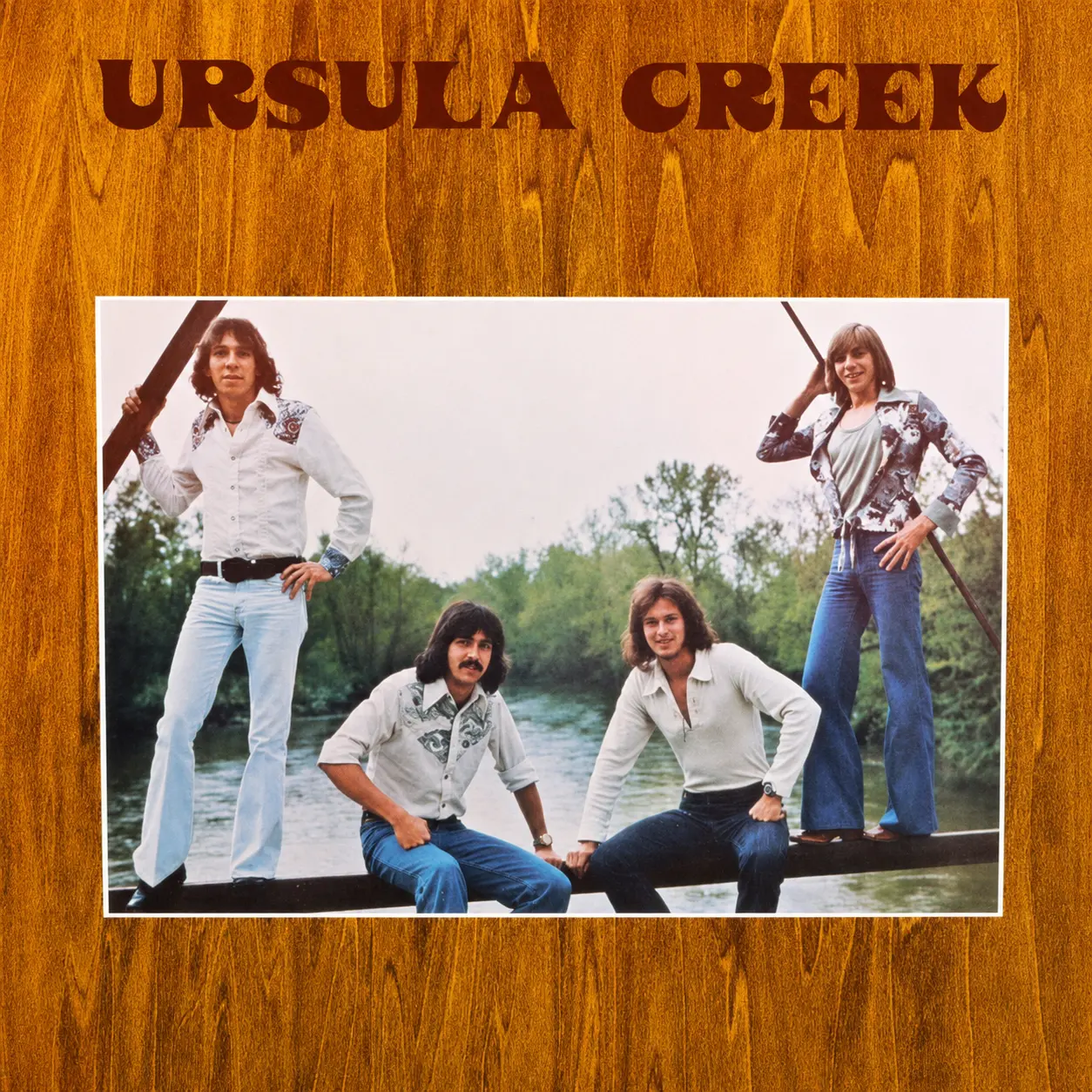 Ursula Creek released their singular album in 1976 on Richard Luft Music.
The album contains ten group-arranged originals with Culbertson lyrics. Musically, Ursula Creek alternates guitar-based hard-rock with softer passages, formed by the trio and supplemented by Vohs’ keyboard parts.
“Until the Music Ends” revs with winding chords, urgent vocals, and rattling metals. “Pictures of Red Roses” rains in with plucked/harmonic filigree and humble verses. “Movement G” waves Moog lines, coiled with staccato guitar runs and eventual chordal fire.
“Rainy Days” strips to finger-picked acoustic mesh and somber vocals with ghostly reflections. “Highlights of the World” runs thick chordal assaults amid searing leads in a DP-like flurry.
A1. “Callin’ My Name” (4:12)
A2. “Dying for You” (4:00)
A3. “Until the Music Ends” (3:01)
A4. “Pictures of Red Roses” (3:45)
A5. “Movement G” (4:55)
B1. “Will You Shine” (3:17)
B2. “Gypsy on the Road” (3:20)
B3. “Rainy Days” (4:25)
B4. “Have You Got the Time” (4:09)
B5. “Highlights of the World” (4:20)
Sessions occupied 40 hours in March 1976 at Golden Voice Studio in South Pekin, Illinois, with producer Jerry Brightman and engineer Tom Byler. Brightman came from a 1972–75 run as Buck Owens’s pedal-steel guitarist, recording sixteen albums with Owens and appearing on Hee Haw. Singley first recorded with a Rickenbacker 4001, then recut the bass parts on a Fender Precision after Brightman requested a less brittle tone.
Artists Recording and Record Pressing, Inc. manufactured 1,047 copies in Cincinnati. The front sleeve places a four-member outdoor portrait within a faux-woodgrain field beneath oversized title lettering. No design or photography credit appears on the packaging.
Goldenlane Records reissued the ten tracks on digital services as Folk Rock Essentials on May 1, 2012. Kastner later stated that the release occurred without the musicians’ involvement.
Postlude
Ursula Creek split three days after the final mix, before completed copies reached the musicians. The remaining trio formed Cloud Burst, while Kastner continued through other Illinois groups.
Discography:
- Ursula Creek (1976)
Sources:
Artist/Album Pages:
Stephen Bishop (born Nov. 14, 1951) is an American singer/songwriter who debuted with the 1976 ABC...
Claude Engel is a French guitarist and songwriter behind the 1972 instrumental jazz-funk album 99%...
Todd Rundgren (born June 22, 1948) is an American vocalist, songwriter, multi-instrumentalist, ban...
John Lee & Gerry Brown were an American jazz-funk duo that cut the 1974 album Infinite Jones f...
Indexi was a Yugoslav pop-rock and later post-psych band from Sarajevo, Bosnia-Herzegovina, that c...
Masabumi Kikuchi — 菊地 雅章 (Oct. 19, 1939 — July 6, 2015) — was a Japanese jazz pianist and composer...
Patrick Moraz is a Swiss keyboardist and composer who emerged in the post-psych act Mainhorse, whi...
Washington Jamb Band was an American soul-funk band that issued two 1976 singles and the 1977 albu...
Voyage was a French electro/space-funk band that released four albums between 1977 and 1982 on Sir...
Spektar was a Yugoslav symphonic/jazz-funk trio from Zagreb, Croatia, that released a 1974 self-ti...
Minnie Riperton (Nov. 8, 1947 — July 12, 1979) was an American soul singer from Chicago, best known ...
János Gonda (January 11, 1932 – March 10, 2021) was a Hungarian jazz pianist, composer, and educat...