

Slayer was an American metal band from Huntington Park, California, that formed in 1981 and fixed its classic lineup around bassist-vocalist Tom Araya, guitarists Kerry King and Jeff Hanneman, and drummer Dave Lombardo.
The band opened its catalog with Show No Mercy in 1983, followed by the Haunting the Chapel EP and the 1985 album Hell Awaits on Metal Blade, with Roadrunner handling key overseas issues during that first phase. Slayer then moved into its Rick Rubin years, which produced Reign in Blood, South of Heaven, Seasons in the Abyss, and the live double set Decade of Aggression between 1986 and 1991 on Def Jam and Def American. That run carried the band from the club circuit into international theaters and festivals while keeping the same core four-man identity through its first decade.
Members: Kerry King (guitar), Tom Araya (vocals, bass), Jeff Hanneman (guitar, 1981-2013), Dave Lombardo (drums, 1982-86, 1987-92, 2001-13), Tony Scaglione (drums, 1986-87), Paul Bostaph (drums, 1992-96, 1997-2001, 2013-present), Jon Dette (drums, 1996-97), Gary Holt (guitar, 2013-present)
Background
Slayer assembled in Huntington Park during 1981 after guitarist Kerry King met guitarist Jeff Hanneman while both pursued the same audition. King then brought in bassist Tom Araya, who held a respiratory-therapy job, and drummer Dave Lombardo completed the four-man lineup. The band started on Southern California club and party sets built from Judas Priest, Iron Maiden, Black Sabbath, and Venom covers, then fixed its early identity through spikes, inverted crosses, and a harsher visual program.
A Woodstock Club booking in Los Angeles brought the first label break. Brian Slagel caught the band during an Iron Maiden cover, placed “Aggressive Perfector” on Metal Massacre III, and followed that appearance with a Metal Blade deal. Araya’s savings and money from Kerry King’s father financed the November 1983 sessions, which carried Slayer into Show No Mercy.
Show No Mercy
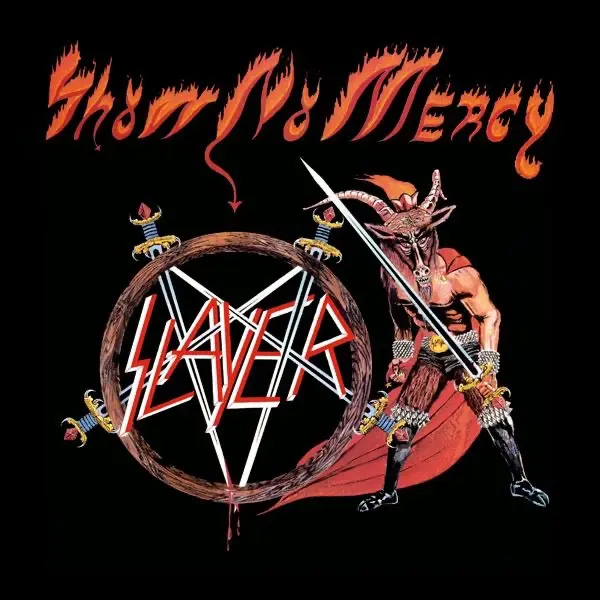 Slayer released their debut album, Show No Mercy, on December 3, 1983, on Metal Blade.
Fast tremolo figures, brisk downstroke patterns, and abrupt rhythmic snaps drive the album through short, hard cuts. Guitarists Kerry King and Jeff Hanneman trade sharp lead breaks, twin-line figures, and fast handoffs over Tom Araya’s bass underpin and Dave Lombardo’s hard backbeat. King and Hanneman wrote the whole record between them, with King alone or in tandem on six titles and Hanneman alone or in tandem on eight.
“Evil Has No Boundaries” opens the album with gang-shouted responses and a quick surge into bladed riff changes, “Die by the Sword” and “Fight till Death” cut the form down to compact attacks, and “Metal Storm / Face the Slayer” stretches the side through an instrumental lead-in before the vocal section hits. “Black Magic” and “Tormentor” turn the second side toward slower, heavier openings before the guitars accelerate again, “Crionics” drives one of the album’s tightest riff patterns, and “Show No Mercy” closes the record on a direct chant title and a short, forceful final run. The lyric program circles Satanic imagery, combat, and violent retribution from start to finish.
A1. “Evil Has No Boundaries” (3:09) — Hanneman, King / King
A2. “The Antichrist” (2:49) — Hanneman / Hanneman, King
A3. “Die by the Sword” (3:36) — Hanneman / Hanneman
A4. “Fight till Death” (3:37) — Hanneman / Hanneman
A5. “Metal Storm / Face the Slayer” (4:53) — King / Hanneman, King (credits apply to “Face the Slayer”)
B1. “Black Magic” (4:03) — King / Hanneman, King
B2. “Tormentor” (3:45) — Hanneman / Hanneman
B3. “The Final Command” (2:32) — King / Hanneman, King
B4. “Crionics” (3:29) — Hanneman, King / Hanneman, King
B5. “Show No Mercy” (3:06) — King / King
Slayer recorded Show No Mercy at Track Record in Los Angeles during November 1983 with engineer and mixer Bill Metoyer. The band handled production, Brian Slagel took executive production, and Gene Hoglan joined the “Evil Has No Boundaries” gang-vocal passage. Araya’s hospital wages and money from Kerry King’s father financed the sessions.
Lawrence R. Reed drew the cover and shared the sleeve concept with Steve Craig, who also handled logo work and part of the photography. Some early vinyl and cassette editions added “Aggressive Perfector,” and the 1987 reissue appended the Haunting the Chapel material.
After release, Slayer took the album onto its first US run with friends and family helping on lights, sound, and backline. That campaign turned Show No Mercy into Metal Blade’s biggest seller at the time and set up the next studio release.
Haunting the Chapel
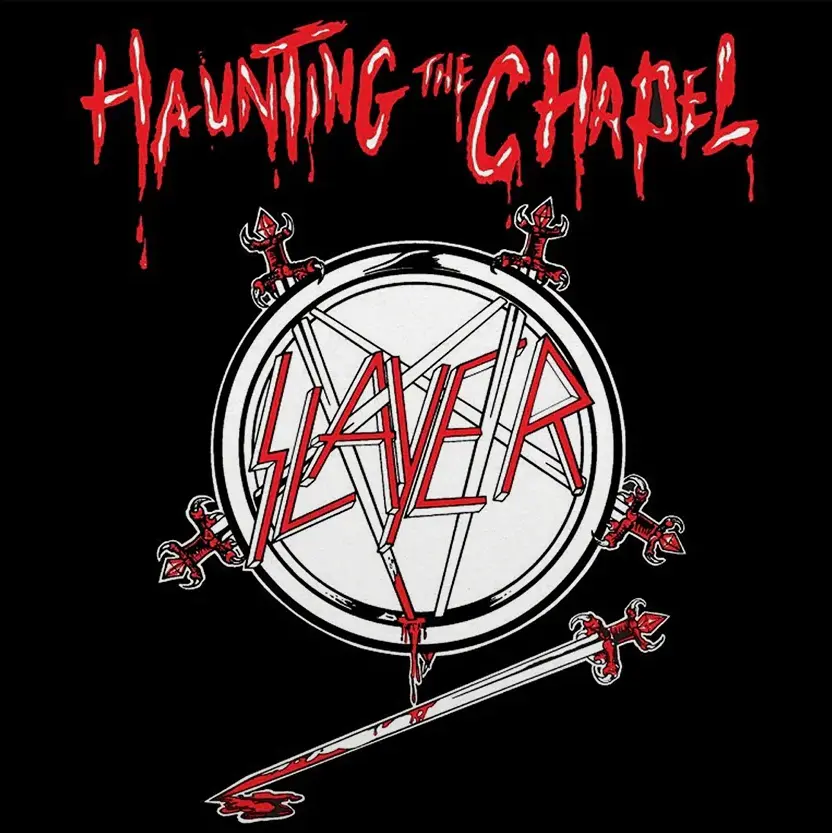 Slayer released the EP Haunting the Chapel in June 1984 on Metal Blade and Enigma.
The record cuts harder and tighter than the debut through steeper riff changes, quicker accelerations, and a darker lyric program. Guitarists Kerry King and Jeff Hanneman drive the whole set with fast tandem figures, abrupt breaks, and sharp lead exchanges, while Tom Araya and Dave Lombardo tighten the underpin into a leaner, more exact attack. King and Hanneman wrote all three tracks.
“Chemical Warfare” opens the EP with its longest and most sustained charge, “Captor of Sin” follows with anti-religious language and a shorter, more compact attack, and “Haunting the Chapel” closes the original issue with the same hostile lyric thrust and concentrated runtime. The release marked a clear turn toward the more severe method that shaped the next phase of the band’s catalog, and both “Chemical Warfare” and “Captor of Sin” stayed in the live set.
A1. “Chemical Warfare” (6:02) — Hanneman, King
B1. “Captor of Sin” (3:29) — Hanneman, King
B2. “Haunting the Chapel” (3:56) — Hanneman, King
Slayer recorded Haunting the Chapel at Track Record in North Hollywood during 1984 with engineer Bill Metoyer. Brian Slagel took executive production, Eddie Schreyer handled mastering, and the sessions also marked Dave Lombardo’s first use of double bass after contact with Gene Hoglan during the recording period.
Vince Gutierrez designed the cover and shared the concept with King and Hanneman. Later reissues and current catalog listings append “Aggressive Perfector,” the earlier Metal Massacre III cut that also appeared on some vinyl and cassette copies of Show No Mercy.
Hell Awaits
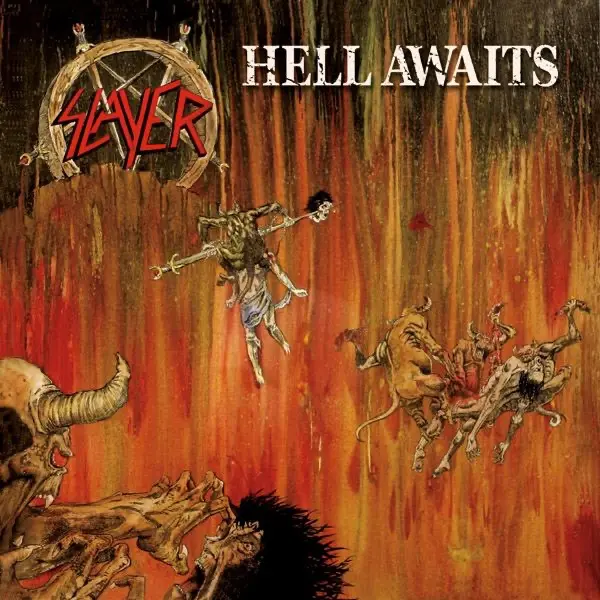 Slayer released their second album, Hell Awaits, on April 8, 1985, on Metal Blade.
Long-form structures, slower openings, abrupt accelerations, and dense riff overlap give the album a more labyrinthine pull than the first records in the catalog. Guitarists Kerry King and Jeff Hanneman thread tandem runs, jagged lead breaks, and sudden handoffs through Tom Araya’s bass underpin and Dave Lombardo’s hard backbeat. King and Hanneman wrote the full set, with Araya joining the lyric sheet on “At Dawn They Sleep” and “Crypts of Eternity.”
The title track opens with backward voices before the main riff enters in slow, stalking steps and later breaks into faster bursts. “Kill Again” and “Praise of Death” drive through compact attacks and quick turns, while “At Dawn They Sleep” stretches the side through a heavier crawl that gives way to double-bass propulsion near the close. “Necrophiliac” cuts the form down to a shorter violent charge, “Crypts of Eternity” builds a broader six-minute span from occult imagery and repeated riff cycles, and “Hardening of the Arteries” closes the album with a fading figure that circles back toward the opening idea. The lyric program stays fixed on hell, Satan, murder, and ritual violence.
A1. “Hell Awaits” (6:16) — King, Hanneman
A2. “Kill Again” (4:56) — King, Hanneman
A3. “At Dawn They Sleep” (6:17) — Araya, Hanneman, King / Hanneman
B1. “Praise of Death” (5:21) — Hanneman, King
B2. “Necrophiliac” (3:46) — Hanneman, King / Hanneman
B3. “Crypts of Eternity” (6:40) — Araya, Hanneman, King
B4. “Hardening of the Arteries” (3:55) — Hanneman
Slayer recorded Hell Awaits at Eldorado Recording in Los Angeles with co-producer Brian Slagel, engineers Ron Fair and Bill Metoyer, assistant engineer Carolyn Collins, and mastering engineer Bernie Grundman. Slagel co-financed the budget with the band, which gave the sessions a larger scale than the self-funded debut.
Albert Cuellar drew the cover, Brian James handled layout design, and Lowell Katz took the band photography. The sleeve places skeletal demonic figures in a hellscape that matches the album’s lyric program.
Reign in Blood
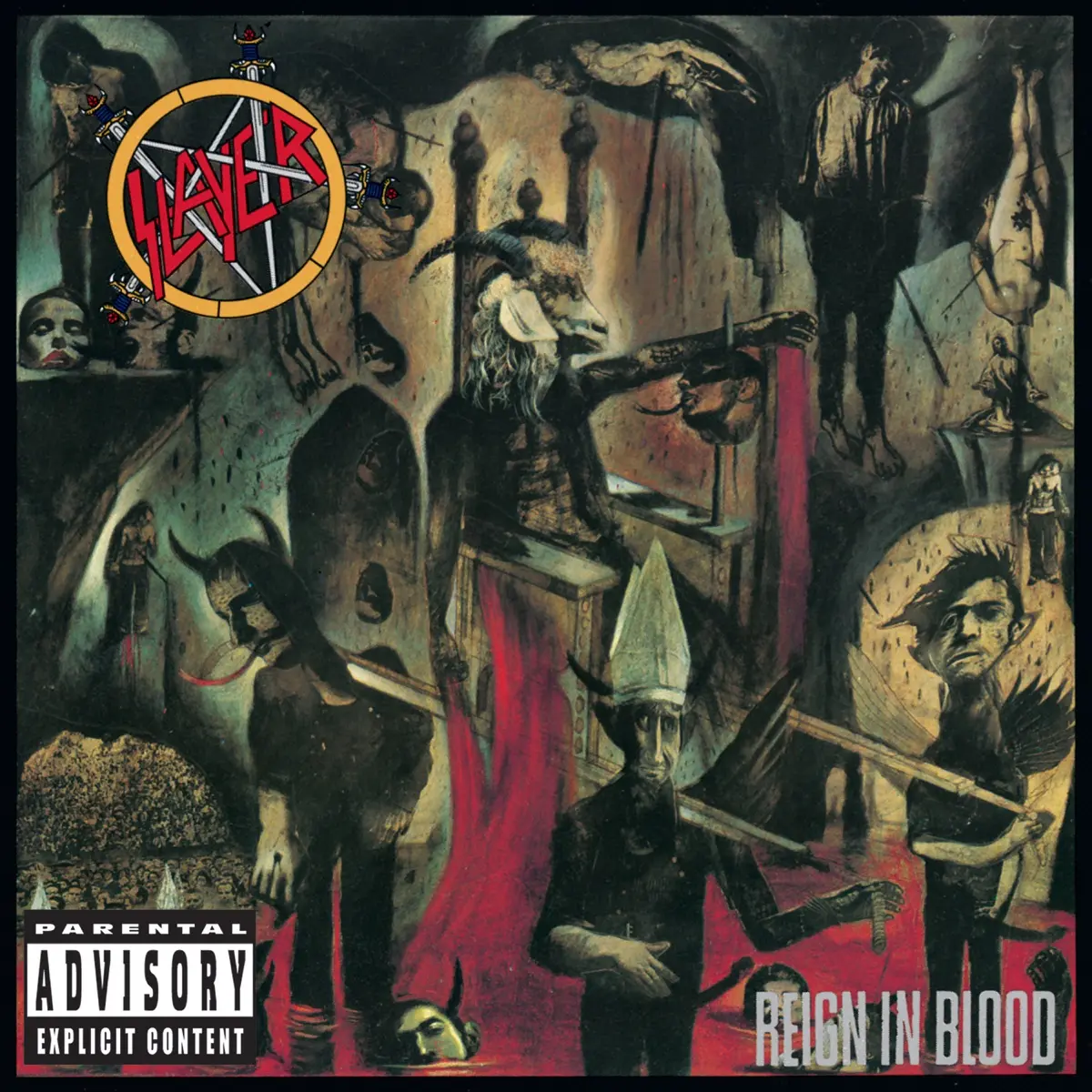 Slayer released their third album, Reign in Blood, on October 7, 1986, on Def Jam.
Short runtimes, hard cuts, dry sonics, and near-constant acceleration give the album a stripped, exact attack. Guitarists Kerry King and Jeff Hanneman fire rapid tandem lines, dive-bomb leads, and sudden handoffs over Tom Araya’s bass underpin and Dave Lombardo’s clipped backbeat. King and Hanneman wrote the full set between them, with Hanneman alone on “Angel of Death” and “Postmortem,” King alone on “Piece by Piece,” and shared credits across much of the balance.
“Angel of Death” opens with Araya’s scream and Jeff Hanneman’s Mengele lyric. “Piece by Piece,” “Necrophobic,” “Altar of Sacrifice,” and “Jesus Saves” compress side one into a chain of sub-three-minute attacks. “Criminally Insane,” “Reborn,” and “Epidemic” keep the same short-form pressure on side two, then “Postmortem” and “Raining Blood” carry the closing stretch, with the latter entering through rain effects and ending under a second storm-sound passage.
A1. “Angel of Death” (4:51) — Hanneman
A2. “Piece by Piece” (2:02) — King
A3. “Necrophobic” (1:40) — Hanneman, King
A4. “Altar of Sacrifice” (2:50) — King / Hanneman
A5. “Jesus Saves” (2:54) — King / Hanneman, King
B1. “Criminally Insane” (2:23) — Hanneman, King
B2. “Reborn” (2:11) — King / Hanneman
B3. “Epidemic” (2:23) — King / Hanneman, King
B4. “Postmortem” (3:27) — Hanneman
B5. “Raining Blood” (4:14) — Hanneman, King / Hanneman
Slayer recorded Reign in Blood at Hit City West in Los Angeles from January through March 1986 with co-producer Rick Rubin, engineer Andy Wallace, and mastering engineer Howie Weinberg. Rubin stripped reverb from the sound and left the finished album at 28:55 across ten tracks.
Larry Carroll drew the sleeve at Rubin’s request. Columbia, Def Jam’s distributor, refused the album over “Angel of Death,” so Geffen handled distribution and left its logo off the cover.
Def Jam issued “Postmortem” as a 12-inch single in Europe during 1986 with the “Criminally Insane” remix and “Aggressive Perfector.”
In April 1987, “Criminally Insane (Remix)” appeared as a UK 7-inch with “Aggressive Perfector.” Reign in Blood reached No. 94 on the Billboard 200 and No. 47 in the UK.
South of Heaven
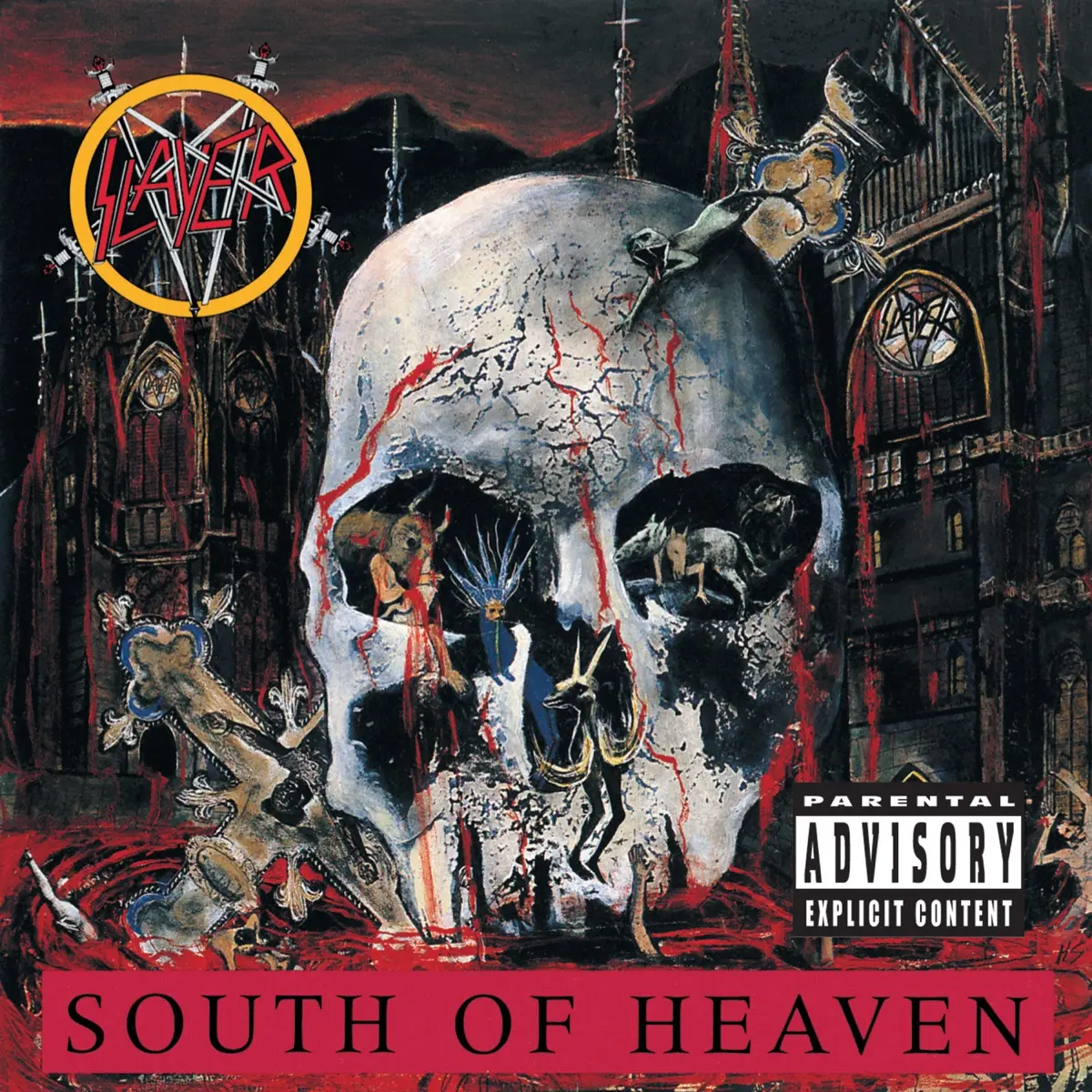 Slayer released their fourth album, South of Heaven, on July 5, 1988, on Def Jam.
Lower-tempo riff patterns, wider pauses, clean-guitar passages, and more measured vocal lines give the album a broader, heavier span than the band’s first three records. Guitarists Kerry King and Jeff Hanneman thread tandem runs, clipped lead breaks, and abrupt handoffs over Tom Araya’s bass underpin and Dave Lombardo’s hard backbeat. Araya, Hanneman, and King split the writing across nine originals, and B9 carries Glenn Tipton, Rob Halford, and K. K. Downing’s “Dissident Aggressor.”
A1. “South of Heaven” (4:58) — Araya, Hanneman
A2. “Silent Scream” (3:07) — Araya, Hanneman, King
A3. “Live Undead” (3:50) — Araya, King, Hanneman
A4. “Behind the Crooked Cross” (3:15) — Hanneman
A5. “Mandatory Suicide” (4:05) — Araya, Hanneman, King
B1. “Ghosts of War” (3:53) — King, Hanneman
B2. “Read Between the Lies” (3:20) — Araya, King, Hanneman
B3. “Cleanse the Soul” (3:02) — Araya, King, Hanneman
B4. “Dissident Aggressor” (2:35) — Tipton, Halford, Downing
B5. “Spill the Blood” (4:48) — Hanneman
Slayer recorded South of Heaven at Hit City West in Los Angeles and Chung King in New York City from December 1987 through February 1988 with co-producer Rick Rubin. Andy Wallace mixed the album, and Howie Weinberg mastered the final release.
Larry Carroll and Howard Schwartzberg designed the sleeve, and Glen E. Friedman supplied the back-cover photograph. The front image draws from KNM-ER 1470, the archaic human skull discovered in Kenya during 1972.
Def Jam serviced “South of Heaven” and “Mandatory Suicide” as singles during 1988. The album reached No. 57 on the Billboard 200, and later earned gold status in the US and silver status in the UK. It also closed Slayer’s Def Jam run before the band shifted to Rick Rubin’s Def American label.
Seasons in the Abyss
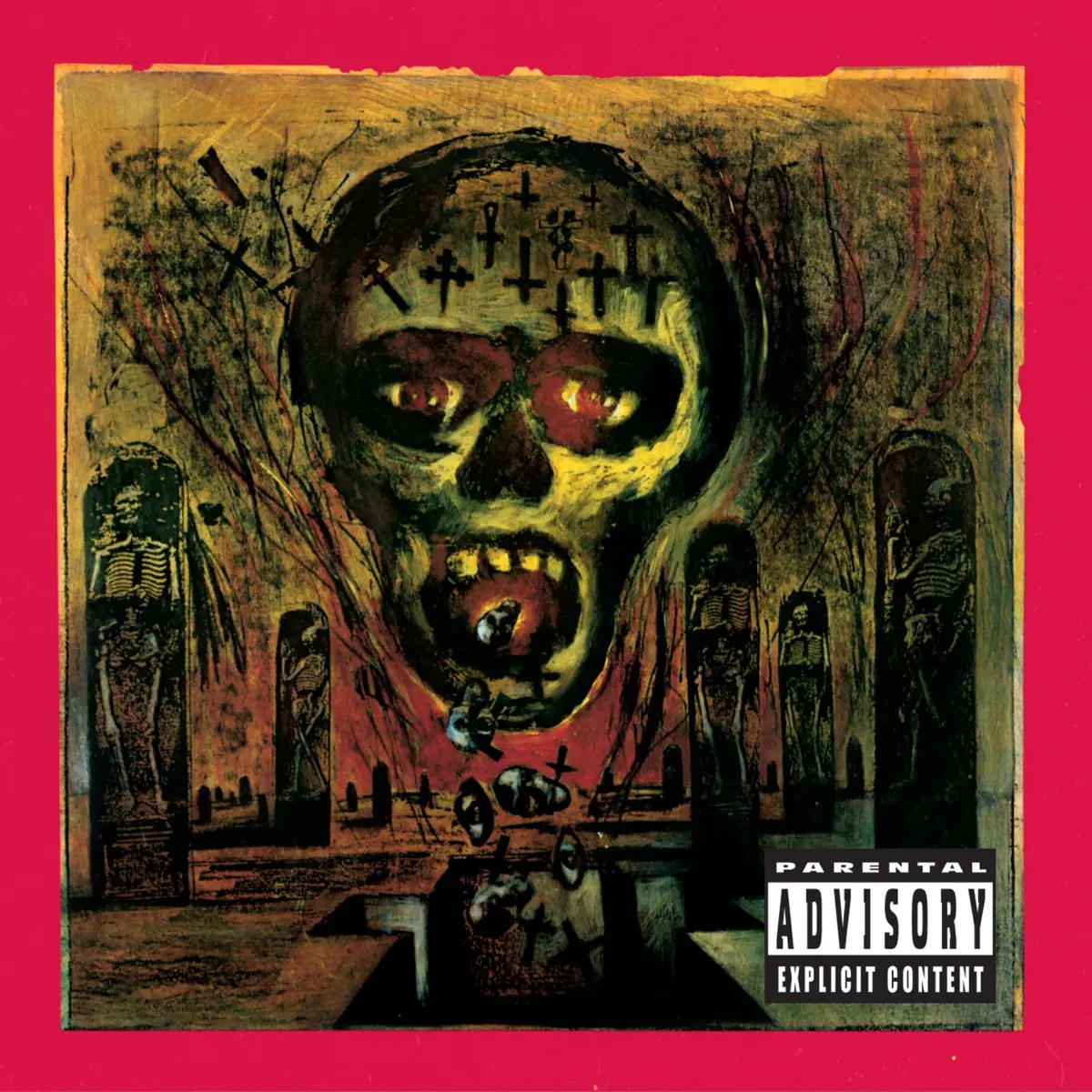 Slayer released their fifth album, Seasons in the Abyss, on October 9, 1990, on Def American.
Fast barrages and mid-tempo crawls alternate across the album, with longer riff chains and wider pauses than the band had used on its earlier records. Guitarists Kerry King and Jeff Hanneman split the album between tandem runs, clipped lead breaks, and abrupt handoffs over Tom Araya’s bass underpin and Dave Lombardo’s double-bass attack. Araya, Hanneman, and King divide the writing across the full set.
“War Ensemble” opens the record with its quickest barrage and its most direct war lyric. “Dead Skin Mask” lowers the tempo and fixes its lyric on Ed Gein, “Temptation” carries the accidental doubled vocal that stayed in the final mix, and the title track stretches the closing side through a longer, slower riff cycle. “Blood Red,” “Spirit in Black,” and “Born of Fire” return the album to short, hard attacks between those broader cuts.
A1. “War Ensemble” (4:51) — Araya, Hanneman
A2. “Blood Red” (2:47) — Araya, Hanneman
A3. “Spirit in Black” (4:07) — King
A4. “Expendable Youth” (4:09) — Araya, King
A5. “Dead Skin Mask” (5:20) — Araya, Hanneman
B1. “Hallowed Point” (3:23) — Araya, Hanneman, King
B2. “Skeletons of Society” (4:40) — King
B3. “Temptation” (3:25) — King
B4. “Born of Fire” (3:07) — Hanneman, King
B5. “Seasons in the Abyss” (6:34) — Araya, Hanneman
Slayer recorded Seasons in the Abyss at Hit City West, Hollywood Sound, and Record Plant in Los Angeles from March through June 1990 with producer Rick Rubin, co-producer/engineer/mixer Andy Wallace, assistant engineers Chris Rich, David Tobocman, and Allen Abrahamson, and mastering engineer Howie Weinberg. Matt Polish added the child voice on “Dead Skin Mask.”
Larry Carroll did the artwork and illustrations, Robert Fisher designed the cover with photography by Sunny Bak and Marty Temme.
Def American issued “War Ensemble” as a single in 1990. “Spirit in Black” appeared as another single from the album.
On the later leg of the campaign, “Seasons in the Abyss” became the third single. Gerard Di Puglia’s video placed the band at the Giza Plateau in Egypt, and the UK release reached No. 51. Seasons in the Abyss reached No. 40 on the Billboard 200, No. 18 on the UK Albums Chart, and gold status in the US and Canada.
Discography:
- Show No Mercy (1983)
- Haunting the Chapel (EP, 1984)
- Hell Awaits (1985)
- Reign in Blood (1986)
- South of Heaven (1988)
- Seasons in the Abyss (1990)
- Decade of Aggression: Live (2CD, 1991)
Sources:
Artist/Album Pages:
Pale Acute Moon was a Japanese symphonic-rock band behind the 1985 album Newtopia on Monolith Comm...
The Cars were an American new wave band that released six albums between 1978 and 1987 on Elektra. T...
Haruomi Hosono — 細野晴臣 (July 9, 1947) — is a Japanese multi-instrumentalist, songwriter, and produc...
Altered Images were a Scottish new wave band that released three albums between 1981 and 1983 on E...
Lakeside was an American soul-funk band from Dayton, Ohio, that released a self-titled debut on AB...
Paul Young is an English soul-pop singer who first recorded with Streetband, which made two albums...
Scapa Flow was a Finnish symphonic-folk band that released the 1980 album Uuteen Aikaan on Kompass...
Enchantment was an American soul group from Detroit that released six albums between 1976 and 1983...
Manfred Schoof (born April 6, 1936) is a German trumpeter and bandleader with over 200 album credi...
Space was a French electro/space-funk band that released four albums between 1977 and 1980 on Vogu...
The Commodores were an American soul-funk band from Tuskegee that released eleven studio albums (1...
Fleetwood Mac are an English–American rock band formed in 1967 by drummer Mick Fleetwood and guitari...