

Mo was the performance moniker of Moe Whittemore, an American musician from Indiana who ran 700 West Recording, a 1970s label behind regional titles by Primevil and Sailor. In 1976, he released his own album in a limited run of 200 copies. The album gained wider circulation in 2014 courtesy of Greek archivists Anazitisi Records.
Background
Maurice James Whittemore Jr. was born on September 1, 1934, in Richmond, Virginia. He earned an electrical-engineering degree from Purdue University in 1956 and joined Allison Transmission. Later engineering posts at Delco Electronics and RCA covered audio circuits and optical recording systems, including studio monitors and low-noise amplifiers.
The family settled in New Palestine, Indiana, in 1969, three years before Whittemore opened 700 West Recording in their home. 700 West supplied demo and album sessions alongside instrument repair. The business also prepared lead sheets and distributed records. 700 West Music handled ASCAP publishing for area composers.
Whittemore equipped the room with custom signal processors and a hybrid analog–digital synthesizer for client recordings and advertising work. He then selected ten publisher’s demos for a self-issued 700 West LP.
First Album
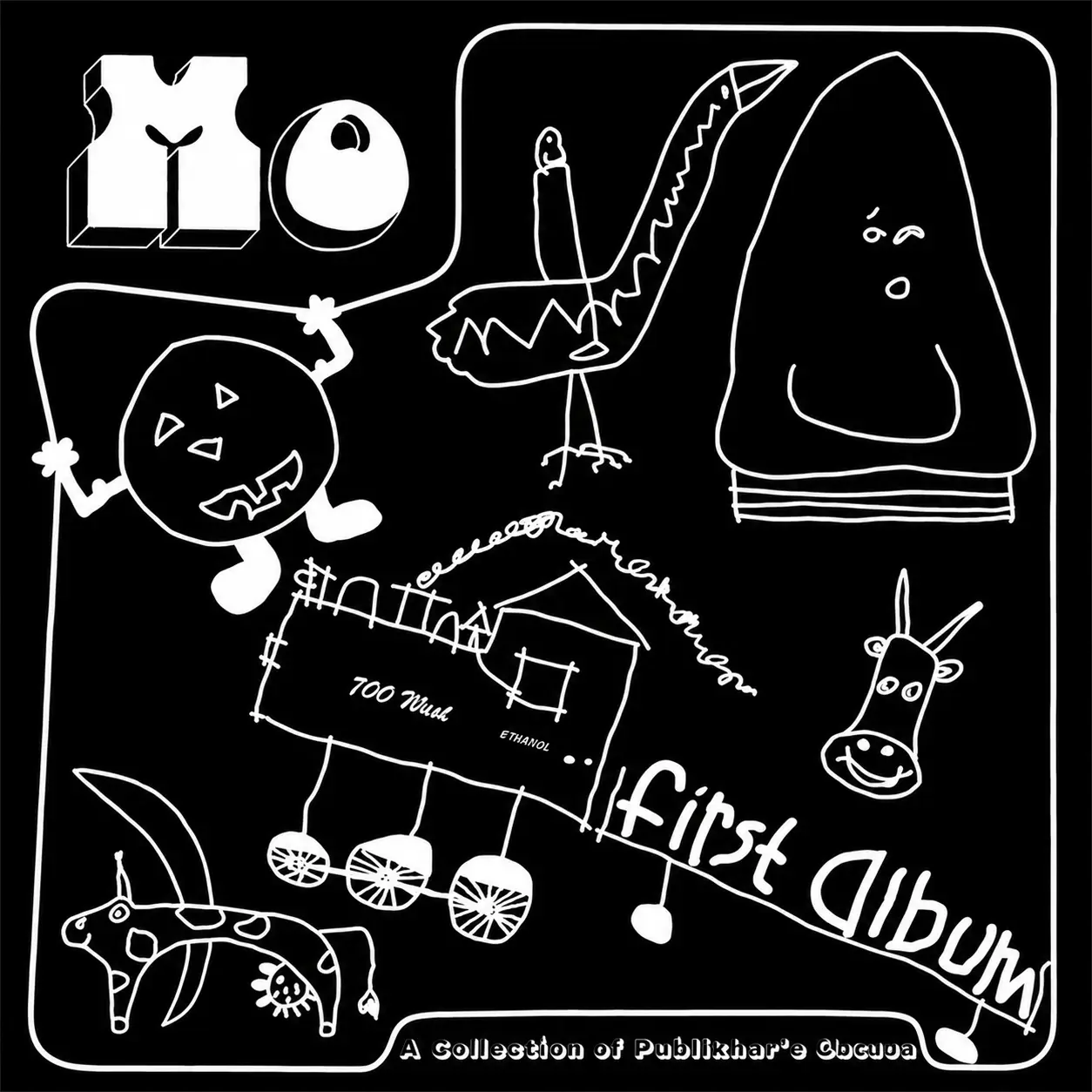 Mo released his singular album, First Album, in 1976 on 700 West as a private pressing.
First Album combines Whittemore-led electronic pieces with client demos that range from avant-rock and soul songs to jazz-funk and electro-space instrumentals. He colors the tracklist with piano, electric oboe, homemade synthesizer, and sundry keyboards. His rotating studio cast includes soul singer Tony Black, while “Make a Little Wine” reuses a Match II master from an earlier 700 West single.
“Nowhere to Go” churns through low electronic loops, a heavy beat, and electric oboe figures. “K2 – 3rd Movement” cycles through Aeolian synthesizer figures and successive timbral shifts. “Slammer” prowls through Phrygian figures as unison singing doubles a reed line over dense backing. “Congratulations” sidesteps through five-beat meter with satirical lines and late mock-DJ interjections. “Muscle Pumpkin” coils through a free-form synthesizer barrage.
“Make a Little Wine” struts through talk-sung lines and female replies over beat-led backing. “Don’t Ya Think About Leavin’” ambles through pedal-steel turns and electronic backing beneath Bill Johnson’s clear lead. “Cross Country” skips through instrumental guitar interplay and pedal-steel figures. “A Little While” eases through a sentimental opening and revs midway into brisk improvisation and sharply contoured lines.
A1. “Nowhere to Go” (4:31)
A2. “K2 – 3rd Movement” (2:20)
A3. “Slammer” (6:21)
A4. “Congratulations” (3:24)
A5. “Muscle Pumpkin” (3:07)
B1. “Make a Little Wine” (2:54)
B2. “Don’t Ya Think About Leavin’” (3:12)
B3. “Cross Country” (2:41)
B4. “Check Me Out” (3:38)
B5. “A Little While” (2:41)
The ten masters came from separate sessions at 700 West Recording in New Palestine, with Whittemore as producer and engineer. He used a four-track system with self-built pitch shifters and a hybrid modular synthesizer. Custom circuitry connected live sources to the electronic equipment. Singer-songwriter J. Michael Henderson produced To Make the Night Complete at the same studio while Whittemore engineered the four-track sessions. Sequoiah also recorded a self-titled private LP at 700 West in the same period.
First Album appeared in a black sleeve with white line drawings of a pumpkin-headed figure and bird above a train marked “700 West.” A cow and abstract figure occupy the right side. The lower border identifies the record as “A Collection of Publisher’s Demos.”
700 West first issued “Make a Little Wine” under the Match II name (b/w “Incident”). Whittemore reused the A-side on First Album; the single supplied early WTLC airplay for the studio.
Anazitisi Records reissued First Album in 2014 as a 180-gram LP limited to 200 copies. The edition added the archival “Wait ’Til Yesterday,” a 1978 recording with Primevil guitarist Larry Lucas and Ebony Rhythm Band drummer Matthew Watson, plus a four-page insert.
Later Activity
Whittemore closed 700 West in December 1983 as a recession reduced demand for band demos. His return to Butler University in 2003 led to a master’s degree in music composition. At the Phillips Music Guild, he mentored oboe and English-horn students and served on the board. Whittemore died on January 20, 2022, after a career that linked engineering with independent recording and composition.
Discography:
- First Album (1976)
Sources:
Artist/Album Pages:
Gebärväterli was a German jazz-rock band that released the 1978 album Im Tal der Emmen on Brutkas...
Tim Moore is an American singer/songwriter who emerged beside Daryl Hall in Gulliver and released ...
Azimuth was a contemporary jazz trio featuring English pianist John Taylor and his vocalist wife N...
Abraxis was a Belgian jazz-rock band that released a self-titled album in 1976 on IBC. Members: Ch...
Washington Jamb Band was an American soul-funk band that issued two 1976 singles and the 1977 albu...
Brass Construction was an American soul-funk band from Brooklyn, best known for their crossover hi...
Novos Baianos were a Brazilian samba-psych band that debuted with the 1970 RGE album É ferro na bo...
The Movies were an American pop-rock trio that released a self-titled album in 1976 on Arista, fol...
Reggie Lucas (Feb. 25, 1953 — May 19, 2018) was an American jazz-funk guitarist and producer from...
Daryl Hall is an American vocalist, musician, songwriter, and producer from Philadelphia who rose ...
Mess was an Estonian symphonic/space-rock ensemble, active in the mid-Seventies. In 1976, they recor...
Teri DeSario (born Nov. 27, 1951) is an American pop vocalist from Miami who emerged on Casablanca...