

Westfauster was an American psych-rock trio from Cincinnati that released the 1971 album In a King’s Dream on Nasco Records.
Members: Michael Newland (flute, saxophone, vibraphone), Stephen Helwig (drums, vocals), C. W. Fauster (piano, harpsichord, bass, keyboards, vocals)
Background
Westfauster formed in Cincinnati, Ohio, in the late 1960s as a trio centered on multi-instrumentalist C.W. Fauster (piano, harpsichord, bass, keyboards, vocals), drummer/vocalist Stephen Helwig, and woodwind player Michael Newland (flute, saxophone, vibraphone). Fauster and Newland first collaborated as students in the Cincinnati area, where Fauster trained in classical piano and composition. Helwig, a former member of local act Haymarket Riot, joined after meeting the pair through mutual acquaintances on the regional live circuit.
Initially operating without a guitarist, Westfauster developed a chamber-rock sound built on baroque keyboard textures, modal flute leads, and tight vocal harmonies. Managed by A. Jaye, they recorded demos in 1970 and secured a deal with Nasco Records, a subsidiary of Nashville-based Crescent City Sound.
In a King’s Dream
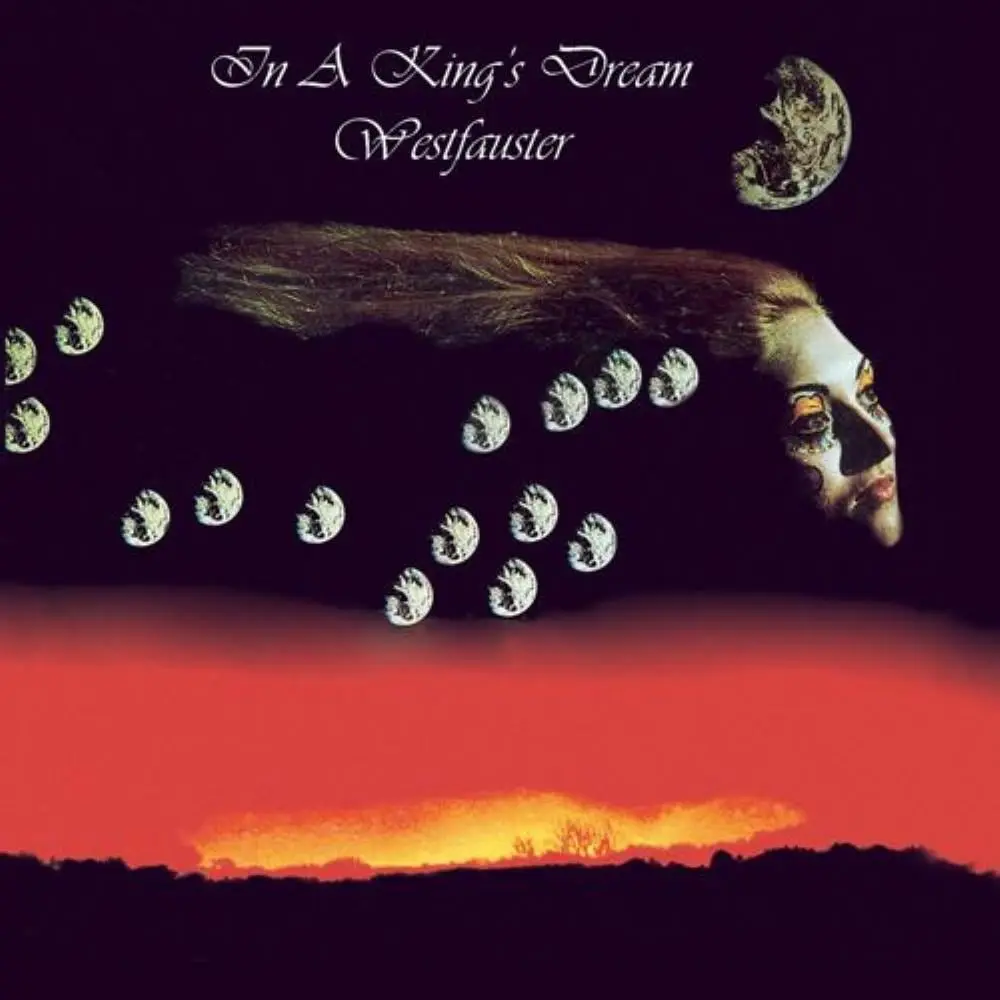 Westfauster released their singular album, In a King’s Dream, in June 1971 on Nasco.
Westfauster recorded In a King’s Dream as a trio without guitars, relying on piano, harpsichord, organ, vibraphone, flute, and saxophone for its tonal foundation. The band paired jazz-informed phrasing with soft harmonic layering and frequent instrumental interludes, particularly on the extended pieces “Everyday” and the title track.
“Everyday” spans eight minutes of shifting piano-flute overlays and blended organ textures, while “In a King’s Dream” contrasts with lower brass voicings and slower development. “Blind Man’s Epitaph” centers on harpsichord and choral-style vocals, and “Low Sun” draws from baroque-pop arrangement. Throughout the set, Westfauster uses subtle dynamic variation and controlled pacing, maintaining a soft, chamber-like atmosphere marked by close vocal harmonies and restrained instrumentation.
A1. “Where Are You” (3:26)
A2. “Everyday” (8:55)
A3. “Blind Man” (3:16)
A4. “Blind Man’s Epitaph” (2:54)
B1. “In a King’s Dream” (10:08)
B2. “A Sunny Day” (3:18)
B3. “Low Sun” (2:53)
B4. “Did It or Didn’t It (Take Us High)” (5:09)
Sessions occurred at Woodland Studios in East Nashville, where C.W. Fauster co-produced the album with Stanley B. Hertzman, who oversaw the 1970 Nasco release by Whalefeathers. Woodland staffer Lee Hazen engineered In a King’s Dream back-to-back with Jukin’, the debut Manhattan Transfer album.
Aftermath
Westfauster disbanded after the album’s release. The members left music apart from Stephen Helwig, who co-produced and arranged the 1975 single “Don’t You Make Me Blue” (b/w “Has Love Been Here Before”) by Buckeye soulsters The Fabulous Determinations.
Discography:
- In a King’s Dream (1971)
Sources:
Artist/Album Pages:
Maxayn was an American soul-funk/psych band that released the 1972–74 Capricorn albums Maxayn, Min...
Marva Whitney (May 1, 1944 — December 22, 2012) was an American soul singer who toured with the J...
Chilliwack was a Canadian rock band from Vancouver that debuted with a 1970 self-titled album on P...
Ginger Baker’s Air Force was an English jam-rock big band, formed by drummer Ginger Baker after serv...
Midnight Sun was a Danish art-rock band that released three albums on Sonet between 1971 and 1974....
Eero Koivistoinen (Jan. 13, 1946) is a Finnish jazz-rock saxophonist, composer, and bandleader who...
Deep Purple are an English hard-rock band formed in 1967. They emerged at the height of psychedelia ...
Kraftwerk are a German electronic group formed in Düsseldorf by Ralf Hütter and Florian Schneider,...
Dusty Springfield (April 16, 1939 – March 2, 1999) was an English singer with a career in pop that s...
Elf was an American hard-rock band that released a self-titled 1972 album on Epic, followed by the 1...
49th Parallel was a Canadian pop-psych band that released multiple singles on RCA and Venture duri...
Lost Nation was an American post-psych band that released the 1970 album Paradise Lost on the Rare E...
I was a roadie for these guys when they were located in Windsor Ontario .
They were playing locally , the fellows were Chuck,Bo and Roger. Chuck was married and Linda was his wife.
While in Windsor they were working at going back to the USA.
They continued on .
I knew Chuck was from Ottawa and in 79 or 80 ,I tracked him down thru the musicians union , as I was in town playing bass in a band .
We exchanged greetings and that was the last time I’ve heard from him.