

The Abyssinians are a Jamaican roots-reggae act that released the 1976 album Satta Masa Gana, followed in 1978 by Arise. Formed in Kingston in 1968 by Bernard Collins and brothers Donald and Lynford Manning, they became known for spiritual themes and use of Amharic lyrics that reflected Rastafarian doctrine. After their initial run, they regrouped in the 1990s and resumed recording and touring, sustaining their reputation as one of the genre’s defining vocal trios.
Members: Bernard Collins, Donald Manning, Linford Manning, Carlton Manning, David Morrison
Background
The Abyssinians formed in Kingston in 1968 when Bernard Collins and Donald Manning began rehearsing together with a schoolmate. When the third singer dropped out, Donald’s brother Linford Manning joined. Both Mannings had earlier sung in Carlton and the Shoes, the group led by their older brother Carlton.
Carlton and the Shoes first recorded as Carlton and His Shades, but a printing error on their debut 7″ changed the name. After one single for Sonia Pottinger, the group cut “Love Me Forever” b/w “Happy Land” for Studio One in 1968. The record became a Jamaican hit and secured their place in the transition from rocksteady to reggae. Carlton remained at Studio One as a guitarist while Donald and Linford went forward with Collins as The Abyssinians.
1969–1975 Singles
The Abyssinians’ first recording was “Satta Massagana,” rooted in Carlton’s “Happy Land” and sung partly in Amharic. Coxsone Dodd produced the original March 1969 session but refused to release it. Later that year, the group issued “Satta-A-Nasa-Gana” b/w “Jerusalem” on their Clinch label, followed by alternate pressings on blank-label promos and a variant coupling with “Thunder Storm.” The group retrieved the Studio One tapes in 1971 and issued further takes, spawning multiple versions by themselves and others.
In 1971, they paired “Declaration of Rights” with Sound Dimension’s “Declaration (Ver.)” for Studio One. The same year Clinch issued “Mabrak” b/w “Issat,” a scripture-based chant, and “Licken Sticks” b/w “Sticks Version” under Bernard Collins and the Abyssinians with the Massigians. A fresh cut of “Satta Amassa Gana” b/w “Thunder Storm” appeared on Clinch that year as well.
Through 1972, the group released several new singles and versions on Clinch, including “Let My Days Be Long” b/w “Long Days Version,” “Long Day” b/w “Version,” and “Lego Beast” b/w “Lego Beast Version.” Studio One reissued “Declaration of Rights” that year with a dub B-side, while Sir Harry voiced a deejay spin called “Musical Rights” for Clinch. Also in 1972, the group cut “Reason Time” b/w “Reason Version” for Rebel, now a rare collector’s single.
In 1973 they issued “Yim-Mas-Gan” b/w Now Generation’s “Crank Shaft” on Secret Agent, echoing the Amharic phrasing of “Satta.” The following year Bernard Collins fronted “The Good Lord” on Clinch, and the trio cut “Love Comes and Goes” b/w a dub version for Arab.
They returned in 1975 with two more Amharic-influenced titles: “Satta Me No Born Yah” b/w “Satta Satta Yah” on Clinch, and “Tenayistillin Wandimae (Greetings My Brethren)” b/w “Tenayistillin” on Antrim. In 1976, they released “Prophesy” b/w “Revelation Dub” on Clinch under the name Satta and the Abyssinians, and “Abendigo” b/w “Abendigo Dub” on Penetrate, setting the stage for their first full-length album.
Satta Amasagana
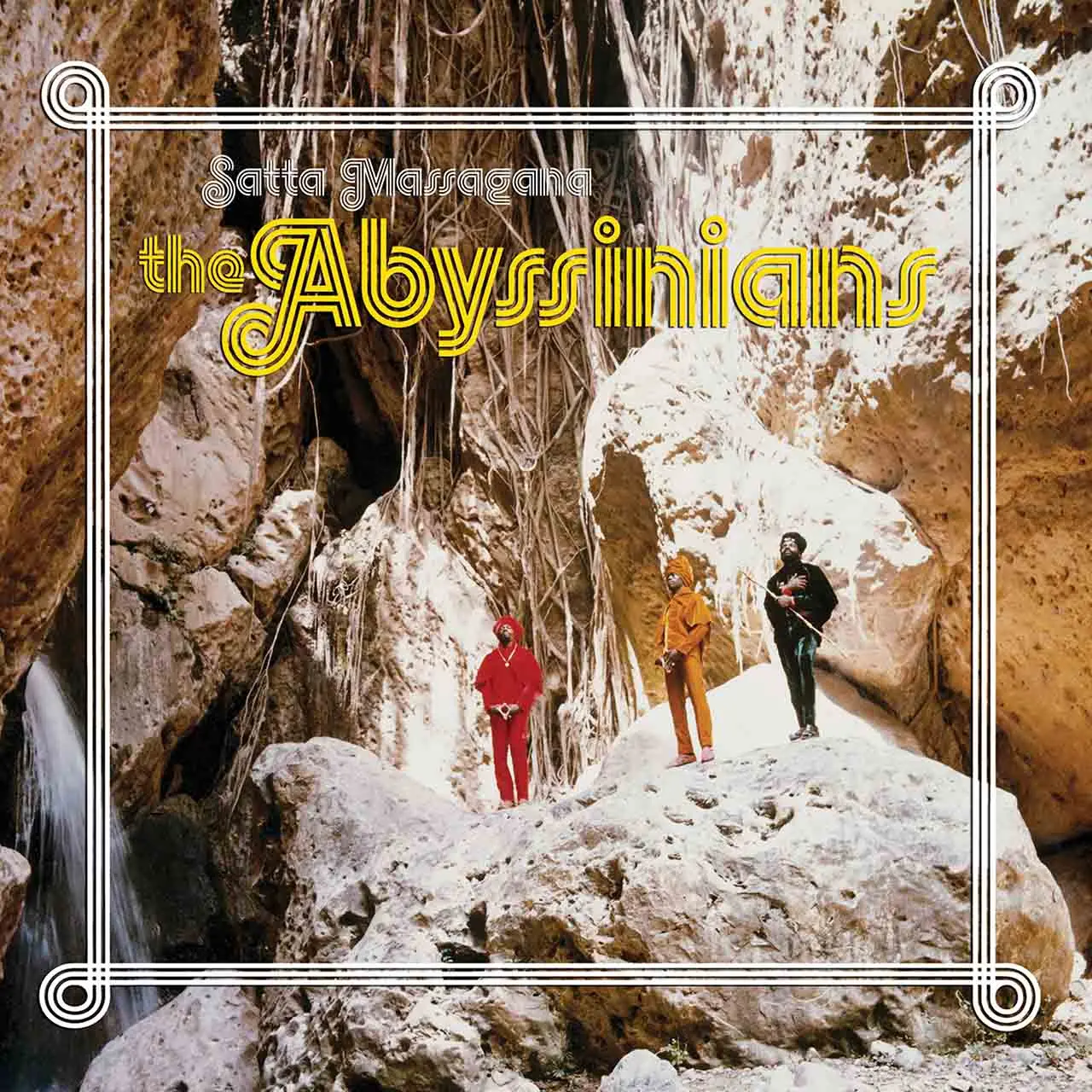 The Abyssinians first released their debut album, Satta Amasagana, in 1975 as a white-label test press. In 1976, the album appeared on Penetrate Records (Jamaica) and Jam Sounds (US).
The record marked the trio’s entrance into roots reggae with a spiritual focus that drew heavily from Rastafarian faith and Ethiopianist identity. Their vocal blend carried both devotional weight and melodic precision, setting them apart from rougher-sounding contemporaries.
Bernard Collins and brothers Donald and Lynford Manning wrote most of the material. The only song not from their hands, “Good Lord,” came from outside the group.
The album divides between solemn invocations and rallying declarations. “Satta Amasagana” takes the form of a hymn recast in reggae rhythm, while “Declaration of Rights” voices political defiance in anthem-like phrases. Tracks such as “Forward Onto Zion” and “Know Jah Today” emphasize spiritual grounding, and “Black Man Strain” speaks directly to economic and racial hardship. The harmonies thread through these themes with a clarity that owes as much to American soul tradition as to Jamaican ritual chant.
A1. “Satta Amassagana” (3:15) is an Amharic phrase (the liturgical language of the Ethiopian Orthodox Church) that translates to “He Gave Praise” or “Give Thanks.”
A2. “I and I” (3:20)
A3. “African Race” (2:45)
A4. “Black Man Strain” (2:34)
A5. “Yimasgan” (3:25)
B1. “Declaration of Rights” (3:15)
B2. “Good Lord” (3:05)
B3. “Forward-Onto-Zion” (3:30)
B4. “Know Jah Today” (2:37)
B5. “Abendigo” (3:15)
Sessions occurred at an unspecified Kingston studio with Clive Hunt producing and Bruce Davidson engineering. Hunt also contributed flute, horns, and keyboards, while Geoffrey Chung, Tyrone Downie, Earl “Chinna” Smith, Robbie Shakespeare, and Leroy “Horsemouth” Wallace were among the musicians shaping the backing tracks.
The title track appeared earlier as a Clinch label single, laying the foundation for the album’s release. “Declaration of Rights” likewise circulated in single form and grew into one of the band’s best-known works.
Arise
 The Abyssinians first released their second album, Arise, in 1978 on Tuff Gong (Jamaica) and Front Line, the reggae division of Virgin Records.
The record shifted from the darker solemnity of Satta Amasagana toward a lighter and more contemplative tone. Harmonies remained central, framed by steady guitar-and-organ patterns, with arrangements alternating between devotional calm and sharper political themes.
Donald and Lynford Manning handled the majority of the songwriting. Bernard Collins contributed to several tracks and took production duties on his share, while outside writing credits are not present.
Songs divide between meditative hymns and direct commentaries. “Mightiest of All” carries the heavier pulse and spiritual cadence closest to their debut’s style, while “Meditation” pares back instrumentation for a quieter, more reflective space. “Jah Loves” layers bright guitar figures beneath a dense weave of horns and percussion. In contrast, “South African Enlistment” addresses political struggle with brevity and urgency.
A1. “Oh Lord” (3:10)
A2. “This Land Is For Everyone” (3:54)
A3. “Mightiest of All” (3:50) – closer in style to Satta Amasagana with a heavier cadence
A4. “Meditation” (2:55) – stripped-back arrangement emphasizing vocal harmonies
A5. “Wicked Men” (3:05)
B1. “Jah Loves” (4:04) – built on bubbling guitar figures beneath full horn textures
B2. “Dem A Come” (3:56)
B3. “South African Enlistment” (2:26) – concise, politically urgent piece
B4. “Hey You” (4:26)
B5. “Let My Days Be Long” (3:30)
Sessions occurred in Kingston with Donald and Lynford Manning producing the majority and Bernard Collins handling the remainder. Mixing alternated between Boris Gardiner and Errol Thompson. Instrumental support came from Earl “Chinna” Smith, Sly Dunbar, Robbie Shakespeare, Lloyd Parks, George Fullwood, Bongo Herman, and horns arranged by Tommy McCook, Cedric “Im” Brooks, Glen DaCosta, and Bobby Ellis.
Following the album, internal rifts grew. Collins departed soon after, with Carlton Manning stepping in for live performances at Reggae Sunsplash 1979 before the group split the following year.
Discography:
- Satta Masa Gana (1976)
- Arise (1978)
- Forward (1982)
Sources:
Artist/Album Pages:
Popol Vuh was a German new age group led by Florian Fricke. They debuted as a trio with the 1971 Mo...
Margie Joseph is an American soul singer who had R&B hits with the 1973–74 singles "Come Lay S...
Third World are a Jamaican roots-reggae band, established abroad with the 1976–78 Island albums Th...
Happy the Man is an American symphonic-rock band that released the 1977–78 Arista albums Happy the M...
Zomby Woof was a German symphonic-rock band behind the 1977 album Riding on a Tear. Members: Ulri...
The Rich Kids were an English rock band that made the 1978 EMI album Ghosts of Princes in Towers. ...
Harry Nilsson (1941–1994) was an American singer/songwriter who released fourteen albums between 1...
Shawne Jackson is a Canadian soul singer who released three singles between 1974 and 1983 around h...
Fiori-Séguin were a Québécois symphonic-folk duo of ex-Harmonium guitarist/singer Serge Fiori and ...
Eela Craig was an Austrian rock band that made a 1971 post-psych album and the 1974 single "Storie...
Ayers Rock was an Australian jazz-rock band from Melbourne that released two albums on Mushroom: B...
Vytas Brenner (Sept. 19, 1946 — March 18, 2004) was a Venezuelan keyboardist, guitarist, and compo...