

Happy the Man is an American symphonic-rock band that released the 1977–78 Arista albums Happy the Man and Craft Hands, both comprised of lavish, intricate pieces (mostly instrumental). Their near-completed 1979 third album appeared posthumously in 1983 as 3rd – “Better Late…”
Keyboardist Ken Watkins joined Camel for their 1979 album I Can See Your House from Here, then went solo with the 1981–82 albums Labyrinth and Frames of Mind. Demos from HtM’s pre-Arista period appear on the archival CD Beginnings.
Members: Stan Whitaker (guitar, lead vocals), Rick Kennell (bass), Frank Wyatt (keyboards, saxophone, woodwinds), Kit Watkins (keyboards, flute, 1972-79), Mike Beck (percussion, drums, 1972-77), Cliff Fortney (vocals, 1972-75), David Bach (keyboards, 1972), Dan Owen (vocals, 1975), Ron Riddle (drums, 1977-78), Coco Roussel (drums, 1978-79)
Background
Happy the Man had its roots in Shady Grove and Zelda, two unrecorded early Seventies bands that operated 4,000 miles apart on different continents.
In 1972, American teenager Stan Whitaker (the son of an Army officer) lived with his family in Germany, where he attended school and played guitar in Shady Grove, a rock band with keyboardist and fellow expat David Bach. One night, bassist Rick Kennell (a young draftee stationed in Germany) saw them perform and introduced himself.
Whitaker and Kennell discovered their mutual love for English symphonic rock and decided to form a band together in the states. Stan was due back sooner than Rick, who handed the contact info of his Zelda bandmates: drummer Mike Beck and singer–flutist Cliff Fortney. Both musicians relocated from Fort Wayne, Indiana, to join the new band in Harrisonburg, Virginia, where Whitaker enrolled at James Madison University.
On his first day at JMU, Whitaker befriended pianist–saxophonist Frank Wyatt, a classmate under Dr. George West (JMU’s “King of Jazz” from 1970–1996)>. Stan’s ability to name intervals by ear impressed Frank, who joined the new band. Meanwhile, Bach cleared for another BMU attendee, keyboardist Kit Watkins (b. 1953), who studied piano from age five to thirteen and played in multiple amateur bands. Whitaker introduced Watkins (an avowed Yes and ELP fan) to the music of Genesis, Gentle Giant, and Van der Graaf Generator.
In January 1974, Rick Kennell arrived in Harrisonburg. The now-complete band named itself Happy the Man, a phrase picked by Whitaker’s brother, Ken, in reference to the biblical verse “Happy is the man who finds wisdom” and the early 19th-century tragic play Faust by German polymath and Romantic playwright Johann Wolfgang von Goethe (1749–1832). (Genesis also used the phrase as the title to a rare 1972 non-album folk single.)
Early Recordings
Happy the Man rehearsed at their shared band house at Rockbridge Circle, Harrisonburg. Their early setlist included covers of Genesis (“Watcher of the Skies”), King Crimson (“21st Century Schizoid Man”), and VdGG (“Man-Erg”).
In February 1974, they taped two originals — Fortney’s “Partly the State” and the Wyatt–Whitaker epic “Gretchen’s Garden” — with two mics into a 2-track recorder. In April, they performed at the Menninite Broadcasting headquarters on Virginia Avenue, where staffer Abe Ritenhouse engineered two songs: Wyatt’s “Passion’s Passing” and Fortney’s “Don’t Look to the Running Sun.”
Fortney, the vocalist on all four tracks, left soon after the Menninite session to focus on flute studies. Happy the Man hired singer Dan Owen, a friend of the Zelda camp from their days in Fort Wayne. Owen wrote the lyrics to “Death’s Crown,” a 38-minute suite composed by Wyatt in eleven parts. Its thematic basis was the Hanged Man (XII), the twelfth Major Arcana in tarot cards.
Happy the Man recorded “Death’s Crown” and another Wyatt original, “New York Dreams’ Suite,” in late 1974 at their rehearsal house. They composed “Death’s Crown” at the request of James Madison Uni theatre professor Edward Kenestrick, who staged productions at The Blackfriar, a dinner theatre in Greater Harrisonburg. He cast several band members in The Fantasticks, a Blackfriar revival of the 1960 musical by Harvey Schmidt.
In early 1975, Owen left Happy the Man, which de-emphasized vocals in their subsequent live set. That July, they demoed three new originals: one each by Wyatt (“Leave That Kitten Alone, Armone”), Watkins (“Broken Waves”), and Whitaker (“Portrait of a Waterfall”). Soon after, they moved to Washington DC and befriended the DJs at Georgetown University’s radio station, WGTB, which aired the band’s music and sponsored their local concerts.
(Meanwhile, Kenestrick directed a single performance of Death’s Crown in December 1975 at the Blackfriar Theatre, choreographed by Nancy Jo Morrisey.)
Happy the Man established a residency at The Cellar Door, a DC hotspot with a management company that linked them with industry talent scouts. On June 28, 1976, ex-Genesis frontman Peter Gabriel visited the band at their Arlington house, where they rehearsed “Slowburn,” a song from his debut album-in-progress. He almost hired HtM before labels circled with contract offers. Meanwhile, they demoed another Wyatt original, “Merlin of the High Places.”
At the insistence of Arista A&R Rick Chertoff, label head Clive Davis signed Happy the Man, which found a manager in Bob Steinem, the brother of Ms magazine founder Gloria Steinem.
Happy the Man
 Happy the Man released their self-titled debut album in August 1977 on Arista.
The album presents a seamless synthesis of symphonic and jazz-rock elements performed with chamber precision and technical interplay. Built around intricate instrumental compositions with occasional vocal passages, it captures the group’s dual focus on structural complexity and lyrical atmosphere. Guitarist Stanley Whitaker, keyboardists Kit Watkins and Frank Wyatt, bassist Rick Kennell, and drummer Mike Beck form the core lineup, with Wyatt doubling on saxophone and flute to expand the tonal range.
Watkins wrote four of the album’s nine tracks and co-wrote one with Wyatt, who contributed four titles himself. Whitaker composed two numbers, while the album’s remainder derives from ensemble arrangements that balance collective input with individual virtuosity.
Pieces such as “Stumpy Meets the Firecracker in Stencil Forest” and “Knee Bitten Nymphs in Limbo” showcase rapid shifts in meter and texture, blending tight ensemble runs with extended harmonic detours. “Mr. Mirror’s Reflections on Dreams” develops through multi-part variations that juxtapose lyrical keyboard figures and dynamic transitions, while “Carousel” channels a darker, more cinematic tone through repeating motifs and ominous sax phrasing. The two vocal pieces, “Upon the Rainbow (Befrost)” and “On Time as a Helix of Precious Laughs,” provide brief lyrical interludes amid the instrumental flow, the latter distinguished by its marimba coda. “Starborne” and “Hidden Moods” convey the band’s gentler side through fluid, contemplative interplay, while the closing “New York Dream’s Suite” integrates the album’s contrasting moods in a unified finale.
A1. “Starborne” (4:22)
A2. “Stumpy Meets the Firecracker in Stencil Forest” (4:16)
A3. “Upon the Rainbow (Befrost)” (4:42)
A4. “Mr. Mirror’s Reflections on Dreams” (8:54)
A5. “Carousel” (4:06)
B1. “Knee Bitten Nymphs in Limbo” (5:22)
B2. “On Time as a Helix of Precious Laughs” (5:22)
B3. “Hidden Moods” (3:41)
B4. “New York Dream’s Suite” (8:32)
Sessions occurred at A&M Studios in Hollywood between November and December 1976 with producer Ken Scott, who also engineered.
Happy the Man established the band as one of America’s most refined progressive acts of the late 1970s, noted for its compositional precision, layered textures, and fusion of symphonic and jazz idioms.
Craft Hands
 Happy the Man released their second album, Craft Hands, on September 21, 1978, on Arista.
The album refines the band’s fusion of symphonic and jazz-rock idioms through a seamless instrumental focus, balancing precision and atmosphere. It features the same five-piece lineup as their debut: Stanley Whitaker (six- and twelve-string guitars, vocals on B5), Kit Watkins (piano, harpsichord, Moog synthesizer, clavinet, recorder), Frank Wyatt (piano, harpsichord, saxophone, flute), Rick Kennell (bass), and Ron Riddle (drums, percussion). The music is more fluid and polished than their first release, favoring contour and texture over extended improvisation.
Keyboardist Kit Watkins wrote or co-wrote half the album’s eight tracks, sharing writing duties with Wyatt, Whitaker, and Riddle. Wyatt contributed two titles, and Whitaker one. The lone vocal number, “Wind Up Doll Day Wind,” was co-written by Watkins, Whitaker, and Wyatt.
The album alternates between vibrant ensemble pieces and atmospheric tone studies. “Service with a Smile” opens with harpsichord interplay and brisk, asymmetric rhythm shifts, invoking mid-period Genesis and Focus while emphasizing textural precision. “Morning Sun” contrasts with soft acoustic guitar lines and gently layered synthesizers that evoke sunrise imagery. “Ibby It Is” builds through cyclical themes and shifting tempos, culminating in dense keyboard counterpoint, while “Steaming Pipes” develops in angular bursts, its rhythmic tension reminiscent of Crimson’s early-’70s abstractions.
“Wind Up Doll Day Wind” opens pastoral before evolving into a darker instrumental midsection with sax and searing lead guitar. “Open Book” moves from flute and classical acoustic passages into a quasi-medieval cadence, then resolves in a dynamic interplay between percussion and keys. “I Forgot to Push It” fuses syncopated drumming and staccato sax in a jazz-tinged frame, and the closing “The Moon, I Sing (Nossuri)” returns to a serene, slow-building atmosphere with phased synth textures.
A1. “Service With a Smile” (2:44) — co-written by drummer Ron Riddle and Cars keyboardist Greg Hawkes
A2. “Morning Sun” (4:05) — written by Kit Watkins
A3. “Ibby It Is” (7:50) — written by Frank Wyatt
A4. “Steaming Pipes” (5:30) — written by Stanley Whitaker
B1. “Wind Up Doll Day Wind” (7:06) — written by Watkins, Whitaker, and Wyatt
B2. “Open Book” (4:53) — written by Wyatt
B3. “I Forgot to Push It” (3:08) — written by Watkins
B4. “The Moon, I Sing (Nossuri)” (6:16) — written by Watkins
Sessions occurred at A&M Studios in Hollywood between December 1977 and January 1978 with producer and engineer Ken Scott.
Arista promoted Crafty Hands with the opening track “Service with a Smile,” which earned minor FM airplay in select U.S. markets.
Crafty Hands reaffirmed Happy the Man’s standing as one of America’s most sophisticated symphonic prog acts, achieving a more cohesive and refined sound while preserving their trademark rhythmic intricacy and compositional depth.
3rd – “Better Late…”
 In February 1979, Happy the Man recorded their third proper album, which got vaulted due to Kit Warkin’s departure and Arista’s termination of their contract. In 1983, Watkins issued the contents as 3rd – “Better Late…” on Azimuth.
The album retains the group’s intricate, instrumental focus while reflecting a subtler, jazz-fusion inclination. It features guitarist Stanley Whitaker (six- and twelve-string guitars, vocals), keyboardist–flutist Kit Watkins, multi-instrumentalist Frank Wyatt (electric piano, alto saxophone, flute), bassist Rick Kennell, and drummer–percussionist Coco Roussel, whose supple rhythmic style gives the music a lighter, more fluid motion. The overall sound is more introspective than Crafty Hands, trading grandeur for sustained nuance and ensemble interplay.
Watkins wrote or co-wrote most of the album’s eight principal tracks, sharing credits with Wyatt, Whitaker, and Roussel. Whitaker provided the two additional songs appended to the 1990 CD reissue. The band performed all basic tracks live in studio, capturing their characteristic fluidity and precision in a direct, unembellished setting.
The material alternates between lyrical, contemplative pieces and dynamic, fusion-driven instrumentals. “Eye of the Storm”—later reworked by Camel—opens with airy counterpoint between flute and sax over swelling synthesizers. “The Falcon” features elongated phrasing and meditative vocals, while “At the Edge of This Thought” builds from reflective piano lines into layered harmonic passages. “While Chrome Yellow Shine” and “Labyrinth” stand as the album’s instrumental pinnacles, both marked by rapid modulations, vibrant keyboard textures, and syncopated percussive accents. “Run into the Ground” and “Shadow Shaping” emphasize jazzier contours with brisk, rhythmic interplay, and “Footwork” closes the sequence of core tracks in tightly constructed thematic exchanges. The later bonus songs, “Who’s in Charge Here?” and “Such a Warm Breeze,” show Whitaker’s understated lyrical sensibility within the band’s atmospheric frame.
A1. “Eye of the Storm” (3:58)
A2. “The Falcon” (6:09)
A3. “At the Edge of This Thought” (5:16)
A4. “While Chrome Yellow Shine” (6:10)
B1. “Shadow Shaping” (4:25)
B2. “Run into the Ground” (5:02)
B3. “Footwork” (4:19)
B4. “Labyrinth” (7:29)
Bonus tracks on 1990 CD reissue:
9. “Who’s in Charge Here?” (5:39)
10. “Such a Warm Breeze” (5:08)
Sessions occurred in early 1979 at the band’s rehearsal facility and were engineered by Watkins, who later remixed the recordings for release.
3rd – “Better Late…” serves as a graceful conclusion to Happy the Man’s 1970s output, showcasing their seamless interplay and harmonic sophistication in a more spacious, jazz-leaning context that bridges their symphonic roots and Watkins’s forthcoming work with Camel.
Beginnings
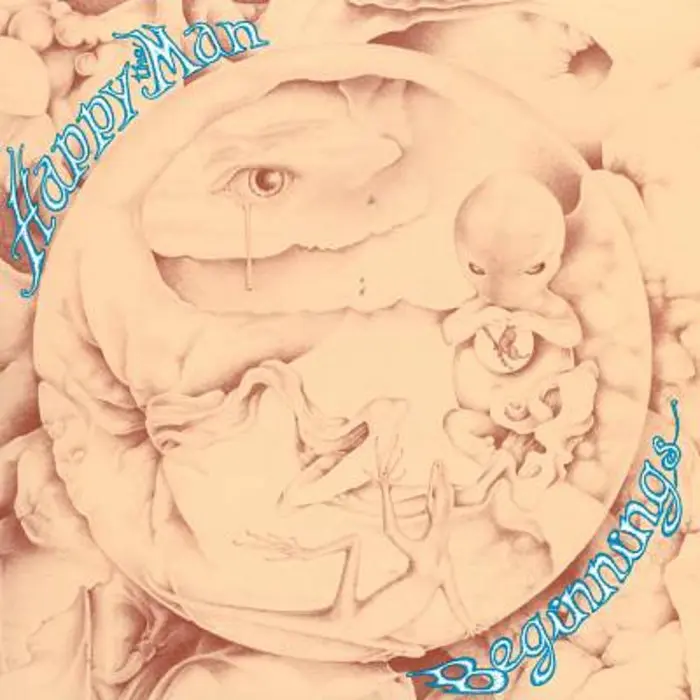 In 1990, Cuneiform Records issued Beginnings, a compilation of early Happy the Man recordings.
Death’s Crown
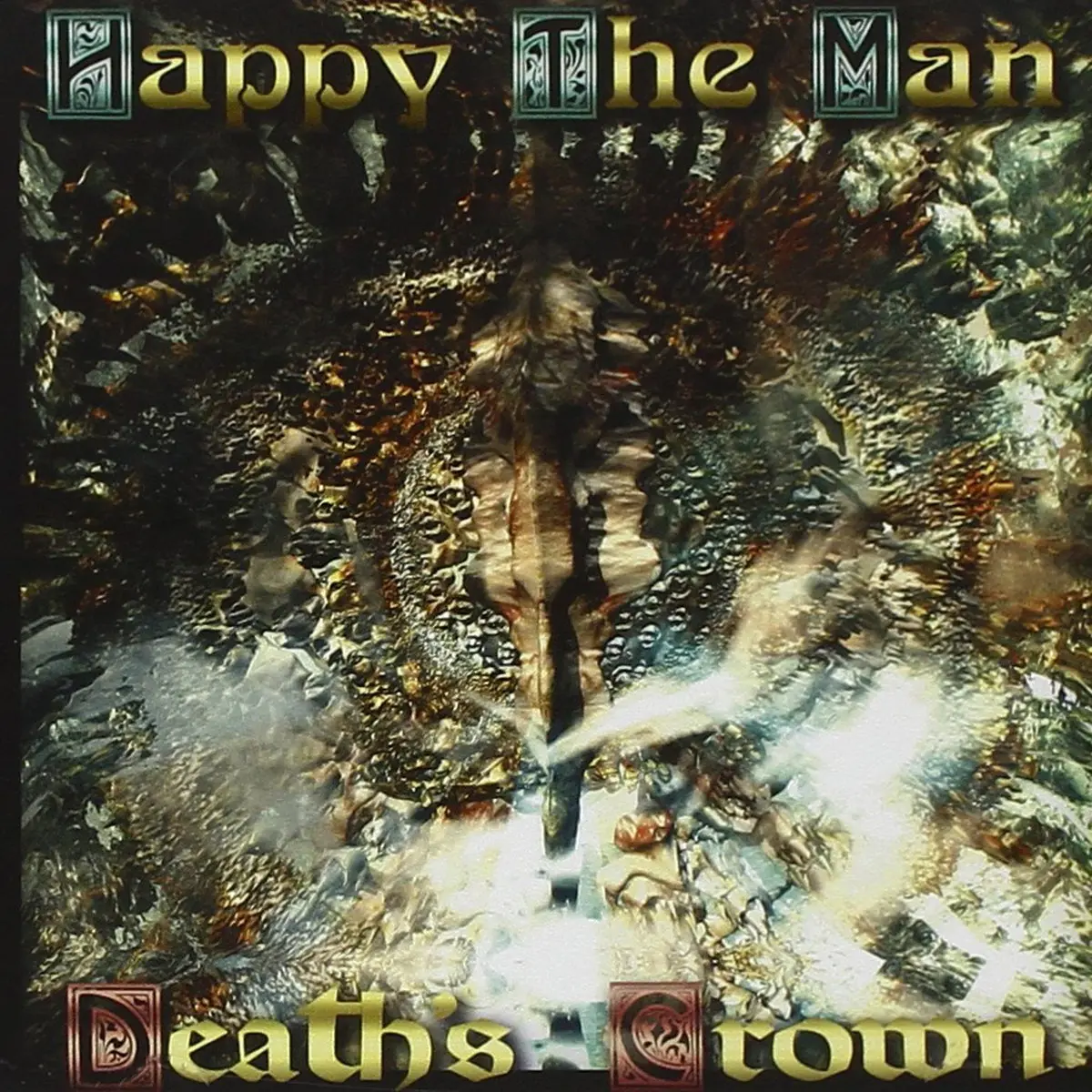 In 1999, Cuneiform Records issued Death’s Crown, which gathers Happy the Man’s 1976 musical suite with another unearthed demo (“Merlin of the High Places”) and a pre-Arista version of “New York Dreams’ Suite.”
The album preserves the band’s earliest foray into extended form, conceived as a multimedia stage work that combined dancers, actors, and coordinated lighting. Performed on the Virginia dinner-theatre circuit, the piece predates the refinement of their Arista-era sound yet already displays the ensemble’s intricate counterpoint, shifting meters, and harmonic sensitivity. The recordings, made on 4-track equipment in their rehearsal space, retain a raw immediacy that accentuates the band’s experimental energy.
The lineup consists of vocalist–guitarist Dan Owen, guitarist–recorder Stanley Whitaker, keyboardist–flutist Kit Watkins (organ, Moog, String Ensemble, clavinet, recorder, effects), keyboardist–saxophonist Frank Wyatt (electric piano, vocals), bassist Rick Kennell, and drummer Mike Beck. Watkins and Wyatt dominate the writing, shaping much of the music in ensemble development sessions that foreshadowed their later compositional synergy.
The 38-minute title suite unfolds in eleven continuous sections, ranging from atmospheric passages and gentle vocal themes to angular rhythmic transitions with jazz and classical inflections. “Death’s Crown” juxtaposes pastoral movements with surging instrumental motifs, at times echoing early Genesis and King Crimson while maintaining Happy the Man’s distinctive American lyricism. The inclusion of “New York Dreams’ Suite” offers a formative version of the piece later reworked for their 1977 debut, complete with Owen’s reflective vocals and a looser structure. “Merlin of the High Places,” recorded two years later, closes the album in luminous fashion with flute, acoustic guitar, and Moog textures that anticipate the meditative tone of Crafty Hands.
1. “Death’s Crown” (38:00)
2. “New York Dreams’ Suite” (8:45)
3. “Merlin of the High Places” (7:10)
Sessions occurred between 1974 and 1976 at the band’s communal rehearsal houses on New York Avenue, Harrisonburg, and Kenmore Street, Arlington, Virginia.
Death’s Crown documents Happy the Man’s embryonic vision of symphonic rock as multimedia art, illuminating the origins of their later precision through these atmospheric and historically resonant performances.
Discography:
- Happy the Man (1977)
- Craft Hands (1978)
- 3rd – “Better Late…” (1983 — recorded 1979)
- Beginnings (1974/75 demos)
- Death’s Crown (1974–76 demos)
Sources:
Artist/Album Pages:
Tritonus was a German symphonic-rock band that released the 1975/76 BASF albums Tritonus and Betwe...
Ben Sidran (born August 14, 1943) is an American singer, pianist, keyboard player, songwriter, pro...
Crossfire was an Australian jazz-rock band from Sydney that released a 1975 self-titled Harvest al...
Didier Bocquet is a French electronic musician who released the 1977 album Eclipse on Le Kiosque D...
Jun Fukamachi — 深町純 (May 21, 1946 — Nov. 22, 2010) — was a Japanese jazz keyboardist. He moved int...
Ruby Starr — aka Constance Henrietta Mierzwiak (Nov. 30, 1949 — Jan. 14, 1995) — was an American s...
Energit was a Czech jazz-rock band from Praha that debuted with a 1975 self-titled album on Suprap...
The Nights were an American soul-funk band that released a 1976 self-titled album on ABC/Little St...
Lonette McKee (born July 22, 1954) is an American singer, songwriter, and actress from Detroit who ...
Slade was an English hard-rock and pop band from Wolverhampton that scored sixteen UK Top 10 hits be...
Azahar was a Spanish symphonic-rock band that released the 1977–79 Movieplay albums Elixir and Aza...
Angelo Branduardi (born Feb. 12, 1950) is an Italian singer/songwriter who emerged with two albums...
Original draft (2018): “Happy the Man are an American symphonic-rock band that released two albums on Arista in 1977 and 1978. Known for its lavish and intricate sound, the band largely focused on instrumental works.
Formed in 1974 in Harrisonburg, Virginia, Happy the Man attracted a fervent mid-Atlantic following during the mid-1970s and recorded a slew of demos that would later see release on Cuneiform. Securing a deal with Arista, the band released Happy the Man in 1977, followed by the sophomoric Craft Hands in 1978. The following year, the band recorded a third album that was ultimately issued in 1983, after their initial breakup.
Following his split from Happy the Man, Watkins briefly joined Camel for the 1979 album I Can See Your House from Here and subsequently launched a solo career.”