

Poison was an American soul-funk band from Richmond, Virginia, that released the album On Our Way to Number 1 on tax-scam label Roulette in 1976.
Members: Charles “Pride” Morris (guitar), Marshall “Frazell” Smith (vocals, percussion), Richard “Gino” Gillyard (saxophone, flute, vocals), Peyton “PJ” Johnson (trumpet, vocals), Melvin “Watlo” Watson (bass, vocals), Janet “Cookie” Cook (vocals, percussion), Tony “Oginga” Joyner (congas, percussion), Allen “Debo” Dabney (keyboards), and Reggie “Black” Smith (drums).
Singles
Poison debuted with “Bring It All Back Home” backed with “Let Me Lay My Funk on You” on Roulette in 1975, followed that year by a standalone issue of “Let Me Lay My Funk on You.” In 1976, they released “Get Up and Move Your Body” backed with “You’ve Got the Power” on Camouflage and “I Got Your Love” backed with “Do What You Wanna Do” on Stratavarious.
On Our Way to Number 1
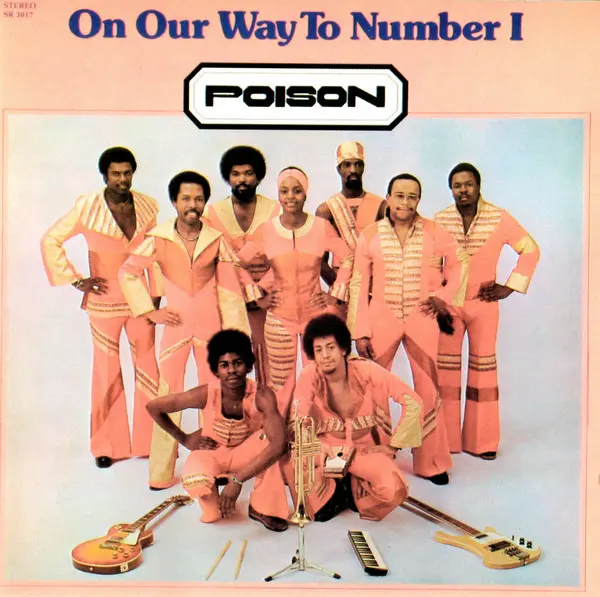 Poison released their lone album, On Our Way to Number 1, in 1976 on Roulette. The record blends ensemble funk rhythms with horn charts, percussion breaks, and group vocals across a dozen originals.
Marshall Smith wrote “How I Wish for Yesterday” and co-wrote six songs with Charles Morris. They teamed with Richard Gillyard on “Magic Words.” Joseph J. Carter Jr. contributed “Do What You Wanna Do.” Allen Dabney joined Morris, Smith, and Franklin McCray on “Unity Man.” The band as a unit claimed credit for “Let Me Lay My Funk on You.”
Numbers such as “Our Place in Time” and “How I Wish for Yesterday” follow a mid-tempo vocal soul format with layered instrumentation, while “Cosmic Dancing” and “Get Up and Move Your Body” drive with rhythmic intensity aimed at the dancefloor. “Let Me Lay My Funk on You” delivers the record’s tightest funk statement, set apart by concise ensemble interplay. “Unity Man” incorporates multiple writer contributions in a socially themed framework.
A1. “Our Place in Time” (3:42)
A2. “Do What You Wanna Do” (4:44)
A3. “How I Wish for Yesterday” (3:44)
A4. “Magic Words” (3:31)
A5. “Cosmic Dancing” (3:07)
B1. “Let Me Lay My Funk on You” (2:58)
B2. “Unity Man” (4:10)
B3. “You Can’t Run Away From Yourself” (3:12)
B4. “Let Your Fingers Do the Walking” (4:37)
B5. “Music Is Our Destiny” (3:09)
B6. “Get Up and Move Your Body” (4:40)
Sessions occurred at Alpha Audio in Richmond with producers Joe Carter and Tom Cephas. Nick Colleran engineered with assistance from Carlos Chafin, Joe Horner, and Joe Sheets. The band arranged the material with Dabney and Carter.
Later Activity
Tony “Oginga” Joyner played on the 1976 albums the Southern Energy Ensemble and Larry Saunders the Prophet of Soul (Stranger). Charles “Pride” Morris resurfaced in 1983 as the writer of “It’s You” on Pure Satisfaction, the debut album by singer Darnell Williams.
Discography:
- On Our Way to Number 1 (1976)
Sources:
Artist/Album Pages:
Mess was an Estonian symphonic/space-rock ensemble, active in the mid-Seventies. In 1976, they recor...
Dr. Music was a Canadian jazz-rock/soul collective from Toronto that released three albums from 19...
Kochi was a multinational jazz-rock super-group behind the 1976 East Wind album Wishes, led by Jap...
Shotgun was an American soul-funk band from Detroit that released three albums on ABC Records betw...
Billy Ocean is a Trinidad-born/U.K.-based soul-pop singer with a career that dates back to the ear...
Norman Connors is an American drummer, composer, producer, and arranger who emerged in the Seventi...
Bergendy was a Hungarian rock and jazz band from Budapest. During the 1960s, the band released num...
Strange Days were an English art-rock band that released the 1975 album 9 Parts to the Wind on Ret...
Television was an American art-rock band from N.Y.C. that released the single "Little Johnny Jewel...
Ollie Baba was an American soul-funk band that released a 1978 self-titled album on Polydor. Mem...
The Dramatics were an American soul group from Detroit, formed in 1964. After a string of '60s loc...
Frob was a German-French jazz-rock band behind a 1976 self-titled album on Musikladen. Guitarist Phi...
They tore it up on “Soul Train”