

Faust was a German krautrock band from Hamburg that released the 1971/72 Polydor albums Faust and So Far, followed in 1973 by the Virgin albums The Faust Tapes and Faust IV, plus a collaboration with American composer Tony Conrad on the Caroline release Outside the Dream Syndicate. A decade after their split, unreleased material surfaced on the 1986–88 ReR Megacorp titles Return of a Legend: Munic and Elsewhere and The Last LP.
Members: Zappi W. Diermaier (drums, percussion), Hans Joachim Irmler (organ), Jean-Hervé Peron (bass, vocals, guitar, trumpet, french horn, 1971-97, 2005-present), Rudolf Sosna (guitar, keyboards, vocals, 1971-96), Gunther Wüsthoff (saxophone, synthesizer, 1971-75), Arnulf Meifert (drums, 1971), Peter Blegvad (guitar, clarinet, vocals, 1973), Uli Trepte (bass, 1973)
Background
Faust (German for Fist) formed in rural Wümme in 1971 under producer and one-time music journalist Uwe Nettelbeck. Tasked by Polydor to assemble the quintessential underground rock band, he merged two local groups: Nukleus and Campylognatus Citelli. Organist Hans Joachim Irmler and drummer Werner ‘Zappi’ Diermaier constituted the original lineup with guitarist Rudolf Sosna, saxophonist Gunther Wüsthoff—both secondary keyboardists—and Moroccan multi-instrumentalist Jean-Hervé Peron.
With a label advance, Nettelbeck converted a disused local school house into Faust’s rehearsal space and encouraged their outside music experiments. They became a six-piece with second drummer Arnulf Meifert.
Faust
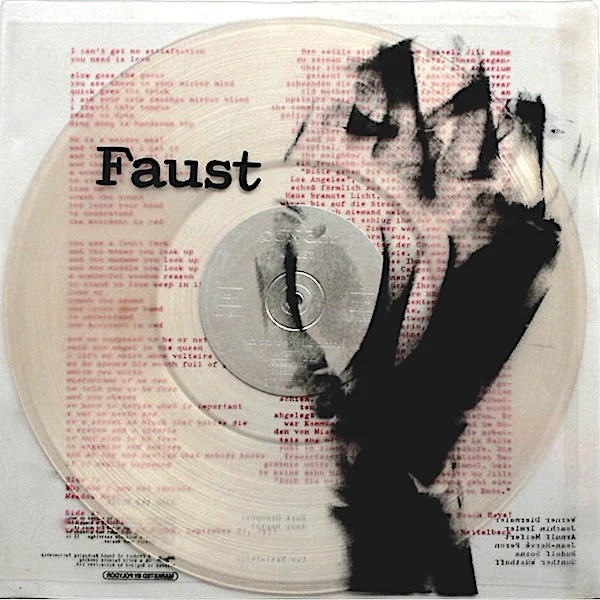 Faust released their self-titled debut album on September 21, 1971, on Polydor.
The album explores abrupt contrasts in tone, texture, and pacing through extended studio experiments that combine instrumental improvisation, musique concrète, and spontaneous collage.
Guitarist Rudolf Sosna and keyboardist Hans Joachim Irmler occupy overlapping layers, with Sosna alternating between fragmented guitar bursts and organ passages that collide and coalesce with Irmler’s tonal clusters. Saxophonist and synthesist Gunther Wüsthoff supplies abrupt timbral ruptures and spatial overlays, while Jean-Hervé Péron inserts spoken fragments amid bass surges and manipulated tape loops.
Faust builds momentum through assembled blocks, using abrupt edits and shifting density to steer direction. “Why Don’t You Eat Carrots” cuts between jagged starts and stops, stacks distorted guitar, clipped brass-like bursts, and spliced fragments, then collapses into music-hall phrasing before fracturing again. The pacing veers between compressed surges and sudden dropouts, as collage elements break any stable center. “Meadow Meal” starts with insistent rhythmic pressure, pulls back into rarefied stretches where distorted guitar strains and treated organ lines stretch time, then lands on a sustained keyboard passage that reframes the earlier tension. “Miss Fortune” traces the album’s longest arc, pushes from fast propulsion into regimented, chant-like sections, then unravels into synthetic chirrs, piano interludes, and looped disruptions. Each segment resets intensity and reinforces a structure shaped by accumulation, rupture, and reassembly.
A1. “Why Don’t You Eat Carrots” (9:35)
A2. “Meadow Meal” (8:05)
B. “Miss Fortune” (16:36)
Uwe Nettelbeck produced the album, engineered by associate Kurt Graupner at the band’s Wümme communal house. This rural isolation provided the conditions for a non-hierarchical workflow in which players, technicians, and conceptualists merged roles. Sessions involved live tracking, overdubs, and tape edits in nonlinear sequence, with sections built around tape manipulation, external sound sources, and repurposed studio gear.
Polydor issued the album in a clear vinyl pressing inside a transparent outer jacket with a silkscreened X-ray image of a clenched fist—“Faust” in German. The first edition also included a plastic lyric sheet printed in red. After this album, they continued as a quintet without Arnulf Meifert.
So Far
 Faust released their second album, So Far, in 1972 on Polydor.
The album presents nine self-contained tracks shaped through ensemble layering and sudden tonal shifts, marked by a sharper division of compositional voices.
So Far structures its runtime around contrast, shifting from repetitive mantras and fractured cabaret to jagged improvisation and machine-like intensity. “It’s a Rainy Day, Sunshine Girl” stretches a locked tom-thump and single-chord acoustic strum into near-hypnosis, layering in distorted harmonica, saxophone blurts, and voice-in-unison chants that grow increasingly saturated before bleeding into noise. “On the Way to Abamäe” pares things back to a doubled acoustic line with faint background tone, offering the album’s only passage of focused restraint. “No Harm” opens on a slow build with overlapping organ and saxophone, then breaks into a fast, shrieking jam that cycles between vocal absurdity and heavy instrumental runs, finally tapering off in static-drenched fragments.
The title track sustains a syncopated 7-count rhythm under spatial overlays and intermittent horns, holding momentum with its uneven gait. “Mamie Is Blue” drops into an arrhythmic, cold loop built on percussive distortion and whirring signal decay, while “I’ve Got My Car and My TV” veers into nursery absurdity, shifting between sing-song clutter and warped instrumental stabs. The final sequence—“Picnic on a Frozen River,” “Me Lack Space…,” and “…In the Spirit”—reverts to sharp edits, cut-up voices, and pastiche brass, closing the album with abrupt turns and abrupt fadeouts that resist cohesion by design.
A1. “It’s a Rainy Day, Sunshine Girl” (7:31)
A2. “On the Way to Abamäe” (2:46)
A3. “No Harm” (10:22)
B1. “So Far” (6:20)
B2. “Mamie Is Blue” (6:05)
B3. “I’ve Got My Car and My TV” (3:51)
B4. “Picnic on a Frozen River” (0:43)
B5. “Me Lack Space…” (0:41)
B6. “…In the Spirit” (2:16)
Rudolf Sosna alternates between fractured electric runs and minimalist keyboard figures, often intersecting with the chordal pacing and tonal washes of organist Hans Joachim Irmler. Synthesist–saxophonist Gunther Wüsthoff inserts sharp textures and upper-register movement, while Jean-Hervé Péron outlines structural contours through bass patterns and abrupt vocal entrances.
Sessions took place in March 1972 at the band’s Wümme compound with engineer Kurt Graupner and producer Uwe Nettelbeck, who maintained the group’s open-process workflow while enforcing a more compartmentalized structure. They conceived and recorded tracks as standalone pieces, each treated with its own arrangement logic and sonic atmosphere.
Polydor issued So Far in an all-black sleeve with individual inserts corresponding to each track, designed under Nettelbeck’s direction with printed contributions by Edda Köchl.
The Faust Tapes
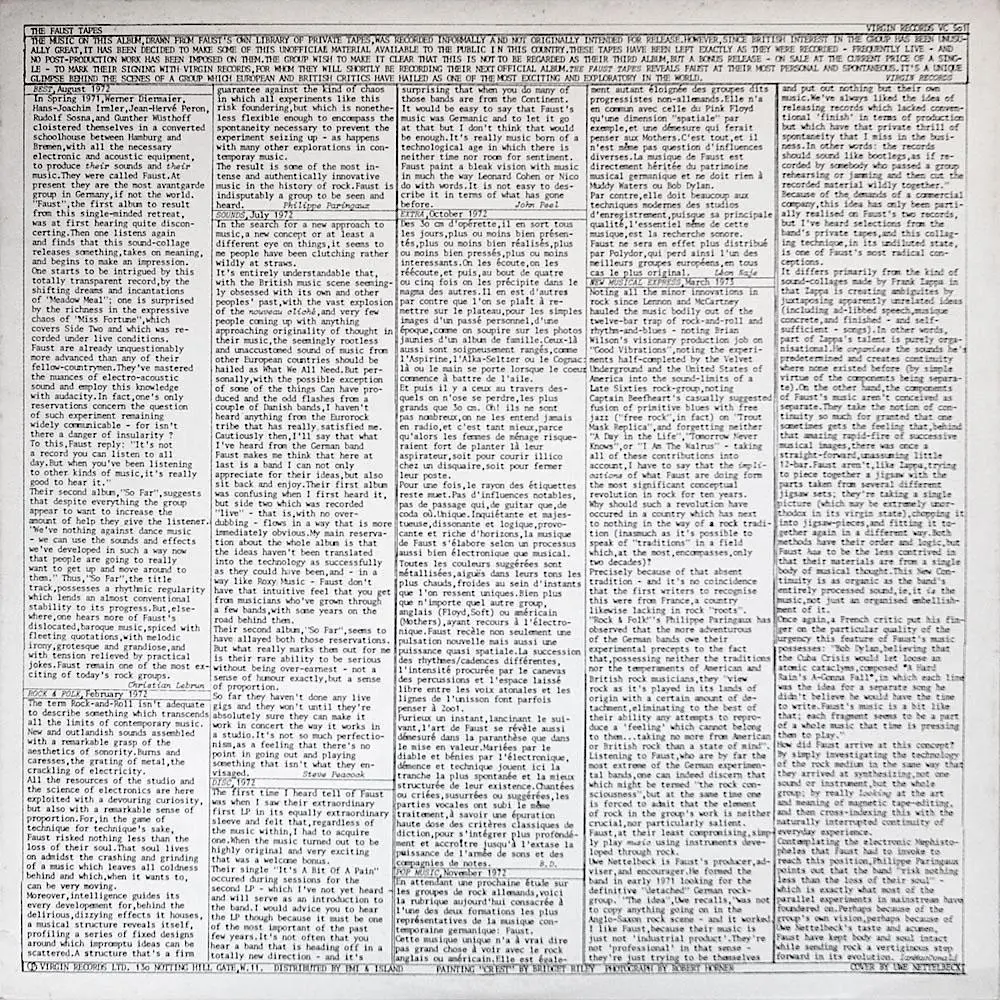 Faust released their third album, The Faust Tapes, in 1973 on Virgin. The album contains two untitled pieces (43:26 total duration). Later reissues divide the music into 26 tracks.
The material plays as a continuous sequence of abrupt edits, layered overdubs, and modular inserts, stitched together from two years of home-studio recordings. Rudolf Sosna and Hans Joachim Irmler shape the dynamic interplay with intersecting guitar tones, organ beds, and cut-up piano motifs. Gunther Wüsthoff punctuates with saxophone and oscillating synthesizer textures, while Jean-Hervé Péron alternates between spoken interludes and bass runs that shift in and out of the layered fragments.
The Faust Tapes cuts together dozens of fragments, rough mixes, and undeveloped sequences into a spliced reel with no fixed pacing or direction. Certain segments lock into identifiable forms—like the swaying keyboard ballad “Flashback Caruso” or the lurching, overdriven riff-loop of “J’ai Mal Aux Dents”—but most dissolve before structure sets in. The early section shifts from abrupt piano strikes into layered voice patterns and clipped percussion, followed by short instrumental figures that drop in and out: downward-falling basslines, broken trumpet flourishes, sax bursts, and guitar fragments faded into tape hiss. Percussive chants, fake radio cues, and reversed tones interrupt any stable atmosphere. Brief flashes of lyric-based songs (“Der Baum,” “Stretch Out Time”) appear toward the end, only to give way to slowed voices, layered signal wash, or ambient tape-manipulated chatter. The album resists linear development; its shape comes from frequency of interruption, depth of layering, and the deliberate mismatch between adjacent parts. Each return to instrumentation feels unstable, as if liable to collapse back into collage at any moment.
A. Untitled (22:37)
B. Untitled (20:49)
Sessions spanned June 1971 to June 1973 at the Wümme schoolhouse facility, where producer Uwe Nettelbeck curated hours of discarded material, sound tests, and partial compositions into a non-linear, longform collage. Engineer Kurt Graupner captured and assembled the tapes with minimal separation between sketches, overdubs, and mixed elements.
Virgin issued the album in the UK at the cost of a 7″ single as part of a promotional initiative that pushed Faust into a broader public sphere. The cover features a stark black-and-white inkblot design credited to Nettelbeck, who also contributed vocals to one segment.
Outside the Dream Syndicate (w/ Tony Conrad)
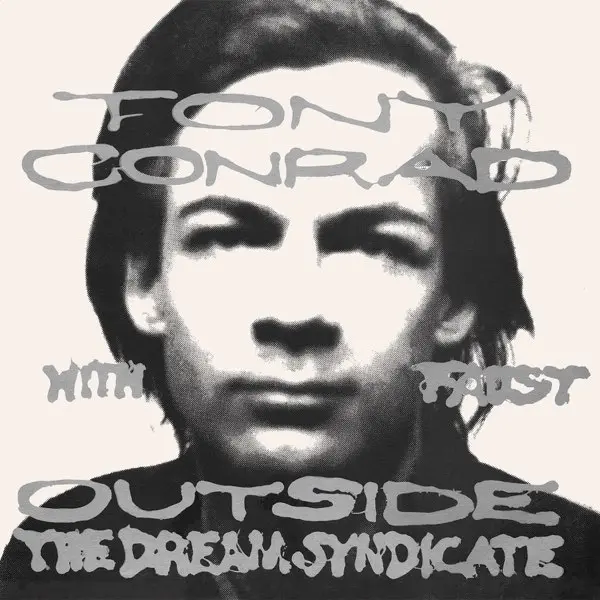 In 1973, Caroline (a subsidiary of Virgin) released Outside the Dream Syndicate, a collaboration between Faust and American avant-garde composer Tony Conrad.
The album builds its structure around sustained tonal stasis and layered microvariations, driven by Conrad’s long-held violin drones and Faust’s repetition-based instrumental framework. Rudolf Sosna introduces minimal harmonic motion and gradual timbral shifts with guitar and keyboards, counterbalanced by Jean-Hervé Péron’s static bass figures and Werner “Zappi” Diermaier’s metered, unyielding pulse. Conrad sustains a continuous violin tone across the album’s length, shaping internal tension through bowing pressure and overtone manipulation.
A. “From the Side of Man and Womankind” (27:16)
B. “From the Side of the Machine” (26:20)
Recording took place in October 1972 at Faust’s Wümme studio under the coordination of producer Uwe Nettelbeck, who introduced Conrad to the band after arranging a transatlantic meeting through Hamburg-based contacts. Engineer Kurt Graupner documented the extended takes in real time with minimal edits, emphasizing the durational discipline central to Conrad’s aesthetic. Hans Joachim Irmler was absent from these sessions.
Caroline packaged the LP in a plain black sleeve with minimal annotation. In 1993, Table of the Elements issued a CD version with the additional track “From the Side of Woman and Mankind.”
Anthony Schmalz Conrad (March 7, 1940 – April 9, 2016) was an American composer, filmmaker, violinist, and early proponent of drone-based minimalism. He emerged in the 1960s New York scene as part of the Theatre of Eternal Music alongside La Monte Young, John Cale, and Marian Zazeela.
Faust IV
 Faust released their fourth album, Faust IV, on September 21, 1973, on Virgin.
The album shifts between extended drone structures, fragmented vignettes, and layered instrumental passages built around discrete contrasts in tone and pacing.
Rudolf Sosna shares the harmonic foreground with organist Hans Joachim Irmler, whose sustained chordal beds offset Sosna’s alternating keyboard figures and clipped electric phrases. Synthesist–saxophonist Gunther Wüsthoff inserts gliding motifs and shrill timbral accents across sections, while Jean-Hervé Péron’s bass pulses shape transitions and emphasize block-form structure.
“Krautrock” opens in stasis, layering guitar drones and electronic hiss into dense overlap before drums cut through, shifting inertia into controlled propulsion. “The Sad Skinhead” reduces its parts to clipped rhythm and blunted chords, keeping the structure stalled as marimba flickers and vocal bursts jab at the frame. “Jennifer” draws the focus inward, tethering its pulse to low bass and skeletal keys before veering into electronic distortion and a stray piano outro.
“Just a Second” opens in a sprint, ruptures into filtered textures and looping fragments, then slams back into pace. The revised “Picnic on a Frozen River” expands on an earlier theme with open-form saxophone and drifting interchanges that resist resolution. “Giggy Smile” shifts to strummed acoustic guitar and harmonica, its calm surface pushed along by murmured lines and fluid layering. “Läuft…” pares momentum to a tonal pulse and rising modulation, flattening the field before the final cut. “It’s a Bit of a Pain” masks its volatility in soft acoustic gestures and keyboard padding, then jolts open with searing guitar and voice snippets, leaving the album split and unsettled.
A1. “Krautrock” (11:47)
A2. “The Sad Skinhead” (2:43)
A3. “Jennifer” (7:11)
B1. “Just a Second” (3:35)
B2. “Giggy Smile / Picnic on a Frozen River, Deuxieme Tableau” (7:45)
B3. “Läuft…Heißt Das es Läuft Oder es Kommt Bald…Läuft” (4:28)
B4. “Run” (3:40)
B5. “It’s a Bit of a Pain” (3:08)
Faust recorded the album in June 1973 at The Manor in Oxfordshire with longtime producer Uwe Nettelbeck and engineer Kurt Graupner. Sessions coincided with work on the Mike Oldfield opus Tubular Bells, creating overlap between groups in residence.
Virgin issued the album with an unembellished black-and-white sleeve and misprinted track list, which scrambled the order and mislabeled several titles. “It’s a Bit of a Pain” appeared previously as the B-side to “So Far” in the German market. This marked the final album by the original Faust lineup.
Discography:
- Faust (1971)
- So Far (1972)
- Outside the Dream Syndicate (1973 • Tony Conrad With Faust)
- The Faust Tapes (1973)
- Faust IV (1973)
- Return of a Legend: Munic and Elsewhere (1986)
- The Last LP (1988)
Sources:
Artist/Album Pages:
Giles Giles and Fripp were the English pop-psych trio behind the 1968 Deram album The Cheerful Ins...
Marconi Notaro (July 10, 1949 — Oct. 24, 2000) was a Brazilian folk-psych singer/songwriter behind...
Pocket-Size was a Danish psych-rock band that recorded an album's worth of material circa 1970. I...
Tin Tin was an Australian orchestral-pop combo that released the 1970–71 albums Tin Tin and Astral T...
Electra-Combo was a German classical-rock band from Dresden that released seven albums between 19...
The Carpenters were the American MOR pop duo of pianist–singer Richard Carpenter and his singer–dr...
Wanda Robinson is an American poet from Baltimore who released the 1971–73 jazz-poetry albums Bla...
Stanley Clarke is an American jazz-funk bassist who gained prominence in the supergroup Return to ...
Tyburn Tall was a German hard-rock/psych band that self-released a limited-edition 1972 album. M...
Bruce Cockburn (born May 27, 1945) is a Canadian singer-songwriter from Ottawa, best known for a lon...
Gary Farr (Oct. 19, 1944 — July 29, 1994) was an English singer/songwriter who first emerged in t...
Lucifer's Friend was a German hard-rock band that evolved from Asterix with a 1970 Philips debut. ...