

Friendsound was an American experimental band that released the album Joyride on RCA in 1969. They were an evolution of psych-rockers Brotherhood, formed by three ex-members of Paul Revere & the Raiders.
Members: Drake Levin (guitar), Chris Brooks (guitar), Nino Candido (guitar), Grape Lemon (guitar), Don Nelson (flute, saxophone), Ron Collins (organ), Phil Volk (bass, piano, celesta), Chris Etheridge (bass), Davey Burke (bass), Jerry Cole (bass), Jim Gordon (drums), Mike Smith (drums, celesta, tambourine), Flip Mullen (wind chimes), Kent Dunbar (percussion), Jim Valentine (percussion), Danny Woody (drums)
Background
Friendsound had its roots in Paul Revere & The Raiders, the perennial Northwest garage-pop band led by singer Mark Lindsey and keyboardist Paul Revere Dick, whose middle name inspired the band’s adaptation of American Revolutionary costumes: an ode to 18th century silversmith Paul Revere.
The classic Raiders lineup featured guitarist Drake Levin, bassist Phil Volk, and drummer Mike Smith. They all played on the band’s 1965–67 hits “Just Like Me,” “Steppin’ Out,” “Hungry,” “Good Thing,” and “Kicks,” a pointed anti-drug evergreen. In 1968, the three broke off into Brotherhood, a psychedelic pop quartet with organist Ron Collins.
Brotherhood
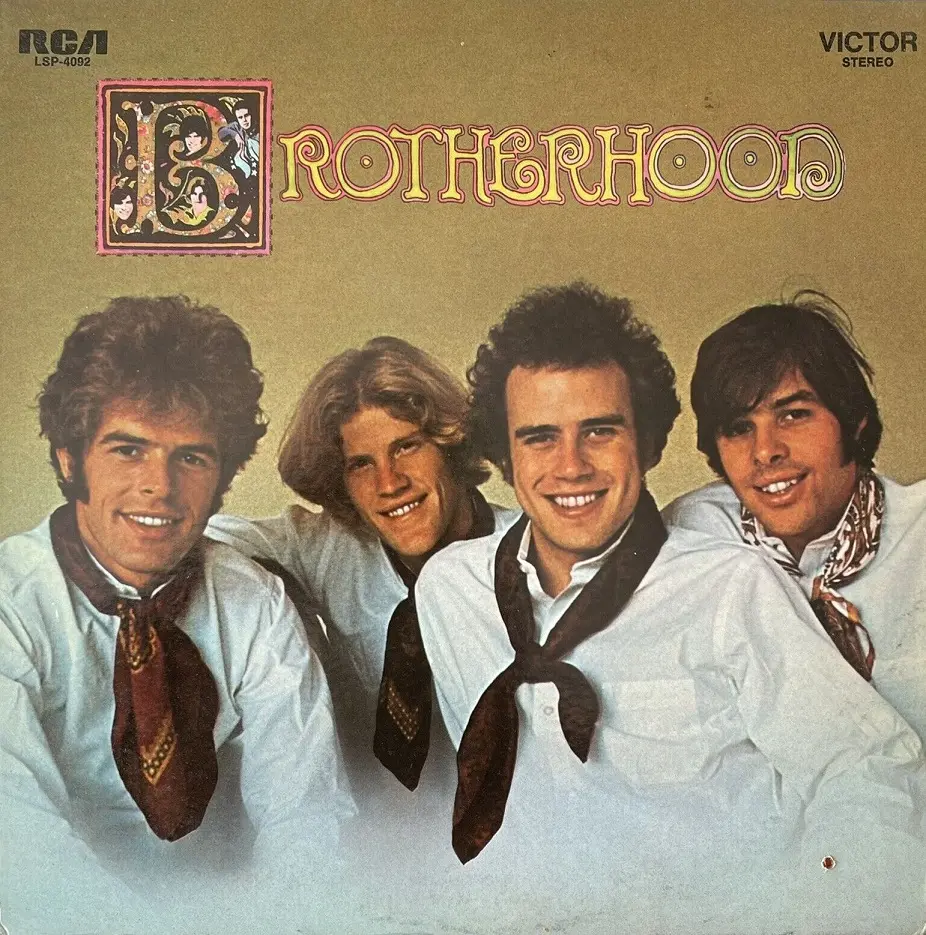 Brotherhood released their self-titled debut in December 1968 on RCA Victor.
The album contains twelve originals written, arranged, and produced by the band. Tracks move fluidly between acid-tinged pop, orchestrated folk, fuzz guitar rock, and Eastern-influenced experimentation.
The opener “Somebody” features clipped fuzz riffs and organ jabs over an anxious pulse. “Seasons” sprawls over five minutes with sitar-style drones and layered vocal parts. “Doin’ the Right Thing (The Way)” veers into jagged funk with wah guitar and tempo shifts, while “Ice Cream” and “Box Guitar” explore whimsy and atmosphere with contrasting tonal palettes. Despite its stylistic breadth, Brotherhood balances its eclecticism with tight arrangements and focused execution.
A1. “Somebody” (3:12)
A2. “Woman Unkind” (2:12)
A3. “Pastel Blue” (2:28)
A4. “Close the Door” (2:50)
A5. “Doin’ the Right Thing (The Way)” (3:10)
A6. “Seasons” (5:17)
B1. “Love for Free” (3:18)
B2. “Lady Faire” (2:15)
B3. “Ice Cream” (3:08)
B4. “Jump Out the Window” (3:05)
B5. “Box Guitar” (3:15)
B6. “Forever” (4:20)
Brotherhood recorded the album at RCA’s Music Center of the World with staff engineer Hank McGill. The cover design was handled by Kittyhawk Graphics, with photography and liner notes by Don Nelson. Songs were published through Brobrobro Music and the LP was pressed at RCA’s Hollywood plant.
Brotherhood later gained interest among psychedelic collectors for its exploratory tone and stylistic breadth.
Friendsound – Joyride
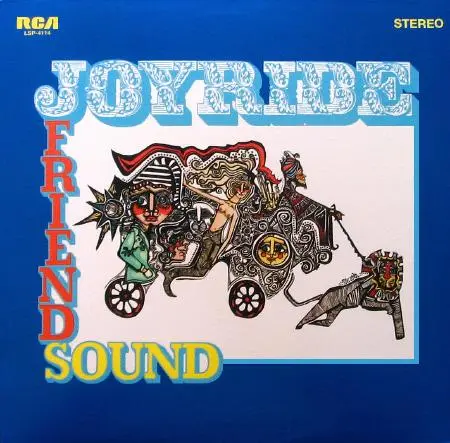 Joyride, the lone album by Friendsound, appeared in April 1969 on RCA Victor. It stemmed from Brotherhood, the psych-rock project of ex-Raiders Phil Volk, Drake Levin, and Mike “Smitty” Smith. During the early sessions for Brotherhood’s debut, the trio invited a large circle of musician friends to participate in what became a spontaneous three-night jam experiment. The results were compiled and credited to Friendsound, with RCA staff Ernie Altschuler and Joe Reisman encouraging the label’s release. The group treated the control console as an active instrument, manipulating tape speed, effects, and stereo imaging in real time.
The album consists of six interlinked instrumental pieces credited to a revolving cast of fifteen musicians. Drawing from psychedelic rock, musique concrète, modal jazz, and the early tenets of Krautrock, Joyride evokes a mood of communal creativity and studio-as-instrument idealism. Instrumentally it features a blend of flute, celesta, finger cymbals, prepared piano, electric guitar, and tape effects. Field recordings and ambient sounds mingle with melodic fragments, echo-laden textures, and abrupt stylistic changes. While the album never aims for commercial accessibility, its rhythmic grounding and recurring motifs reflect the authors’ prior experience with pop form. Critics have compared its adventurous tone to Zappa, Fifty Foot Hose, and Silver Apples, with several noting its resemblance to Revolution 9 and early German experimental rock.
A1. “Joyride” (4:15) – The album opens with its title track, a 6/4 groove layered with manipulated voices, swirling flute (Don Nelson), scattered guitar jabs, and spontaneous effects processed live at the console. A group chorus and various percussive elements weave in and out as the piece warps and folds under real-time fader action and stereo panning.
A2. “Childhood’s End” (1:48) – A musique concrète piece that opens with metallic clanks and drone ambiance before shifting into a fuzzed-out solo by guitarist Grape Lemon. Originally recorded late in the process, it demonstrates the album’s shift toward heavier manipulation and montage.
A3. “Love Sketch” (3:26) – A hazy dreamscape centered on reverb-heavy guitar, prepared piano, and moaning flute. The textures evoke early morning stillness, with tape delay and stereo drift heightening the immersive quality.
A4. “Childsong” (6:12) – Constructed from field recordings at two Los Angeles schools, this tone poem pairs layered playground chatter with celesta, wind chimes, and ethereal flute lines. It conjures a rhythmic illusion from natural cadence, creating a surreal intersection of innocence and form.
B1. “Lost Angel Proper St.” (9:22) – The longest group jam on the record, “Lost Angel” features slowed-down tapes, reversed segments, echoed vocal phrases, and instrumental overlays of organ, flute, piano, and guitars. The piece veers between structure and chaos, frequently likened to “Revolution 9” in form and impact.
B2. “The Empire of Light” (9:40) – Recorded in one take at 4 a.m., this piece features prepared piano, ambient organ, and tape-console manipulation. It fades in and out of tonality, functioning more as a sound installation than a composed track. The finale dissolves into reverb tails and sonic afterimages.
Friendsound recorded Joyride over three nights at RCA’s Music Center of the World in Hollywood. The pressing was handled by RCA Indianapolis. Brotherhood produced the sessions and penned the liner notes. Edna O’Dowd painted the album’s surreal cover illustration, which aligns with the album’s abstract sonic arc.
Though overlooked on release, Joyride gained cult status as an early American precursor to the experimental rock movements that would soon take hold in Germany and elsewhere. It stands today as a rare example of major-label avant-garde studio freedom in the psychedelic era.
Brotherhood Brotherhood
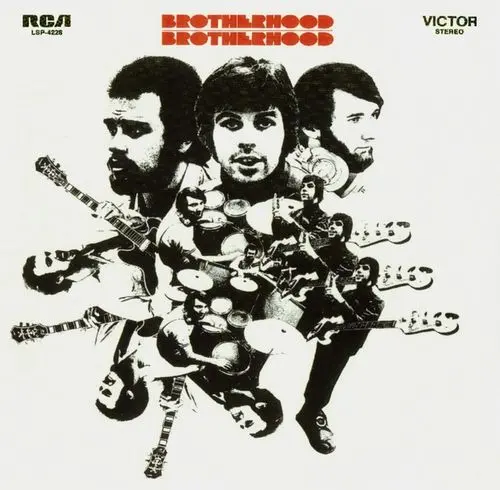 Brotherhood’s second self-titled album, Brotherhood Brotherhood, appeared in September 1969 on RCA.
Departing from the eclectic psych-pop of their 1968 debut, the trio adopted a more grounded, guitar-driven sound aligned with the heavier blues-rock and proto-prog currents of the time.
Volk and Levin composed the bulk of the album, which balances riff-laden rockers (“Back Home Again,” “When the Chips Are Down”) with mellow interludes and three eclectic covers: Joe South’s “Rose Garden,” The Mamas & the Papas’ “California Dreamin’,” and The Beatles’ “When I Get Home.” The band expands into barroom jazz on “Glory Train” and touches bubblegum pop on the brisk “Destination Unknown.”
A1. “Don’t Let Go” (4:20)
A2. “Glory Train” (2:21)
A3. “When the Chips Are Down” (4:10)
A4. “Back Home Again” (2:45)
A5. “California Dreamin'” (5:00)
B1. “Rose Garden” (2:57)
B2. “Deep Blue Sea” (3:25)
B3. “Family Tree” (2:04)
B4. “Love Sketch” (3:30)
B5. “Destination Unknown” (2:03)
B6. “When I Get Home” (3:38)
While less exploratory than its predecessor, the album showcases Brotherhood’s evolving musicianship and responsiveness to the post-psychedelic landscape.
Discography:
- Joyride (1969)
Sources:
Artist/Album Pages:
Moacir Santos (April 8, 1924 — August 6, 2006) was a Brazilian composer, saxophonist, arranger, an...
Wisse Scheper is a Dutch art-pop musician who made the 1972 CBS album Topaz, named after his backi...
Billy Cobham (born May 16, 1944) is a Panamanian-American jazz-rock drummer who played in the band...
Ann Odell is an English keyboardist, vocalist, songwriter, and arranger who played on albums by Sh...
Percy Sledge (Nov. 25, 1940 — April 14, 2015) was an American soul singer who released ten albums on...
Pavol Hammel (born December 7, 1948) is a Slovak singer, guitarist, and songwriter who formed Prúd...
The West Coast Revival was an American soul trio from California that cut three early Seventies si...
Robin Trower (born March 9, 1945) is an English rock/blues guitarist with a musical career that date...
Diana Ross (born March 26, 1944) is an American singer from Detroit who began her solo career in 1...
West Bruce & Laing were an English-American super-trio comprised of ex-Cream bassist-singer Jack...
Bergendy was a Hungarian rock and jazz band from Budapest. During the 1960s, the band released num...
Black Widow was an English organ-psych band from Leicester that released three albums between 1970...