

Overkill is an American metal band from Old Bridge, N.J., that formed in 1980 and built its first run through the Megaforce and Atlantic albums Feel the Fire, Taking Over, Under the Influence, The Years of Decay, Horrorscope, I Hear Black, and W.F.O. between 1985 and 1994.
The group continued on CMC, Metal-Is, Spitfire, Regain, and Bodog during the next phase, which produced The Killing Kind, From the Underground and Below, Necroshine, Bloodletting, Killbox 13, and ReliXIV.
A later stretch on eOne and Nuclear Blast added Immortalis, Ironbound, The Electric Age, White Devil Armory, The Grinding Wheel, The Wings of War, and Scorched.
Bassist D.D. Verni and singer Bobby “Blitz” Ellsworth remained the constants across every phase as the band carried its catalog from the 1983 Power in Black demo to a twentieth studio album in 2023.
Members: D.D. Verni (bass), Rat Skates (drums, 1980-87), Bobby Ellsworth [aka Blitz] (vocals), Robert Pisarek [aka Riff Thunder] (guitar, 1980-81), Dan Spitz (guitar, 1981), Anthony Ammendola (guitar 1981), Rich Conte (guitar, 1981-83), Mike Sherry (guitar, 1981-82), Bobby Gustafson (guitar, 1983-90), Mark Archibole (drums, 1987), Sid Falck (drums, 1987-92), Rob Cannavino (guitar, 1991-95), Merritt Gant (guitar, 1991-95), Tim Mallare (drums, 1993-2005), Sebastian Marino (guitar, 1996-99), Joe Comeau (guitar, 1996-2000), Dave Linsk (guitar, 1999-present), Derek Tailer [aka The Skull] (guitar, 2001-present), Ron Lipnicki (drums, 2005-17), Jason Bittner (drums, 2017-present)
Background
Overkill formed in New Jersey during 1980 after bassist D.D. Verni and drummer Rat Skates closed their prior punk band, the Lubricunts, and placed an ad for a guitarist and singer. Guitarist Robert Pisarek and vocalist Bobby Ellsworth answered the ad and completed the first lineup. The band weighed several names, then chose Overkill from Motörhead’s second album. Early sets drew from punk and British heavy metal, which set the band’s first direction before original material took over the repertoire.
Pisarek soon exited, and a run of replacement guitarists passed through the band during 1981 and 1982, including Dan Spitz, before Bobby Gustafson took the slot late in 1982. By that point Verni, Skates, Ellsworth, and Gustafson had locked the first stable Overkill lineup and turned the focus toward originals such as “Death Rider,” “Rotten to the Core,” and “Raise the Dead.” Regular club work in New York and New Jersey, especially at L’Amour, gave the band a steady regional foothold as the songbook expanded.
That lineup cut the Power in Black demo during 1983 and pushed the tape deep into the underground-trading network. Two songs soon reached wider circulation: “Feel the Fire” landed on New York Metal ’84, and “Death Rider” entered Metal Massacre V on Metal Blade. Those placements carried Overkill from local-club traction into the national tape-and-compilation circuit and opened the path to their first album.
Feel the Fire
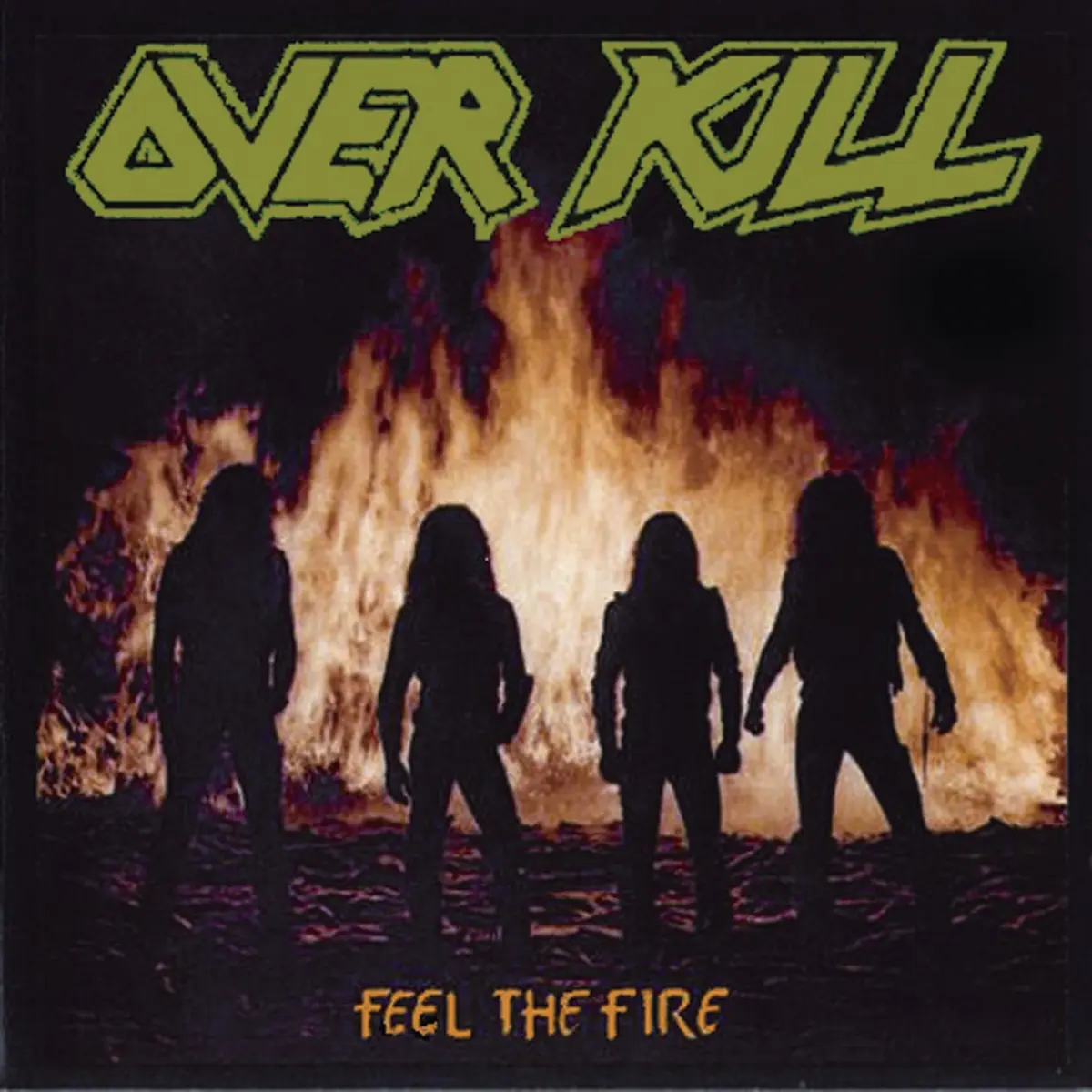 Overkill released their debut album, Feel the Fire, on October 15, 1985, on Megaforce.
The album hits with a raw single-guitar attack and short song forms built for immediate impact. Fast verse sections, abrupt breaks, shouted refrains, and sharper mid-tempo turns give the record its shape, while the rhythm section drives the material with a hard backbeat and constant forward pull. Overkill wrote all nine songs on the original LP.
“Raise the Dead” opens the album with a hard sprint and Bobby Ellsworth’s full upper-register attack. “Rotten to the Core” locks into a firmer mid-tempo stomp, then cuts to a markedly different bridge before the solo swings back to the chorus. “There’s No Tomorrow” carries one of the album’s clearer vocal refrains and slips into a slower, more suspenseful passage inside the rush. “Hammerhead” lands with heavier bass weight and a rougher shove, while “Feel the Fire,” “Kill at Command,” and “Overkill” bring broader dramatic turns and darker pressure into the second half.
A1. “Raise the Dead” (4:18)
A2. “Rotten to the Core” (5:00)
A3. “There’s No Tomorrow” (3:23)
A4. “Second Son” (3:54)
B1. “Hammerhead” (4:01)
B2. “Feel the Fire” (5:52)
B3. “Blood and Iron” (2:40)
B4. “Kill at Command” (4:48)
B5. “Overkill” (3:27)
Overkill recorded Feel the Fire at Pyramid Studios in Ithaca, N.Y., with producer Carl Canedy, engineer Alex Perialas, and mastering engineer George Marino. Jon Zazula handled executive production.
Later CD issues added the Dead Boys song “Sonic Reducer,” which the original vinyl and cassette configurations did not include.
Taking Over
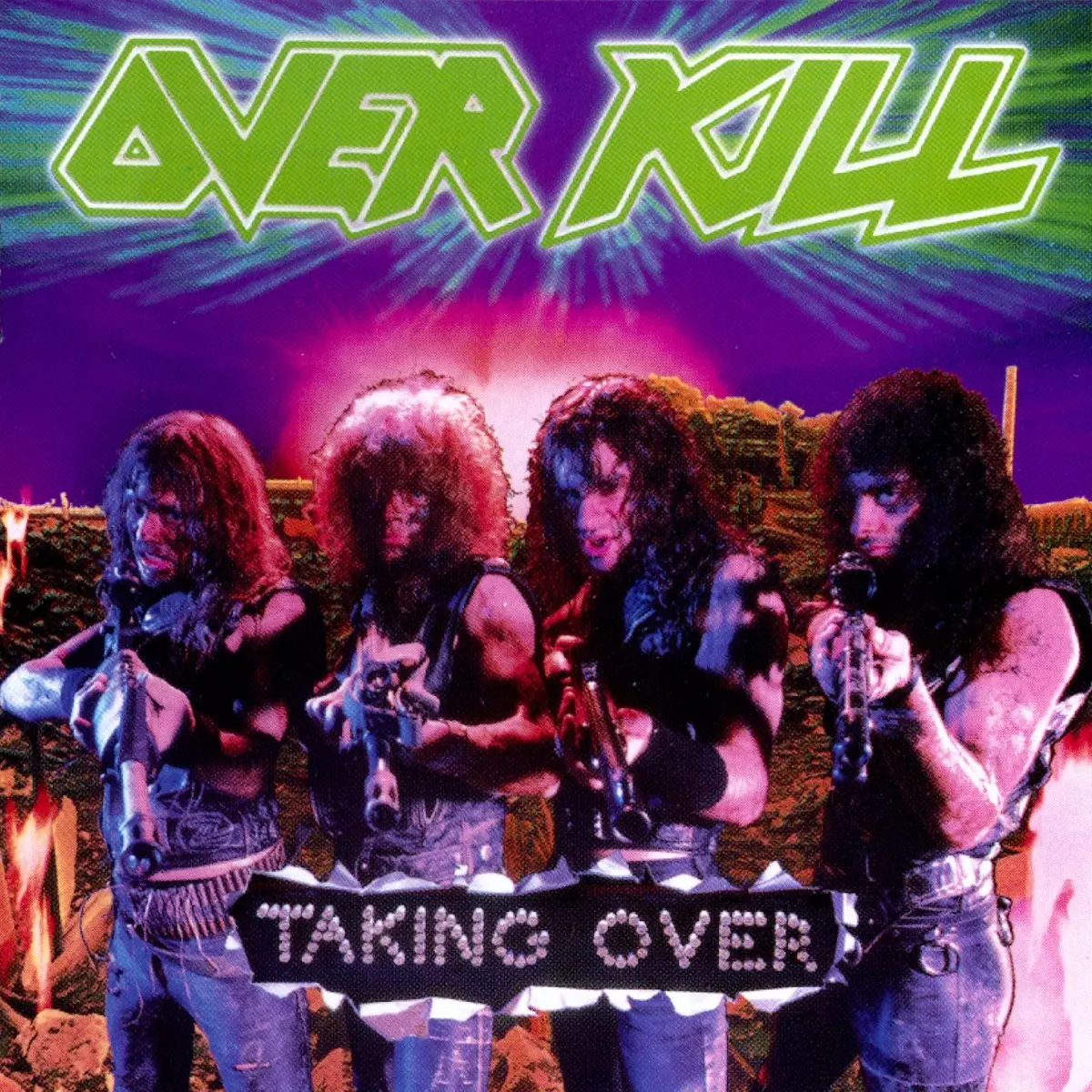 Overkill released their second album, Taking Over, in March 1987 on Megaforce and Atlantic.
The album hits with sharper production and a broader structural range. Fast, tightly packed sections dominate much of the sequence, but heavier stomps, anthem refrains, and a seven-minute closer open more room inside the record. Overkill wrote all nine tracks.
“Deny the Cross” opens with a more chaotic design than most of the album, and “Wrecking Crew” lands as a blunt, chant-driven attack with a stronger punk charge. “Use Your Head” rides a galloping rhythm and saves a dense burst of riff traffic for its closing seconds, while “Fatal If Swallowed” stretches toward a semi-epic form with heavier guitar detail and longer solo space.
“Powersurge” cuts in faster and shorter, “In Union We Stand” slows the attack into a deliberate anthem frame, “Electro-Violence” sharpens the chorus through a hard breakdown riff, and “Overkill II (The Nightmare Continues)” opens with a chime-like intro before the full band drops into a darker closing run.
A1. “Deny the Cross” (4:43)
A2. “Wrecking Crew” (4:32)
A3. “Fear His Name” (5:24)
A4. “Use Your Head” (4:19)
A5. “Fatal If Swallowed” (6:45)
B1. “Powersurge” (4:36)
B2. “In Union We Stand” (4:26)
B3. “Electro-Violence” (3:45)
B4. “Overkill II (The Nightmare Continues)” (7:07)
Overkill recorded Taking Over at Pyramid Sound Studios in Ithaca, N.Y., from September through December 1986 with co-producer and engineer Alex Perialas. Tom Coyne mastered the LP, and Stephen Innocenzi mastered the CD edition.
Bill Benson painted the cover, Rat Skates designed the logo, Pat Calello handled typography, and some early vinyl copies carried a printed inner sleeve.
Taking Over became Overkill’s first Billboard 200 entry at No. 191.
Under the Influence
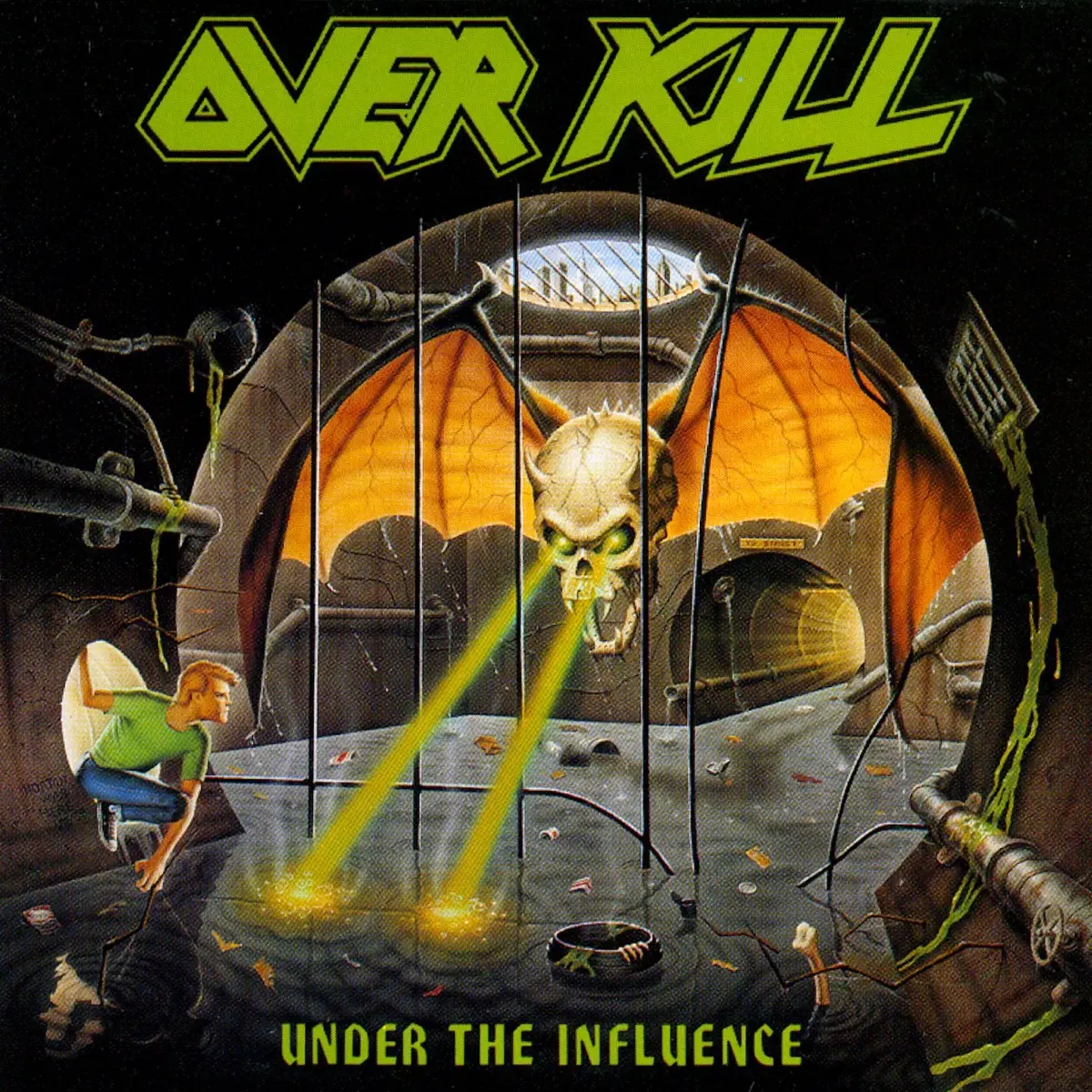 Overkill released their third album, Under the Influence, on July 5, 1988, on Megaforce and Atlantic.
Sid Falck’s arrival alters the band’s attack at once. The songs hit with a drier, more compact thrust, and D.D. Verni’s bass sits high in the mix while Bobby Gustafson cuts the riffs into short, hard patterns that leave Bobby Ellsworth room for a more clipped vocal line. Overkill wrote all nine tracks.
“Shred” opens with a furious rush, a call-and-response chorus, and a fast break midway through the track. “Never Say Never” drops into a firmer mid-tempo pull, while “Hello from the Gutter” turns bright guitar melody and shouted exchanges into the album’s most immediate refrain.
“Mad Gone World” snaps into a faster chorus, while “Brainfade” drives harder and inserts a spoken interruption. “Drunken Wisdom” starts with acoustic guitar before a heavier riff and later speed burst take over. “End of the Line” stretches toward a longer anthem shape, “Head First” carries a punk edge, and “Overkill III (Under the Influence)” closes the LP with a broader chorus and one of Ellsworth’s strongest vocal peaks on the record.
A1. “Shred” (4:05)
A2. “Never Say Never” (4:58)
A3. “Hello from the Gutter” (4:14)
A4. “Mad Gone World” (4:31)
A5. “Brainfade” (4:08)
B1. “Drunken Wisdom” (6:17)
B2. “End of the Line” (7:03)
B3. “Head First” (6:02)
B4. “Overkill III (Under the Influence)” (6:33)
Overkill recorded Under the Influence at Pyramid Studios in Ithaca, N.Y., during March and April 1988 with co-producer and engineer Alex Perialas. Michael Wagener mixed the album at Enterprise Studios in Burbank, and George Marino mastered it at Sterling Sound in New York.
Rich Larson and Steve Fastner supplied the cover illustration, Dan Muro and Pat Calello handled art direction, Rat Skates designed the logo, and early copies carried a printed inner sleeve with lyrics, credits, and photos.
Megaforce issued “Hello from the Gutter” (b/w “Head First”) as a single in 1988.
“Head First” appeared as a promotional 12-inch in 1988 with the same track on both sides. Under the Influence reached No. 142 on the Billboard 200.
The Years of Decay
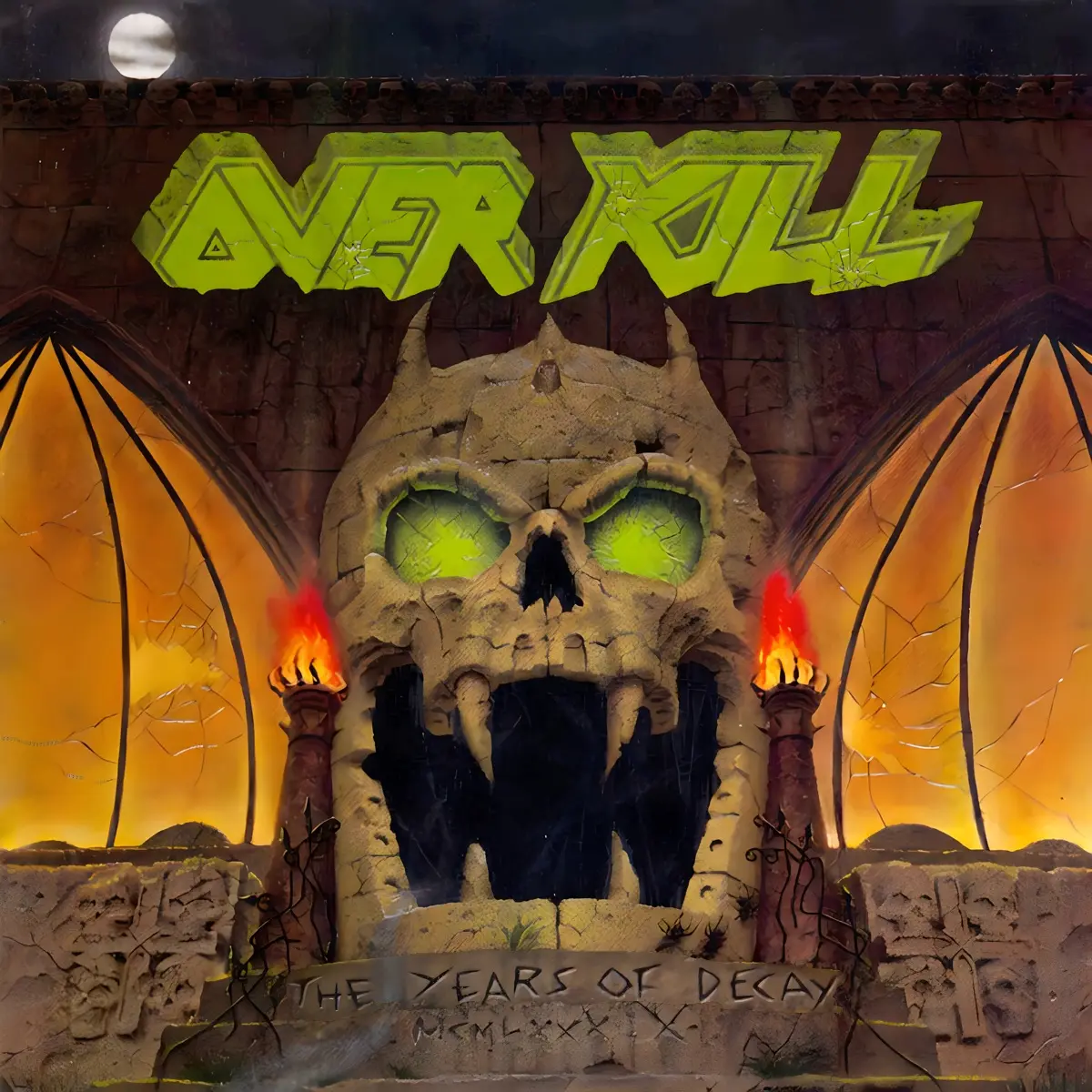 Overkill released their fourth album, The Years of Decay, on October 13, 1989, on Atlantic and Megaforce.
The Years of Decay stretches the band’s song forms and darkens the attack. Slower openings, mid-song pivots, and longer breakdown sections sit beside fast riff runs, while the mix gives D.D. Verni’s bass an unusually strong presence. Overkill wrote all nine tracks, and the album closes Bobby Gustafson’s run in the band.
“Time to Kill” opens from a slow, heavy intro, then breaks into palm-muted riffing and a tighter charge. “Elimination” cuts hardest through the first side with rapid-fire vocal phrasing and a blunt chorus attack, while “I Hate” rides a sharper opening figure into a harder chorus pull. “Nothing to Die For” threads shifting rhythm patterns through a bass break and a lead passage before the final return.
“Playing With Spiders/Skullkrusher” turns the album toward a low, drawn-out crawl, then snaps into a faster middle section. “Birth of Tension” resumes the attack with start-stop turns and a double-kick chorus, “The Years of Decay” opens in near-ballad form with acoustic guitar and a softer vocal line, and “E.vil N.ever D.ies” ends the record with charging chugs, ominous bass lines, and a late acceleration.
A1. “Time to Kill” (6:16)
A2. “Elimination” (4:35)
A3. “I Hate” (3:46)
A4. “Nothing to Die For” (4:22)
A5. “Playing With Spiders/Skullkrusher” (10:15)
B1. “Birth of Tension” (5:04)
B2. “Who Tends the Fire” (8:12)
B3. “The Years of Decay” (7:58)
B4. “E.vil N.ever D.ies” (5:49)
Overkill recorded The Years of Decay at Carriage House Studios in Stamford, Conn., during June and July 1989 with co-producer, engineer, and mixer Terry Date, second engineer Matt Lane, and mastering engineer Howie Weinberg.
Rich Larson and Steve Fastner supplied the cover illustration, Michael Paras shot the photography, and Rat Skates designed the logo.
Atlantic issued “Elimination” as a promotional single in 1989. The song’s video entered regular rotation on MTV’s Headbangers Ball. The Years of Decay reached No. 155 on the Billboard 200 and No. 58 in Germany.
Select discography:
- Feel the Fire (1985)
- Taking Over (1987)
- Under the Influence (1988)
- The Years of Decay (1989)
- Horrorscope (1991)
Sources:
Artist/Album Pages:
The Jazz Passengers are an American avant-jazz band from NYC that emerged with the 1987/88 albums...
Streets were an American hard-rock band behind the 1983–85 Atlantic albums 1st and Crimes in Mind....
Woody Shaw (December 24, 1944 — May 10, 1989) was an American trumpeter and composer. He recorde...
Belouis Some — aka Neville Keighley (b. December 12, 1959) — is an English singer and songwriter w...
Marc Seberg was a French new wave/coldwave band that released five albums and accompanying singles...
Oingo Boingo was an American new wave band from Los Angeles, best known for the Eighties hits "Onl...
Holding Pattern was an American progressive-rock band founded by guitarist–composer Tony Spada an...
Kengo Kurozumi (黒住憲五) is a Japanese singer, songwriter, and arranger from Okayama who emerged in t...
Michel Ripoche is a French violinist who emerged in the brass-rock band Zoo at the turn of the 197...
Nitzinger was an American hard-rock band from Fort Worth, Texas, that released the 1972–73 Capito...
The Mission are an English goth-rock band formed in Leeds in late 1985 by singer-guitarist Wayne H...
Kate Bush is an English singer–songwriter who released five albums between 1978 and 1985 on EMI. S...