

Eskaton was a French Zeuhl/chamber-rock band that self-released three albums and a standalone single between 1979 and 1983.
Members: Marc Rozenberg (bass, keyboards), Gérard Konig (drums, 1970-84), Alain Blesing (guitar, 1970-79), Xavier de Raymond (keyboards, 1970-79), André Bernardi (guitar, bass, 1973-present), Eric Guillaume (keyboards, 1973-79), Paule Kleynnaert (vocals, 1973-84), Amara Tahir-Konig (vocals, 1973-84), Gilles Rozenberg (organ, synthesizer, 1979-84), Patrick Lemercier (violin, 1980)
Background
Eskaton formed in Paris in 1970 under the name Eskaton Kommandkestra. The original four-piece lineup featured keyboardist Xavier de Raymond (Fender piano), drummer Gerard Konig, bassist Marc Rosenberg, and guitarist Alain Blesing.
By 1974, they shortened their name to Eskaton and grew to an octet with keyboardist Eris Guillaume, guitarist Andre Bernardi, and vocalists Paule Kleynnaert and Amara Tahir. This lineup gigged for the next three years. capacity crowds. After a brief pause while members fulfilled national service obligations, Eskaton reassembled and secured a notable early opportunity, opening a show for Magma.
“Le Chant de la Terre”
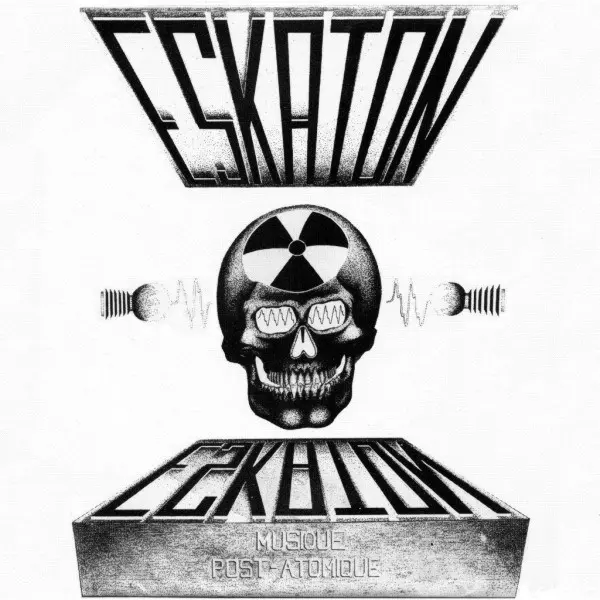 In 1979, Eskaton released their debut single: “Le Chant de la Terre” backed with “If.” The record presents early formulations of Eskaton’s Zeuhl language, with repetitive, staccato rhythms, disharmonic female vocals, and organ-driven textures.
Backing players include bassist André Bernardi, drummer Gérard Konig,guitarist Alain Blesing, organist/synthesist Gilles Rozenberg, and keyboardists Eric Guillaume and Marc Rozenberg (Fender electric piano). Vocal duties are handled by Amara Konig and Paule Kleynnaert. Bernardi wrote both songs.
A1. “Le Chant de la Terre” [The Song of the Earth] (6:24) — Built on a steady rhythmic pulse with vocal scatting and layered keyboards, shifting briefly near the close as the pattern thickens. Lyrics evoke planetary voice, natural resonance, and ambiguous resolution.
B1. “If” (4:26) — Opens with airy ambience, then moves to organ, Fender, and wordless vocals over repetition. The text carries impressionistic reflections and abstract phrasing.
Sessions occurred at an unspecified studio with producer Eskaton and engineers Marie Jeanne Jouclard and Patrick Guinard, who also handled recording and mixing. The title features artwork by Alain Faurie, depicting a radiation-motif skull insert printed on thin cardboard with notes and lyrics. Eskaton self-pressed the single in a monochrome booklet sleeve. The same two tracks later appeared on Ardeur in 1979, at which point original copies became chiefly collector’s items.
4 Visions
 Eskaton recorded their first album, 4 Visions, in late 1978 at Studio Adam in Roissy-en-Brie. In 1981, it appeared after their second-recorded album on Eurock, a sublabel of Mir Records.
The album presents four extended pieces that exemplify the French Zeuhl idiom through relentless rhythmic drive, contrapuntal female vocals, and dense Fender Rhodes and synthesizer textures.
Compared to their model Magma, Eskaton employed a more terrestrial tone—singing in French instead of the invented Kobaïan language—and favored layered intensity over gradual build-up. The group comprised vocalists Amara Tahir and Paule Kleynnaert, guitarist Alain Blésing, keyboardists Gilles Rozenberg (organ, synthesizer) and Éric Guillaume (Fender electric piano), bassist–composer André Bernardi, and drummer Gérard König.
Bernardi composed all four tracks, which merge elements of symphonic, hard, and jazz-rock with electronically processed sound effects.
The twelve-minute “Écoute” opens with unaccompanied vocals before escalating into a double-time sequence driven by angular bass patterns and spiraling synth leads. “Pitié” unfolds from a slow, dreamlike electric piano passage into heavier rhythmic interplay and tense vocal exchanges. “Attente” alternates between apocalyptic sections of rapid bass–drum coordination and eerie instrumental interludes suggestive of Univers Zero’s chamber minimalism. The closing “Eskaton” serves as the most forceful entry, marked by dual-vocal counterpoint, staccato keyboard figures, and an unrelenting rhythmic surge.
A1. “Écoute” [Listen] (12:44)
A2. “Pitié” [Pity] (8:53)
B1. “Attente” [Waiting] (10:30)
B2. “Eskaton” (10:59)
Sessions occurred at Studio Adam in Roissy-en-Brie with production and mixing handled by Eskaton.
4 Visions features graphic design by Stéphane Dumont.
Two of its pieces, “Eskaton” and “Attente,” were later re-recorded in alternate arrangements for the band’s subsequent album Ardeur.
Ardeur
 Eskaton released their second album, Ardeur, in 1980 on Musique Post Atomique.
The album refines the band’s Zeuhl concept with a leaner, more keyboard-centered sound that balances rhythmic drive with harmonic density. With fewer players than on 4 Visions, Ardeur emphasizes tight interplay between choral vocals, electric piano, and cyclical bass patterns, yielding a sound that’s fervent yet texturally spacious.
The lineup features bassist André Bernardi, drummer Gérard Konig, guitarist–keyboardist Gilles Rozenberg (organ, synthesizer), keyboardist Marc Rozenberg (electric piano), and vocalists Amara Tahir and Paule Kleynnaert, augmented by violinist Patrick Lemercier on select tracks.
Gilles and Marc Rozenberg wrote the material, maintaining Eskaton’s chant-like vocal interplay and rhythmic propulsion.
The album opens with “Ardeur,” a driving statement piece where steady percussion and dual voices establish the album’s intensity before a midsection of organ calm. “Couvert de Gloire” builds from layered electric piano motifs to a dramatic coda of colliding sounds. “Attente,” reprised from 4 Visions, highlights rhythmic piano phrasing and overlapping vocal lines. “Un Certain Passage” moves from subdued violin and voice passages to a soaring midsection and calm resolution. “Dagon,” closing the original LP, unfolds from atmospheric synth pulses into an accelerating rhythmic sequence with surging drums and keys.
A1. “Ardeur” [Ardor] (2:30)
A2. “Couvert de Gloire” [Covered in Glory] (4:25)
A3. “Attente” [Waiting] (6:45)
A4. “Eskaton” (5:58)
B1. “Un Certain Passage” [A Certain Passage] (6:53)
B2. “Pierre et l’Ange” [Stone and the Angel] (4:03)
B3. “Dagon” (6:05)
Sessions occurred at Studio Ramsès in Paris with production by Benoît Roussel and engineering by Jean-Louis Rizet.
Ardeur features cover artwork by Stéphane Dumont.
Fiction
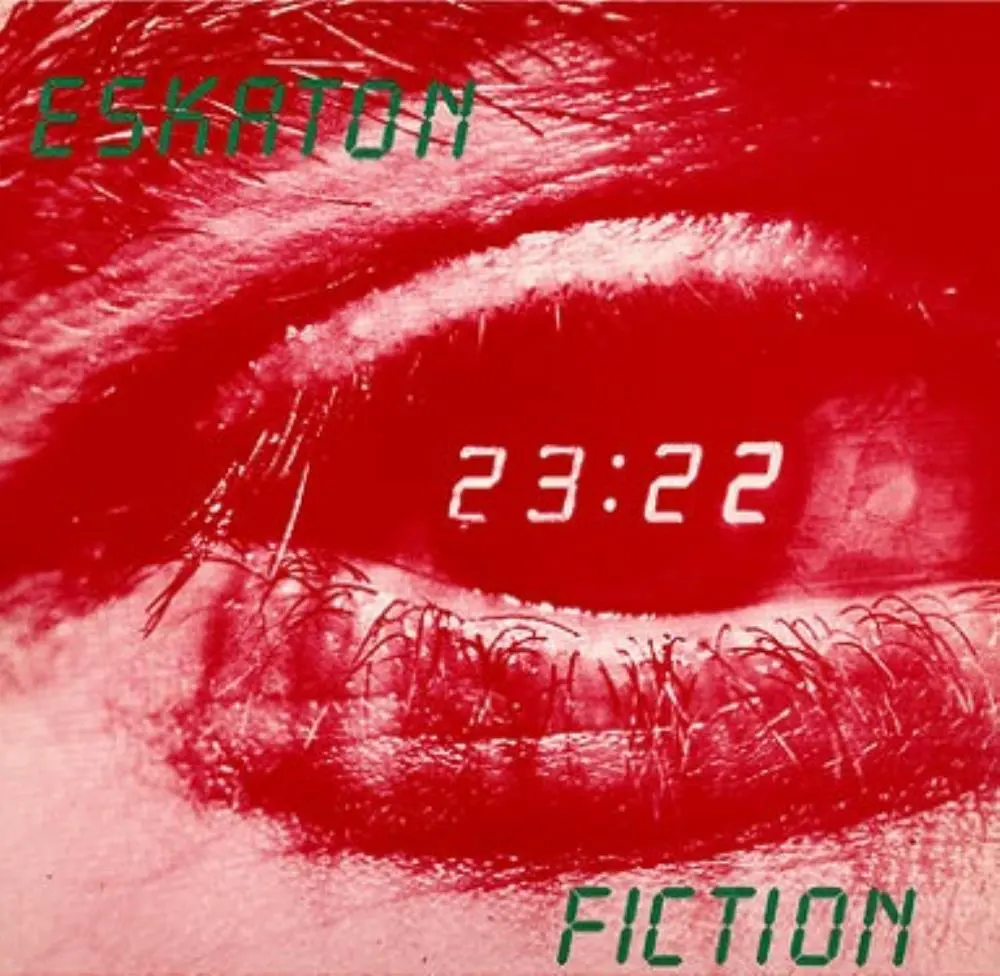 Eskaton released their third album, Fiction, in 1983 on Musique Post Atomique.
The album marks a stylistic shift from the dense Zeuhl of 4 Visions and Ardeur toward a leaner, more rhythm-oriented sound infused with new wave textures and electronic accents. While maintaining their characteristic vocal intensity and propulsive bass patterns, Eskaton incorporated sharper synth tones, angular guitar figures, and spoken male narration alongside the established dual-female vocals. The lineup comprised vocalist–keyboardist Marc Rozenberg, vocalists Amara Tahir and Paule Kleynnaert, guitarist–organist–synthesist Gilles Rozenberg, bassist André Bernardi, and drummer Gérard Konig.
Marc Rozenberg served as the album’s principal writer, contributing lyrics or music to five of the nine tracks. Vocalist Paule Kleynnaert composed three titles, while Bernardi co-wrote two with Marc Rozenberg.
The music divides between short experimental pieces and mid-length vocal arrangements that blend Zeuhl cadence with early-1980s art-rock energy. “Automute” opens the album with a steady bass pulse and clipped rhythms under alternating male narration and female chants. “Simplicius” develops from fluid jazz-fusion motifs into syncopated vocal counterpoint and echo-treated guitar, while “Plus et Moins” juxtaposes clipped rhythmic phrasing with percussive vocal exchanges reminiscent of early COS. The brief “Parenthèse” offers an electric piano interlude of subdued lyricism. “La Danse des Feux” revives Zeuhl’s cyclic intensity through layered fuzz guitar and organ interplay.
Side two opens with “Le Cinéma,” where spoken vocals and bright keyboards evoke the mechanized humor of Devo. “La Mort de Tristan” unfolds as a slow, atmospheric lament led by sustained synth and piano chords. “Les Deux Trucs” alternates male declamation and female response over driving rhythm, and “F.X.” closes with an extended instrumental sequence of shifting tempos and interlocking bass–keyboard figures.
A1. “Automute” (4:20)
A2. “Simplicius” (7:03)
A3. “Plus et Moins” [More and Less] (3:40)
A4. “Parenthèse” [Parenthesis] (2:10)
A5. “La Danse des Feux” [The Dance of Fires] (4:03)
B1. “Le Cinéma” (3:30)
B2. “La Mort de Tristan” [The Death of Tristan] (4:20)
B3. “Les Deux Trucs” [The Two Things] (4:13)
B4. “F.X.” (7:18)
Sessions occurred at Eskaton Studio in September 1982 with production by the band and engineering by Marie Jeanne Jouclard and Patrick Guinard.
Fiction features photography by Jean-Claude De and printing by Aude.
The album signaled Eskaton’s final studio statement before their 1984 dissolution, bridging the band’s Zeuhl foundation with emergent electronic and avant-pop elements.
“Le Musicien”
In 1984, Eskaton resurfaced on Préludes, a limited-edition French cassette compilation featuring jazz-rock, fusion, experimental electronics, and progressive rock from several contemporary ensembles. Sequenced midway through side B, their contribution, “Le Musicien,” presents the group’s familiar blend of staccato rhythms, layered vocal textures, and keyboard-driven momentum. Bassist André Bernardi locks the pulse while Gérard Konig handles drums and percussion. Gilles Rozenberg adds keyboards, with further keyboards and vocals from Marc Rozenberg alongside Amara Tahir and Paule Kleynnaert.
Elsewhere on the cassette, the lineup includes contributions from Noco Music, Troll, Joël Dugrenot, Serge Bringolf & Strave, and André Viaud on side A, followed by Uppsala, Yog-Sothoth, and Datura on side B. Within this varied roster, Eskaton’s track stands as a concise marker of their vocal-keyboard Zeuhl language during a period when new material from the group had become scarce.
Discography:
Sources:
Artist/Album Pages:
Rockets was a French electro/space-funk band whose 1976–84 run produced On the Road Again, Plaster...
Quartet Music was an American jazz-rock unit from Los Angeles that released three albums between 1...
Slade was an English hard-rock and pop band from Wolverhampton that scored sixteen UK Top 10 hits be...
Circus was the Swiss symphonic-rock band behind the 1976–78 Zytglogge albums Circus, Movin' On, Al...
McFadden & Whitehead were an American soul duo from Philadelphia. Singers Gene McFadden and Jo...
The Abrial Stratageme Group was a French hard-rock/art-rock band that released the 1977 album Mann...
Crosby, Stills and Nash (CSN) were an English–American folk-rock/harmony super-trio comprised of ...
Clearlight was a French space-rock ensemble that released the 1975 Virgin albums Clearlight Sympho...
Dial M was an American new wave/synthpop duo behind a 1983 self-titled album on D&D Records. ...
The Manhattan Transfer are an American vocal group from N.Y.C., formed in 1969 by swing enthusiast...
Kenji Mori — 森剣治 (born 1942) — is a Japanese saxophonist who headed multiple jazz combos between t...
Rheingold was a German NDW trio that released nine singles and the 1980–82 albums Rheingold and R., ...