

June Wallack is a Québécois singer, songwriter, pianist, and flutist who issued a 1974 single on Vibrations and a 1976 self-titled album on RCA Victor.
Profile
June Wallack emerged on the Montreal folk circuit in the early Seventies. In 1974, she issued two originals on Vibrations, a DIY one-press.
A. “A Partir d’a Matin” [Starting this Morning] (3:09)
B. “Je Veux Bien Essayer” [I’d Like to Try] (5:41)
June Wallack
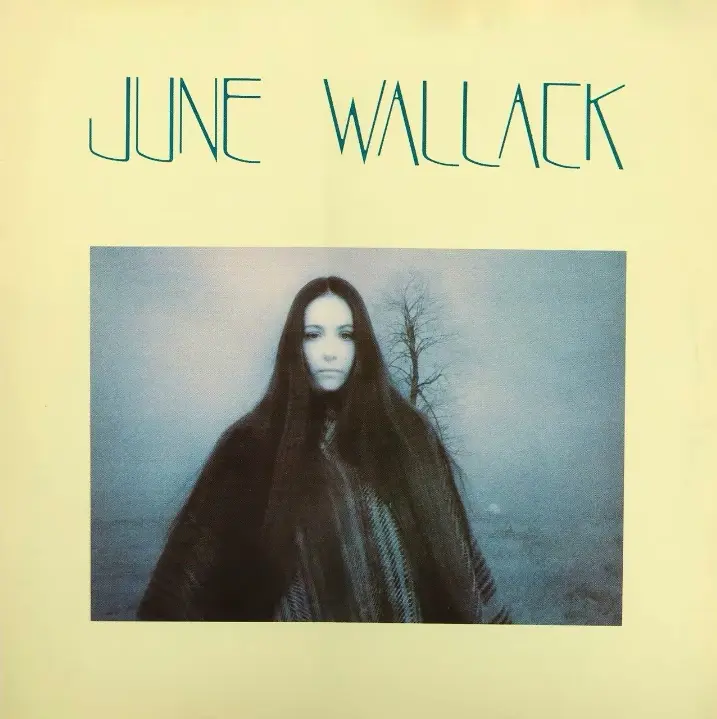 June Wallack released her self-titled debut album in 1976 on RCA Victor.
The album contains seven Wallack originals: six French-language vocal titles and the instrumental “Amalgame.” “Pour qui qu’tu m’prends” adds music co-written with guitarist Yves Vincent, and the program also includes “Don’t Explain,” the Billie Holiday–Arthur Herzog Jr. standard.
Wallack leads a Montréal studio group with bassist Bill Gagnon, banjoist–guitarist Michel Robidoux, harpsichordist Marcel Beauchamp, pianist–vibraphonist Le Gros Pierre, drummers Denis Farmer and Max Décoste, and guitarists Yves Vincent and Moose Tellier.
“On est rien qu’des amis ici” settles into acoustic calm, wispy flute color, traditionally shaded piano, and delicate French vocal placement. “Pour qui qu’tu m’prends” quickens the pace with syncopated rhythmic drive and a brighter ensemble lift. “Mirage” meanders through abrupt tempo movement and heavy electric-guitar lead with a darker, vaporous edge. “Don’t Explain” slows around close vocal phrasing and a piano setting that folds cabaret poise into formal chord color.
“Amalgame” pivots through piano-led rhythm changes, keyboard color, wordless vocal traces, and unsettled tempo. “Je suis venue un soir” lifts the late-room accent into a quicker vocal glide. “Sur la Colline” returns to acoustic footing with string-bent picking and rustic color. “Déjà c’est l’automne” lingers on plunky keyboard figures before a tempo shift brings theatrical vocal phrasing, synthesizer color, power chords, layered self-harmony, and an extended fade.
A1. “On est rien qu’des amis ici” [We’re Just Friends Here] (4:30) – Wallack
A2. “Pour qui qu’tu m’prends” [Who Do You Take Me For] (3:33) – Wallack; music Wallack, Vincent
A3. “Mirage” [Mirage] (8:02) – Wallack
A4. “Don’t Explain” (5:33) – Herzog, Holiday
B1. “Amalgame (Instr.)” [Amalgam (Instr.)] (4:54) – Wallack
B2. “Je suis venue un soir” [I Came One Evening] (6:45) – Wallack
B3. “Sur la colline” [On the Hill] (3:35) – Wallack
B4. “Déjà c’est l’automne” [Already It’s Autumn] (7:31) – Wallack
Sessions occurred with engineer Gaetan Desbiens at RCA Victor Studios in Montreal, where Yves Vincent and Bill Gagnon co-produced the album for Les Productions Billyves.
June Wallack appeared in a sleeve with cover art by Robert Morin, whose front image shows Wallack in a poncho before a bare tree and pale horizon. Morin received a 1977 Juno nomination for Best Album Graphics for the sleeve.
“On est rien qu’des amis ici” first as a 1975 single backed with “Pour te garder,” a non-album original. “Pour qui qu’tu m’prends” accompanied the album as a second single (b/w “Sur la colline”).
Months later, Wallack issued a non-album fourth single, “Pour l’humanité” (b/w “instrumental”), co-written by Bobby Edwards and CKFM broadcaster Fred Napoli. RCA issued an English titled variant, “For Humanity.”
B. “Pour te Garder” [To Keep You] (3:25)
A. “Pour l’humanité” (2:50)
Discography:
- “A Partir d’a Matin” / “Je Veux Bien Essayer” (1974)
- June Wallack (1976)
Sources:
Artist/Album Pages:
Kellee Patterson is an American singer who released the 1973 album Maiden Voyage on Black Jazz Rec...
Heldon was a French avant-garde/electronic band that released three albums in 1974/75 on Disjunct...
Lynyrd Skynyrd is an American hard-rock boogie band from Jacksonville that released five albums a...
George Jinda (June 4, 1941 — Jan. 11, 2001) was a Hungarian drummer, composer, and producer who pl...
Heart are an American hard-rock band from Seattle that debuted with the popular album Dreamboat An...
The Natural Four were an American soul group from Oakland that recorded Good Vibes for ABC before...
Kong Lavring was a Norwegian folk-rock band that released two albums between 1977 and 1978 on Nor-...
Danny O'Keefe is an American singer/songwriter, best known for his 1972 hit "Good Time Charlie's G...
Tierra was an American Latin-rock band from Los Angeles that made a 1973 self-titled album on 20t...
The Sons of Champlin were an American brass-rock-soul band from San Francisco, formed in 1965 by n...
Dimmornas Bro was a Swedish art-rock band behind the 1977–79 albums Dimmornas Bro and Mål on Silen...
Matia Bazar are an Italian pop group that released nine studio albums on Ariston between 1976 and ...