

Strawberry Alarm Clock was an American West Coast rock band, best known for their 1968 psychedelic rock evergreen “Incense and Peppermints.” They released four albums between 1967 and 1969 on Uni Records.
Members: Lee Freeman (guitar, vocals), Ed King (guitar, bass, vocals), Gene Gunnels (drums), Gary Lovetro (bass, vocals, 1967), Randy Seol (drums, vocals, 1967-68), Mark Weitz (keyboards, vocals), George Bunnell (bass, guitar, vocals, 1967-68), Steve Bartek (guitar, flute, 1974-75), Jimmy Pitman (guitar, vocals, 1968-69), Paul Marshall (guitar, vocals, 1969-71)
Background
Strawberry Alarm Clock evolved from Thee Sixpence (originally The Irridescents), a garage band from Glendale, California, that cut five singles in 1966–67 on the local small-press All-American.
Thee Sixpence originally featured Ed King (guitar), Michael Luciano (vocals), Lee Freeman (rhythm guitar, harmonica), Gary Lovetro (bass), Steve Rabe (guitar), and Gene Gunnels (drums). As Rabe, Luciano, and Gunnels departed, they were replaced by keyboardist Mark Weitz and drummer Randy Seol. The band soon rebranded as Strawberry Alarm Clock, incorporating new material and members from Seol’s prior band, Waterfyrd Traene, which included bassist–lyricist George Bunnell and guitarist–arranger Steve Bartek.
Weitz, trained in classical piano from childhood, emerged as the band’s lead composer. He submitted three songs for their 1967 single on All-American, including the backing track for “Incense and Peppermints.” Producer Frank Slay brought in 16-year-old Greg Munford to sing the song’s lead vocal. Reissued by Uni Records with “Incense” as the A-side, the single topped the Billboard Hot 100 in November 1967.
Prior to national exposure, Strawberry Alarm Clock worked under multiple names while cycling members and material across two parallel bands. Songs written by Seol, Bunnell, and Bartek had roots in Waterfyrd Traene, which continued intermittently as Public Bubble and Buffington Rhodes. Sessions at Sunset Sound and the Recording Factory yielded a handful of unreleased tracks, but the original masters were lost. These threads converged in the lineup that would record the band’s debut for Uni.
Incense and Peppermints
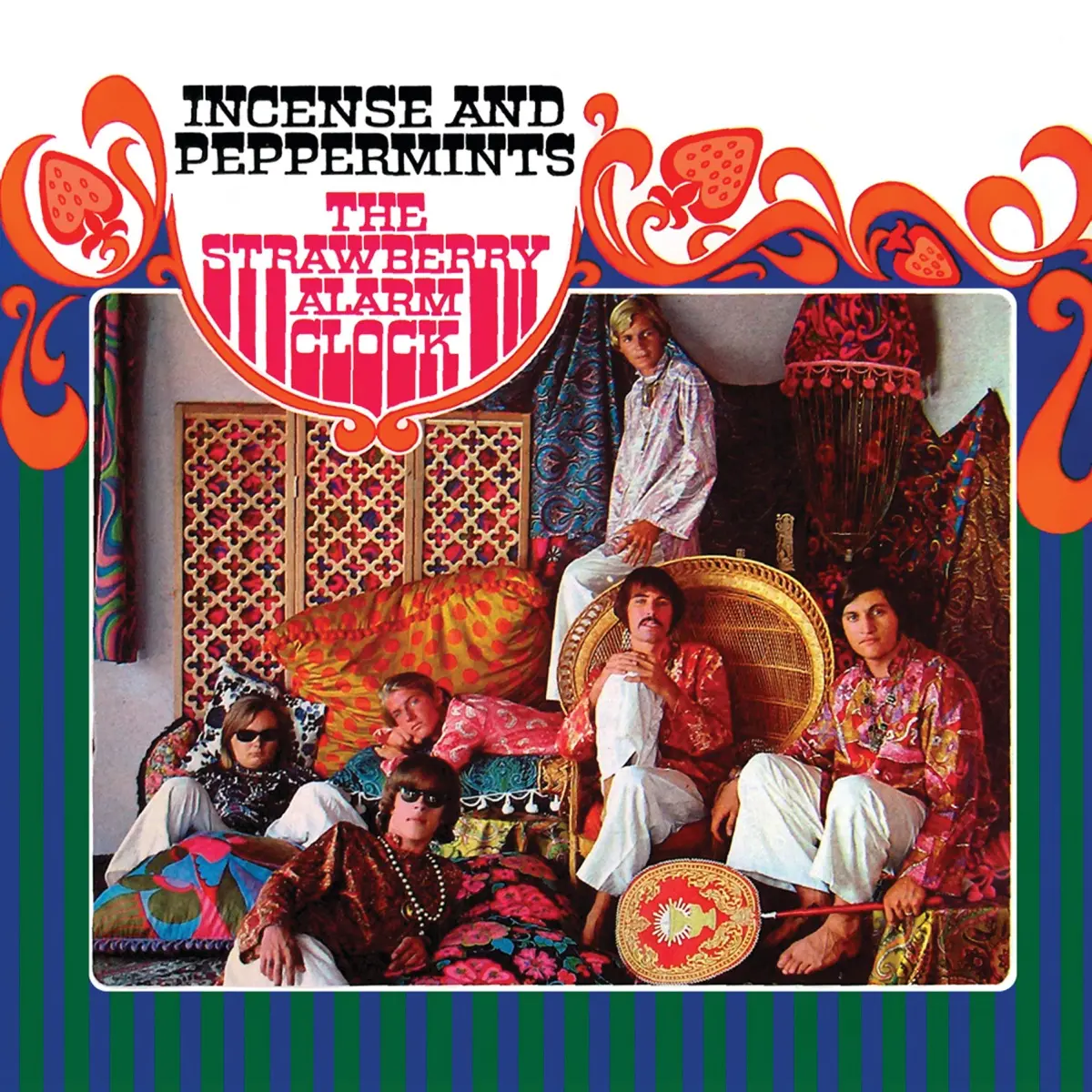 Strawberry Alarm Clock released their debut album, Incense and Peppermints, in October 1967 on Uni.
The album blends fuzz-toned psych rock with baroque instrumentation and layered vocals, set to short, tempo-shifting songs. It features the band’s breakout single and three selections used in the 1968 film Psych-Out, including a newly recorded track that would appear on their follow-up.
George Bunnell and Steve Bartek wrote nearly half the album, with Bunnell contributing lyrics and Bartek providing uncredited flute. Keyboardist Mark Weitz led songwriting among the main lineup. The track “Incense and Peppermints” was penned by outside writers John Carter and Tim Gilbert, with music by Weitz and guitarist Ed King. Greg Munford sang the song’s uncredited lead vocal.
Songs like “Rainy Day Mushroom Pillow” and “Paxton’s Back Street Carnival” use off-center rhythms and stacked vocals. “The World’s on Fire” opens the album with an extended sequence of modal jamming and distorted organ and flute interplay, while “Strawberries Mean Love” runs on dual fuzz guitar leads. “Hummin’ Happy” and “Lose to Live” shift into darker tonal territory.
A1. “The World’s on Fire” (8:21) – Opens with longform jamming rooted in modal organ, flute, and fuzz guitar; structurally loose and stylistically ahead of its time.
A2. “Birds in My Tree” (1:53) – Compact and guitar-forward, layered with vocals; channels garage psych energy.
A3. “Lose to Live” (3:13) – Dense arrangement with tonal undercurrents that hint at unease.
A4. “Strawberries Mean Love” (3:01) – Brisk psych-pop driven by twin fuzz guitars and harmonic stacking.
B1. “Rainy Day Mushroom Pillow” (3:05) – A standout with drifting vocals and subdued instrumentation.
B2. “Paxton’s Back Street Carnival” (2:01) – Angular rhythm changes mimic a carnival ride; sonically off-kilter.
B3. “Hummin’ Happy” (2:25) – Juxtaposes upbeat rhythm with a darker lyrical edge.
B4. “Pass Time with the SAC” (1:21) – Short instrumental interlude with no provided detail.
B5. “Incense and Peppermints” (2:47) – Psychedelic single marked by sharp rhythm shifts and Greg Munford’s uncredited lead vocal.
B6. “Unwind with the Clock” (4:10) – Ends the album with an instrumental written by Freeman and King.
Sessions occurred at Original Sound Studio in Hollywood with producer Frank Slay and engineer Paul Buff. Bill Holmes managed production.
The cover features a photo by Ed Caraeff, who captured the paisley-clad sextet lounged amid pillows and exotic furnishings.
The album includes three tracks — “The World’s on Fire,” “Rainy Day Mushroom Pillow,” and “Incense and Peppermints” — featured in the film Psych-Out, a counterculture film starring Bruce Dern and Jack Nicholson.
Wake Up… It’s Tomorrow
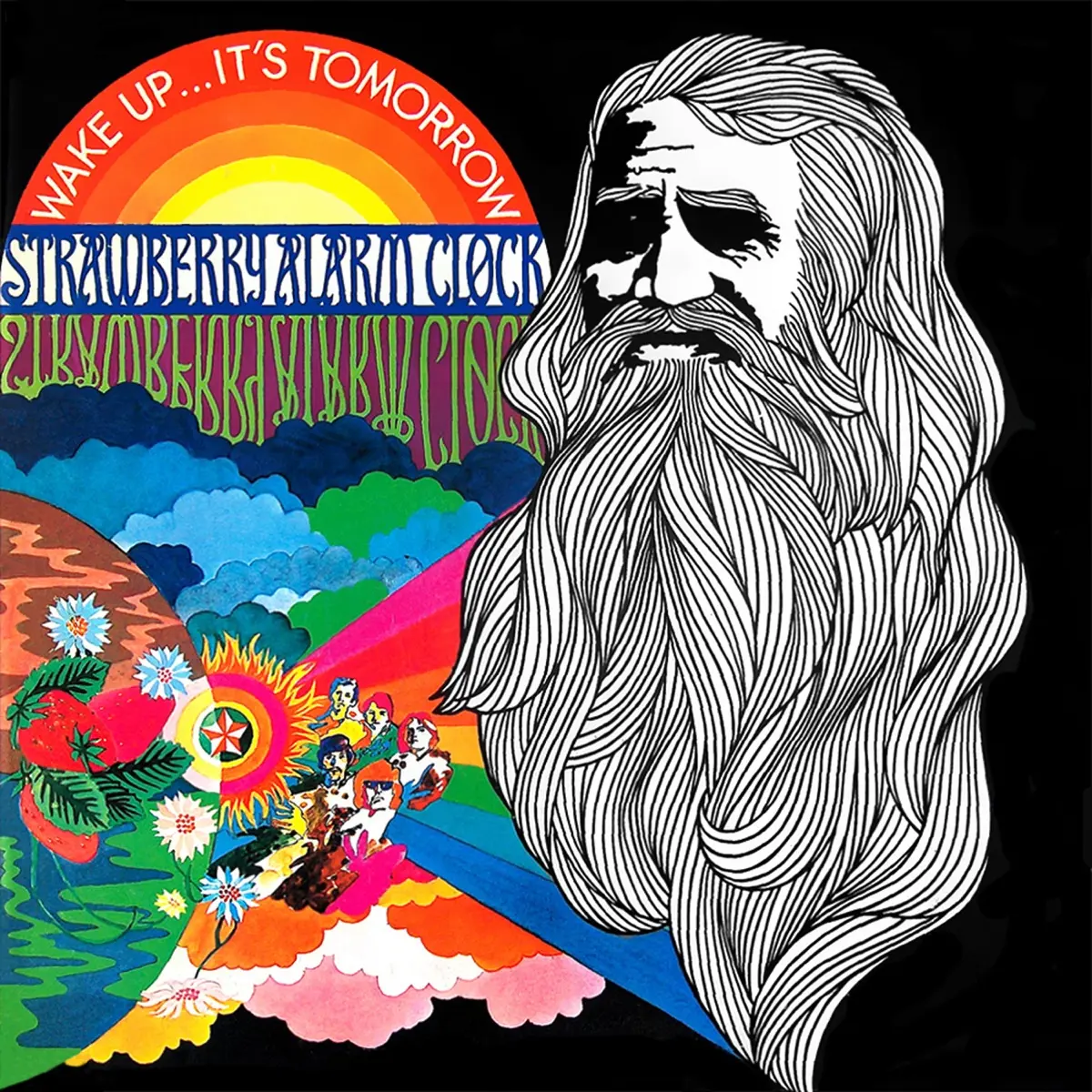 Strawberry Alarm Clock released their second album, Wake Up… It’s Tomorrow, in June 1968 on Uni.
The album deepens the band’s blend of psych-pop and ornate vocal arranging, with a denser studio approach and wider compositional range. The group split songwriting duties into factions, resulting in a set that shifts between baroque textures, sharp rhythmic phrasing, and opaque themes.
Most tracks were composed internally by the band, with guitarist Ed King and rhythm guitarist Lee Freeman collaborating on nearly half the album. Keyboardist Mark Weitz and drummer Randy Seol contributed arrangements and lyrics, while lyricist Roy Freeman co-wrote two tracks. “Sitting on a Star” was the final contribution by non-member Steve Bartek. Howard Davis provided vocal arrangements and a spoken interlude.
Tracks like “Curse of the Witches” and “Nightmare of Percussion” explore off-kilter pacing and layered percussion, contrasting with lighter songs like “Tomorrow” and “Sit with the Guru,” which return to the compact, harmony-stacked format of the debut. The “Black Butter” suite closes the album with three movements—“Past,” “Present,” and “Future”—that pivot from pop structure to extended psych abstraction. “Pretty Song from Psych-Out” appears from the Psych-Out soundtrack, and “They Saw the Fat One Coming” reflects internal tension, directed toward the band’s imposed lyricist.
A1. “Nightmare of Percussion” (2:57) – Opens the album with uneasy percussion shifts, a narrated passage, and dissonant tones
A2. “Soft Skies, No Lies” (3:07) – Uses sharp vocal layering and softened instrumentation in contrast to the prior track
A3. “Tomorrow” (2:14) – Bright pacing and compressed arrangement; one of three standout tracks recalled from the debut’s tone
A4. “They Saw the Fat One Coming” (3:25) – Cryptic narrative aimed at management interference; heavy and ominous
A5. “Curse of the Witches” (6:46) – Longform sequence of fuzz bass, tuned percussion, and loosely patterned rhythms
B1. “Sit with the Guru” (2:59) – Vocal-driven psych track; closes on the same chorus used in “Incense and Peppermints”
B2. “Go Back (You’re Going the Wrong Way)” (2:19) – Tightly constructed rhythm sequence with strong vocal arrangement
B3. “Pretty Song from Psych-Out” (3:15) – Atmospheric vocal layering; drawn from Psych-Out film
B4. “Sitting on a Star” (2:55) – Minor-key arrangement with darker tone and flute accent
B5. “Black Butter, Past” (2:23) – Standard psych-pop form
B6. “Black Butter, Present” (2:10) – Abstract and tonally fragmented
B7. “Black Butter, Future” (1:32) – Resolves the suite with light, sunshine pop phrasing
Sessions occurred at TTG Studios in Los Angeles with producers Frank Slay and Bill Holmes and engineers Paul Buff and Jack Hunt.
“Tomorrow” charted at No. 23 on the Billboard Hot 100. “Sit with the Guru” reached No. 65. “Pretty Song from Psych-Out” was issued as a B-side and featured in the film Psych-Out.
The World in a Sea Shell
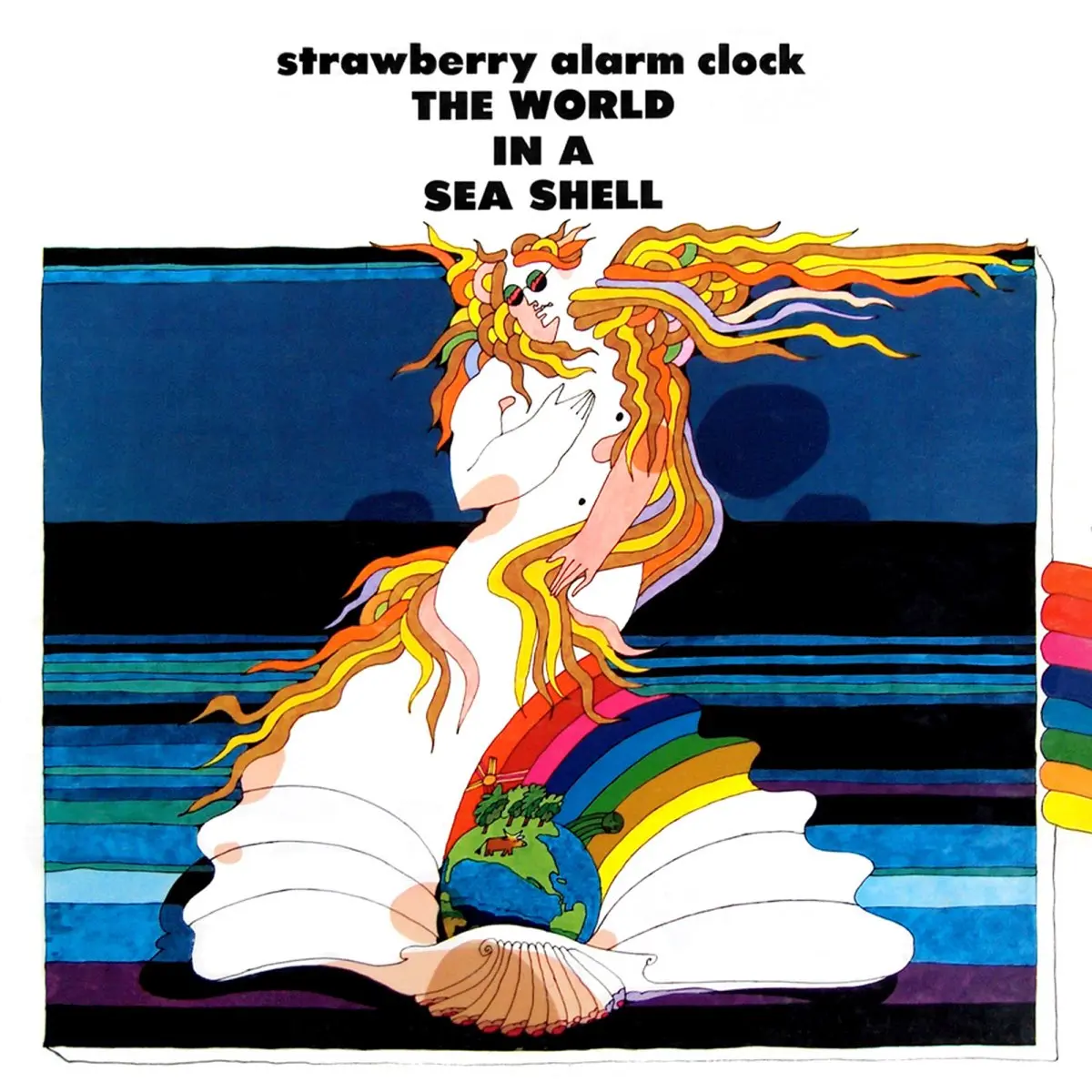 Strawberry Alarm Clock released their third album, The World in a Sea Shell, in November 1968 on Uni.
The album marks a shift toward ornate orchestration and subdued arrangements, with half the material written by outside contributors. It was the final full-length to feature the original lineup.
Of the twelve tracks, six were group-written. Ed King and Lee Freeman continued as primary composers, joined by George Bunnell, Randy Seol, and Mark Weitz. The remaining songs came from John Carter, Tim Gilbert, Carole King, Toni Stern, and Bob Stone. These contributions, pushed by producers Frank Slay and Bill Holmes, dominate side one.
The band’s own compositions anchor side two, where tracks like “Love Me Again” and “Eulogy” show a return to more angular guitar phrasing and atmospheric vocal layering. “Heated Love” stands out for its percussion-led structure, while “Shallow Impressions” closes the album in a drifting, minor-key tone. Side one contrasts sharply, frontloaded with lush orchestration and soft pop pacing. “Sea Shell,” “Home Sweet Home,” and “Lady of the Lake” share this format, while “A Million Smiles Away” and “Barefoot in Baltimore” carry lighter rhythmic lift and stacked harmonies.
A1. “Sea Shell” (2:59) – Opens with soft textures and a mid-tempo vocal layering that emphasizes the album’s shift
A2. “Blues for a Young Girl Gone” (2:38) – Downcast pacing; shaped around a character sketch with softened orchestration
A3. “An Angry Young Man” (2:33) – Slower phrasing with string arrangement; lacks the group’s tonal signature
A4. “A Million Smiles Away” (2:43) – Vibraphone-led track with understated rhythm accents
A5. “Home Sweet Home” (2:46) – Horn-driven, organ-heavy arrangement with thick vocal layers
A6. “Lady of the Lake” (3:09) – Similar to prior track in tone; ornate arrangement with little rhythmic shift
B1. “Barefoot in Baltimore” (2:30) – Light, harmony-forward phrasing with clean rhythm but limited dynamics
B2. “Wooden Woman” (2:09) – Simple, minor-key structure closer in sound to earlier SAC output
B3. “Heated Love” (2:00) – Percussion-forward arrangement with sharp drum work and firm pace
B4. “Love Me Again” (3:37) – Guitar-driven with layered harmonies and contour shifts; strongest return to prior style
B5. “Eulogy” (1:50) – Psychedelic ballad with Oedipal theme and off-kilter vocal phrasing
B6. “Shallow Impressions” (3:29) – Instrumental closer with drifting tempo and ambient minor-key guitar
Sessions occurred at TTG Studios in Los Angeles with producers Frank Slay and Bill Holmes and engineer Paul Buff. George Tipton handled orchestral arrangements. Howard Davis arranged vocals.
“Sea Shell” charted at No. 88 in Canada. “Barefoot in Baltimore” reached No. 67 in the US and No. 45 in Canada.
Good Morning Starshine
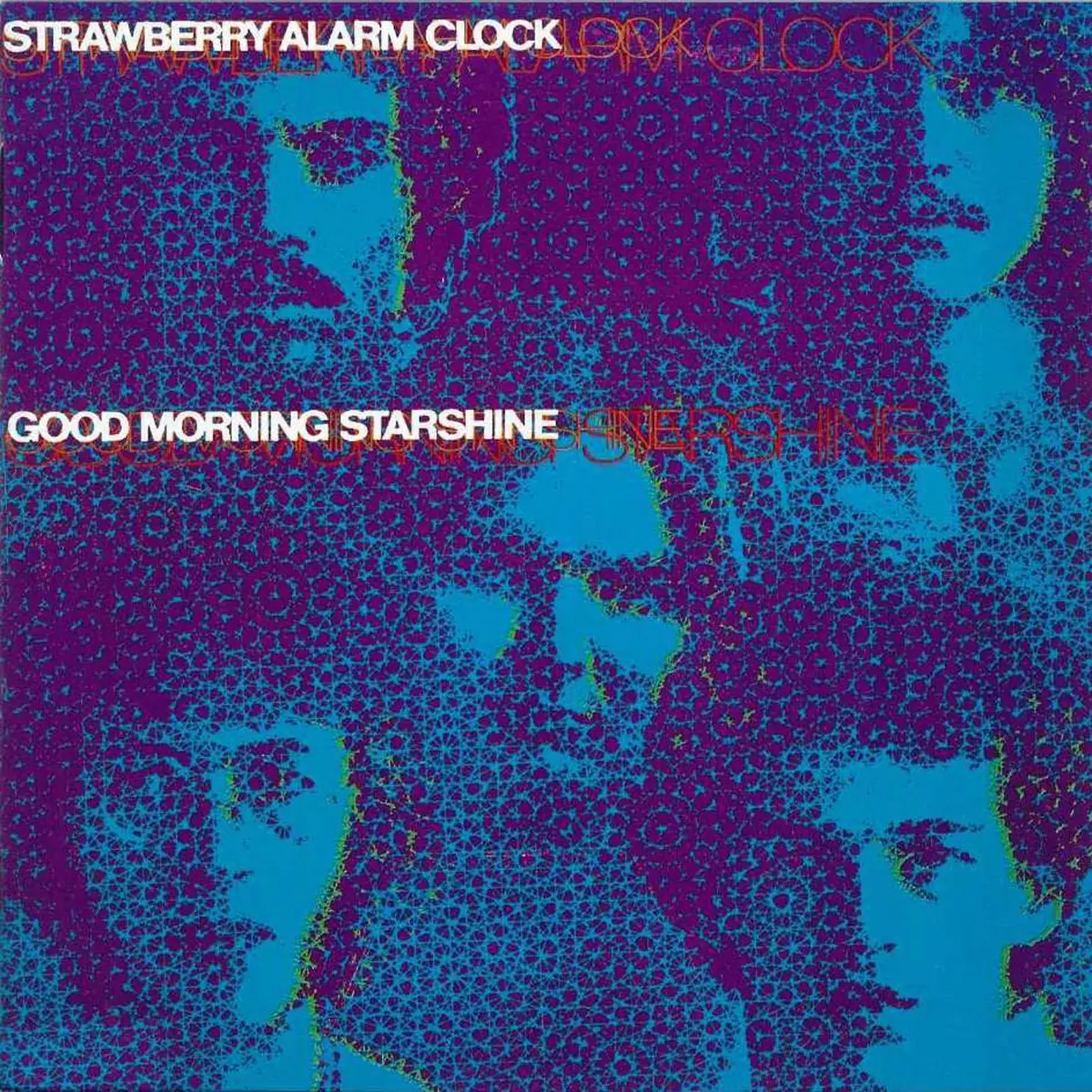 Strawberry Alarm Clock released their fourth album, Good Morning Starshine, in May 1969 on Uni. The album marked a lineup change and a shift from psychedelic pop to electric blues rock.
They recorded Good Morning Starshine with ex-Nightcrawlers singer/guitarist Jimmy Pitman. The title track, originally from Hair, was the only song not written or produced by the band, instead penned by Galt MacDermot, Gerome Ragni, and James Rado.
Pitman’s contributions led the group through sharp, blues-driven territory on “Me and the Township,” “Off Ramp Road Tramp,” and “Hog Child.” The latter two tracks stretch into extended forms and dense arrangements, contrasting with the brighter, compact phrasing of “Small Package” and “(You Put Me On) Standby.” “Miss Attraction” appears in two versions: a jam-heavy full-length cut and a shorter, more focused single take. “Dear Joy” and “Write Your Name in Gold” shift the tone with softer, mid-tempo arrangements. “Changes” closes the album with an expansive, organ-heavy passage.
A1. “Me and the Township” (3:14) – opens the album with blues-forward pacing and a pro-nationalist lyrical stance
A2. “Off Ramp Road Tramp” (4:15) – leans into Doors-style roadhouse energy with twin fuzz and jamming
A3. “Small Package” (3:58) – short-form psychedelia with vocal inflections echoing Wake Up…It’s Tomorrow, includes a Beach Boys homage in the coda
A4. “Hog Child” (5:06) – distorted, extended blues number marked by heavy guitar and unfocused structure
A5. “Miss Attraction” (4:27) – album version features overlong jamming and dual guitar leads
B1. “Good Morning Starshine” (2:20) – cover of the Hair track, included at the label’s insistence
B2. “Miss Attraction” (2:39) – tighter alternate version, aligns closer with earlier SAC stylings
B3. “Write Your Name in Gold” (3:32) – ballad marked by simpler structure and subdued delivery
B4. “(You Put Me On) Standby” (2:20) – a return to the group’s rhythm-centered pop-soul leanings
B5. “Dear Joy” (3:15) – gentle track blending their psych roots with late-’60s pop sentiment
B6. “Changes” (5:15) – album closer with psychedelic color and long-form arrangement driven by organ and layered fuzz
Sessions occurred at an unspecified studio in Los Angeles with production by Strawberry Alarm Clock. Ed King and Mark Weitz led the recording and mixing process.
“Good Morning Starshine” was released as a single, charting modestly before being eclipsed by Oliver’s hit version.
The album marked the last recorded effort from SAC’s original era. It introduced a rawer tone and pivoted from their earlier formula, offering a closing chapter that leaned heavier but still nodded to their 1967 origins.
Postlude
Keyboardist Mark Weitz departed in December 1969, after which the band issued three non-album singles—“I Climbed the Mountain,” “California Day,” and “Girl from the City” (all backed with “Three”)—on Uni through mid-1970.
Strawberry Alarm Clock appeared in the 1970 Russ Meyer film Beyond the Valley of the Dolls and continued touring through 1971, often paired with then-unknown Southern acts, including Lynyrd Skynyrd. The group disbanded later that year amid label loss and musical disagreements. Guitarist Ed King relocated south and joined Lynyrd Skynyrd in late 1972, contributing to their 1974 hit “Sweet Home Alabama.” A brief reunion followed in 1974–75, when Bunnell, Seol, and Bartek played select concerts and performed the theme to ABC in Concert, including an appearance at California Jam.
Discography:
- Incense and Peppermints (1967)
- Wake Up… It’s Tomorrow (1968)
- The World in a Sea Shell (1968)
- Good Morning Starshine (1969)
Sources:
Artist/Album Pages:
Estus was an American hard-rock band behind a 1973 self-titled album on Columbia, produced by for...
Pearls Before Swine was an American folk-psych band from Melbourne, Fla., that released the 1967/68 ...
Poliphony was an English jazz-rock band that released a 1973 self-titled album on the Birmingham s...
Woody Kern was an English psychedelic blues-rock band that released the 1969 album The Awful Disclos...
Bandolero was a Puerto Rican psych-rock band behind a 1970 self-titled album on Truth Records. M...
The Flock was an American psychedelic jazz-rock band from Chicago that released the 1969–70 Colum...
Kahvas Jute was an Australian post-psychedelic hard-rock band from Sydney that released the 1971 a...
Paulo Bagunça e a Tropa Maldita were a Brazilian folk-psych band behind a 1973 self-titled album o...
Drama was a Dutch hard-rock/psych band, formed as a followup to After Tea. They released four sing...
Silberbart was a German Krautrock trio behind the 1971 Philips album 4 Times Sound Razing. Membe...
Socrates Drank the Conium was a Greek hard-rock/psych band that released a clutch of singles circa...
Malo was an American Latin rock band from San Francisco that released four albums between 1972 an...