
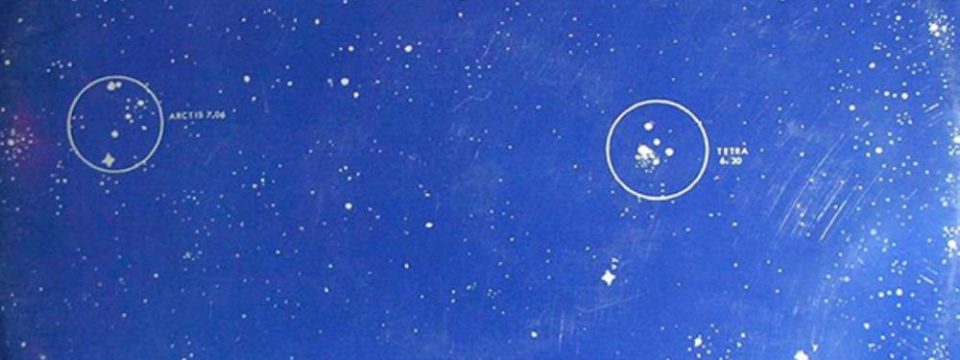
 Eider Stellaire is the debut album by the French Zeuhl band Eider Stellaire, self-released in 1981 with the catalog number K 001.
The album presents a dense strain of Zeuhl-fusion built on relentless bass patterns, rapidfire drum shifts, and contoured electric piano figures. Guitar assumes a prominent voice across extended ensemble passages, while wordless dual-voice shapes hover at the edges of the instrumentation. Occasional saxophone and flute expand the timbral palette during transitional sections.
The group features drummer Michel Le Bars, bassist Patrick Singery, guitarist Jean-Claude Delachat, keyboardist Pierre Gérard-Hirne (pianos, organ), vocalist Véronique Perrault, guest flutist/vocalist Marie-Anne Boda, and guest tenor saxophonist Michel Moindron. The rhythm section drives most thematic pacing, with guitar entering as a fiery lead presence. Pierre Gérard-Hirne wrote two pieces, while Michel Le Bars composed three.
Sessions occurred May 27–31, 1981 at an unidentified French studio with production handled by Eider Stellaire and engineering that positions bass forward, drums close-mic’d, and keyboards dry and immediate.
The Music
The record divides into five long-form instrumental works. “Onde” evolves from interior electric piano gestures into thicker ensemble movement, “Arctis 6ème Éphéméride” builds around a four-note vocal motif sharpened by guitar, and “Légende” pivots toward looser jazz-fusion interplay. “Tetra” alternates slow-paced phrasing and turbulent acceleration with a late saxophone entry, while “Nihil” escalates through staged dynamic ascents framed by repetitive bass insistence and terse voice lines.
A1. “Onde” [Wave] (8:38) — Pierre Gérard-Hirne
Drums and bass establish an urgent pace within seconds, pushing short keyboard figures into sharper turns as guitar enters with serrated accents. The bass emits compulsive pulses that jab at the harmonic center while electric piano outlines angular counter-shapes. Two minutes in, the ensemble resets and climbs again, amplifying density through thick midrange guitar presence. After 3 ½ minutes, the bass shifts into a jagged pattern and the drums accelerate into rapidfire fills. Guitar becomes increasingly abrasive near the five-minute mark, trading terse attacks against brief keyboard flashes. Late in the track, piano isolates the harmonic cell, pulling the ensemble down into bare, suspended space. Final guitar statements land in clipped gestures, ending abruptly without resolution.
A2. “Arctis 6ème Éphéméride” (7:06) — Michel Le Bars
Bass, drums, and electric piano launch a tight pulse that climbs into faster pacing after one minute. Wordless female vocal shapes enter on a four-note cell, repeating in short cycles against shifting guitar contours. The bass stays percussive and obsessive, pushing the progression forward as flute arrives with brief coloristic lines. Guitar turns raunchy at key peaks, slicing above the rhythm with sharp articulation before retreating into ensemble blend. Toward the midpoint, the texture narrows, then expands again with thicker guitar presence. The final ascent reinforces the four-note vocal cell as all instruments converge in a compressed finish.
A3. “Légende” (5:46) — Michel Le Bars
Bass establishes a buoyant rhythmic footing while Fender Rhodes spreads broad harmonic fields. Guitar enters just before the minute mark and escalates quickly into fiery lead patterns, bending phrases over cycling keyboard motion. Drums maintain steady pressure below, occasionally thinning to allow piano to assume foreground authority near 3 ½ minutes. Wordless female vocals soften the texture in brief interludes, then withdraw as the pace increases again. Guitar returns with distorted emphasis, darting between intervals while the bass claims a short ascending spotlight. The track ends on a tightened ensemble push rather than thematic dissolution.
B1. “Tetra” (6:30) — Pierre Gérard-Hirne
Keyboards open alone in slow pacing before the band slams into faster, Latin-leaning rhythmic motion. Bass fists out short, repetitive figures while guitar launches rapidfire flurries over the top. The ensemble alternates between restrained passages and explosive accelerations, each shift punctuated by drum jolts. Around 4 ½ minutes, tenor saxophone enters and threads a contoured line through the established harmonic frame. The band thickens the attack behind it, then pulls back once more for a quick reset. Guitar returns to close the piece with edged articulation and sudden deceleration.
B2. “Nihil” (7:34) — Michel Le Bars
Wordless female vocals and electric piano open in measured pacing, gradually pulling the ensemble into motion. After a minute, the full band drives forward as guitar and bass swing into repetitive, forceful cycles. Drums attack the pattern early, then recede slightly in the mix while keys and bass become the structural anchors. A mid-track retreat clears space for brief vocal presence, followed by a surge into relentless repetition after five minutes. The energy peaks in a maniacal ascent before dissolving into looser, slower phrasing. Vocals and drums taper the track into a subdued final cadence.
Summary
The record documents a young unit prioritizing tension, acceleration, and incremental variation across sustained rhythmic cells. Bass and electric piano anchor each escalation, while guitar spikes the ensemble with volatile surges. Within this frame, brief voice, flute, and saxophone gestures add color without altering the structural core. The result presents a focused statement of early-1980s Zeuhl-fusion, performed with cohesion and urgency across five extended pieces.
Tracklist:
A1. “Onde” (8:38)
A2. “Arctis 6 éphéméride” (7:06)
B1. “Legende” (5:46)
B2. “Tetra” (6:30)
B3. “Nihil” (7:34)
Credits:
Bass Guitar – Patrick Singery
Drums – Michel Le Bars
Guest, Flute, Vocals – Marie-Anne Boda
Guest, Tenor Saxophone – Michel Moindron
Guitar – Jean-Claude Delachat
Piano, Organ – Pierre Gerard-Hirne
Vocals – Véronique Perrault
Artist/Album Pages:
The Gospel According to the Meninblack is the fifth album by English art-rock/New Wave band The Stra...
Don't Say No is the second album by American hard-rock guitarist/singer Billy Squier, released in 19...
Eider Stellaire was a French Zeuhl/jazz-rock band that self-released two eponymous albums between ...
Eros is the lone album by French Zeuhl/chamber-rock combo Dün, self-released in 1981 with the catalo...
The Judgement of Paris is an album by American New Wave eccentric Kevin Dunn, recorded with backup c...
All American Girls is the fifth album by American soul/funk vocal act Sister Sledge, released in 198...
L'Aldila is a soundtrack album by Italian composer Fabio Frizzi to a namesake supernatural horror mo...
My Melody is the fourth album by American soul singer Deniece Williams, released in 1981 on ARC/CBS....
Rage in Eden is the fifth album by English art rock/New Wave band Ultravox, released in 1981 on Chry...
185 is the second and final proper album by Maryland avant-garde/jazz-rock band The Muffins, release...
Věci is an album by Czech avant-garde/art-rocker quintet Combo FH, released in 1981 on Panton. ...
Wired for Sound is the 24th studio album by Cliff Richard, released on September 14, 1981, on EMI. T...