

The Thompson Twins were an English new wave band that rose to global prominence with the Second British Invasion. They made eight albums between 1981 and 1991 and scored hits with “Love On Your Side,” “Hold Me Now,” “You Take Me Up,” “Lay Your Hands On Me,” and “Doctor! Doctor!”
Tom Bailey formed the initial four-piece lineup that cut two 1980 indie singles. They expanded to a sextet with percussionist Joe Leeway for their 1981 debut album, A Product Of…, a mix of post-punk and tribal rhythms. Percussionist Alannah Currie joined the septet formation of their second album, Set, which spawned the club hit “In the Name of Love.”
Bailey, Currie, and Leeway reconfigured as a synthpop trio for their 1983 album, Quick Step & Side Kick, which launched them as an MTV fixture with the single “Lies.” Their 1984/85 albums Into the Gap and Here’s to Future Days solidified their global prominence. After Leeway’s 1986 departure, Bailey and Currie made three albums as a duo and later recorded as Babble.
Members: Tom Bailey (vocals, keyboards), Peter Dodd (guitar, 1977-82), John Roog (guitar, 1977-82), Chris Bell (drums, 1979-82), Alannah Currie (percussion, saxophone, vocals, 1981-93), Matthew Seligman (bass, 1981-82), Jane Shorter (saxophone, 1981-82), Joe Leeway (percussion, vocals, 1981-86)
Background
The Thompson Twins formed in 1977 in Sheffield, South Yorkshire, where then-bassist Tom Bailey teamed with two guitar-playing pals, Pete Dodd and John Roog, plus a drummer named Pod. They took their name from Thomson and Thompson, a pair of clumsy lookalike detectives in The Adventures of Tintin, a popular Belgian comic strip by Hergé (1907–1983).
Bailey (b. January 18, 1956; Halifax, Yorkshire) grew up in a medical family and attended Chesterfield Grammar School, where he trained as a classical pianist. Prior to forming the band, he traveled the world and taught a music class at Brook School in Sheffield.
Minus Pod, they soon moved to London, where they lived communally as squatters on Lillieshall Road, Clapham, in close proximity to another arrival, young journalist Alannah Currie (b. Sept. 20, 1957, Auckland, New Zealand). Her and Bailey became an item.
1980
In early 1980, Tom backed Alannah’s improvisational band, The Unfuckables, at an anti-psychiatry conference at Conway Hall, Red Lion Square, with members of The Slits, The Pop Group, and This Heat. For eighteen months, drummer Andrew Edge (later Savage Progress) filled out the Thompson Twins lineup. With the arrival of drummer Chris Bell, the Thompson Twins cut their debut single.
First Two Singles
 In April 1980, the Thompson Twins released their first single: “Squares and Triangles” backed with “Could Be Her .. .. Could Be You,” both group-credited songs issued on Dirty Discs, a DIY one-off label that pressed eight color-variations of the picture sleeve.
A. “Squares and Triangles” (3:17)
B. “Could Be Her, Could Be You” (3:16)
The Thompson Twins cut both sides at Point Studios, an 8-track facility in Belgravia, Central London, where engineer Alex Burak co-produced the single with studio co-owner Alan O’Duffy, a longtime Horslips soundman with recent credits behind Meal Ticket, Radiator, and Rory Gallagher.
 In September 1980, the Thompson Twins issued their second single: “She’s In Love With Mystery” backed with “Fast Food/Food Style” both group-credited songs issued on Latent, a one-off label started by producer/journalist Steve Taylor, a contributor to Smash Hits and The Face.
A. “She’s In Love With Mystery” (2:33)
B. “Fast Food/Food Style” ()
The Thompson Twins cut “She’s In Love With Mystery” at Point Studios with engineer Steve Dewey, a prior soundman for Dead Fingers Talk. They cut “Fast Food” with engineer Peter Leggett at Mousehole Studio, an Orpington, Kent, facility where Bailey played clarinet on a concurrent project: Drip Dry Zone, the first of two albums by Local Heroes SW9, a post-punk/dub band.
1981
 On January 31, 1981, the Thompson Twins released their third single: “Perfect Game” backed with “Politics.”
They recorded both sides at Point Studios with Mike Howlett, the erstwhile Gong bassist whose growing list of production credits included recent titles by Athletico Spizz 80, Fischer-Z, Martha + The Muffins, Orchestral Manoeuvres In the Dark, Penetration, Punishment of Luxury, The Revillos, and the Teardrop Explodes.
“Perfect Game” inaugurated T Records, an imprint for Thompson Twins releases, distributed by the Ariola Group.
 For this release, the band were still the quartet of Bailey, Dodd, Roog, and Bell. Soon after, they welcomed two additional members: roadie-turned-percussionist Joe Leeway and saxophonist Jane Shorter, formerly of post-punks The Fridges.
The new six-piece lineup commenced work on a full-length album.
A Product Of…
 The Thompson Twins released their debut album, A Product Of…, on June 5, 1981, on T Records.
A Product Of… contains two adaptations and ten group-written songs, including “Make Believe,” “When I See You,” and both sides of their recent single, “Perfect Game” and “Politics.” Side B contains both sides of their fourth single, “Animal Laugh” and “Anything Is Good Enough.”
Tom Bailey plays bass, keyboards, and reeds on the album, which features percussion from all six members and backing vocals from everyone but Jane Shorter, who shares the saxophone slot with co-guitarist Peter Dodd.
A1. “When I See You” (4:05)
A2. “Politics” (2:24)
A3. “Slave Trade” (3:28)
A4. “Could Be Her…Could Be You” (3:50)
A5. “Make Believe” (3:30)
A6. “Don’t Go Away” (3:05)
B1. “The Price” (4:28)
B2. “Oumma Aularesso (Animal Laugh)” (3:02) is a Bailey-arranged traditional from Sierra Leone.
B3. “Anything Is Good Enough” (2:34)
B4. “A Product Of…” (3:52)
B5. “Perfect Game” (4:25)
B6. “Vendredi Saint” (3:10) is a Bailey-arranged Gregorian chant.
 Apart from the earlier Howlett-produced sides, sessions occurred in April 1981 with Steve Dewey, who engineered A Product Of… in sequence with titles by The Barracudas and onetime Hawkwind poet Robert Calvert.
The Thompson Twins self-produced six tracks at London’s Town House Studio. They recorded four tracks (“Slave Trade,” “Make Believe,” “Don’t Go Away,” and the title track) at Studio 80 with reggae producer Dennis Bovell, a recent post-punk soundman (The Pop Group, The Slits) and dub musician (Blackbeard, Matumbi).
Artist Jonathan Phipps illustrated the cover: a 32-panel grid of scribbled-over male/female bathroom-sign figures. The back cover features a monochrome group shot by one Gwendoline Patmore.
 The Thompson Twins lifted “Animal Laugh (Oumma Aularesso)” as their fourth single, backed with “Anything Is Good Enough” and “A Dub Product,” a dub version of the album’s title track. They also issued a 12″ version with an extended “Animal Laugh” (4:30), co-produced by Sixties soundman Steve Rowland (ex-Family Dogg).
In August, the Thompson Twins lifted “Make Believe (Let’s Pretend)” as their fifth single, backed with the non-album “Lama Sabach Tani.” They issued two versions of “Make Believe”: a standard 7″ and an extended 12″ (4:58).
B. “Lama Sabach Tani” (4:59)
1982
Between the first and second album, the Thompson Twins expanded to seven with bassist Matthew Seligman, who recorded prior albums with Bruce Woolley & The Camera Club (English Gardens) and The Soft Boys (Underwater Moonlight). As a member of Local Heroes SW9, he interacted with Bailey beforehand on Drip Dry Zone.
Seligman recently cut three singles as a member of the Fallout Club. His presence in the Thompson Twins freed Bailey to focus on keyboards and vocals. Meanwhile, Jane Shorter cleared for Bailey’s girlfriend, Alannah Currie, who joined on percussion and saxophone.
Set
 The Thompson Twins released their second album, Set, on February 26, 1982, on T Records.
Set contains six songs written exclusively by Tom Bailey, including “Living in Europe,” “Fool’s Gold,” and the singles “Runaway” and “In the Name of Love.” He co-wrote “Blind,” “Bouncing,” and “Tik Tok” with Joe Leeway, who submitted “Good Gosh” and co-wrote “Crazy Dog” with guitarist/keyboardist Peter Dodd.
The album features a septet lineup with five members from the prior sextet — Bailey, Leeway, Dodd, drummer Chris Bell, and guitarist/co-founder John Roog — plus Matthew Seligman and Alannah Currie. Seligman’s Camera Club bandmate Thomas Dolby plays synthesizer on “The Rowe,” “Runaway,” and “Fool’s Gold.”
1. “In the Name of Love” (3:50)
2. “Living in Europe” (3:26)
3. “Bouncing” (2:30)
4. “Tok Tok” (2:24)
5. “Good Gosh” (3:10)
6. “The Rowe” (6:28)
7. “Runaway” (3:33)
8. “Another Fantasy” (3:59)
9. “Fool’s Gold” (3:20)
10. “Crazy Dog” (3:45)
11. “Blind” (4:53)
 Original copies contained a bonus repress of their firs single, “Squares and Triangles,” backed with two exclusive Tom Bailey songs: “Weather Station” and “Modern Plumbing.”
B1. “Weather Station” (1:01) was Bailey’s contribution to The Onlooker, a 1982 indie film.
B2. “Modern Plumbing” (5:43) is a late-1979 recorded attributed to The Blankets, a Bailey side-project with Thompson Twins manager John Hade and one Traci.
The Thompson Twins recorded Set in late 1981 with U2 soundman Steve Lillywhite, who also produced 1982 titles by The Chameleons and Toyah. Cure soundman Phil Thornalley engineered Set between album by The Psychedelic Furs (the Lillywhite-produced Talk Talk Talk) and Classix Nouveaux.
 Set features cover illustrations and a colorized group photo by Thomi Wroblewski, whose visuals also appear on 1981/82 sleeves for Simple Minds, Siouxsie & The Banshees, Talking Heads, and The Wall.
“In the Name of Love” preceded Set by three weeks as a single, backed with “In the Beginning,” a non-album Dodd track.
B. “In the Beginning” (3:11)
In May, the Thompson Twins lifted a remixed version of “Runaway” as a single, backed with “Open Your Eyes,” a non-album group original. T Records also issued a limited edition “Runaway” double-7″ with live versions of “Living In Europe” and “Make Believe.”
B. “Open Your Eyes” (3:04)
“In the Name of Love” spent five weeks at No. 1 on the Billboard Dance Chart in the US, where Arista Records re-titled Set after the hit. The American album replaces “Blind,” “Crazy Dog,” and “Tik Tok” with the Product Of… tracks “Make Believe” and “Perfect Game.”
New Lineup
 In light of the Thompson Twins’ club success, Tom Bailey and manager John Hade reconfigured the group as a synthpop trio composed of Bailey, Joe Leeway, and Alannah Currie.
John Roog and Peter Dodd formed Big View, which cut the 1982 single “August Grass” (b/w “Confess”) at Point for the studio’s eponymous Point Records label.
Chris Bell did subsequent stints in Specimen, Spear of Destiny, and Gene Loves Jezebel.
Matthew Seligman played on 1983–86 titles by Dolby, Birch & Hallam, Gardening by Moonlight, The Waterboys, Whodini, ex-Vibrators frontman Knox, and ex-Soft Boys bandmates Robyn Hitchcock and Kimberly Rew. In 1987, he backed the Dolphin Brothers, the group moniker of Japan alumni Steve Jansen and Richard Barbieri.
Meanwhile, the new-look Thompson Twins debuted on October 22, 1982, with “Lies,” a taster from their upcoming album, backed with “Beach Culture,” an exclusive trio-credited original. Arista issued “Lies” in standard 7″ (3:10) and extended 12″ (6:35) formats.
The “Lies” video takes place in a gray, computer-generated room, where Tom (half-blazer, slacks and tie) sings to three unseen people grouped in a single bed. Random objects and characters appear and disappear, including two iconic images of Belgian surrealist René Magritte: the giant apple (from The Listening Room, 1952) and the floating Son of Man (from Golconda, 1953).Ech member appears as an advancing, disembodied head during the chorus.
B. “Beach Culture” (3:55 / 6:48)
“Lies” reached No. 6 in New Zealand and No. 27 in Australia. The song became their second No. 1 on the US Dance Club Songs chart and reached No. 30 on the Billboard Hot 100 while the video received high MTV rotation. Their stateside breakthrough coincided with the Second British Invasion.
1983
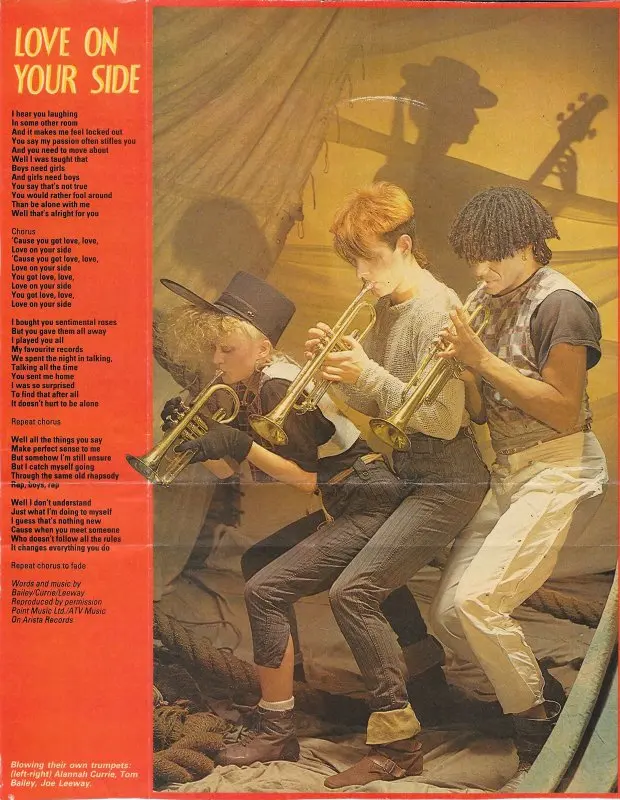
 In January 1983, the Thompson Twins released their eighth single: “Love On Your Side,” a poignant dance number backed with a dub version titled “Love On Your Back.”
A. “Love On Your Side” (3:34) is a single edit of the opening track from their upcoming album. Alannah Currie wrote the original lyrics, which Tom Bailey modified to a male perspective. Arista also issued a double-length 12″ version (7:22) subtitled “Rap Boy Rap” after Joe Leeway’s line in the middle.
B. “Love On Your Back” (4:06) is a mostly instrumental variation of the backing track with select utterances of choice words. The 12″ version (5:48) is subtitled “No Talking.”
The song’s video takes place in a steamy, shadowy room laden with ropes and sheets. Tom sings straight to the camera, which cuts frequently to scenes of Joe and Alannah (often silhouetted), who mime, gesticulate, and play-quarrel. “Love On Your Side” became another MTV staple.
 The Thompson Twins mimed “Love On Your Side” between purple-lit metal gables for the February 10 and 24 broadcasts of the BBC music program Top of the Pops, which also featued in-studio numbers by the Belle Stars (“Sign of the Times”), Central Line (“Nature Boy”), China Crisis (“Christian”), Depeche Mode (“Get the Balance Right”), Level 42 (“The Chinese Way”), Eurythmics (“Sweet Dreams (Are Made of This)”), and Spandau Ballet (“Communication”). Bailey sported a burgundy bouffant in the Thompson Twins segment, flanked by Currie and Leeway in red batwing tops.
“Love On Your Side” reached No. 9 in New Zealand and No. 16 in Belgium. The song also reached No. 9 on the UK Singles Chart and launched their home-country hit streak.
Quick Step & Side Kick
 The Thompson Twins released their third album, Quick Step & Side Kick, in February 1983 on Arista. This is the first of three albums by their popular trio configuration. In North America, the album appeared with a shuffled tracklist as Side Kicks.
The album contains ten group-written songs, including “Judy Do,” “We Are Detective,” and the pre-released singles “Lies” and “Love On Your Side.”
Tom Bailey plays programmed drums and shares synthesizers with Joe Leeway, who plays congas and shares backing vocals with Alannah Currie, who plays xylophone and percussive sundries.
Future Cure drummer Boris Williams plays cymbals on “If You Were Here” and “Tears.” T-Connection guitarist Monte Brown guests on “Watching,” which features backing vocals by his longtime associate, Grace Jones.
1. “Love On Your Side” (4:25)
2. “Lies” (3:15)
3. “If You Were Here” (2:55)
4. “Judy Do” (3:48)
5. “Tears” (5:00)
6. “Watching” (3:57)
7. “We Are Detective” (3:05)
8. “Kamikaze” (3:57)
9. “Love Lies Bleeding” (2:50)
10. “All Fall Out” (5:25)
 Sessions took place in late 1982 at Compass Point Studios in Nassau, Bahamas, where T-Connection soundman Alex Sadkin produced Quick Step in sequence with albums by Grace Jones, Joe Cocker, Classix Nouveaux, and the third Duran Duran album, Seven and the Ragged Tiger. Phil Thornalley engineered Quick Step in tandem with titles by The Cure, Danse Society, Julian Cope, Seona Dancing, and XTC (Mummer).
 The designs firm Satori Graphic created the visuals on Quick Step and its corresponding singles, which all feature the faceless three-headed group icon. Photographer Roger Charity captured the cover image, which shows the capri-clad trio sprinting from a menace from behind.
 In April 1983, the Thompson Twins released “We Are Detective” as the third single, backed with the non-album “Lucky Day.” The 12″ contains extended version subtitled ‘More Clues’ (6:00).
B. “Lucky Day” (3:52 / ‘Space Mix’ 6:58)
In the “We Are Detective” video, the group mimes with unused instruments (accordion, saw) in a makeshift alleyway. They don detective overcoats and later hold a mini formal dance while side-stepping a blue ray.
The Thompson Twins mimed “We Are Detective” in gray baggies and suspenders for the 1000th episode of TotP, a May 5 broadcast that also featured in-studio numbers by Blancmange (“Blind Vision”), The Beat (“Can’t Get Used to Losing You”), Fun Boy Three (“Our Lips Are Sealed”), Heaven 17 (“Temptation”), The Human League (“(Keep Feeling) Fascination”), and Spandau Ballet (“True”). “We Are Detective” reached No. 7 on the UK Singles Chart.
 In July, “Watching” became the fourth UK single, backed with an instrumental version titled “Dancersaurus.” The 12″ contains extended versions of “Watching” (5:48) and the flipside (subtitled “Even Large Reptiles Have Emotional Problems”). Arista issued a picture-disc version in the shape of the Thompson Twins’ icon.
In the “Watching” video, the group appear as steam-factory workers who mime on the job and slack off with play marches and costume routines.
Quick Step & Side Kick reached No. 2 on the UK Albums Chart and No. 7 in New Zealand. In North America, the Side Kicks version reached No. 26 in Canada and No. 34 on the US Billboard 200.
“Hold Me Now”
 On November 11, 1983, the Thompson Twins released their eleventh single: “Hold Me Now,” a taster from their upcoming fourth album, backed with “Let Loving Start,” an exclusive group-written number. The 12″ contain a double-length version (9:54).
B. “Let Loving Start” (3:44 / 9:09)
In the “Hold Me Now” video, the group mimes at different levels in a blue studio. Alannah wears a batwing Navy blue bolero jacket with red lapels. Later, the shadow-cast members (sans instruments) dance apart under brass-tinted lighting.
The Thompson Twins mimed “Hold Me Now” amid flashing coloured lights and chrome scaffolding for the November 24 and December 8 TotP broadcasts, which also featured in-studios by Howard Jones (“What Is Love?”), Paul Young (“Love of the Common People”), Simple Minds (“Waterfront”), The Smiths (“This Charming Man”), and Tears for Fears (“The Way You Are”).
“Hold Me Now” reached No. 4 in the UK and New Zealand, the group’s two biggest markets. The single consolidated their breakthrough in North America, where “Hold Me Now” reached No. 3 on the Canadian Top Singles chart and the US Billboard Hot 100. Elsewhere, the single went Top 10 in Germany (No. 7), South Africa (No. 8), and Ireland (No. 9).
1984
 On January 27, 1984, the Thompson Twins released a second preview from their upcoming album: “Doctor! Doctor!” – a poignant production ballad backed with “Nurse Shark,” a trio-written exclusive. Arista issued “Doctor! Doctor!” in three versions: standard 7″ (4:30), promo edit (3:46), and extended 12″ (7:50).
B. “Nurse Shark” (4:07)
The video takes place on a lunar, fog-laden studio set with blue block levels. Tom sings impassioned to the camera while Joe and Alannah (batwing tops and gloves) make melodramatic gestures and interact with robed, face-painted dancers.
The Thompson Twins mimed “Doctor! Doctor!” inside pink-lit metal gables for the February 2 TotP broadcast, which also featured in-studios by Fiction Factory (“(Feels Like) Heaven”), Matthew Wilder (“Break My Stride”), and Musical Youth (“Sixteen”).
“Doctor! Doctor!” reached No. 3 in the UK, No. 5 in Ireland, and peaked at No. 11 in the US, Canada, and West Germany.
Into the Gap
 The Thompson Twins released their fourth album, Into the Gap, on February 17, 1984, on Arista.
Into the Gap contains nine group-credited originals, including “Sister of Mercy,” “No Peace for the Wicked,” “Storm on the Sea,” and the pre-released singles “Hold Me Now,” and “Doctor! Doctor!”
Alannah Currie plays marimba, xylophone, and assorted percussion on Into the Gap, which features Joe Leeway on congas and synthesizers. Tom Bailey handles the album’s instrumental balance: guitar, bass (electric and standup), piano, synthesizer, melodica, harmonica, and drum machine.
1. “Doctor! Doctor!” (4:39)
2. “You Take Me Up” (4:26)
3. “Day After Day” (3:49)
4. “Sister of Mercy” (5:09)
5. “No Peace for the Wicked” (4:09)
6. “The Gap” (4:44) features Monsoon tablist Pandit Dinesh, a recent Blancmange sessionist.
7. “Hold Me Now” (4:46)
8. “Storm on the Sea” (5:26)
9. “Who Can Stop the Rain” (5:46)
Aside from the earlier “Hold Me Now,” sessions occurred between November 1983 and January 1984 at Compass Point in Nassau, where Bailey co-produced Into the Gap with Alex Sadkin, who co-engineered the album amid projects with Foreigner and ex-Josef K frontman Paul Haig. Phil Thornalley (now an actual Cure member) mixed the album in London at RAK Studios.
Alannah served as art director of the Satari-designed cover and inner-sleeves, which all display the three-headed group icon. The front cover shows the Thompson Twins surrounded by globes with three space shuttles (color-coded to each member) zoomed across the title. The back-cover shows an infrared world map with land-masses in the shape of the group icon. They posed for the front cover for Paul Cox, whose photography also appears on early Eighties sleeves for Big Country, The Bluebells, The Cult, Landscape, The Pretenders, The Selecter, Wang Chung, and Zee.
 In March, “You Take Me Up” became the third single, backed with “Passion Planet,” a non-album original. The UK 12″ contains an extended version titled “You Take Me Up / Machines Take Me Over” (7:33) with an instrumental postlude called “Down Tools” (4:18), plus a second b-side exclusive, “Leopard Ray.” Arista pressed picture-disc versions in multiple shapes, all with details culled from the album’s cover art.
B. “Passion Planet” (3:43)
B. “Leopard Ray” (3:15)
In the “You Take Me Up” video, the Thompson Twins portray chain-gang POW’s who toil with shovels in the sand but plot their escape behind bars. A mine explosion sets them free. Alannah sports an iconic casual getup: off-shoulder pink batwing top, high-water Banana Republic baggies, and a headwrap with avalanche bangs.
The Thompson Twins mimed “You Take Me Up” in studded leather jacket amid flashing neon wall panels for the March 29 TotP broadcast, which also featured in-studio numbers by Captain Sensible (“Glad It’s All Over”), Siouxsie & The Banshees (“Swimming Horses”), and The Special AKA (“Nelson Mandela”).
“You Take Me Up” reached No. 5 in Ireland and No. 2 in the UK, their highest home-country placement. The single received heavy stateside airplay apart from Los Angeles, where KROQ-FM (Pasadena) favored “Passion Planet,” which became a local hit.
 In late June, “Sister of Mercy” became the fourth single, backed with a Thompson Twins medley titled “Out of the Gap.”
B. “Out of the Gap” (5:08)
In the “Sister of Mercy” video, a suited Tom sings at a black grand piano while Joe and Alannah (both in funeral garb) play flute and later sing and pray with solemn expressions. Meanwhile, a haggard housewife murders her husband and later contemplates her actions inside a metal institution.
Tom mimed “Sister of Mercy” on a white baby grand for the July 5 TotP, which also featured in-studios by Frankie Goes to Hollywood (“Two Tribes”), OMD (“Talking Loud and Clear”), and Ultravox (“Lament”).
Into the Gap reached No. 1 in the UK and New Zealand and No. 3 in Canada. The album also reached No. 4 in Australia, No. 6 in Germany, No. 7 in Switzerland, and No. 10 on the US Billboard 200.
“Lay Your Hands On Me”
 The Thompson Twins name appeared on “Adventure Game for the Spectrum,” a flexi-disc of digi-code sounds included in the October 1984 issue of Computer and Video Games, a UK gaming magazine.
On November 26, 1984, the Thompson Twins returned with “Lay Your Hands On Me,” their first fruits of an album in-progress; backed with “The Lewis Carol,” a group-written exclusive.
A. “Lay Your Hands On Me” (4:00 / 6:02)
B. “The Lewis Carol” (4:08)
The Thompson Twins recorded “Lay Your Hands On Me” at Marcadet Studios, a 32-track facility in Paris, where Bailey co-produced the song with Alex Sadkin.
 Bailey donned a yellow satin jacket and matching sharkskin pants for the video, in which he’s crouched with an orange Gibson hollow body while a scarved Joe (upright bass) and a bejeweled Alanna (mallets) play before an art-house audience with an auxiliary pianist, drummer, and four-piece string section. As the song reaches its chanted climax, the crowd rises with members in superstar guises (Boy George, Kate Pierson, August Darnell, Steve Strange).
Arista originally limited “Lay Your Hands On Me” to the UK, Europe, and Oceania. The 1984 release reached No. 17 in Sweden, No. 19 in New Zealand, and No. 13 on the UK Singles Chart.
 The single’s picture sleeve features hand details from a group shot in pearls and satin by photographer Molshe Brakha, whose imagery appears on Seventies classics by Mr. Big and Roderick Falconer. Details of the back-sleeve photo appear on the diamond-shaped picture disc of “Lay Your Hands On Me.”
The label withheld the song’s North American release to avoid competition with the current stateside Thompson Twins single, “The Gap” (b/w “Out of the Gap”).
 The song’s US/Canadian release saw further delays after Bailey broke from Sadkin and continued as the new album’s self-producer. However, he collapsed in March 1985 due to workload exhaustion. After a period of rest, the Thompson Twins resumed work Nile Rodgers, the erstwhile Chic mastermind who produced recent titles by INXS, Madonna, Peter Gabriel, Spoons, and David Bowie‘s 1983 comeback Let’s Dance.
Niles remixed “Lay Your Hands On Me” for its US release, which finally appeared in September 1985, eleven months after its UK release. The song received high MTV rotation and reached No. 8 in Canada and No. 6 on the Billboard 200.
1985
 In April 1985, Arista issued “Roll Over,” a taster from the near-finished fifth Thompson Twins album, backed with “Fools In Paradise.” However, the group recalled the single in light of Tom Bailey’s collapse. The single became an instant rarity due to its early cancellation.
A. “Roll Over” (4:55)
B. “Fools In Paradise” (4:45)
After Bailey’s recovery, the Thompson Twins played Live Aid, a globally telecast, multi-act charitable concert for Ethiopian famine relief organized by Boomtown Rats frontman Bob Geldof. The transatlantic event occurred on Saturday, July 13, at Wembley Stadium in London and JFK Stadium in Philadelphia.
The Thompson Twins played the JFK event, where they first appeared (with Rodgers) during Madonna’s late-afternoon set for a rendition of “Love Makes the World Go ‘Round,” a song from the US singer’s eventual third album, True Blue (released in June 1986, eleven months after Live Aid). The Twins reappeared at 9:21pm EST for their own set, which featured “Hold Me Now” and “Revolution,” a cover of the 1968 Beatles song, performed with Rodgers, Madonna, and guitarist Steve Stevens (of Billy Idol‘s backing band).
 In August 1985, the Thompson Twins released “Don’t Mess With Dr. Dream,” a second advance single backed with “Big Business,” a group original co-produced by Nile Rodgers.
B. “Big Business” (4:14)
Tom and Alannah sport longer undersides in the video, which intersperses zoomed blue-tinted closes-ups of each member with text-overlaid cloud footage. The video concludes with a pan-down to a cathedral cemetery where the Thompson Twins walk from a funeral clad in gothic robes.
The single and ensuing album feature fashion group shots by director Rebecca Blake, whose grainy, high-styled imagery also graces 1984/85 sleeves for Heart, Pat Benetar, and Sheila E.
The Thompson Twins mimed “Don’t Mess With Dr. Dream” within a lavender-lit contraption of geometric shapes and bars for the August 29 TotP broadcast, which also featured in-studios by Bananarama (“Do Not Disturb”), Dan Hartman (“I Can Dream About You”), and Madness (“Yesterday’s Men”). In the Twins’ segment, Alannah sports a spiked updo reminiscent of Seventies punk icon Jordan, the early manager (and sometimes co-singer) of Adam & The Ants.
“Don’t Mess With Dr. Dream” reached No. 15 on the UK Singles Chart and went Top 20 in New Zealand and multiple European markets.
Here’s to Future Days
 The Thompson Twins released their fifth album, Here’s to Future Days, on September 20, 1985, on Arista.
The album contains nine group-credited originals, including “Emperor’s Clothes,” “You Killed the Clown,” “Don’t Mess with Doctor Dream,” and a remixed version of their 1984 single “Lay Your Hands on Me.”
Here’s to Future Days finds Alannah Currie with her standard arsenal: percussion, marimba, and xylophone. Joe Leeway plays congas, synth bass, and the E-mu Emulator, an early computerized sampler popularized on Michael Jackson‘s Thriller album. Tom Bailey handles the bulk of instrumentation (guitar, contrabass, piano, synthesizers) and programs the drum machines and Fairlight CMI.
Select tracks feature supplemental guitar work by producer Nile Rodgers, who marshaled the East Harlem Hobo Choir on “Lay Your Hands on Me” and “Future Days.” Guitarist Steve Stevens plays on “Breakaway” and “Revolution,” their studio version of the Live Aid Beatles cover.
The album’s release coincided with the belated North American appearance of “Lay Your Hands on Me,” which reached No. 8 in Canada and No. 6 on the US Billboard Hot 100 in September/October 1985 (eleven months after the song’s UK/European chart run). US/Canadian versions of the LP substitute “Breakaway” with “Roll Over,” another Stevens track. Both songs appear on CD and cassette versions of Here’s to Future Days.
1. “Don’t Mess with Doctor Dream” (4:25)
2. “Lay Your Hands on Me” (4:22)
3. “Future Days” (3:00)
4. “You Killed the Clown” (4:54) features tenor saxophonist Steve Elson, a recent David Bowie sideman.
5. “Revolution” (4:06) is a 1968 rocker by John Lennon; first released as the b-side to Paul McCartney’s epic ballad “Hey Jude” (both credited to the Lennon–McCartney partnership).
6. “King for a Day” (5:22)
7. “Love Is the Law” (4:45)
8. “Emperor’s Clothes (Part 1)” (4:46)
9. “Tokyo” (3:39)
10. “Breakaway” (3:34)
The original sessions spanned September 1984 to March 1984 at in Paris at Marcadet Studios, where Bailey self-produced the backing tracks after parting ways with Alex Sadkin, who produced the two prior Thompson Twins albums and the original mix of “Lay Your Hands on Me.” After Bailey’s recuperation, work re-commenced in New York City at Skyline Studios, where Rodgers remixed the tracks with overdubs.
The Marcadet sessions were engineered by John “Tokes” Potoker, a Queens-born soundman with credits on Eighties albums by Ashford & Simpson, Steely Dan, Stephanie Mills, and Talking Heads. Skyline engineer James Farber assisted Rodgers in sequence with titles by Madonna and Sister Sledge.
Early UK copies included a five-track bonus album of remixes, which also appeared as bonus tracks on the cassette version.
1. “Shoot Out” (6:23)
2. “Alice” (4:59)
3. “Heavens Above!” (3:20)
4. “The Kiss” (5:44)
5. “Desert Dancers” (7:05)
Alannah advised the visuals on Here’s to Future Days, which featured design details by Satori’s Andie Airfix and a stylish cover image by Rebecca Blake, who photographed the trio on cathedral grounds. Airfix earned subsequent credits on We’ve Got a Fuzzbox and We’re Gonna Use It, the 1986 debut by Fuzzbox, an all-female Brummie quartet with an Alannah-like dress sense.
 The Thompson Twins promoted the UK release of Future Days with “King for a Day,” a September single backed with “Rollunder,” a non-album instrumental. Bronx DJ John Morales remixed the extended 12″ version (7:20). The song reached No. 4 in New Zealand and No. 8 on the US Billboard Hot 100.
B. “Rollunder” (6:34)
The video to “King for a Day” takes place on a cluttered open floor of a city high-rise, where Tom pleads with a fussy Alannah, who fidgets over which jewelry to wear with her elaborate neo-Victorian ensemble. Joe caters and ultimately flower-showers the pair. They conclude in a church, where they perform with jubilance against a stained-glass backdrop. U2 videomaker Meiert Avis directed “King for a Day” in sequence with clips for Killing Joke (“Kings and Queens”), The Waterboys (“The Whole of the Moon”), and the Clannad/Bono duet “In a Lifetime.”
In November, Arista lifted “Revolution” as a third UK/European single, backed with “The Fourth Sunday,” a non-album original. The “Revolution” video takes place in a concert under flashing lights and giant white spheres, where camera zoom-ins of the trio and their extended backing band intermix with scenes of a side-stage robot. Items of note appear on Joe (yellow fringe jacket) and Alannah (frayed red tench coat). Tom sports long red hair and a patterned, multi-colored overcoat.
B. “The Fourth Sunday” (4:18)
Here’s to Future Days reached No. 1 in New Zealand and No. 5 in the UK. The album also went Top 10 in Sweden (No. 7), Australia (No. 8), and Norway (No. 9). Here’s to Future Days peaked at No. 20 in the US, where the three videos received high MTV rotation throughout the fall 1985 and winter/spring 1986 seasons.
Discography:
- A Product Of… (1981)
- Set (1982)
- Quick Step & Side Kick (1983)
- Into the Gap (1984)
- Here’s to Future Days (1985)
- Close to the Bone (1987)
- Big Trash (1989)
- Queer (1991)
Sources:
- Discogs: Thompson Twins
- 45cat: Thompson Twins
- 45worlds: Thompson Twins
- MusicBrainz: Thompson Twins
- English T Albums: Thompson Twins
- TVRDb: Top of the Pops – Thompson Twins
Artist/Album Pages:
Pink Floyd was an English rock band that released twelve studio albums and two soundtracks between 1...
Lacrymosa was a Japanese chamber-rock unit led by composer and multi-instrumentalist Chihiro Saito...
Rahmann was a French Zeuhl band that released a self-titled album in 1980 on Ramsès. Members: Ma...
Gypsy was an English folk-rock band that released the 1971–72 albums Gypsy and Brenda & the Ra...
Estiban Lindsay is a Canadian soul singer from Mississauga, Ont., who released the album L.A. Walk...
Quarterflash was an American modern-rock band from Portland that scored a rare NW breakout with "H...
Dana Gillespie is an English singer and actress who made the 1968 album Foolish Seasons on London ...
Act Big Band were a Belgian avant/modern-jazz ensemble that released a self-titled album on PIAS-s...
Nébu was a Québécois jazz-rock band that made the 1978–80 Cadence albums Nébu and Motus. Members...
Ratt was an Americann hard-rock band from Southern California that took shape on the Hollywood clu...
Dada was an English brass-rock-soul band that released a self-titled album on Atco in 1970. They fea...
Nik Kershaw (born March 1, 1958) is an English musician, vocalist, and songwriter who rose to prom...