

The Wild Magnolias were an American Mardi Gras Indian ensemble that merged traditional chants with a funk rhythm section. They worked with Willie Tee and members of The Gaturs on two albums in 1974 and 1975 for Barclay. Their blend of street-rooted vocal rituals and electric instrumentation linked New Orleans tribal culture with the city’s modern R&B sound.
Members: Theodore “Bo” Dollis (vocals, percussion), Joseph “Monk” Boudreaux (congas, vocals), “Gator June” Johnson Jr. (percussion, vocals), “Crip” Adams (percussion, vocals), “Quarter Moon” Tobias (percussion, vocals), “Gate” Johnson (percussion, vocals), “Bubba” Scott (percussion, vocals), James Smothers (congas, bongos, vocals), Wilson “Willie Tee” Turbinton (piano, synthesizer), Earl Turbinton (saxophone), Guitar June (guitar), Erving Charles (bass), Alfred “Uganda” Roberts (congas), Larry Panna (drums), Snooks Eaglin (guitar), June Yamagishi [Yamagishi Junshi] (guitar), Norwood “Geechie” Johnson (percussion), Gerard “Little Bo” Dollis (vocals), Queen Rita (vocals)
Background
The Wild Magnolias originated as a Mardi Gras “Indian masking” tradition in New Orleans, with a history extending back to the 1950s. Prior to 1964, the group was headed by several Big Chiefs, including Leon, Flap, and Joe Lee Davis. In 1964, Theodore “Bo” Dollis, who had previously participated in tribes like the White Eagles and Golden Arrows, became the group’s Big Chief. The Wild Magnolias’ music combined traditional Mardi Gras Indian chants with a percussive ensemble.
In 1970, the Wild Magnolias made their first commercial recording. The group, under the name Bo Dollis & The Wild Magnolia Mardi Gras Indian Band, released the 45rpm single “Handa Wanda” on the Crescent City label. Bo Dollis wrote the song, produced by Cosmic Q. The recording, a two-part track, featured the group’s signature blend of vocals and percussion.
That same year, the group performed at the inaugural New Orleans Jazz & Heritage Festival. At this festival, Dollis collaborated with Joseph “Monk” Boudreaux, the Big Chief of the Golden Eagles Mardi Gras Indian tribe. Dollis and Boudreaux had been close friends since childhood. Their collaboration became central to the group’s sound.
The New Orleans Project
For live performances, the Wild Magnolias enlisted a backing band, the New Orleans Project, which merged The Gaturs with veteran Cajun musicians Snooks Eaglin and Alfred “Uganda” Roberts.
The Gaturs
The Gaturs were a funk band formed in New Orleans in 1969. The group included brothers Wilson “Willie Tee” Turbinton and Earl Turbinton, along with bassist Erving Charles and drummer Larry Panna. Three of these members, the Turbinton brothers and Charles, would later play on The Wild Magnolias’ debut album.
Willie Tee (1944–2007) was a prominent keyboardist, songwriter, and producer who helped shape the New Orleans funk and soul sound for decades. Raised in the Calliope Projects, he began his career as a teenager, making his first recordings for AFO Records in 1962. His solo career included popular singles on Atlantic like “Teasin’ You” (1965), “Walking Up a One-Way Street” (1967), and “Thank You John” (1965). He also released singles on Capitol and his own Gatur label. As a session musician, Tee contributed to recordings by artists such as Nat Adderley (1968) and Margie Joseph (1969).
Earl Turbinton (1941–2007), Willie Tee’s brother, was a highly respected saxophonist in the New Orleans music scene. He worked as a session musician for local R&B recordings from the late 1950s and was involved in the Jazz Workshop, a project that provided music lessons to children. In the 1960s, he recorded in New York, Detroit, and Los Angeles, and toured with major acts, including B.B. King, the Supremes, and the Temptations. His credits include work on Joe Zawinul‘s 1971 album Zawinul and LaBelle‘s 1974 album Nightbirds.
The Gaturs’ rhythm section included drummer Larry Panna (1944–2007) and bassist Erving Charles Jr. (1941–2003). Charles, a veteran bassist, was a long-time member of Fats Domino’s band, playing with him for 20 years. He also worked with other notable New Orleans artists, including Dave Bartholomew, Snooks Eaglin, and Irma Thomas.
The Gaturs released four singles on their own Gatur label between 1970 and 1972:
-
“Cold Bear” / “The Booger Man” (1970): The A-side features a two-and-a-half-minute instrumental.
-
“Wasted” / “Gator Bait” (1971): The B-side became a popular track.
-
“A Hunk of Funk” / “Yeah You’re Right You Know You’re Right” (1972): This single highlights the band’s tight rhythm section.
-
“Swivel Your Hips (Part 1)” / “Swivel Your Hips (Part 2)” (1972): A two-part track that further showcases their funky, improvisational style.
The first three singles appear with unvaulted Gaturs tracks on Wasted, a 1994 compilation issued by Funky Delicacies as a ten-track LP and fifteen-track CD.
Other New Orleans Project Members
Snooks Eaglin (1936–2009) was a New Orleans blues guitarist and singer. He began his career as a solo artist, playing a country blues style on an acoustic guitar. Harry Oster, a folklorist from Louisiana State University, discovered Eaglin in the streets of New Orleans and recorded him in sessions between 1958 and 1960. These recordings were later released by several labels.
In the early 1960s, Eaglin shifted his style, recording for Imperial. He played electric guitar and was backed by a band that included James Booker on piano. These sessions produced New Orleans R&B tracks. Later in his career, he worked with Professor Longhair in 1971 and 1972 on the album Mardi Gras in Baton Rouge.
Alfred “Uganda” Roberts (1943–2020) was a renowned conga and percussion player from the Tremé neighborhood of New Orleans. He developed an early interest in calypso rhythms, which he heard in clubs frequented by Caribbean sailors.
Roberts began his career playing bongos as a teenager before switching to congas in his early 20s at the encouragement of drummer Smokey Johnson. He became an in-demand session musician and worked as a house percussionist at Allen Toussaint’s Sea-Saint Studios. Roberts’s credits at Sea-Saint include playing on The Meters‘ tracks “Afrika” and “Hey Pocky Way” and on Toussaint’s 1972 album Life, Love, and Faith. He also began a long-term collaboration with Professor Longhair in 1972.
Meanwhile, “Handa Wanda” received little radio airplay but found success through local jukeboxes and word-of-mouth. The single’s success led to the group’s signing with French label Barclay Records, which secured distribution in the United States through Polydor Records.
The Wild Magnolias
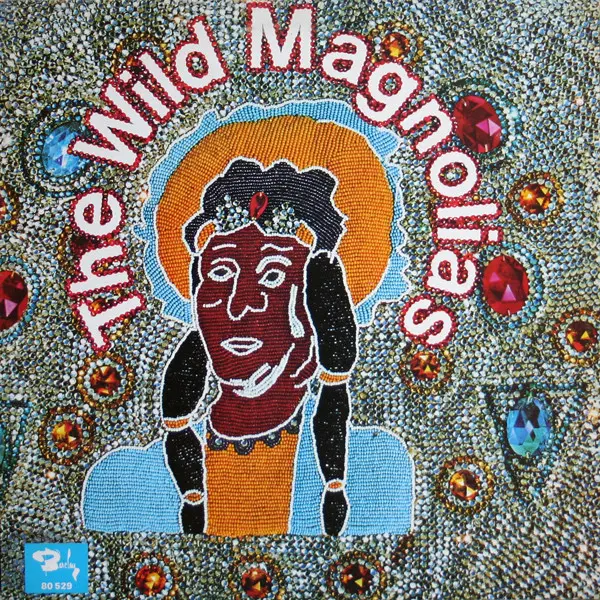 The Wild Magnolias released their self-titled debut album in 1974 on Polydor (US) and Barclay (Canada, Germany, Spain).
The album fused Mardi Gras Indian chants with extended tribal-funk arrangements, placing the group’s call-and-response vocals against an electric rhythm section anchored by members of the New Orleans Project. Its release marked the first major-label album by a Mardi Gras Indian tribe.
The lineup features singer Big Chief Bo Dollis, bass drummer Norwood “Gitchie” Johnson, guitarist Snooks Eaglin, bassist Julius Farmer, and multiple singer–percussionists (Crip Adams, Gate Johnson, Gator June Johnson Jr., Bubba Scott, Quarter Moon Tobias) and congueros (James Smothers, Monk Boudreaux, Alfred “Uganda” Roberts), along with three-fourths of The Gaturs: drummer Larry Panna, keyboardist–arranger Willie Tee, and reedist Earl Turbinton Jr. (alto clarinet, alto and soprano saxophone).
Bo Dollis wrote “Handa Wanda,” while Willie Tee composed “Smoke My Peace Pipe (Smoke It Right)” and “Corey Died on the Battlefield.” Dollis, Boudreaux, and their percussion ensemble collectively wrote “(Somebody Got) Soul, Soul, Soul.” The Wild Magnolias arranged and adapted the traditional chants “Two Way Pak E Way” and “Saint.”
The set alternates between chants reframed as long, ritualistic pieces and Tee’s funk originals with sharper rhythmic pacing. “Handa Wanda” lays the template with percussion layering under Dollis’s chants. “Smoke My Peace Pipe” opens with circular piano patterns and builds into a dense, rolling pulse. “Two Way Pak E Way” stretches a street-chant into a nearly eight-minute performance where whistles and tambourines mesh with stabbing guitar. “Corey Died on the Battlefield” takes on a more narrative stance, while “(Somebody Got) Soul, Soul, Soul” crystallizes their communal spirit into a rallying anthem. The closing “Saint” pushes the Mardi Gras take on “When the Saints Go Marching In” into a lengthy, trance-like finale.
A1. “Handa Wanda” (4:42)
A2. “Smoke My Peace Pipe (Smoke It Right)” (6:31)
A3. “Two Way Pak E Way” (7:51)
B1. “Corey Died on the Battlefield” (4:49)
B2. “(Somebody Got) Soul, Soul, Soul” (6:12)
B3. “Saint” (8:48)
Sessions took place at Studio in the Country in Bogalusa, Louisiana, with producer Philippe Rault and engineer Steve Hodge.
The cover features beadwork artwork by Monk Boudreaux with photography by Michael P. Smith and design by Ted Pettus.
They Call Us Wild
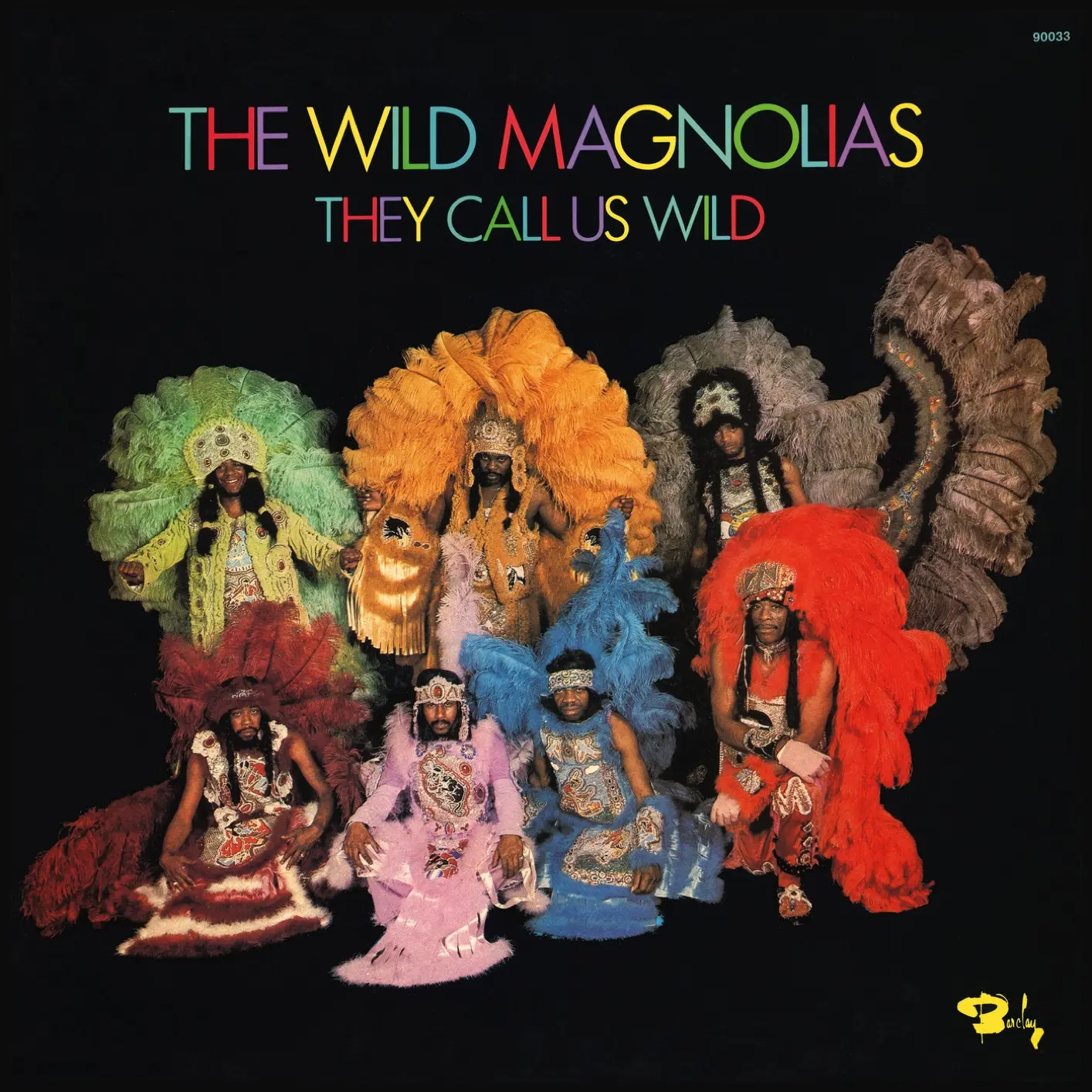 The Wild Magnolias released their second album, They Call Us Wild, in 1975 on Barclay (UK, Canada, Europe).
The album built on their debut’s Mardi Gras chants with denser percussion layers and swamp-funk pacing shaded by jazz inflections. Wilson “Willie Tee” Turbinton’s synthesizer and arrangements gave the material a sharper, more electric character compared to the earlier set.
They recorded They Call Us Wild with the prior album’s lineup (minus Gitchie), plus Guitar June and Gaturs bassist Erving Charles.
Turbinton wrote the bulk of the songs, including “They Call Us Wild,” “New Suit,” “Ah Anka Ting Tang Boo Shanka Boo,” “New Kinda Groove,” “Jumalaka Boom Boom,” and “We’re Gonna Party.” The Wild Magnolias collectively wrote “Fire Water,” “Injuns, Here We Come,” and “Ho Na Nae.”
A1. “They Call Us Wild” (3:13)
A2. “New Suit” (3:05)
A3. “Ah Anka Ting Tang Boo Shanka Boo” (4:27)
A4. “Fire Water” (3:44)
A5. “Injuns, Here We Come” (5:21)
B1. “New Kinda Groove” (4:00)
B2. “Jumalaka Boom Boom” (5:13)
B3. “We’re Gonna Party” (3:07)
B4. “Ho Na Nae” (4:36)
Sessions occurred at Studio in the Country in Bogalusa, Louisiana, with producer Philippe Rault and engineer Stephen Hodge. The cover features photography by Dennis Wile.
Discography:
- The Wild Magnolias (1974)
- They Call Us Wild (1975)
- I’m Back at Carnival Time! (1990 • Bo Dollis & The Wild Magnolias)
- 1313 Hoodoo Street (1996 • Bo Dollis & The Wild Magnolias)
- Life is a Carnival (1999)
Sources:
- Discogs: The Wild Magnolias
- RYM: The Wild Magnolias
- 45cat: The Wild Magnolias
- MusicBrainz: The Wild Magnolias
Artist/Album Pages:
Abraxis was a Belgian jazz-rock band that released a self-titled album in 1976 on IBC. Members: Ch...
Cliff Richard (born Oct. 14, 1940) is an English pop vocalist with a career that has spanned more ...
Milkweed was a Québécois symphonic-rock band behind a 1978 self-titled album on Checkmate. Membe...
The Storm was a Spanish hard-rock band that released a 1974 self-titled album on BASF, then return...
Édition Spéciale was a French jazz-rock band that debuted with the 1976 UA title Allée des Tilleul...
Jean-Claude Pognant (born 1943) is a French author, singer, and music entrepreneur best known as t...
Harold Melvin & The Blue Notes were an American soul group, formed in 1954 as The Blue Notes. ...
Klaus Weiss (Feb. 17, 1942 — Dec. 10, 2008) was a German drummer and bandleader who first emerged ...
Gene Harris (September 1, 1933 — January 16, 2000) was an American jazz pianist. He led The Three ...
A-440 was an American rock band from Houston that released three local garage-psych singles in 19...
The Futures were an American soul group from Philadelphia that scored a 1975 R&B hit with “Ca...
Universe City was an American funk band that released a self-titled album Midland International in...