

The Seeds were an American garage-rock band that released four 1966–67 studio albums and a 1968 live album on GNP Crescendo. They are best known for the folk-pop number “I Can’t Seem to Make You Mind” and the proto-punk classic “Pushing Too Hard,” both mainstays of sixties psych comps.
Members: Sky Saxon (vocals, bass), Daryl Hooper (keyboards, guitar, 1965-?), Jan Savage (guitar, 1965-69, 2003), Rick Andridge (drums, 1965-69), Jeremy Levine (guitar, 1965)
Background
The Seeds formed in Los Angeles in early 1965 when singer Sky Saxon and guitarist Jan Savage teamed with keyboardist Daryl Hooper and drummer Rick Andridge. Rhythm guitarist Jeremy Levine briefly completed an early quintet before the group settled as the four-piece lineup that made the first GNP Crescendo recordings.
Saxon was born Richard Elvern Marsh in Salt Lake City, Utah, and moved to Los Angeles before his first records. Saxon recorded “Baby Baby Baby” / “Half Angel” with the Hoodwinks and “They Say” / “Go Ahead and Cry” with the Soul Rockers. He followed with the Electra-Fires single “Do the Swim” / “Trouble with My Baby” under the Sky Saxon name.
Savage was born Buck Jan Reeder in Ardmore, Oklahoma, in 1942, the son of a postal railroad worker. Reeder first took up guitar in Albuquerque after his parents separated and later lived in Fresno and San Jose. He settled in Los Angeles in 1962 for college, where he entered the local folk and surf circuits before joining Jack & the Rippers.
Hooper was born in Detroit and grew up in Farmington, Michigan, where he received classical piano training. He met Andridge in seventh grade, and the pair later played weekend parties and bars with the Four Sharps while in high school. Hooper and Andridge moved to California together after graduation, where Saxon contacted Hooper about a keyboard opening and accepted Andridge after Hooper asked whether he also needed a drummer.
Early Activity
The four musicians first played together after assembling a cover set at a club on the night of their meeting. Saxon offered Hooper and Andridge further bookings, and the group worked early dates around Los Angeles and Santa Monica. The musicians used temporary names, including the Earls of England, before a Los Angeles disc jockey suggested the Seeds after using the word “seedy” for the band. The Seeds built a regular audience at Bido Lido’s in Hollywood, where Saxon and Hooper developed original songs between sets and gradually removed covers from the program.
Hooper covered bass parts onstage from low-register keyboards, while session bassist Harvey Sharpe played on most recordings. The musicians pooled money for early recordings of “Can’t Seem to Make You Mine” and “Daisy Mae,” which Saxon carried to record companies around Los Angeles. Jimmie Maddin, a Los Angeles saxophonist, club owner, and producer, helped bring the group to Gene Norman at GNP Crescendo.
The Seeds entered United Western Recorders in Hollywood on April 21, 1965, and engineer Chuck Britz recorded the master of “Can’t Seem to Make You Mine.” The group released the song in July on GNP Crescendo (b/w “Daisy Mae”), and Los Angeles listeners first heard the record through late-night airplay on Santa Monica station KBLA. The quartet returned to United Western on September 14 for “You’re Pushing Too Hard,” which appeared as a November single (b/w “Out of the Question”). The Seeds entered early 1966 with enough original material from their club sets and GNP sessions to complete the self-titled debut album.
The Seeds
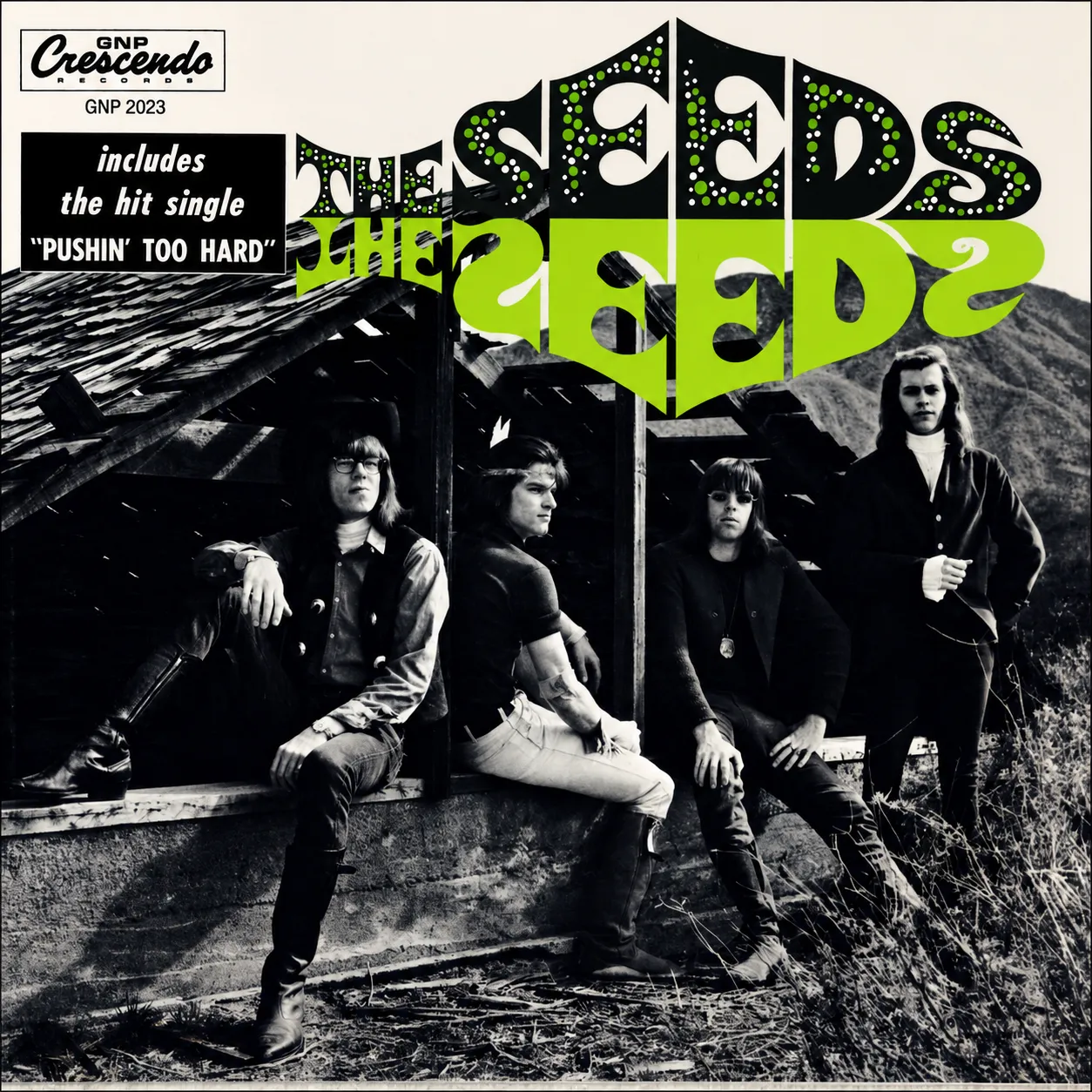 The Seeds released their self-titled debut album in April 1966 on GNP Crescendo.
Seeds contains twelve originals, including the early A-sides “Can’t Seem to Make You Mine” and “Pushin’ Too Hard.” Saxon takes sole credit on ten songs and shares “No Escape” with Jan Savage and Jimmy Lawrence; Hooper joins him on “Evil Hoodoo.”
“Can’t Seem to Make You Mine” broods over an insistent twanging figure with spare accompaniment. “No Escape” bounds through a repeating keyboard figure on a two-chord cycle. “Lose Your Mind” threads a staggered figure through harmonica punctuation. “Evil Hoodoo” grinds on an extended two-chord cycle beneath a dense fuzz-guitar passage. “Pushin’ Too Hard” gallops through repeated figures toward a terse solo break. “Try to Understand” lingers over a slowed recurring figure with a gentle electric-piano passage. “It’s a Hard Life” bounces through a blues-inflected slide figure. “Fallin’ in Love” shuffles around a mid-song solo and steady mid-tempo sway.
A1. “Can’t Seem to Make You Mine” (2:56) – Saxon
A2. “No Escape” (2:08) – Saxon, Savage, Jimmy Lawrence
A3. “Lose Your Mind” (2:11) – Saxon
A4. “Evil Hoodoo” (5:00) – Saxon, Hooper
A5. “Girl I Want You” (2:15) – Saxon
A6. “Pushin’ Too Hard” (3:03) – Saxon
B1. “Try to Understand” (2:45) – Saxon
B2. “Nobody Spoil My Fun” (3:50) – Tybalt
B3. “It’s a Hard Life” (2:38) – Saxon
B4. “You Can’t Be Trusted” (2:05) – Tybalt
B5. “Excuse, Excuse” (2:20) – Saxon
B6. “Fallin’ in Love” (2:47) – Saxon
Sessions spanned April 1965 through April 1966 at Western Recorders and Universal Audio Recorders in Hollywood, with Sky Saxon producing under his own name and the Marcus Tybalt alias. Western staffer Chuck Britz appears among the engineers amid concurrent Beach Boys work on Pet Sounds, while Dave Hassinger also entered the session rotation.
Saxon conceived the sleeve and received the cover-art credit. Front cover places the group against a weathered wooden structure beneath a vertically mirrored green Seeds logo.
GNP Crescendo issued “Can’t Seem to Make You Mine” in August 1965 (b/w “Daisy Mae”), followed by “You’re Pushing Too Hard” in November (b/w “Out of the Question”). “Try to Understand” became the third single in February 1966 (b/w “The Other Place”).
In July, “Pushin’ Too Hard” reappeared as a single (b/w “Try to Understand”) and reached No. 36 on the Billboard Hot 100. GNP Crescendo reissued “Can’t Seem to Make You Mine” in February 1967 (b/w “I Tell Myself”); the single reached No. 41 on the Billboard Hot 100.
The Seeds reached No. 132 on the Billboard album chart.
A Web of Sound
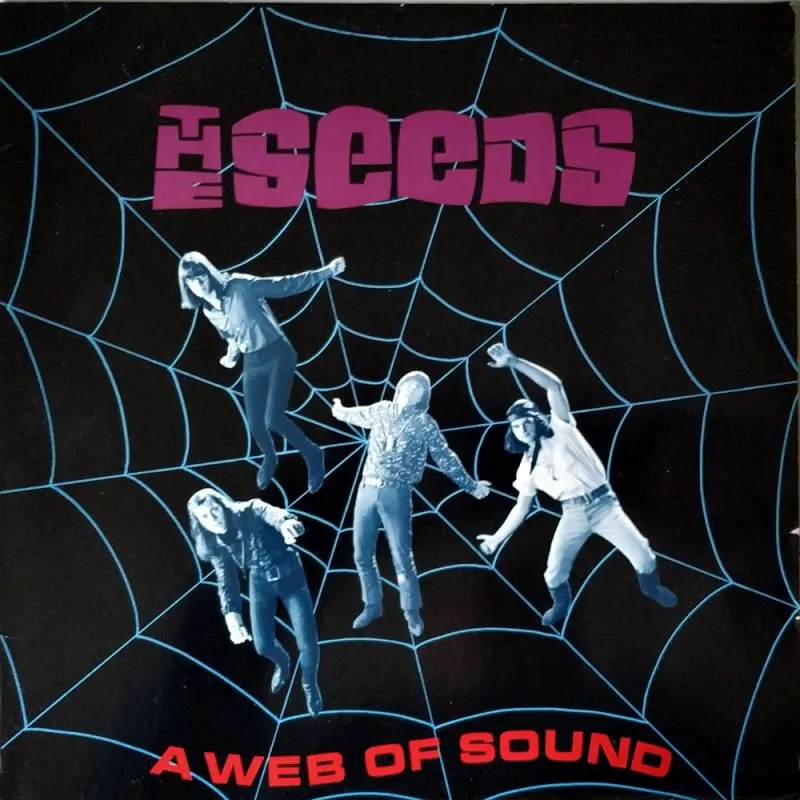 The Seeds released their second studio album, A Web of Sound, in October 1966 on GNP Crescendo.
A Web of Sound contains eight originals, with Hooper sharing four composition credits and Savage joining “Just Let Go.” Side two consists of that four-minute track and the fourteen-minute “Up in Her Room.” Bottleneck guitarist Cooker supplements the familiar studio personnel.
“Mr. Farmer” swirls around rolling organ figures, fuzz guitar, and Saxon’s plaintive drawl. “Tripmaker” careens through comic sound effects and rapid-fire rhythmic bursts. “I Tell Myself” coasts through a mid-tempo slide figure and brief instrumental interlude. “A Faded Picture” slows through elastic phrasing toward a sustained solo. “Rollin’ Machine” hustles from a compact opening figure into a distorted closing passage. “Just Let Go” rolls through probing figures over a bouncing rhythmic pattern. “Up in Her Room” simmers on persistent repetition before heavier fuzz and a piano interlude reshape its second half.
A1. “Mr. Farmer” (2:58) – Saxon
A2. “Pictures & Designs” (2:40) – Hooper, Saxon
A3. “Tripmaker” (2:40) – Hooper, Tybalt
A4. “I Tell Myself” (2:25) – Tybalt
A5. “A Faded Picture” (5:14) – Hooper, Saxon
A6. “Rollin’ Machine” (2:28) – Saxon
B1. “Just Let Go” (4:04) – Hooper, Savage, Saxon
B2. “Up in Her Room” (14:27) – Saxon
Sessions spanned July 5 through July 29, 1966, at Columbia Studios and RCA Victor Studios in Hollywood, with Tybalt producing. Hassinger co-engineered with Rafael Valentin after 1966 work on the Rolling Stones (Aftermath); the same period also brought Hassinger into production with the Electric Prunes.
Saxon conceived the cover around a spider web that traps full-length images of the four members. Ray Leong supplied the photography after the 1966 Mothers of Invention cover Freak Out!
GNP Crescendo lifted “Mr. Farmer” as a December 1966 single (b/w “No Escape”). A January 1967 pressing paired “Mr. Farmer” with “Up in Her Room”; the single reached No. 86 on the Billboard Hot 100.
Future
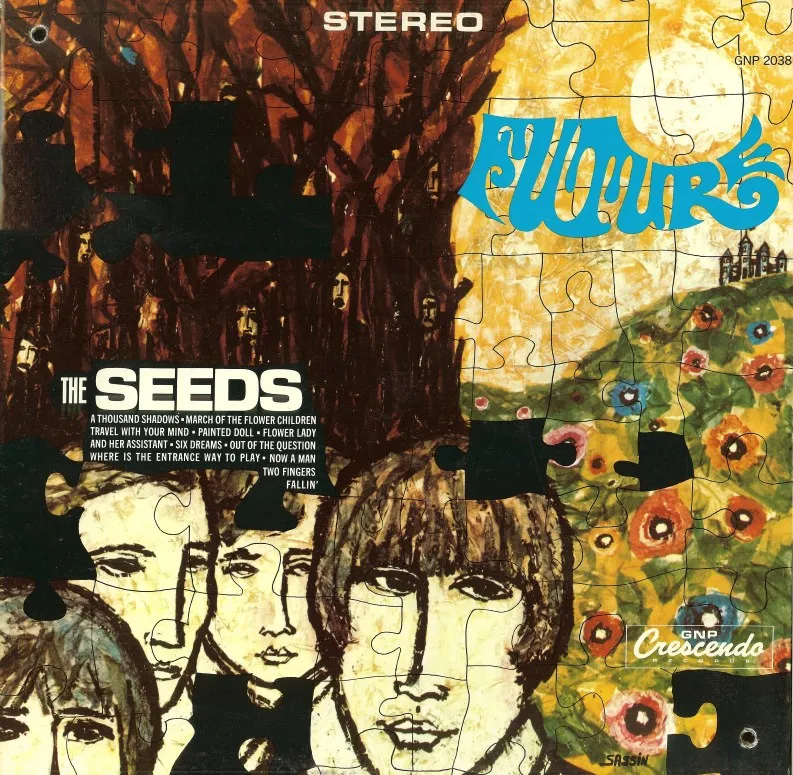 The Seeds released their third studio album, Future, in August 1967 on GNP Crescendo.
Future expands the four-piece format with orchestral and chamber instrumentation under arrangements by Saxon and Hooper. The additional pool includes drummer Hal Blaine, harpist Gale Levant, reed player Tjay Cantrelli, and tuba player George Callender, with four string players across violin, viola, and cello. Hooper adds sitar to his keyboard role.
“Intro / March of the Flower Children” parades from a half-spoken drawl into a gradually thickened march with harp flourishes, horn growls, and whip effects. “Travel With Your Mind” glides through sitar phrases and hand-percussion patterns across a hazy stereo field. “Painted Doll” waltzes through softly spoken lines and doo-wop harmonies over rolling piano and weeping strings. “Flower Lady and Her Assistant” quickens from an eerie opening into insistent figures, tambourine, and sweeping harmonies. “Now a Man” charges behind chiming guitar figures and chugging bass as Saxon enters with a shout.
“A Thousand Shadows” surges from a brooding opening into a galloping drive with ringing replies. “Two Fingers Pointing on You” seethes through harpsichord figures and snarled lines as tuba enters a dense organ swell. “Fallin’” races through pizzicato phrases, fuzz, feedback, and sudden harmonica bursts before a loose ensemble jam.
A1. “Introduction” (1:03) – Saxon, Hooper
A2. “March of the Flower Children” (1:45) – Saxon, Hooper
A3. “Travel With Your Mind” (3:00) – Saxon, Hooper, Savage
A4. “Out of the Question” (3:02) – Saxon, Serpent
A5. “Painted Doll” (3:20) – Saxon
A6. “Flower Lady and Her Assistant” (3:15) – Saxon
A7. “Now a Man” (3:20) – Saxon, Hooper, Savage
B1. “A Thousand Shadows” (2:25) – Saxon, Hooper, Savage
B2. “Two Fingers Pointing at You” (3:10) – Saxon
B3. “Where Is the Entrance Way to Play” (2:55) – Saxon
B4. “Six Dreams” (3:05) – Saxon
B5. “Fallin’” (7:40) – Saxon, Hooper
Sessions spanned November 1966 through May 1967 at Gold Star Studios in Hollywood, where Tybalt continued as producer with Doc Siegel at the console.
Saxon devised the album-picture concept and gatefold design, which combines a shadowed woodland photograph, line-drawn member faces, and a floral collage beneath the blue Future logotype. Original copies included three color inserts: two group photographs and a cut-and-paste sheet of flower panels.
GNP Crescendo lifted “A Thousand Shadows” as a June 1967 single (b/w “March of the Flower Children”), which reached No. 72 on the Billboard Hot 100.
Future reached No. 87 on the Billboard album chart.
A Full Spoon of Seedy Blues
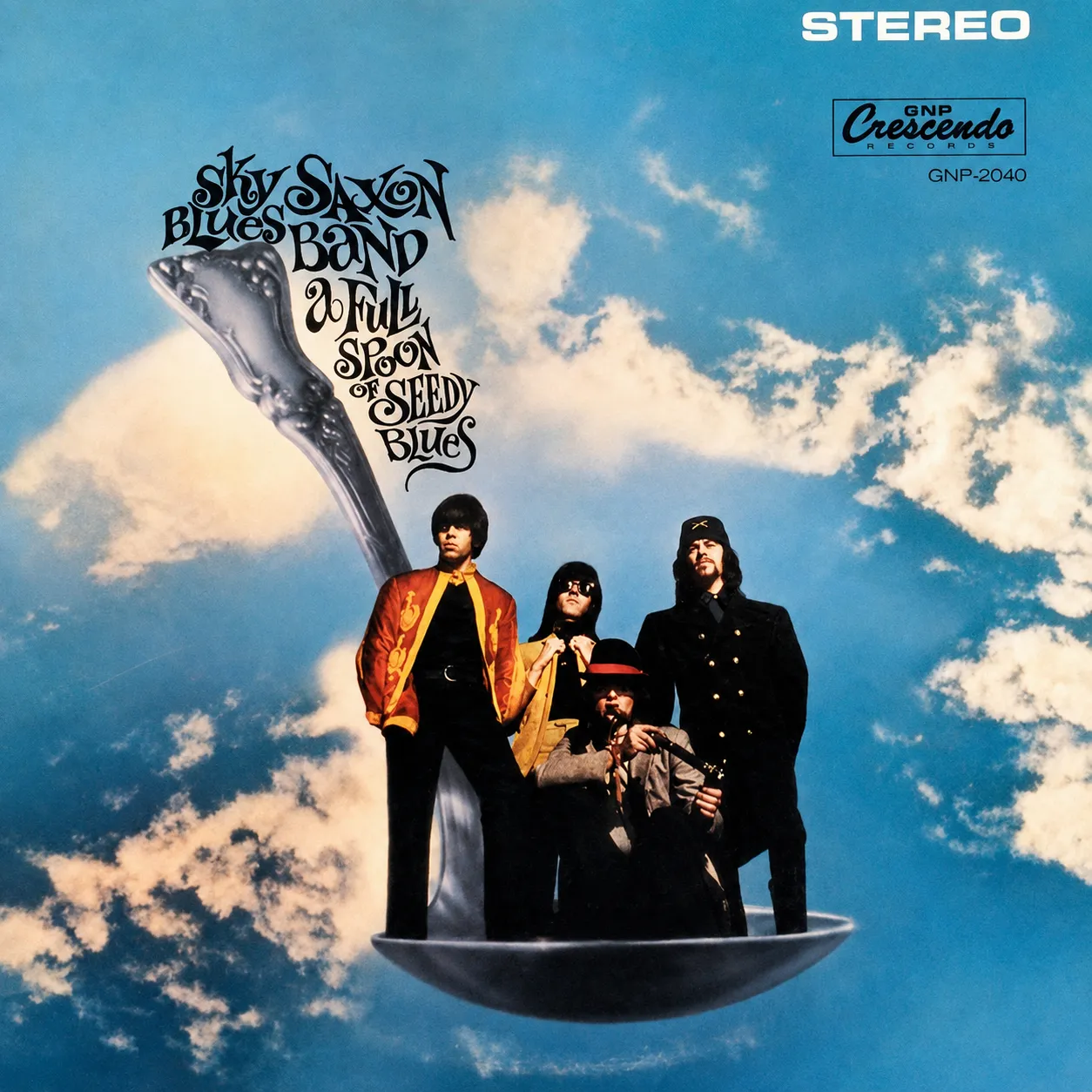 The Seeds released their fourth studio album, A Full Spoon of Seedy Blues, in November 1967 on GNP Crescendo under the Sky Saxon Blues Band credit.
Seedy Blues contains six Saxon originals and three compositions from outside the group. Luther “Guitar Junior” Johnson contributes “Pretty Girl” and “One More Time Blues”; Muddy Waters contributes “Plain Spoken.” The sessions add harmonica player George “Harmonica” Smith, saxophonist James Wells Gordon, and guitarists Johnson and Mark Arnold.
“I’ll Help You (Carry Your Money to the Bank)” saunters through delicate piano phrases before a boogie-woogie turn as Saxon underplays each line. “Cry Wolf” coils around prominent slide-guitar figures. “Plain Spoken” settles into spare accompaniment under Saxon’s restrained phrasing. “The Gardener” dwells over keyboards and wailing harmonica. “One More Time Blues” tears through an uptempo stretch under continuous lead figures.
A1. “Pretty Girl” (1:58) – Luther Johnson
A2. “Moth and the Flame” (3:47) – Saxon
A3. “I’ll Help You (Carry Your Money to the Bank)” (3:27) – Saxon
A4. “Cry Wolf” (6:04) – Saxon
A5. “Plain Spoken” (2:52) – Muddy Waters
B1. “The Gardener” (4:57) – Saxon
B2. “One More Time Blues” (2:25) – Luther Johnson
B3. “Creepin’ About” (2:43) – Saxon
B4. “Buzzin’ Around” (3:43) – Saxon
Sessions spanned August 12 through October 14, 1966, at RCA Studios, where Tybalt produced the Sky Saxon Blues Band album with Hassinger at the console and Doc Siegel on remix work.
Ray Leong returned for the sleeve photography. Front cover places the group inside an oversized spoon against a cloud-filled sky, with ornate Sky Saxon Blues Band lettering rising above the bowl; Muddy Waters supplied the liner notes.
Raw & Alive: The Seeds in Concert at Merlin’s Music Box
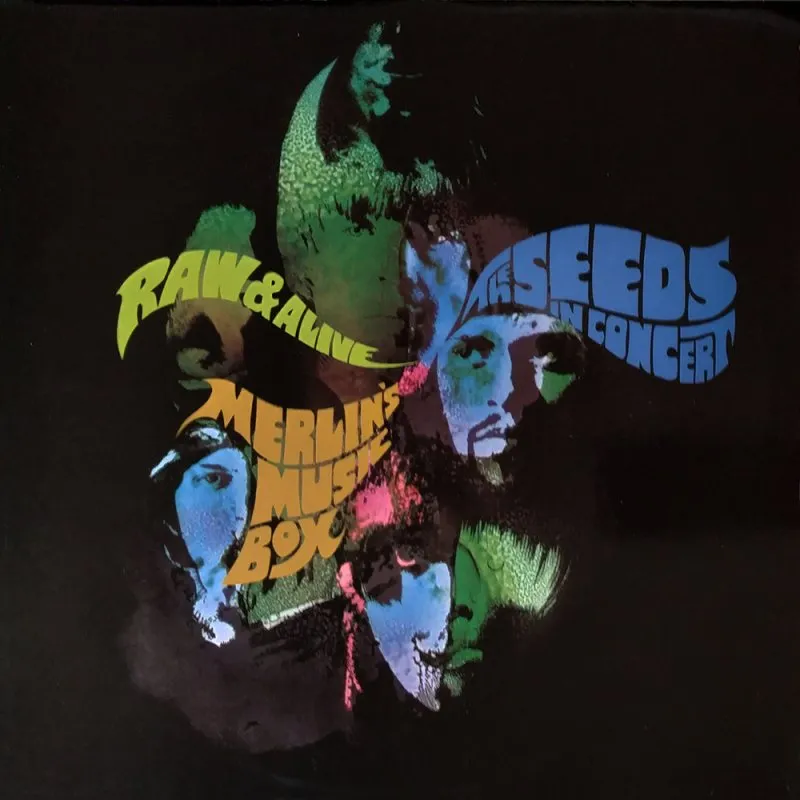 The Seeds released Raw & Alive: The Seeds in Concert at Merlin’s Music Box in May 1968 on GNP Crescendo.
Raw & Alive presents studio performances cut live to tape at Western Recorders, with crowd noise added afterward to simulate a concert at Merlin’s Music Box. The set revisits five earlier album titles and adds six then-new songs, including both sides of the “Satisfy You” single. Radio personality “Humble Harv” Miller supplies the opening introduction.
A1. “Introduction by ‘Humble’ Harv” (0:20) – Harvey Miller
A2. “Mr. Farmer” (3:50) – Saxon
A3. “No Escape” (2:25) – Saxon, Savage
A4. “Satisfy You” (2:00) – Saxon, Savage
A5. “Night Time Girl” (2:30) – The Seeds
A6. “Up in Her Room” (9:45) – Saxon
B1. “The Gypsy Plays His Drums” (4:30) – Saxon, Hooper
B2. “Can’t Seem to Make You Mine” (2:30) – Saxon
B3. “Mumble and Bumble” (2:25) – Saxon
B4. “Forest Outside Your Door” (2:40) – Saxon, Hooper
B5. “900 Million People Daily All Making Love” (4:50) – The Seeds
B6. “Pushin’ Too Hard” (2:40) – Saxon
Sessions occurred in April 1968 at Western Recorders in Hollywood, where Tybalt co-produced with GNP producer Neil Norman, son of label founder Gene Norman. The issued performances followed the rejection of a February studio set with an invited audience; GNP added crowd noise at mixdown to construct the Merlin’s Music Box setting. Chuck Britz shared the engineering credit with Joe Sidore, concurrently on West Coast Pop Art Experimental Band (Volume 3: A Child’s Guide to Good and Evil).
Ray Rostad designed the black sleeve around color-tinted portrait fragments and warped display lettering, with photography by Ed Caraeff. Caraeff also supplied photography for the contemporary Strawberry Alarm Clock album Incense and Peppermints.
GNP Crescendo lifted “Satisfy You” as an August 1968 single (b/w “900 Million People Daily (All Making Love)”).
Later Activity
Rick Andridge left the Seeds in 1968, and Jan Savage followed that autumn after the group recorded “Falling Off the Edge of My Mind.” Sky Saxon and Daryl Hooper rebuilt the lineup around guitarist Bob Norsoph and drummer Don Boomer. Saxon recorded two MGM singles with later Seeds personnel in 1970: “Bad Part of Town” (b/w “Wish Me Up”) and “Love in a Summer Basket” (b/w “Did He Die”). Hooper left after a final Pasadena auditorium appearance in 1970, while Saxon continued the Seeds name with changing musicians into the first years of the following decade.
Savage left professional music after his Seeds departure. He married and moved to Las Vegas, where he worked an office job for most of the next two decades. Hooper and Andridge likewise withdrew from regular band activity through much of the Seventies and Eighties.
Saxon joined Father Yod’s Source Family in 1973 and took the name Sunlight within the commune. He moved with the Source Family to Hawaii and later appeared on Fire Water Air’s 1977 album Golden Sunrise. Saxon recorded Sunlight & the New Seeds in 1976 and Stars New Seeds Live at the Orpheum Theatre the following year. He followed with the 1978 albums In Love with Life and Lovers Cosmic Voyage.
Saxon returned to album work with the 1984 Starry Ride, recorded with guitarist Mars Bonfire and former members of Iron Butterfly and Fraternity of Man. Saxon and Bonfire formed Firewall for the 1986 album A Groovy Thing. Saxon also recorded the 1986 Private Party with Purple Electricity, a one-off lineup of Redd Kross brothers Jeff and Steve McDonald and Primates drummer Brian Corrigan. Firewall followed with the 1988 In Search of Brighter Colors, recast for the United States as World Fantastic.
The original quartet reunited for a handful of U.S. dates in 1989, with Saxon, Savage, Hooper, and Andridge together for the Summer of Love tour. The package placed the Seeds alongside Arthur Lee and Love, Big Brother and the Holding Company, The Music Machine, and Strawberry Alarm Clock.
Nuggets Legacy
Lenny Kaye selected “Pushin’ Too Hard” for the 1972 Elektra double-LP Nuggets: Original Artyfacts from the First Psychedelic Era, 1965–1968, placing the Seeds among 27 American singles on the original anthology. Collectors encountered Kaye’s sequence again through the 1976 Sire edition. The Seeds catalog gained further circulation through the 1977 rarities collection Fallin’ Off the Edge and the 1983 AIP set New Fruit from Old Seeds. Collectors received another Seeds anthology with the 1988 Evil Hoodoo.
Rhino compilers broadened Seeds representation when they rebuilt Nuggets as a twelve-LP series across 1984 and 1985. They placed “Pushin’ Too Hard” on Nuggets, Vol. 1: The Hits and “Can’t Seem to Make You Mine” on Vol. 2: Punk in the first LP cycle. The following volumes added “Try to Understand” to Vol. 6: Punk, Part Two and “The Wind Blows Your Hair” to Vol. 9: Acid Rock.
Rhino compilers carried the group into the CD version of the series with the 1986 Nuggets: A Classic Collection from the Psychedelic Sixties, where “Pushin’ Too Hard” appeared alongside “Can’t Seem to Make You Mine.” Compilers added “Mr. Farmer” to the 1987 More Nuggets collection. The repeated placements extended the anthology trail from the best-known single into four additional Seeds recordings.
Pebbles / Cover Versions
ESD compilers brought later Seeds material into the Pebbles line at the turn of the decade. Their reprogrammed 1990 CD edition of Pebbles, Volume 3 included “Bad Part of Town,” the later Seeds recording associated with the MGM period.
Alex Chilton placed “Can’t Seem to Make You Mine” on the B-side of his 1978 single “Bangkok.” The Rubinoos added “Pushin’ Too Hard” to a 1978 live set later preserved on an archival collection. British punk group Chelsea recorded “No Escape” for the 1980 Alternative Hits collection, issued in the United States as No Escape.
The Bangles regularly played “Pushin’ Too Hard” in live sets through the Eighties. Johnny Thunders and Patti Palladin opened their 1988 album Copy Cats with “Can’t Seem to Make You Mine.” Pere Ubu played “Pushin’ Too Hard” in 1989 concert sets, including a March appearance at the London Astoria.
Discography:
- The Seeds (1966)
- A Web of Sound (1966)
- Future (1967)
- A Full Spoon of Seedy Blues (1967 • Sky Saxon Blues Band)
- Raw & Alive: The Seeds in Concert (1968)
Sources:
Artist/Album Pages:
Modern Music Band was a Swedish jazz-rock/funk group that made a 1972 self-titled album on Spark R...
Gloria Barnes is an American soul singer from NYC who released the 1971 album Uptown. https://ope...
Hole in the Wall was a Norwegian rustic folk-rock band that made a 1972 self-titled album on Sonet...
Ben Sidran (born August 14, 1943) is an American singer, pianist, keyboard player, songwriter, pro...
October Country was an American chamber-pop/psych band from Los Angeles that released a 1968 albu...
Ginger Baker’s Air Force was an English jam-rock big band, formed by drummer Ginger Baker after serv...
Jumbo was an Italian symphonic-rock band that released the 1972/73 Philips albums Jumbo, DNA, and ...
Ram was an American art-rock band from N.Y.C. that released the 1972 Polydor album Where? (In Conc...
Lonnie Liston Smith is an American jazz-funk keyboardist, composer, arranger, and band-leader who ha...
Joni Mitchell is a Canadian singer–songwriter who released nineteen studio albums between 1968 and 2...
Locomotiv GT was a Hungarian rock band from Budapest. Ringasd el magad and Bummm! established the ...
Banten was a Dutch avant-jazz-rock band that released a 1972 self-titled album on BASF. Members:...